
Outbuild Your Competition: The 2026 Construction and Trades Digital Playbook to Win Bids

Dual image showcasing a luxurious commercial interior design ("Go Beyond The Build") juxtaposed with construction trades workers on a steel rooftop structure, representing full project lifecycle management.
The modern construction firm must “Go Beyond The Build,” demonstrating the full scope of project mastery from sophisticated design and planning to on-site quality control and final delivery.

Your Website Should Be Your Best Salesperson

Let’s be honest: your website is working harder than anyone on your team. It never sleeps, never takes vacation, and it most likely meets every prospect before you do.

The question is—but, is it actually closing deals?

For construction and trades, your website isn’t just a nice-to-have. It’s your most powerful business development tool. Yes, we know it’s about building relationships, being a great “culture” company, and more… but in 2026, the firms winning the best projects are the ones who’ve figured out that their online presence is what makes the difference in closing big deals.

This playbook gives you everything you need: the strategic framework, real numbers, and practical steps to build a website that converts visitors into qualified leads. Whether you’re planning a redesign or starting fresh, think of this guide as your roadmap to turning your website into a revenue machine.

This is real advice–not an AI bot. Jacob Tyler is a brand and creative agency with over 25 years of experience building global brands and watching them succeed. This is not Ai. This is real talk from real experts working with brands from 1 million to over 4 billion in the A/E/C space. 

Look, we know our audience here ranges wildly. You might be a one-truck operation just getting started, or a multi-billion dollar firm with offices in 15 states.

It’s impossible to write one playbook that speaks perfectly to everyone. A 25-year-old launching their first contracting business isn’t thinking like a 60-year-old industry veteran with decades of wins under their belt.

But here’s what we’ve learned after working with over 30 construction companies across every size and stage: the fundamentals don’t change. Whether you’re trying to land your first $100K job or your next $10M project, the principles in this guide will help you do it.

Why Your Website Matters More Than Ever

Here’s the reality: there are nearly 4 million construction companies in the U.S. Construction is still a relationship business. Deals happen over lunch, on the golf course, through referrals from guys you’ve known for 20 years.

But here’s what’s happening while you’re shaking hands: 63% of prospects are already sizing you up online. Your website is their first impression—and for most of them (not the guys you have known for 20 years… although they are reviewing your Website. Trust me.), it’s the deciding factor before they even call you back.

You don’t know what you don’t know. But your customers? They’re looking. And they’re looking online.

Today’s site (whether small or large) needs to do two things exceptionally well: build credibility and generate leads.

The Numbers Don’t Lie

You’ve got 3 seconds on average to grab someone’s attention on your homepage. That’s it. And let’s be honest, 3 seconds can seem like a lifetime when you’re waiting for a page to load. The only worse position to be in would be a boxing ring. You need to make it super fast to prove you’re worth talking to (and winning the fight).

Here’s the reality: 70% of prospects start on mobile. They’re browsing your work from the job site, in the truck, between meetings.

But they’re not making decisions there. That happens later, on desktop—when they’re digging into portfolios, comparing firms, and getting ready to reach out.

So if your mobile site is clunky, you’re eliminated before the real evaluation even starts. And if your desktop experience doesn’t deliver? All that mobile interest dies at the finish line.

You need both. Period.

The cost of getting this wrong? Well if you’re paying for ads, the average cost per lead from search ads in construction is $165.67. If your website can’t convert that traffic, you’re literally burning money. If you’re not paying for ads, you just burned money on a Website that people leave.

Bottom line: in a crowded market, your website is where differentiation starts. Get it right, and you’re ahead of the competition before the first conversation.

The 5 Pillars of a High-Performing Construction Website

Digital screens showcasing a modern construction and trades website, emphasizing the firm's portfolio, content strategy, and digital marketing playbook.
A strong digital presence is central to the 2026 playbook. Your professional, content-rich website is the foundation for SEO, lead generation, and winning more bids.

Pillar 1: Show Off Your Work

Your portfolio is your proof. But dumping 200 random projects on a page doesn’t build confidence—it overwhelms people.

Here’s what actually works:

Professional photography that shows the details. Clients want to see your craftsmanship, the scale of your projects, and the finished results. Skip the generic stock photos of hard hats and blueprints. Show your actual team, your trucks, your job sites.

Make it easy for visitors to find what they’re looking for. Organize your portfolio by project type (commercial, residential, industrial) and service (new construction, renovation, design-build). Let people filter to find projects like theirs.

Tell the full story. Go beyond pretty pictures. For your best 15-25 projects, include the scope, timeline, challenges you solved, and what the client said about it. Make it personal.

Before-and-after shots are absolutely worth the effort. They prove the dramatic change you created in a way nothing else can.

Look, we get it. Remembering to snap that “before” shot when you’re managing a dozen things on day one? Nearly impossible. We’ve been guilty of forgetting to do that with our own client brand projects.

It’s not the end of the world if you miss a few. But when you do capture that contrast—the messy teardown next to the stunning finish—it changes how prospects see your work. That visual proof can be the difference between “looks nice” and “we need to hire them.”

What kills trust:

  • Generic stock imagery – It’s okay to have a few images but let’s try to keep it to a minimum
  • Walls of text that bury the visuals
  • Projects from 40 years ago (save those for your company history page)

The Bottom Line: Your portfolio should tell stories, not just display photos. When someone can see themselves in your work—and see the results you delivered for clients like them—that’s when trust begins.
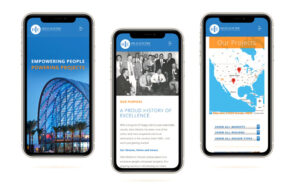
Three mobile phone screens displaying a construction company's responsive website, showcasing their mission, history of excellence, and a map of their nationwide project locations.
A mobile-optimized website is the foundation of the 2026 digital playbook, immediately showcasing brand history, mission, and geographical reach to potential clients.

Pillar 2: Mobile-First Design That Actually Works

Speed and mobile aren’t “nice features”—they’re deal-breakers.

Google punishes slow sites. In fact, in 2016, our CEO Les Kollegian was hired by Google to speak at their conferences about this exact issue. Here’s the stat that should terrify you: for every extra second your page takes to load, your bounce rate jumps 8X higher.

Think about that. One extra second. Eight times more people, gone.

If you don’t know how to optimize your site properly—and most don’t—you’re hemorrhaging traffic and conversions without even realizing it. And with over 70% of construction buyers starting their research on mobile, building for phones isn’t optional anymore. It’s fundamental.

Don’t get us wrong. Desktop design is EXTREMELY important. However, mobile-first in the A/E/C vertical is how all companies should be thinking. Once they’re evaluating a project or issuing a bid, your prospects are likely to switch to a larger screen to review PDFs, drawings, case studies, and detailed qualifications. A robust, desktop-friendly experience helps with credibility, downloads, and document access.

What matters:

Load time under 3 seconds. Period. Every second longer and you’re losing people.

Easy navigation for thumbs, not mouse cursors. Big buttons, smart spacing. Remember, your best trades might be on a job site wearing gloves. Your best prospect may be doing research while waiting for his/her cocktail at the bar. 

Images that look great on small screens. Don’t sacrifice visual impact, but optimize everything so it loads fast.

Simple forms. Mobile users won’t fill out 15 fields. Keep it to name, email, phone, and project type.

Here’s a stat that should scare you: mobile users are 5 times more likely to abandon a site that isn’t optimized. You can’t afford to lose half your audience because your site looks bad on a phone.

The Bottom Line: If your site doesn’t work flawlessly on mobile, you’ve disqualified yourself from the majority of potential clients before they even see your work.

Practical guidance:

  • Start with a mobile-first design mindset:
    • Fast load times (optimized images, compressed videos, lean code).
    • Clear navigation with prominent project gallery, capabilities, and contact.
    • Accessible CTAs (Get a quote, Request a proposal, Call now).
    • Readable typography, concise copy, and scannable sections.
    • Strong, trust-building elements: client logos, case studies highlights, safety records, licenses, certifications.


Pillar 3: Build Trust Before the First Call

Construction is a relationship business–and trust is everything. Your website needs to prove you’re legitimate, capable, and reliable and yes… trustworthy—before someone picks up the phone.

Essential trust-builders:

Show your credentials. Certifications, licenses, insurance, safety records. Display logos from your suppliers and partners. Make it obvious you’re the real deal.

Sounds basic, right?

We’ve worked with companies doing $50 million+ in revenue who don’t do this. Their response? “We have enough business.”

Our response? Do you, though? Because “enough” isn’t the same as “all the business you could have.” What are you leaving on the table by making prospects guess whether you’re legit? Trust signals aren’t just for startups trying to prove themselves. They’re for every company that wants to convert more of the traffic they’re already getting. 

Real testimonials with real details. “Saved us 15% on materials and finished two weeks early” beats “Great to work with!” every time. Use names, titles, photos if possible.

Introduce your team. People want to know who they’re hiring. Real photos of real people build connection.

Highlight your track record. OSHA ratings, safety certifications, project completion rates—these signal operational excellence.

Here’s why this matters: 47% of buyers look at 3-5 pieces of content before they’ll even talk to a salesperson. Make it easy for them to say yes by giving them the proof points they need.

The Bottom Line: Trust isn’t given, it’s earned. Your website should make it effortless for prospects to find the evidence they need to feel confident about working with you.

Pillar 4: Make It Stupid-Easy to Contact You

Every page should have a purpose. Every purpose should have a clear next step.

If someone’s interested, don’t make them hunt for how to reach you.

What converts:

Multiple ways to get in touch. “Request a Bid,” “Schedule a Consultation,” “Get an Estimate,” “Download Our Capabilities Deck.” Different people want different entry points.

Click-to-call on mobile. 61% of mobile users will call during the buying process. Make the phone number tappable everywhere.

Contact options that follow them. Sticky contact bars or chat widgets that stay visible as people scroll.

Forms right where they’re looking. Put inquiry forms directly on portfolio pages so prospects can reach out while viewing relevant work.

The math: you’re paying $165+ per lead from search ads. If your site doesn’t make it easy to convert, you’re wasting that investment.

Pro tip: Keep forms short. Name, email, phone, project type—that’s enough for a first conversation.

The Bottom Line: Every page needs a clear “do this next” moment. The easier you make it to contact you, the more qualified leads you’ll capture.

Pillar 5: Get Found by the Right People

A beautiful website is worthless if no one can find it.

The firms that dominate their markets don’t just build great sites—they make sure those sites show up when potential clients are searching.

The technical stuff (simplified):

Make sure your site is fast, clean, and organized in a way that search engines—and now AI—can understand. This includes things like clear page titles, good site structure, and behind-the-scenes code that helps Google, ChatGPT, Perplexity, and other AI tools figure out what you actually do.

Here’s why this matters more than ever: people aren’t just Googling anymore. They’re asking ChatGPT “who are the best commercial contractors in [city]?” or using AI search tools to compare firms. If your site isn’t structured properly, you won’t show up in those results—even if you’re the perfect fit. AI reads your site differently than humans do, and if it can’t parse your information clearly, you’re invisible in the fastest-growing search channel out there.

The content strategy:

Content marketing generates 54% more leads than traditional marketing. Adding a blog to your site increases your chances of ranking on Google by 434%.

Here’s what to create:

Service pages that match what people search for. Think “commercial general contractor in [your city]” or “design-build services in [your region].”

Project case studies with location details. Construction is local. Make sure every case study includes where the project was and what type of work it involved.

Educational content that answers questions. Blog posts like “How long does commercial construction permitting take?” or “What’s the difference between design-bid-build and design-build?” These attract people early in their research process.

The Bottom Line: SEO isn’t optional—it’s your primary lead source. Build it into your website from day one, target the searches your ideal clients are making, and create content that answers their questions. Do this right and your site becomes a lead-generating machine. And for those of you who don’t believe you are being found via search in any capacity. Aehhhhhhhh (buzzer sound). You have NO idea. At Jacob Tyler, we never thought in a million years that an executive at Sony would be upset with his current agency and “search” for another and find us. Being optimized for search got us that account and assistance developing the VAIO brand for Sony. So yeah, we believe. We will give you some more information on “search” in a little bit.

Design Trends That Actually Matter in 2026

Clean and Simple Wins

Less is more. White space, clean fonts, minimal navigation. Focus attention on what matters—your work.

Large Typography

Use of clean and modern typography in a large point type grabs attention and keeps it. Don’t overdo it though. Remember that people need to be attracted to read more and not yelled at. 

Video Makes a Difference

Time-lapse build videos, drone footage, client testimonials. Video tells stories in ways photos can’t.

Dark Mode Is Here

Dark backgrounds with sharp contrast can make architectural work pop. It’s modern, striking, and effective. With that said, be careful to not have too much body copy in reverse (white on top of black) as it can make paragraph content more difficult to read. 

Subtle Motion Adds Polish

Hover effects, scroll animations, interactive filters. Small details that make the experience feel premium without overwhelming users.

Sustainability Messaging Matters

Affiliations, green building practices, LEED certifications, energy-efficient outcomes—these resonate with commercial clients and conscious homeowners alike.

What a Professional Website Actually Costs

Let’s talk money. Here’s what you should expect to invest:

Small to Mid-Size Firms: $15,000 – $25,000

You get:

  • 15-25 pages
  • Custom design that’s mobile-responsive
  • 10-15 portfolio projects
  • Contact forms and lead capture
  • Basic search optimization
  • Timeline: 10-14 weeks

Best for: Local contractors, small commercial builders, residential remodelers

Mid-Size to Large Firms: $25,000 – $55,000+

You get:

  • 30-50+ pages
  • Advanced functionality and design
  • 25-50 portfolio projects with filtering
  • Integration with your CRM and project tools
  • Comprehensive SEO strategy
  • Blog and content marketing setup
  • Video integration
  • Timeline: 14-20 weeks

Best for: Regional general contractors, design-build firms, commercial construction companies

Enterprise-Level Firms: $55,000 – $100,000+

You get:

  • 50-100+ pages
  • Fully custom everything
  • Multi-location support
  • Project portals and employee logins
  • Interactive maps and advanced showcases
  • Marketing automation
  • Ongoing optimization and testing
  • Timeline: 20-24+ weeks

Best for: National contractors, large commercial builders, industrial construction firms

Ongoing Maintenance: $1,500 – $3,000/month

Includes:

  • Security updates
  • New project additions
  • SEO monitoring
  • Performance optimization
  • Analytics reviews

Think of this as the cost of keeping your best salesperson sharp and effective. Keep in mind that most Websites as mentioned above can be developed in WordPress, which is infinitely scalable so even though you may start with 15 to 20 pages, you can add as many as you like, and it is super easy to do so.

Mistakes That Kill Conversions

  1. Portfolio overload. Quality beats quantity. Show your best 15-25 projects, not every job you’ve done since 1985.
  2. Ignoring mobile. If it doesn’t work on a phone, you’ve lost the lead. Period.
  3. Hiding your call-to-action. Every page should answer: “What should I do next?” Make it obvious.
  4. Treating SEO as an afterthought. 57% of B2B marketers say SEO generates more leads than anything else. Build it in from the start.
  5. Slow load times. Users leave. Google penalizes. You lose.
  6. No way to track results. If you can’t measure it, you can’t improve it. Set up tracking for form submissions, calls, and key pages.
  7. Stale content. A portfolio that stops in 2019 signals a business that stopped growing. Update regularly.

How to Know If It’s Working

Track these numbers to measure your website’s impact:

  • Traffic growth (month-over-month and year-over-year)
  • Conversion rate (forms, calls, downloads as a % of visitors)
  • Bounce rate (target under 40% on key pages)
  • Time on site (longer = more engaged
  • Search rankings for your target terms
  • Leads generated (qualified inquiries)
  • Cost per lead (compared to other channels)
  • Projects won from web inquiries

The goal isn’t to hit industry averages—it’s to beat your own baseline. A 20% lift in traffic or a 0.5% bump in conversion rate translates directly to revenue.

Your 2026 Website Checklist

Use this when evaluating proposals or scoping your project:


Strategy & Planning

  • Audience personas defined
  • Competitor analysis completed
  • Keyword research done
  • Conversion goals established
  • Site structure approved


Design & Experience

  • Mobile-first, responsive design
  • Loads in under 3 seconds
  • Clean layouts with white space
  • High-quality, authentic photos (no stock)
  • Consistent branding throughout


Content & Messaging

  • Clear value proposition on homepage
  • Service pages optimized for search
  • 10-20 featured projects with case studies
  • Client testimonials (text or video)
  • Team bios and photos
  • Trust signals visible (certifications, licenses)


Functionality

  • Contact forms on key pages
  • Click-to-call phone numbers
  • Filterable project portfolio
  • Blog/resources section
  • Secure hosting and backups


SEO & Analytics

  • Google Analytics installed
  • Search Console configured
  • Page titles and descriptions optimized
  • Sitemap submitted
  • Redirects set up (if redesign)


Post-Launch

  • Tested across all devices
  • Monthly analytics reporting
  • Content update plan in place
  • Ongoing optimization strategy defined

Common Questions Answered

How much should I really spend on a website?

For most construction companies, expect to invest $15,000 to $75,000+ depending on complexity and scale.

Think of it this way: if a well-designed site generates even 3-5 additional qualified leads per month, it pays for itself within months. The question isn’t “what’s the cheapest option?” It’s “what delivers the best return?” 

How long does it take to build?

Quality takes time. Most projects run 10-16 weeks from kickoff to launch. Smaller sites might be done in 8-10 weeks. Enterprise sites with complex features can take 20-24 weeks.

Rushing usually means compromising quality. Launch something you’re proud of, not something you’re settling for.

Do I really need mobile optimization?

Absolutely. Over 70% of potential clients browse on mobile before making a decision. Google ranks your mobile site first. Mobile users are 5X more likely to bail on a site that doesn’t work properly.

If your site doesn’t work flawlessly on phones, you’re eliminating the majority of your market.

Can I just use a template?

Sure, if you want to blend in and hope for the best.

Template platforms like Wix or Squarespace are cheap upfront, but they come with hidden costs that kill your competitiveness. Here’s why they fall short for construction companies:

  1. Speed kills your conversions. These platforms are bloated with code you don’t need. They’re slower out of the box, and you can’t optimize them the way a custom site can. Remember: every extra second costs you 8X more bounces.
  2. You’re locked into their limitations. Need a custom project filtering system? Want to integrate with your CRM? Looking to build something unique that sets you apart? Good luck. Templates box you into what everyone else is doing.
  3. SEO is hobbled from the start. Sure, they claim to be “SEO-friendly,” but you can’t control the technical foundation the way you need to. Your ability to rank for competitive local terms is significantly hampered compared to a properly built custom site.
  4. You look like everyone else. Prospects can spot a Squarespace template from a mile away. When you’re competing for six- and seven-figure projects, looking like a DIY startup doesn’t inspire confidence.
  5. AI can’t read it properly. These platforms generate messy code that makes it harder for AI search tools (ChatGPT, Perplexity, etc.) to understand and recommend your business. You’re invisible in the fastest-growing search channel.
  6. Mobile experience is “good enough” at best. Remember that 70% of your prospects start on mobile? Template platforms give you a responsive site, but not an optimized one. There’s a massive difference.

The bottom line: when your average project is worth $50K to millions, a $200/year website isn’t a smart savings—it’s a costly compromise. Investing in a professional custom site delivers exponentially better ROI because it actually converts the traffic you’re working so hard to generate.

How often should I update it?

A website isn’t a “set it and forget it” asset. It’s a living business tool that needs regular attention to stay effective.

At minimum, add new projects quarterly. Fresh content tells both visitors and search engines you’re active and growing. But there’s more to it than that.

Why regular updates actually matter:

Search engines reward fresh content. Google prioritizes sites that consistently publish new material. A site that hasn’t been touched in six months gets buried, while competitors updating regularly climb the rankings. This isn’t theory—it’s how the algorithm works.

AI search needs current data. ChatGPT, Perplexity, and other AI tools pull from recently updated sources. If your site is static, you’re invisible in AI-powered search results—the fastest-growing way people find contractors.

Your prospects are watching. When someone lands on your site and sees your last project is from 2022, what do they think? Either you’re not busy (red flag) or you don’t care about your digital presence (also a red flag). Fresh content signals momentum and success.

SEO compounds over time. Every new blog post is another opportunity to rank for search terms. Every updated project page strengthens your local SEO. This isn’t busy work—it’s building equity that generates leads for years.

Ideal update cadence:

  • New blog posts monthly – drives SEO, answers buyer questions, positions you as an expert
  • Portfolio updates quarterly – keeps your best work front and center
  • Testimonials as you receive them – fresh social proof builds trust faster
  • Service pages refreshed annually – keeps messaging aligned with your current capabilities and market positioning
  • Technical SEO audit quarterly – ensures your site stays optimized as search algorithms evolve

Should you hire someone to manage this?

Unless you have a dedicated marketing person who understands SEO, content strategy, and technical optimization—yes, absolutely.

Here’s why: most construction company owners don’t have time to write optimized blog posts, resize images properly, update meta descriptions, monitor search rankings, or stay current on algorithm changes. And frankly, you shouldn’t. Your time is worth more managing projects and closing deals.

A monthly retainer with a specialized agency or freelancer ($1,500-$5,000/month depending on scope) typically includes:

  • Regular content creation and optimization
  • Portfolio and project page updates
  • SEO monitoring and adjustments
  • Technical performance optimization
  • Analytics reporting so you see what’s working

Think of it this way: if your site generates even 2-3 additional qualified leads per month because it’s consistently updated and optimized, that monthly investment has already paid for itself several times over.

The bottom line: A stale website signals a stale business. But more importantly, an outdated site actively costs you leads, rankings, and revenue. Regular updates aren’t optional maintenance—they’re how your website continues generating ROI long after launch.

What’s the difference between a brochure site and a lead generation site?

Brochure sites build trust and credibility through compelling storytelling, professional imagery, and showcases of your work. When designed thoughtfully, they serve as powerful digital portfolios that help potential clients understand who you are, what you do, and why they should work with you. For smaller businesses especially, a well-crafted brochure site with clear contact options and conversion points can be exactly what’s needed to turn visitors into leads.

Lead generation sites take this foundation further by prioritizing conversion at every turn—with multiple strategic calls-to-action, optimized user journeys, lead capture mechanisms throughout the experience, and content specifically designed to move visitors down the funnel.

Both approaches should ultimately drive leads and conversions. The difference is in emphasis: brochure sites lead with trust-building and storytelling, while lead generation sites lead with conversion optimization—but the best sites often blend elements of both.

We have plenty of business. Does SEO really matter?

Look, I get it. We hear this all the time: “We don’t need to worry about our website because we don’t get business from it anyway.”

But here’s the thing—comfort is the enemy of growth.

Think about it: why would you turn down the chance to be considered for projects you didn’t even know existed? Projects where the prospect finds you instead of you having to chase them down?

When we push back and ask “How do you actually know you’re not getting business from your site?”, there’s usually just crickets. Or worse, assumptions based on… well, nothing.

Here’s a story (in case you missed it earlier) that changed everything for us. Years ago, we won the brand development for Sony VAIO products for college students. Want to know how? A Sony senior executive (fed up with his current agency relationship) literally Googled agencies and found us. We didn’t even think that was possible. But it happened, and we became true believers.

Fast forward to 2025. We redesigned the website for Dempsey Construction. About three months after launch, Michaela Weibel, their Director of Marketing, called us—absolutely shocked. She’d been there over five years and had never received a single lead through their website. Not one.

With the new site and proper optimization? Leads started coming in.. and while just a few, it is certainly better than none. Now they’re actually in the game instead of watching from the sidelines. And get this—just one deal pays for the entire website investment and then some.

But it gets even better. At Jacob Tyler, we’re now landing clients through something most agencies aren’t even thinking about yet: generative search.

Sure, people still Google “Best Web Design Agencies in San Diego” or “Construction Web Designer”—and we show up for those. But recently, an executive asked Gemini (Google’s AI), “Who designed the Hensel Phelps website?” Because we optimized our site for generative search, they got the right answer: us. We won that client.

This is the new reality. In 2026, if you’re in construction and you’re not optimized for generative search—especially around your completed projects—you’re invisible to a massive chunk of potential clients.

Should I hire a construction specialist or a general agency?

Here’s our honest take, and we’d be lying if we told you otherwise: you don’t need an agency that only does construction.

We’ve been doing this for 25 years at Jacob Tyler. In that time, we’ve built high-performing websites for health and life sciences companies, medical product manufacturers, ecommerce brands, financial services firms, and yes—construction and industrial companies. The idea that an agency must be vertically niched to deliver results? That’s marketing spin, not reality.

What you actually need is this:

An agency that takes the time to deeply understand your buyers, your sales cycle, your competitive landscape, and what drives decisions in your market. Whether that’s construction, manufacturing, or healthcare doesn’t matter as much as their commitment to learning what makes your business tick.

That said, industry experience does accelerate results.

When an agency has worked with construction firms before, they come to the table knowing:

  • How to structure project portfolios that actually convert
  • Which trust signals matter most (certifications, safety records, bonding capacity)
  • How to optimize for the long, relationship-driven sales cycles typical in construction
  • What questions prospects ask before they’re ready to request a bid
  • The balance between showcasing capabilities and not overwhelming decision-makers

That expertise means faster onboarding, fewer missteps, and a site that performs from day one instead of needing months of trial and error.

But here’s what matters more than niche experience:

Does the agency have a track record of driving measurable results? Do they understand conversion optimization, SEO, user experience, and content strategy at a deep level? Can they point to specific outcomes—increased leads, higher rankings, improved conversion rates—across any B2B vertical?

Those fundamentals transcend industry. A team that’s driven results in financial services or life sciences can absolutely apply that same rigor and strategic thinking to construction. The principles of effective digital marketing don’t change just because the hard hats do.

The bottom line:

Choose an agency based on their strategic chops, their commitment to understanding your specific market, and their proven ability to deliver ROI—not just their client roster. Industry experience is a plus and can accelerate results, but it’s not a requirement. Deep expertise in digital strategy, combined with genuine curiosity about your business, will always outperform shallow “niche specialist” credentials.

At Jacob Tyler, we bring both: 25 years of cross-industry experience and a proven track record in construction and industrial markets. That combination means we know what works universally and what needs to be tailored specifically for how contractors buy.

How do I measure ROI?

First, let’s be clear about something: your website is a critical piece of your marketing engine, but it’s not the only piece.

We’d be doing you a disservice if we said “build a great website and watch the leads roll in.” That’s not how sustainable growth works. Your website needs to work in concert with your brand, your relationships, your presence at trade shows, your direct mail, your reputation in the community, and yes—even those conversations on the 19th hole.

That said, your website should absolutely be measured and held accountable for ROI.

Here’s what to track:

  • Qualified leads generated – how many serious inquiries came directly from the site
  • Conversion rate – percentage of visitors who take action (form fills, calls, downloads)
  • Revenue from web-sourced inquiries – actual project wins that started with your website
  • Cost per lead – compare what you’re spending on the website against other channels like trade shows, print ads, or pay-per-click

Most construction firms find that once their website is properly optimized, it delivers the lowest cost per qualified lead of any marketing channel. Even modest improvements—like a 1% conversion bump—can generate hundreds of thousands in additional project value annually.

But here’s the bigger picture:

Your website doesn’t exist in a vacuum. It’s the hub where all your other marketing efforts converge:

  • Someone meets you at a trade show → they Google you → your website seals the deal (or kills it)
  • A referral mentions your name → the prospect checks you out online → your site validates the recommendation
  • You run targeted ads → traffic lands on your site → conversion optimization determines if that spend pays off
  • Your brand shows up in their LinkedIn feed → they click through → your website tells the full story

Think of it this way: Your brand is your reputation. Your website is where that reputation gets verified and converted into action. Traditional marketing—networking, events, direct outreach—gets you in the conversation. Your digital presence determines whether that conversation becomes a contract.

So yes, measure your website’s performance religiously. But don’t forget that your entire marketing ecosystem—brand positioning, consistent messaging across channels, strategic relationship building, and traditional outreach—all work together to drive revenue.

The website is your best salesperson. But even the best salesperson needs leads to close. That’s where the rest of your marketing comes in.

Your Website Is Your Competitive Advantage

In 2026, your construction website isn’t a cost center. It’s a strategic asset that either generates revenue or bleeds opportunity.

The firms winning the best projects understand this: your website is a business development engine that works around the clock. While your competitors are still treating their online presence as an afterthought, the leaders in your market are converting browsers into bids—24/7, without a single sales call.

Here’s the math that matters: construction websites average around a 2% conversion rate. That means 98 out of 100 qualified prospects leave without contacting you.

Now imagine cutting that waste in half. Better mobile experience, faster load times, clearer calls-to-action, stronger portfolio presentation—these aren’t cosmetic upgrades. They’re the difference between doubling your lead volume and watching opportunities go to competitors who got the details right.

Combine that with smart SEO and a relentless commitment to showcasing your best work, and you’ve built something that compounds: a platform that gets stronger, ranks higher, and generates more qualified leads every month—without you spending another dollar on traffic.

For owners and marketing leaders evaluating partners, the criteria are simple: find an agency that understands how construction buyers make decisions, builds for conversion not just aesthetics, and measures results in leads and revenue, not likes and page views.

The investment in getting this right pays dividends for years. The cost of getting it wrong? You’re already paying it—you just don’t see the opportunities you’re missing.

Let’s Talk About What’s Possible

If you’ve made it this far, you already know your website could be working harder for you.

Maybe you’re frustrated watching leads go to competitors with slicker digital presence. Maybe you know your site doesn’t represent the quality of work you actually deliver. Or maybe you’re just tired of leaving money on the table because your online experience doesn’t match your reputation in the field.

We get it. We’ve spent 25 years helping companies in construction, industrial, and beyond turn their digital presence into a genuine competitive advantage—not just a prettier version of what everyone else has.

Here’s what we believe:

Your website should earn its keep. It should generate qualified leads, support your sales team, and prove ROI. If it’s not doing that, something’s broken—and it’s fixable.

You shouldn’t have to become a digital marketing expert to make this work. That’s what partners are for. Our job is to understand your business, your buyers, and your goals—then build something that delivers results you can measure.

If you’re ready to explore what’s possible, here’s how we typically start:

  1. Have a real conversation. No sales pitch. No generic proposal. Just an honest discussion about where you are, where you want to be, and whether we’re the right fit to help you get there.
  2. Build a plan that makes sense for your business. Not a one-size-fits-all template. A strategy tailored to your market, your goals, and your timeline.
  3. Execute with accountability. We measure what matters—leads, conversions, revenue—and adjust as we learn what works best for your specific audience.

The firms that are winning in your market aren’t doing anything magical. They’re just committed to making their digital presence as strong as their craftsmanship. And they’re working with partners who understand that construction isn’t sold the same way software or sneakers are.

The best time to fix this was last year.
The second best time? Right now.

If you’re curious about what’s possible for your business, let’s talk. No pressure, no pitch—just a conversation between people who care about building things that work.

Schedule a consultation or reach out and fill out our own lead form at www.jacobtyler.com. Hell… just call our CEO (Les Kollegian) directly at 619-379-0007.  We’re here when you’re ready.

Crafting Effective Targeted Marketing Strategies for Your Business

In today’s digital age, consumers are bombarded with marketing messages from all directions. To stand out from the noise and reach the right people, businesses must adopt targeted marketing strategies.

What is Targeted Marketing?

Targeted marketing is a strategic approach that focuses on identifying and reaching a well-defined audience segment most likely to be interested in your product or service. Unlike mass marketing, which blasts generic messages to a broad audience, targeted marketing allows you to personalize your approach, leading to several key benefits.

Targeted marketing fosters brand awareness within your ideal customer segment, establishing you as a thought leader and a trusted resource. Finally, targeted marketing builds stronger customer loyalty by nurturing relationships with relevant content and personalized interactions.

The Targeting Process

The foundation of any effective targeted marketing strategy lies in the process of segmentation. The characteristics can be demographic (age, income, location), psychographic (values, interests, lifestyles), behavioral (purchase history, website activity), or geographic (region, country).

By segmenting your audience, you gain a deeper understanding of their unique needs and preferences. This understanding allows you to develop buyer personas – detailed profiles that represent your ideal customers within each segment.

Once you’ve segmented your audience and developed buyer personas, you can choose the most appropriate targeting strategy. Here’s a breakdown of the four main targeting approaches:

Undifferentiated Marketing (Mass Marketing): This traditional approach broadcasts a single message to the entire market. While cost-effective initially, it’s often ineffective in today’s landscape due to its lack of personalization and focus.

Differentiated Marketing (Segmented Marketing): This strategy caters messages to their unique characteristics. For instance, a clothing company might target young adults with trendy styles and career professionals with work-appropriate attire.

Concentrated Marketing (Niche Marketing): This approach focuses on a very specific niche market with highly defined needs. A company specializing in handcrafted hiking boots would target their marketing efforts to avid hikers rather than the general population.

Micromarketing: This strategy takes targeting to the extreme, tailoring messages and offers to individual customers. This approach is often used in e-commerce, where product recommendations and website content are personalized based on a customer’s browsing history and purchase behavior.

Building Your Targeted Marketing Strategy

The first step in building your targeted marketing strategy is identifying your ideal customer. This involves defining the specific characteristics, needs, and pain points of the customers you want to attract. Once you have a clear picture of your ideal customer, you can choose the marketing channels that best reach them.

Crafting Targeted Marketing Messages

Generic marketing messages fall flat because they fail to resonate with specific audiences. Personalization is key to creating targeted marketing messages that grab attention and drive engagement. When crafting targeted content, tailor headlines, calls to action (CTAs), and visuals to resonate with each audience segment.

Measuring and Optimizing Your Strategy

The success of your targeted marketing strategy hinges on measuring your key performance indicators (KPIs). Here are some examples:

Brand Awareness Campaigns: Track website traffic, social media engagement (likes, shares, comments), and brand mentions to gauge how effectively your message is reaching your target audience.

Lead Generation Campaigns: Measure the number of leads generated through your targeted marketing efforts, such as signups for email lists, webinar registrations, or ebook downloads.

Sales Conversion Campaigns: Track website conversions (purchases), click-through rates on CTAs, and customer acquisition cost (CAC) to assess the effectiveness of your targeted messages in driving sales.

Continuously optimize your targeted marketing strategy based on your findings. This iterative process ensures your campaigns stay aligned with your audience’s needs and keep delivering the desired results.

Reaping the Rewards of Targeted Marketing

In today’s competitive landscape, businesses that embrace targeted marketing strategies gain a significant advantage. By focusing your efforts on well-defined audience segments, you can create personalized messages that resonate deeply with potential customers. 

This targeted approach translates into higher ROI, improved conversion rates, stronger brand awareness, and ultimately, a loyal customer base. If you’re looking for help developing and implementing a targeted marketing strategy for your business, contact us today!

Unveiling the Power of Market Research Services

Imagine launching a new fitness app only to discover later that the market is saturated with similar options, or worse, that your target audience craves features you completely overlooked. Market research services are like business intelligence specialists, providing a wealth of data and insights to help companies navigate the ever-changing market landscape and make informed decisions.

Demystifying Market Research Services

The process typically unfolds in five key stages:

Defining the Problem: The first step involves pinpointing the specific questions you need answers to. Are you looking to understand customer needs for a new product? Evaluate the effectiveness of your marketing campaign? Clearly defining your research objectives ensures you gather the most relevant data.

Designing the Research: Once you know what you want to learn, market research specialists will help you choose the most appropriate methods for collecting data. This could involve conducting online surveys to reach a broad audience, holding focus groups to gain in-depth qualitative feedback, or carrying out competitor analyses to understand your rivals’ strengths and weaknesses.

Data Collection: This stage involves gathering information through the chosen methods. Surveys can be distributed electronically or via mail, focus groups convene participants for moderated discussions, and competitor analysis involves gathering publicly available data and conducting interviews with industry experts.

Data Analysis: The raw data collected holds little value without proper analysis. Market research specialists use statistical tools and their expertise to interpret the findings, identify trends, and uncover actionable insights.

Reporting: This could be a comprehensive report, an interactive dashboard, or a presentation tailored to your specific needs.

Unveiling the Power: Benefits of Market Research Services

By investing in market research services, businesses can unlock a treasure trove of benefits:

Reduced Business Risks: Operating in a competitive market is inherently risky. However, market research services equip businesses with valuable data to make informed decisions. Imagine a company contemplating a significant investment in a new product line. Market research can help assess potential customer demand, identify any existing competitors, and even inform pricing strategies. With this knowledge in hand, businesses can mitigate risks and increase their chances of success.

Enhanced Marketing Strategies: Effective marketing campaigns are targeted and speak directly to the audience’s needs. Market research services provide businesses with the data they need to understand their ideal customer profile, including demographics, interests, and media consumption habits. Armed with this knowledge, companies can develop targeted marketing messages, choose the most effective channels to reach their audience, and optimize their marketing spend for maximum return on investment.

Competitive Advantage: Market research services can provide in-depth competitor analyses, revealing their strengths and weaknesses, pricing strategies, and marketing tactics. By leveraging this knowledge, businesses can differentiate themselves in the market, identify opportunities for innovation, and develop strategies to gain a competitive edge.

Finding the Right Fit: Choosing Market Research Services

With a variety of market research service providers available, choosing the right partner is crucial. Here’s a breakdown of the main options:

Specialized Firms: These firms focus on specific areas of market research, such as customer satisfaction research, competitor analysis, or brand perception studies. They may offer a more targeted approach and in-depth knowledge within their niche.

Online Survey Platforms: These platforms provide businesses with DIY tools to conduct their own market research. While offering a cost-effective solution, they may lack the expertise and guidance available from traditional research agencies.

Here are some key factors to consider when selecting a market research service provider:

Industry Expertise: Look for a provider with experience in your specific industry or sector. Their understanding of the market landscape and trends will ensure they collect the most relevant data.

Methodology: Don’t be afraid to ask questions about the provider’s research approach. Understand how they plan to collect data, the types of analyses they will perform, and the quality control measures they have in place.

Communication Style: Effective communication is essential. Choose a provider who is responsive to your questions and keeps you informed throughout the research process. Regular progress reports and clear explanations of the findings are crucial.

Cost and Value: While cost is a factor, prioritize value. Focus on finding a provider who delivers high-quality insights that align with your research objectives and budget.

Reaping the Rewards: Putting Market Research into Action

Once you have the results of your market research, it’s time to translate them into actionable insights. Here are some steps to ensure you get the most out of your investment:

Align Findings with Objectives: Carefully review the research findings and ensure they directly address the questions you set out to answer. Identify key trends, patterns, and any unexpected insights that may have emerged.

Develop Actionable Strategies: Use the research findings to inform your business decisions. Whether it’s refining your product development roadmap, optimizing your marketing campaigns, or identifying new market opportunities, leverage the insights to create actionable strategies for growth.

Communicate Effectively: Don’t let the research gather dust on a shelf. Share the key findings with relevant stakeholders across your organization. This ensures everyone is on the same page and can contribute to implementing the developed strategies.

Monitor and Adapt: The market is dynamic, so your strategies should be too. Continuously monitor the performance of your initiatives based on the market research findings.

Contact Us Today

Are you ready to unlock the power of market research and gain valuable insights to propel your business forward? Our team of experienced market research specialists is here to help. Contact us today for a free consultation!

Crafting a Lasting Impression: The Art of Modern Logo Design

In today’s digital age, a well-crafted logo is more than just a visual representation—it’s the face of a brand, a key player in building a strong and memorable identity. Modern logo design, with its emphasis on simplicity, versatility, and timelessness, has become a crucial aspect of successful branding. 

In this guide, we’ll explore the intricacies of creating a lasting impression through the art of modern logo design.

Understanding Modern Design Trends

Minimalism in Logo Design:

In the realm of modern logos, less is often more. Minimalism reigns supreme, with designers embracing simplicity and clarity. Take, for instance, the iconic Apple logo—a sleek, bitten apple that conveys sophistication and innovation. This design philosophy extends beyond aesthetics, delving into the psychology of minimalism. By stripping away excess elements, minimalist logos create a lasting impact, allowing consumers to instantly recognize and recall a brand.

Versatility and Scalability:

Modern logos need to be as adaptable as the platforms they inhabit. A logo that looks impeccable on a website might lose its charm when scaled down for a mobile app. Designers must prioritize versatility and scalability, ensuring their creations maintain visual integrity across various mediums. Responsive design, a cornerstone of modern logo creation, guarantees that logos remain impactful whether displayed on a billboard or a smartphone screen.

Color Psychology in Modern Logos:

Colors wield immense influence over consumer perception. Modern logo designers leverage color psychology to evoke specific emotions and associations. For instance, the use of blue in logos often conveys trust and reliability, as seen in the logos of Facebook and IBM. Choosing a palette that aligns with the brand’s identity is a strategic decision that can significantly enhance the logo’s impact.

Typography in Modern Logo Design:

Beyond symbols, typography plays a crucial role in modern logo design. The font chosen can convey a brand’s personality, and it’s essential to strike the right balance. The FedEx logo, with its hidden arrow in the negative space is a prime example of using typography creatively to reinforce brand messaging. When selecting fonts, designers should consider readability, uniqueness, and alignment with the brand’s image.

The Creative Process of Crafting Modern Logos

Research and Conceptualization:

The journey of crafting a modern logo begins with thorough research and conceptualization. Understanding the market landscape and analyzing competitors is a crucial first step. By delving into the brand’s values and target audience, designers can lay the foundation for a logo that resonates with its intended audience. The goal is to create a unique and original concept that sets the brand apart.

Sketching and Iteration:

The creative process involves more than digital tools; it starts with the simplicity of pencil and paper. Hand sketching allows designers to explore a myriad of ideas quickly. The iterative nature of logo design demands openness to revisions and refinements. Designers should experiment with various concepts, continuously refining until they achieve a balance between simplicity and uniqueness.

Digital Tools and Techniques:

As technology advances, so do the tools available for logo design. Popular software like Adobe Illustrator and online tools such as Canva provide designers with the means to bring their concepts to life. It’s essential to embrace these tools and stay adaptable to new technologies. Modern logo design is not just about the concept; it’s about effectively executing that concept in the digital realm.

Implementing Timeless Elements

Balancing Trend and Timelessness:

One of the challenges in modern logo design is striking the right balance between contemporary trends and timeless design. While it’s tempting to chase the latest fads, a logo that withstands the test of time is rooted in enduring design principles. Consider iconic logos like Nike’s swoosh or McDonald’s golden arches—they have evolved, but their core elements remain unchanged.

Focusing on Simplicity and Memorability:

Simplicity is the key to memorability. The most enduring logos are often the simplest. Think of the Nike swoosh or the Adidas trefoil. These logos distill complex ideas into simple, memorable symbols that stand the test of time. When crafting a modern logo, designers should prioritize clarity and avoid unnecessary complexity.

Testing and Gathering Feedback

Importance of Testing:

A logo’s effectiveness lies not just in its design but in how well it resonates with the target audience. Testing is a crucial step in the design process, offering valuable insights into how the logo is perceived. Designers should conduct surveys, focus groups, or usability tests to gather constructive feedback and refine their creations.

Iterative Refinement:

Feedback is not the end but a new beginning. The iterative refinement process is a continuous loop of testing, feedback, and improvement. Designers must be open to making changes based on constructive criticism without losing sight of the core concept. This commitment to refinement ensures that the final logo is not just visually appealing but also resonates with the intended audience.

Crafting Timeless Impressions

In the dynamic landscape of modern logo design, the art lies in creating something timeless yet contemporary. By embracing minimalism, prioritizing versatility, understanding color psychology, and navigating the creative process with precision, Designers have the ability to create logos that can make a lasting impression.

The key is to balance simplicity with uniqueness, using digital tools and iterative refinement to bring concepts to life. In the ever-evolving world of branding, the journey to crafting a lasting impression through modern logo design is a dynamic and rewarding process.

If you’re looking to revamp your brand’s logo, let’s connect. At Jacob Tyler, we specialize in elevating brands in countless industries – driving results with enhanced branding at the center. To get started, contact us today.

Marketing vs Promotion: Why They’re Different

marketing-vs-promotion

The terms “marketing” and “promotion” are used interchangeably by many. While they share some similarities, they are different in the way that these messages interact with audiences. 

Should you focus more on marketing? Promotion? Both. We’re going to answer this question as well as quite a few others about the differences between marketing and promotion in today’s guide.  First, let’s dive into what marketing exactly is at its core. 

Key Differences in Marketing vs Promotion 

Marketing: The Comprehensive Approach to Value

Marketing isn’t about selling a product; it’s about selling value. It begins with identifying a gap, a need in the market. By analyzing consumer behavior, monitoring trends, and listening to feedback, businesses can shape products or services tailored to these needs.

With the product formulated, marketing still isn’t done. The next phase involves positioning. Where does this product fit in the grand marketplace mosaic? By understanding competitors and carving a distinct space, businesses can elevate their offerings from mere commodities to essential solutions.

Carving out your position requires creating the framework through which your message and brand will be seen and where value will be provided. From creating written content, videos, social media strategies, and corporate website design, these spaces will serve as hubs for where the larger strategy will be implemented. 

But even post-launch, marketing’s role persists. The relationship nurtured through marketing extends beyond initial sales. By continuously engaging with consumers, seeking their feedback, and adapting accordingly, businesses foster lasting relationships. The trust built here forms the bedrock for brand loyalty and advocacy. 

Promotion: Direct Channels of Communication

Promotion steps in when it’s time to make some noise. It encompasses all the strategies and tactics employed to boost product visibility and drive sales. From ads splashed across billboards to targeted social media campaigns, promotion aims to grab attention.

Effective promotion isn’t just about casting a wide net but ensuring the message resonates. This entails understanding where the potential customers are and tailoring messages to speak their language. But here’s the catch: no amount of promotional prowess can salvage a product that doesn’t serve a clear market need.

Promotional strategies change, adapt, and evolve based on market dynamics. New platforms emerge, consumer attention shifts, and promotional strategies must pivot to stay relevant. It’s a game of agility, creativity, and timing.

Differing Lenses: Customer Insights vs. Brand Messaging

The overarching distinction between promotion and marketing is how the information is presented. While marketing is more customer-focused and benefits-focused, promotion is a direct spotlighting of your brand as well as the product or service that you offer. 

Let’s use the content on your website to illustrate the differences. For example, your blog posts on your website are a major canvas for your content-driven SEO efforts. 

To create content that aids your website in ranking highly on organic search listings, it needs to be helpful and accessible to the user. Someone should be able to read the content in your blogs, extract real value from it, and leave never feeling like they were hard-pitched on a product or service. 

However, you may have a landing page tied to an advertising campaign or a product or service page on your site that more directly mentions your brand, your products/services, and why your business is the right choice. This is promotion, where you’re directly mentioning and amplifying  your business, the value you offer, and then pitching an audience to convert. 

Recognizing these different lenses is critical. An overly promotional approach, lacking depth in customer understanding, risks missing the mark. Conversely, deep market insights without effective promotional strategies can result in valuable products being overshadowed in a crowded marketplace.

Neither is better or worse than the other. They are two sides of the same strategic coin. There needs to be a balance of both and an understanding that some efforts may be entirely marketing-focused or entirely promotional. 

Strategies Over Time: Endurance vs. Impact

Marketing plays the long game. Strategies are sculpted for longevity, fostering brand loyalty, and facilitating repeat business. It’s not just about a single transaction but a continuum of engagements, keeping consumers connected and invested.

Promotion, by nature, is more immediate. It seeks to ignite a spark, to cause a stir, and to induce action here and now. Promotional strategies, whether they’re seasonal discounts or launch campaigns, are designed for short bursts of high impact.

To truly thrive, businesses must intertwine these strategies, leveraging the depth of marketing insights with the immediacy and vigor of promotion.

Bring Marketing and Promotion Together and Drive Results

The lines between marketing and promotion, while clear in definition, often blur in application. Yet, recognizing their unique roles and leveraging them in tandem is the hallmark of business success. By grounding operations in solid marketing foundations and supercharging them with effective promotions, businesses can navigate the challenging market currents, staying relevant, impactful, and successful.

If you’re looking to take your marketing and promotional strategy to the next level and drive real results for your business, let’s talk. At Jacob Tyler, our San Diego marketing and branding experts can ensure your brand is seen and that your customers feel heard, creating a superior strategic approach that drives measurable results. Contact us today to learn more.

The Key Benefits of Social Media in eCommerce

At first blush, the idea of being an online merchant may seem way easier than running a brick and mortar store. All you need is to decide which ecommerce platform is right for you, upload photos of your services or merchandise, and let the money roll in, right?

Uh, not exactly. Your first order of business is to reckon with the fact that you’re up against millions of competitors who also thought that being an online merchant would be a cinch (or at least a good idea). Add to that the tangled task of curating your social media channels to sharpen your brand visibility. In many ways, the world of digital advertising can be split into social and SEO. We’ve written before about ecommerce SEO best practices—but how can social media also help you expand your ecommerce operation?

First, let’s delineate a few related terms—social selling, social commerce, and social media ecommerce marketing:

  • Social Selling: Using social media to find and nurture sales prospects.
  • Social Commerce: Selling services and products via social media storefronts. (Facebook Shops, Instagram Shops, Pinterest’s Product Pins, the Collections feature of Snapchat, and so on.)
  • Social Media Ecommerce Marketing: A broader category that encompasses building brand awareness, routing web traffic to your site, advertising and selling, as well as social selling and social commerce.

For this blog, we’re going to focus on how social media ecommerce marketing can enhance your ecommerce presence. Considering that 44.8% of internet users use social media to find brand-related information, and that consumers spend about two and a half hours per day on social media, developing social tactics tailored to your ecommerce store may help you reach a larger audience and bolster your bottom line. So let’s explore a few ways you can use social media to build your ecommerce brand.

Define Your Conversion Goals

Before you sprint ahead and sign up for accounts on all the major social media platforms, you need to ask yourself which one is right for you. Research who your target audience is, which social channels they frequent, and what types of content they engage with. Imagine that you’re a working, traveling mom of young children who shares tips via Instagram about how to navigate planes, trains, and automobiles with a few tykes and a cooler of breastmilk in tow. Your target demographic is probably going to be working, traveling moms of young children—women who may be about 25–35 years old, who frequent Instagram and Pinterest, and who are just as tech-savvy as the person serving them content.

With this audience in mind, determine the end-goal of your social strategy. Are you trying to drive them to your site, or are you engaging in some good-new-fashioned social commerce (which we’ll get to later), or both? Let that quandary marinate, and then let the platform you decide to use help you hone in on your objectives. Instagram and Facebook, for instance, let businesses pick one of three conversion goals:

  • Catalog Sales: Allows you to pull products from your catalog and put them into ads.
  • Conversions: Helps you encourage your audience to take a specific action on your site. (Add a product to your cart, for instance.)
  • Store Traffic: Tailored to brick and mortar shops, this ad goal helps you promote your store to customers who are nearby your store.

Instagram and Facebook also let you pair ad formats to your campaigns—usually through video, image, carousel, or collection ads. That last option is a handy tool for ecommerce brands, as it’s designed for vendors to show off their wares, which helps them tap into the importance of mobile commerce. But scope out the sales features of all the big social platforms to figure out which ones will best showcase your products and services.

Build Brand Awareness

Perhaps the key benefit of developing a social media ecommerce strategy is that you can expand your brand awareness. Branding is crucial to your business because it tells your story, establishes trust, and clarifies how you stand out among all the other ecommerce brands out there. Consider social media to be an opportunity to show off whatever makes your brand unique—the depth of your expertise, the empathy you have for social movements, or that penchant of yours to make total strangers laugh out loud. (If that last point sounds trite, remember that humor is a surefire way to drum up a following or clinch a sale.)

An inevitable question lurking about this topic is how social media impacts ROI. Unfortunately, those calculations can get squirrely, because social media often amounts to an engagement strategy with your audience that increases how many people know about—and, ideally, like—your brand. Social media, as they say, is about retention, not acquisition. So transmuting metrics of audience reach into money can turn into a guessing-game. Still, we know that 53% of Americans who follow brands on social media become more loyal to those brands, and that the key to increasing the awareness of your ecommerce store through social media is to post consistently.

Tweet out a fleeting thought once every six weeks, or livestream on Instagram a few times a year, and you won’t see any uptick in the number of people who follow you. Instead, be an active presence on your channels, reply to your customers’ comments, and create content that consumers find valuable. If your posts fail to give your audience the answers they’re looking for, they’ll seek out other social accounts that they find to be more resourceful.

Sell Through Social Commerce

Remember the social commerce options that we listed at the outset of this blog—Facebook Shops, Instagram Shops, Pinterest’s Product Pins? Take full advantage of them. They’re free, and they’re integrated to make the sales process easy. Plus, Facebook and Instagram are better known than you are (at least, we’re assuming they are), so until you become a household name, capitalize on the legitimacy they impart on their users. Somebody coming across “Wacky Bob’s Ecommerce Emporium of Miscellaneous Wonders” via a Google search might think twice about clicking that link, but somebody who finds a miscellaneous wonder that Wacky Bob’s selling on Facebook Shops might figure, okay, Facebook’s vetted this guy, so this will be a safe transaction.

Many brands far more prominent than Wacky Bob, such as Target, use social commerce to add videos, post reviews, list events, upload photo albums, include maps of nearby stores, and create abundant opportunities for people to browse products ranging from honeywood blossom candles to the Martha Stewart MTS-PS10 telescoping electric pole chain saw. (Which, at $99, feels like a steal.) 

Let’s say that you do want to buy Martha’s telescoping chain saw on Target’s Facebook page. You’d click the “View on Website” button, which would link you off to Target’s site. For other transactions, that button might read “Buy on Facebook.” You can link up your social media accounts and purchasing channels into a warp and woof of loops and connections, but the fundamental point here is to bear in mind what you’re selling. Candles or chainsaws of summer swimwear—sure, snap a pic and throw it on a Facebook or Instagram Shops page. For more complex sales, however, where users need to examine and mull over the thing they’re purchasing—engagement rings and mortgage refinancing terms and leases for senior living communities all come to mind—social commerce is probably not the best channel to sell on, since users tend to make snap decisions on social and buy the same way they would pull clothes off a rack at Target a few hours before going to a party. Instead, nurture prospects of more intricate sales on your website. And speaking of which … 

Drive Traffic to Your Site

One downside to social commerce is that, although selling through the shopping interfaces of major platforms has its perks, you are still, in some sense, selling under the awning of another merchant’s storefront. Another tack you might take is to set up your social media accounts to serve as a slip ’n slide that routes users into your site—the checkout counter that you control. Consider the sheer volume of users that you could reach advertising on these channels:

  • Facebook: 190 million people.
  • LinkedIn: 170 million people.
  • Instagram: 140 million people.

Granted, the audience interested in your niche is probably a fraction of all those unwashed masses, and only companies with canyon-deep pockets can afford to pay enough to plunk content in front of most of them. But let’s say you’re that Instagram startup influencer who posts traveling tips for working moms. Social media can serve your operation as an inbound marketing tool, sending other working, traveling moms to your site to buy your training materials or hire you as a consultant. 

Our advice for this influencer is to observe the 80/20 rule of social content, which holds that 80% of your strategy should be quality posts or videos, while 20% should be CTAs or discounts that promote your brand. Remember how we said that social and search comprised the two spheres of digital advertising? Those spheres often overlap. Case in point: The more that users share your social content, the higher your ecommerce store will float up the SERPs (or search engine results pages). Which makes sense: Inundate people with offers and they may think you’re spamming them. Share content that interests or educates them, and they’ll keep following you—and even look forward to the next time that you post.

Collaborate With Influencers

Another benefit of social media: The ease with which you can team up with influencers that your followers love, or with another brand in your niche that can introduce your business to a larger audience. 

Again, let’s say that you run an Instagram account with tips for mothers of young children who travel for work, finding ways to pump or store breastmilk in an airport or a convention center. Reach out to an influencer who specializes in car seat safety or Yeti coolers:

  • Interview them for your podcast.
  • Ask them to review your site and services.
  • Host a Q&A session on Instagram Live about the industry you’re in.

Newsjacking, or the art of aligning your brand with a topic that’s trending, is a related strategy. As everyone with a New York Times app knows, each day brings a fresh opportunity for the media to blast us with “Breaking News” updates. So if you’re overseeing the aforementioned Instagram account and a story breaks about all the Yeti coolers in North America have been recalled due to safety concerns, your task is now to newsjack that report before another story breaks in its place and sweeps it away. Comment on it. Post a video about it. Redirect people to all the Igloo or Coleman coolers that you’re selling on your ecommerce platform (rather than anything that that charlatan Yeti’s peddling these days).

To generate user interest in your content, you could also partner with your own users. Encourage your viewers to share their stories about how traversing the TSA checkpoint at an airport is 1,000 times more harrowing with an infant or a suitcase of pumping equipment. Give them the stage to explain how the Mother’s Lounge is a life-saving oasis, the Starbucks barista can’t grasp why you need a cup of hot water to warm up a bottle of milk, and the passengers on your flight are put out that you’ve brought your child with you, but what they don’t understand is that you’re in Mama Bear mode and your baby isn’t on the plane with them—they’re on the plane with your baby.

Asking your followers to post about their experiences will help consolidate a community that becomes loyal to your brand. Once you’ve amassed a following, point them in the direction of a third-party website like Amazon where you sell some of the products that you trust or that you developed. A tactic like this is akin to leveraging the influence of platforms like Facebook or Instagram to engage in social commerce. Uploading products into Amazon will let you capitalize off the legitimacy of the largest ecommerce brand in the galaxy—and help you set up your shop amid a more rapid stream of digital traffic than you may be used to sustaining.

Work with a Social Media Agency

We often think of social media as the top-of-the-funnel channels where you charm and attract users to your brand, rather than an opportunity to close a sale. Yet the recent innovations in social media ecommerce may be changing the character of social from an organic customer acquisition generator to a paid media model. Time will tell. For the last 21 years, we’ve seen social media undergo seismic changes, and our job involves monitoring its ever-shifting uses and features and advising our clients how to harness it to achieve their goals. Reach out to learn how the insights of this social media agency can benefit your ecommerce brand.

How to Dominate the Search Engines (SEO and Paid Media):

Fun fact: This month marks the 15th anniversary that the Oxford English Dictionary first listed “Google” as a verb. Google and other search engines have since become so important to the business world that digital marketers encounter this question from our clients all the time: “Can you get us to the top of the first search results page?”

That’s a steep request, but also a pertinent one: Search engines are the starting-point for 93% of web experiences, yet only about 25% of users venture onto the second results page. We all know that search engines are in the business of selling your data to corporations, but we allow them to commoditize us because they route us to the answers that we’re looking for. (If they didn’t, we’d jump over to their competitors.) So to dominate the search engines, keep in mind these marketing strategies that the engines reward—and the ones they penalize.

Master the Elements

If you want search engines to crawl your site, you need to become proficient in the basics of search engine optimization. Here are just a few tactics to consider:

Plan Out the User Journey

Before you delve into alt tags and meta descriptions and the rest of it, audit your digital identity to gauge how users are interacting with you. Is your bounce rate going up or down? Are you achieving the holy trinity of clicks, likes, and shares? What’s the final conversion that you’re driving your audience toward? Figuring out how your channels connect will help you plan SEO strategies that ladder up to a larger objective, rather than just improving your metrics for the sake of metrics.

Weave in keywords into your digital content, but limit yourself to about one keyword per 100–150 words—and write a few long-tail keywords that contain the entire phrase that someone might be searching for (4–6-word lines like “how to write a cover letter” along with smaller snippets like “resume” and “job application”). Remember, only weave in long-tail phrases if they feel natural. Search bots will lower your SEO score if your long-tail keywords sound like pianos dropped into the middle of sentences that were otherwise flowing along smoothly.

Incorporate Links

Search engines understand that the internet is a hyperlinked database of information and that we’re all clicking through 37 tabs at once to find the answer to our most pressing question right this second. So if you work in links that are specific, sincere, substantial, and succinct, and that connect to relevant content, search engines will consider your site to be “authoritative.” (If that term seems oddly inflated, that’s because it’s a euphemism for sites that aren’t spammy and that don’t annoy the search engines’ product—us.) Avoid linking to content that’s over a year old, and include internal links to improve the visibility of the lesser-known pages of your site.

Don’t Forget Mobile

In 2011, about 35% of Americans owned a cell phone. A decade later, that number has zoomed up to 97%. Worldwide, you’re looking at 5 billion cell phone users, and to top it off, about half of your audience is finding you through their phones. Point being, optimize for mobile. Search engines will filter you into oblivion if you don’t. Besides, a website today that’s riddled with wonky text and misspaced links when it loads on your phone just feels so … 2011.

Never Cry Wolf

Ever heard of “information scent”? That’s a UX concept that holds that internet users are clicking the links and CTAs that give off a palpable whiff of the intel that they’re looking for. But the opposite could occur, too—sites and content can emit a nasty information scent.

Let’s say you’re writing a blog about starting your own business. If your headline is “Learn How to Grow Your Bottom Line 1,000%,” people will click your link, but if you don’t supply a miracle-gro solution to boosting their revenue, you’re going to disappoint them. In the short term, you’ll drive traffic to your site. In the long term, users may call you out for the charlatan that you are, which could result in search engines downgrading you because of misleading content and sneaky redirects.

Act Local

Search engines are a quandary. On one hand, they make the global village even more united and universal. (Every day, people from Nebraska to Nairobi are all Googling, “How do I fix the printer?”) At the same time, they exert the equal and opposite force of localizing the world. People may or may not be thinking globally these days, but they do seem to be buying locally: Searches with the phrase “near me” in them have risen 150% in the last two years, and 28% of online local searches result in a purchase.

Whether you’re a Mom and Pop shop or an international conglomerate, you’re located near someone, so optimize your web presence for local SEO to make it easy for people to find you, digitally and physically. Update your Google local business listing with the pertinent details about your operation (hours, address, phone numbers), and post customer feedback—especially if it’s positive. Search engines will boost your site’s visibility if people rave about you, since you’ve demonstrated your value to their users.

Make Your Content King

To get noticed online, you need to produce something noticeable, like videos or a blog, and push it out on a regular basis, which demonstrates that what you’re saying is timely and current. If people like watching or reading your work enough to linger on your site, search engines will reward you for having a low bounce rate, since that metric tells them that your site is (you guessed it) valuable to their users.

We’ve talked about linking out from your site, but the real goal is to have authoritative sites link to you. Imagine writing a blog about how to harness fusion and National Geographic gives you a shout-out on social media. Search engines will propel your site up their rankings. But you don’t have to solve one of science’s biggest challenges to craft an organic media plan. If you’re an ecommerce entrepreneur, write an article about your market niche on Forbes that links to your site. Upload your videos to YouTube and your music to Spotify. Even guest blogging on less-established domains can drum up the SEO credit that search engines recognize and respect.

Pay to Play

Blogs, videos, backlink hierarchies, designing for mobile—these are all SEO strategies, sometimes termed “owned media” because they appear on channels that companies or users control. (Or that Big Tech lets you think you control.) The other approach you could take is paid media, where you outright pay search engines to rank you higher. One benefit of paid media is that it’s precise: Spend enough, and you can plop your content in front of your target audience, your competition’s target audience, people who are midway down your funnel, and so on.

The main caveat with paid media is that it can feel, well, like you paid for it. Is it really a surprise when Nike serves you an ad about how great Nike is? But when consumers praise Nike on Google Reviews—doesn’t that feel more credible, like humans are recommending a product to each other? Praise like that is called “earned media,” and brands sometimes pay to put that media in front of audiences that their paid media was intended for. Don’t be afraid to pay for ads, just be sure to interweave them with owned and earned media, and keep in mind the old adage about how money can’t buy you likes.

Be Useful to Users

The seven major search engines today are Google, Bing, Baidu, Yahoo!, Yandex, Ask.com, and DuckDuckGo. But let’s not kid ourselves—“Google” has entered the lexicon in a way that “Bing” has not for a reason: Google commands over 70% of the search engine market and 85% of mobile traffic. Google now handles (give or take) two trillion searches each year. Web optimization trends die every season because Google’s webmaster guidelines change all the time, so you’re better served studying their algorithm rather than trying to trick it. Better yet—study what your audience wants. Explain something that users might not know (how to tie a tie, how to interpret case law, how to dominate the search engines) and Google and its brethren are more likely to route them your way rather than to your clickbaity competitors.

Which eCommerce Platform is Right for You (Shopify, Magento, WooCommerce)?

Everyone from freelancers to multibillion-dollar conglomerates are now launching their own ecommerce brands, in part because an online shop can expand your audience from the local foot traffic that a brick and mortar might attract to a worldwide network of retained customers. As a response to the pandemic, a lot of businesses that sold through traditional in-store methods opened ecommerce accounts in 2020 to ship their inventory while all of us were stuck at home. The effect on the market was evident: Analysts expect sales from borderless ecommerce to crest $4.89 trillion this year—a trend that shows no sign of slowing down.

Today you can choose from more than 370 ecommerce platforms out there. For this blog, though, we’re going to focus on three of the biggest names in ecommerce: Shopify, Magento, and WooCommerce. Each platform sometimes positions itself as an all-in-one solution that caters to unfunded entrepreneurs and mega-brands alike, but the truth is they perform better for different business echelons. So which one is right for you? Read on to weigh your options.

Shopify

Out of the three platforms, Shopify tries the hardest to be everything to everyone. Hence the five plans that it offers, which scale from simplest to most complex in this order: Shopify Lite, Basic Shopify, Shopify, Advanced Shopify, and Shopify Plus. Here’s a breakdown of each tier:

  • Shopify Lite: $9/month. Best for a blogger or startup looking to sell products.
  • Basic Shopify: $29/month. For new businesses wading into the market.
  • Shopify: $79/month. For businesses with one retail store.
  • Advanced Shopify: $299/month. For businesses with 2+ retail stores.
  • Shopify Plus: $2,000/month. For big brands like Heinz who want unlimited online stores and a bevy of digital marketing options.


Pros

Users subscribing to any of the Shopify plans tend to find that they’re easy to set up—adding in your products, choosing a domain name, managing your operations from a central dashboard. Shopify is also SEO-friendly and compatible with mobile, and it comes with a 24/7 Help Center to assist you with tech questions. Another perk: You get your pick of 70+ customizable templates. Which is a generous amount, but as we’ll find out later on, you can’t customize Shopify to the same extent that you can tinker around with some of its competitors.

Cons

One of the downsides of Shopify is that it uses its own coding language, Liquid, which works in tandem with HTML and CSS. So if you’re not already comfortable with coding, you may want to hire a programmer to help you out. Oh, and depending on your plan, Shopify charges you roughly 2% per transaction, and they make you pay for add-ons and nonstandard features, as well.

Takeaway

Shopify is user-friendly, scalable, and requires relatively little technical knowledge. (Plus, it provides support if you do have questions.) If you’re a business netting under $50 million a year, this may be the right platform for you.


Magento

While Shopify offers its users five options, Magento gives you two: Magento Open Source and Magento Commerce. Open Source is the platform’s small business offering, while Commerce is its premier version—the cloud-based option with a subscription fee.

Pros

Magento lets companies set up a unique and customizable storefront with a range of features and a library of over 5,000 extensions. SEO-friendly? Check. Compatible on mobile? Check. Dashboard that gives you a top-level view of live stats? Check again! Magento also makes it easy to glide through the checkout-payment steps.

Cons

But on the topic of payment: They work in fees aplenty for add-ons and web hosting (to name just a few). If you want to upgrade your plan, expect to shell out sums in the four figures. And fair warning to all non-programmers: Magento offers a user forum where developers around the world can compare notes, but no real support for the layman with rudimentary tech questions. Unless you have some background in web dev, the endless customization options of the templates may prove overwhelming.

Takeaway

Magento is a powerful platform best suited for global brands whose tech teams can tweak its features—themes, layouts, plugins, demos, virtual shopping carts—to their products and sales strategies, not the other way around. If you own data warehouses or ship out of 56 locations, this may be the right platform for you.

WooCommerce

About 30% of all online stores use WooCommerce, and for good reason: it’s flexible, SEO-friendly, and easy to integrate into your WordPress site—because WooCommerce only runs on WordPress. Keep that in mind: No WordPress, no WooCommerce. 

Pros

Anyone with a working knowledge of WordPress can navigate WooCommerce with comparative ease, picking up a web host, registering your domain name, installing and activating the plugin, and so on. The Storefront is pretty easy to figure out, too, and it comes with mobile functionality and a dashboard with an overview of sales and orders.

Cons

WooCommerce is self-hosted, so a lot of the maintenance and managing falls back on you. Plus, you gotta pay fees for hosting, themes, a domain, and security features, all of which add up (but, it could be argued, are worth the cost). Like Magento, WooCommerce doesn’t offer much email or phone support. If you have a question, you need to file a ticket, which WooCommerce says it’ll answer within 24 hours.

Takeaway

WooCommerce has fewer tools than Shopify and it’s less customizable than Magento. But it’s generally cheaper than those other platforms, and a good option if you just want to launch a site to get some revenue coming in before you scale up. If you’re a small or medium-sized business that’s not selling that many customized products, this may be the right platform for you.


Jacob Tyler’s Approach to Ecommerce in 2021

So which of these ecommerce platforms is right for you? The answer to that is just the first decision you’ll need to make if you want to open your online store. You’ll also need a digital marketing strategy to advertise your brand. That’s where Jacob Tyler comes in. We love working with ecommerce clients—expanding their cyber presence and getting eye-opening results. Give us a call today so we can help you hang out an e-shingle and hit launch.

Why a Good Logo is So Important

First off, let’s define terms: Your logo is not your brand. As we’ve written before, your brand is the reflection of your products and services, your workplace culture and the totality of your values. Your logo, meanwhile, is the imprimatur of your brand. Think of it as your professional coat of arms—the seal that guarantees the quality that you provide to your customers, the emblem perched at the apex of your brand architecture. Need a few more reasons why a logo is so important? Let’s get granular with it.

A Logo Gets You Noticed

Never forget how busy your consumers are. We’re all sending emails on our tablets, jumping on work calls on our laptops, hopping around between twenty apps on our phones. All that shuttling between tabs and devices tends to obliterate our attention spans into fruitflyish units of a few seconds that your digital marketing has to capture an audience’s interest.

Enter your logo, which amounts to a 1,000-words snapshot of your brand. If an ad pops up on your consumers’ screens and they get the vibe that even the logo isn’t for them—it’s too posh, not posh enough, perfectly posh but more (or less) than they wanted to spend—they’re going to keep on clicking on. Rest assured, this is judge-a-book-by-its-cover territory, and the cover of your book needs to scream, “Buy me. Because this experience, my target audience, is tailored to you.”

A Logo Imparts Legitimacy

Since your logo is the summation of your visual identity, a sloppy logo is akin to a restaurant buffet swarming with flies—that first-impressions moment when a customer thinks, ‘Definitely not spending my money here.’ And even a good product without a logo might seem scammy. Microsoft is an established brand, but if someone tries to sell you a Microsoft laptop that doesn’t have the Microsoft logo on it, would you trust it?

If your answer to that is ‘definitely not,’ then you’ve pinpointed the importance of a logo, which rubber-stamps legitimacy onto a brand—and onto all the collateral that your brand produces. Dedicate some time to perfecting your logo design, because it’s gonna live front and center on your website, tucked in the corner of your business cards and peppered throughout your social media feeds. As the North Star of your brand’s aesthetic, your logo ensures the consistency that consumers need in order to be confident that the same company is talking to them across a medley of platforms and campaigns.

A Logo Communicates Your Brand Personality

A good logo should be eye-catching, but it also needs to hint at what your brand does or convey who you are. For that reason, banks or life insurance companies opt for typography that looks sturdy and reliable. Whereas a business that delivers beauty and wellness products might draw from a palette of yellows and greens and pinks—and throw in a few monstera leaves while they’re at it—to send out vibes of optimism, health, joy. 

Position your logo so that it acts as a harbinger of the experience that consumers are about to receive, be it financial advice or a box of hand lotions and jade rollers. At the same time, bear in mind that some of the most famous logos toe the line between functionality and artistry—getting across what a business does in more subtle messaging. In the Gillete logo, the “G” and the “i” look sliced open, as if by a razor. The yellow arrow in the Amazon logo connects the letters “a” and “z,” implying that Amazon sells and ships everything from A–Z. The ultramodern Apple symbol nods to the Biblical story of the fruits of knowledge (with the bite—or byte—in it representing the tasting of that knowledge).

Because a strong logo should err on the side of coherency and precision, making even one of its design features too abstract can befuddle people. Take the Apple logo again. The bite-of-knowledge motif is clever, but Steve Jobs & Co. were allegedly worried that, without that bite, customers would think the fruit was a cherry tomato. Point taken. If you’re on a mission to build the most urbane tech company in the world, the last thing you want is to overhear someone saying, “Does this thing look like a tomato to you?”

A Logo Welcomes You into the Club

One of the truisms you often hear in marketing is that your customers need to see themselves in your branding. Which means that your logo should tell your audience, on some level, “You’re in the club.” 

Imagine that you own a gym and your logo is a bodybuilder lifting a ponderous barbell above his head. That logo is going to do wonders to attract lunkish fitness fanatics rather than the just-making-a-change crowd, because an effective logo has its own personality and it talks to the personality of its clientele. The Mercedes-Benz logo is refined, silver, sleek. The Nike logo is on a swift upward-and-onward trajectory. The Coca-Cola logo is energetic and bouncy. The iconography of each of these brands tells you what the brands stand for, but it also fulfills a blank-canvas effect of absorbing meaning that customers pour back into them.

One of the most original recent examples of this in-the-club blank canvas may be Disney. The Disney logo is Walt Disney’s signature written against the backdrop of a fairytale castle, but it’s sometimes abbreviated to the silhouette of Mickey Mouse’s head, which is three black circles resembling a Venn diagram that’s drifting apart. Think about that: Three black circles can stir up memories of watching movies and reading books about adventure and friendship. Those memories, in turn, are powerful enough to sway people to subscribe to Disney+, get married at the Happiest Place on Earth, and become annual passholders who fill closets upon closets with Disney merch—which are stamped all over with three black circles.

That’s the power of a logo.

A Logo Champions Your Individuality

Your logo design should be the crowning symbol of your values and beliefs, the shield or flag that your company rallies behind, the signpost that guides consumers along their journey into your fold. All true—but stay flexible enough to change it. Case in point: Check out Apple’s ye olde logo from 1976, a landscape portrait of Isaac Newton reading under an apple tree (with a William Wordsworth quote decorating the frame, to top it off). Pivoting to the minimalist apple with the bite taken out of it was the right move, because Apple is all about sophistication and simplicity. So be honest about who you are and what you want your logo to say about you. Otherwise, you may end up contriving an image rather than consolidating an identity.

Why Copywriting is Important… And Why You Probably Can’t Do It Yourself

Copywriting is a curious art. Virtually everyone in the ad-business world is literate, so it’s easy to assume that all of us can write with the best of ’em. Ask non-specialists to design a logo or code JavaScript and they may lack the basic skills to even start working. But, writing—we text and email all day, don’t we? Doesn’t that qualify anyone to write ads and websites?

Not really. Don’t get us wrong, there are plenty of great writers out there. Yet even great writers steeped in college lit courses or seasoned in composing long-form stories might never come across the principles of advertising writing that make for excellent print collateral or website design. So if you can afford it, shell out some money for professional copywriting. Here’s why it’s important.

Copywriting Sells

Imagine talking to a car salesman who makes you feel like you’re trapped and withholds information from you. You’re probably not going to buy a new Lexus from this person. Now imagine that the salesman is charming without being pushy and seems knowledgeable rather than hungry. That guy might get you to sign on the dotted line today. The same fundamentals of salesmanship apply to the copy on, say, your website, which amounts to a conversation with your audience that should be enjoyable for them.

The balancing act here is to connect with users as fellow humans while also observing the more technical to-dos of UX/UI copywriting—optimizing keywords, avoiding duplicate content, weaving in external links, and uploading metadata into the CMS. Fusing SEO (search engine optimization) strategies with a relatable voice will help your audience A) find you and B) like you, which tends to amplify your brand awareness and lead to higher conversions.

Copywriting Improves CRO

So far, we’ve talked about SEO, but a related term, CRO (conversion rate optimization), is equally important. SEO is the process of luring an audience to your site. CRO is the process of urging that audience to take a certain action on your site—be it buying your vampire lust novel or signing up for your seminar on how to enter the arbitrage business. 

Smart copy helps inch up your conversion rate percentage, since it fulfills a salesperson-tour guide capacity of establishing trust, clarifying the USPs that separate you from your competitors, using language that caters to distinct user groups, and so on. Your copy, in total, is your brand voice. If people love that brand voice, you’re on your way to retaining a base of customers who purchase from you again and again.

(Good) Copywriting Wards Off Calamity

A strong copywriter should serve as a QC gatekeeper, saving your brand from the marketing equivalent of that gauche-pickup-line moment that can bruise your rep. Companies don’t like to admit how many times their campaigns flop, but they do—all the time. Look at this ad that Mr. Clean ran in 2011. The design appears to depict a mother teaching her daughter (with joyous exuberance) how to do house chores, while the copy reads: “This Mother’s Day, get back to the job that really matters.”

As you can imagine, that ad faced swift backlash. We don’t know who wrote the copy, but our guess is that it was someone with a tin ear whose insensitivity may have cost the client a heap of money. Because competent Head of Copy directors know what effective campaigns look like, they also know what disasters look like. So they earn their paychecks in part by finding the best phrases that bubble up in the first-draft creative stages and cutting everything else. Ergo, they often talk to their teams like this: “Keep working on this tagline. Bury this concept and don’t ever show it to anyone. Wait, this idea might have legs …” 

Copywriting is Always Changing

In our humble opinion, writing a 10,000-word story is sometimes easier than fitting the perfect 10 words onto a billboard for a scrap metal yard client, finishing up a landing page for a patent search startup, and then knocking out a blog for a beards-and-brews shop—on any given Monday. With the long-form story, you can at least sink into the storyline and narrate from a single perspective. Whereas when you’re juggling copy assignments, you’ve got to master the chameleon-style art of shuttling between a range of brand voices and account strategies.

As a copywriter, you know that your billboard headlines can be longer and more ad-like, your landing page copy should fill in the knowledge gaps of the users who read it, and your blogs should be chunked into an information hierarchy. And you know how to write in all these formats in a tone that drives the appropriate result—whether it’s conveying information in an About Us page or sounding CTA-oriented in paid media

That even veteran copywriters can struggle with aligning voice, format, and client goals may be the most compelling reason to hire a veteran copywriter: They oversee the sometimes boggling responsibility of making sure that your links are accessible, that you’re leading with benefits-driven language, and that every last H3 subhead helps boost website optimization.

Copywriting Requires Research

The word “copy” is prefixed in front of “writer” for a reason: In practice, copywriting often amounts to winnowing vast reserves of information into a few sharp lines. You’re not exactly copy-pasting what the client has already written, but you are distilling existing content down to its essence. Which means that before they can even write a single line, copywriters spend a lot of their time researching everything from licensing deals to the patient access journey in healthcare to the great chestnut blight of the twentieth century.

So if you need copy written on a bevy of subjects, bear in mind that you really have two jobs in front of you: First, becoming a quasi-expert on a given niche. Second, condensing your newfound expertise into writing that grabs people’s attention and influences their buying habits. Because even if you’re an authority on a certain subject, you may not be an authority on how to convey that subject with a few core insights. Copywriters do all the research about your brand to pinpoint why it matters in a way that nudges your audience further down the marketing funnel.

You Just Can’t Hack It

You’ve probably heard the term “hack writer” before; it derives from “hackney,” or a horse that you could hire for cheap. If you underinvest in copywriters, you may end up with a stable of hacks, rushing out a high volume of words that produce a low caliber of brand. Remember, one daft headline on a site or one typo on a book jacket can torpedo an entire messaging strategy. When you hire a worthy copywriter, you’re not only getting a deep researcher—you’re also teaming up with an editor who reviews the orthography of each piece of content with such rigor that your business always sounds svelte and sophisticated. For that reason alone, leave the writing to the pros.