The Web Design Evolution of Jacob Tyler: A Digital Timeline Spanning Two Decades

Well… we did it. We launched a new website. You know how the old business saying goes; “We’re our own worst client”. That’s true for many and very true for us. We seem to always put ourselves last in the “to-do list” pecking order. However, after months of work, back-and-forth, opinions, changes, and procrastination, we have created an experience that we feel works for us AND the people visiting. In other words, this is yet another Web design we are proud of. We (our team) have a saying that websites are like dog years—every year online is equivalent to seven years in technology evolution. It’s a playful metaphor that captures a serious truth about digital longevity in our rapidly changing industry. Yet despite this accelerated aging, both our own websites and those we create for clients have consistently defied the odds, averaging an impressive eight-year lifespan that speaks to thoughtful design and strategic planning.

Today, we’re taking a journey through our own digital evolution, examining how our website has transformed over the years and what these changes reveal about broader trends in web design, user behavior, and technological advancement.

Version 1: The Foundation Years (Early 2000s)

Our first website was a product of its time—clean, corporate, and information-focused. The design featured our signature red branding with a structured layout that prioritized content hierarchy and professional presentation. Navigation was straightforward, with clear sections for services, portfolio, and contact information.

This early iteration reflected the web standards of the early 2000s: fixed-width layouts, table-based structures, and a desktop-first mentality. Users were patient with longer load times and comfortable with scrolling through dense information.
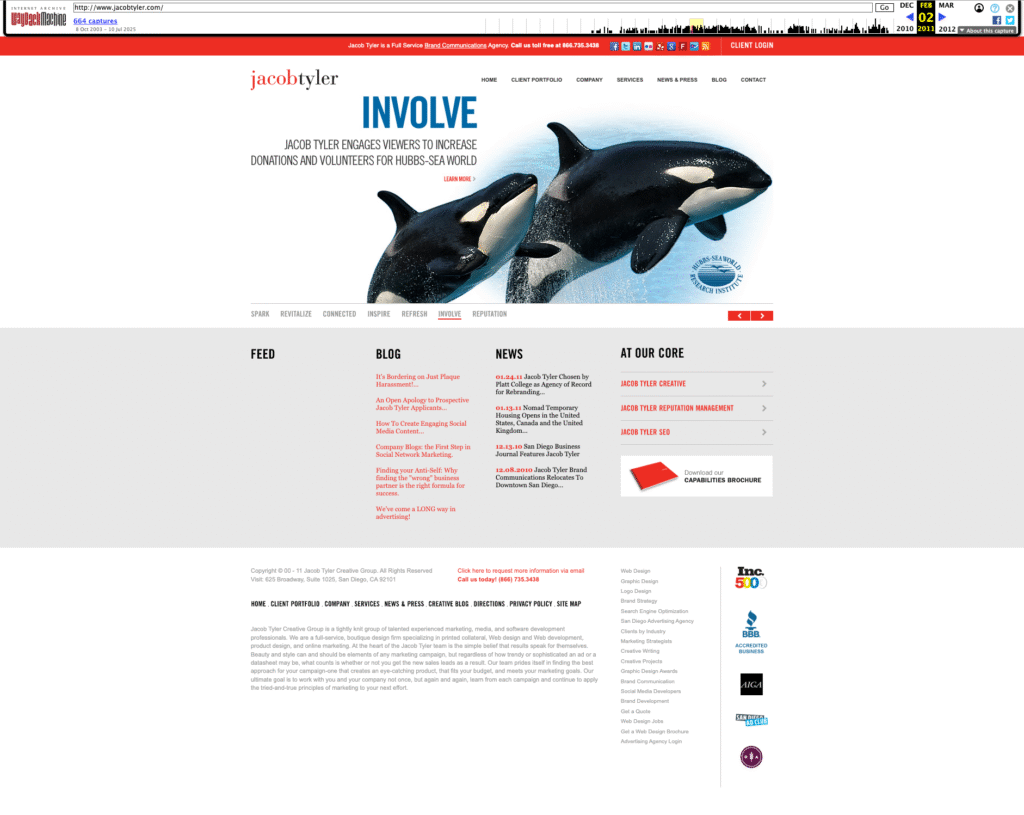
 

Key characteristics of Version 1:

  • Static, information-rich design
  • Desktop-only optimization
  • Traditional corporate aesthetic
  • Content-heavy approach
  • Clear service differentiation

Version 2: The Interactive Revolution

Our second go-around was a total game-changer (at least to us). We ditched the static, corporate look and went big—think larger images, video content (super high-tech at the time), and interactive stuff that actually made people feel something when they landed on our site. Instead of just showing our work like a boring gallery, our case studies started telling real stories with visuals that packed a punch.

This was right when everyone was really getting overly obsessed with Facebook and Instagram (just getting started), and suddenly every brand needed to be a storyteller. So we flipped the script on how we presented our portfolio. Instead of just saying “Hey, look what we made,” we started showing “Here’s how our creative work actually moved the needle for our clients.” We stopped being an information dump and started creating experiences that people actually wanted to stick around for.
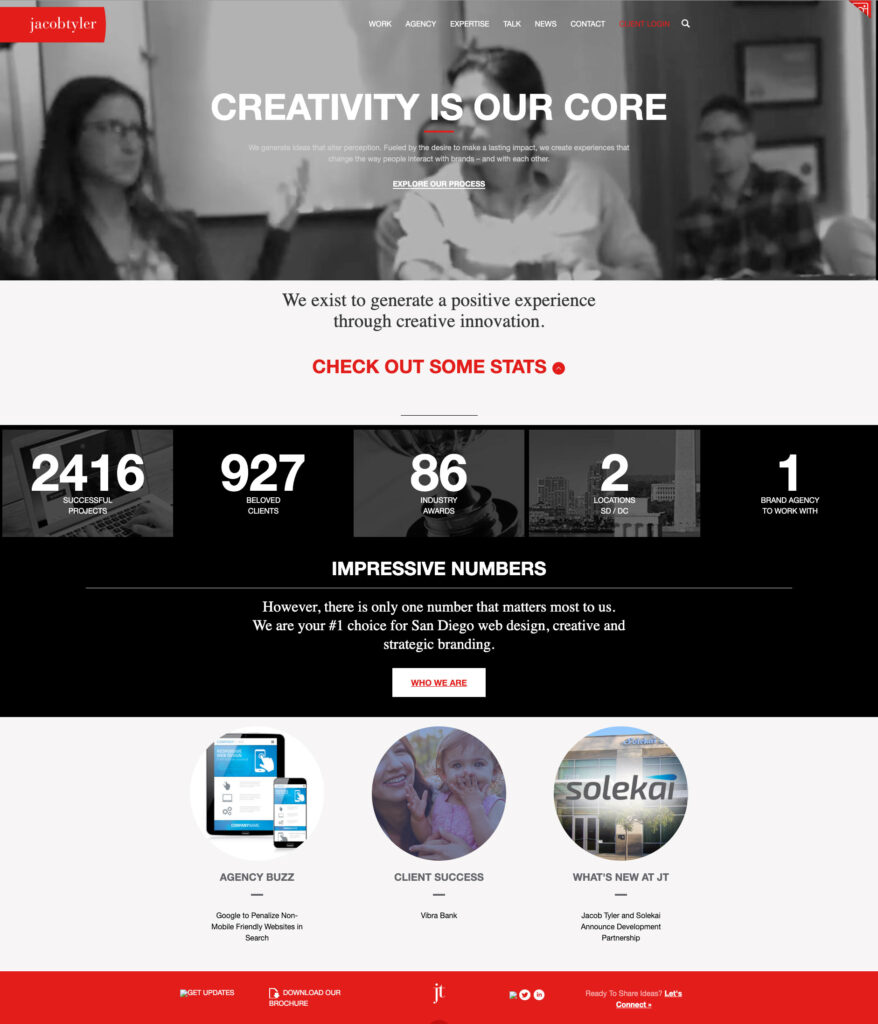
Notable improvements in Version 2:

  • Enhanced visual storytelling
  • Interactive portfolio elements and video
  • Stronger emotional connection
  • Social media integration
  • Results-focused case studies

Version 3: Mobile-First Thinking

The third generation of our website represented our adaptation to the mobile revolution. As smartphones and tablets became ubiquitous, we redesigned with responsive principles at the core. The layout became more flexible, typography scaled appropriately across devices, and navigation transformed to accommodate touch interfaces. At the time, everyone was asking us who designed from mobile phones. And of course, this is extremely important however, a lot of companies that we work with, including us actually have less views on mobile platforms even to this day. That’s because in the business to business environment, many people are doing their research on their laptops and desktop devices.

Also, suddenly, scrolling became natural—people were swiping and scrolling with their thumbs all day long. Mobile screens were small, so longer pages made more sense than trying to cram everything into tiny viewports. That became the norm for desktop as well.

This was also when we started playing around with all the shiny new web tech and jumped on trends like parallax scrolling and those tiny animations that make everything feel more alive. We even spent some time wondering if we should design for the Apple Watch—yeah, that was a thing for about five minutes. Looking back, it’s a good reminder that just because something’s new and buzzy doesn’t mean you need to go all-in, but it’s still worth checking out to see if it’s actually useful or just another flash in the pan.
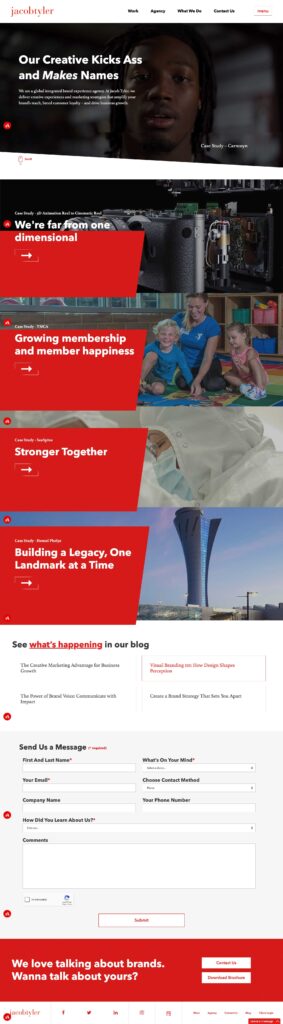
The mobile-first approach fundamentally changed how we structured content:

  • Responsive design principles
  • Touch-friendly navigation
  • Optimized loading speeds
  • Progressive enhancement
  • Cross-platform compatibility

Version 4: The Current Era – Bold, Creative, and Results-Driven

Our latest website embodies everything we’ve learned about effective digital experiences. The tagline “Our Creative Kicks Ass and Makes Names” was the only copy that stayed from the previous website because it immediately establishes our confident, results-oriented approach while maintaining the professional credibility our global clients expect.
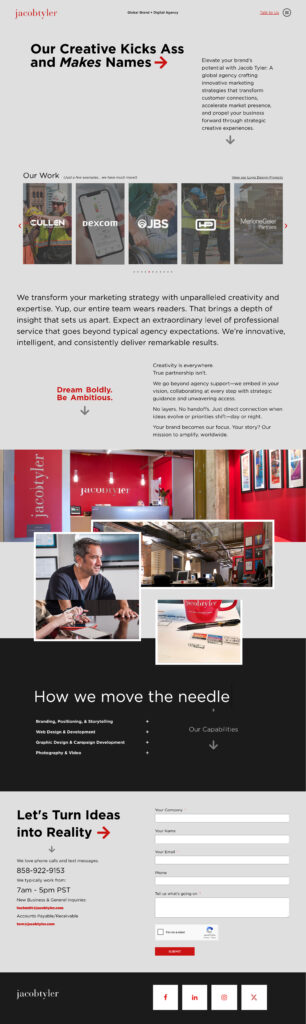
The current design features:

  • Bold Visual Hierarchy: Large typography and strategic use of white space guide users through our story
  • Integrated Case Studies: Portfolio pieces are woven throughout the experience.
  • Multi-Device Optimization: Seamless experiences across desktop, tablet, and mobile devices
  • Performance Focus: Fast loading times and smooth interactions enhance user engagement
  • Conversion-Oriented: Strategic placement of contact forms and calls-to-action drive business results

The Importance of Strategic Redesign

Each evolution of our website wasn’t driven by boredom or aesthetic trends—it responded to fundamental shifts in user behavior, technology capabilities, and business objectives. This strategic approach to redesign offers several key benefits:

Technological Relevance

Keeping pace with web standards, security protocols, and performance expectations ensures your site remains functional and trustworthy.

User Experience Evolution

As user expectations change, websites must adapt to meet new interaction patterns and consumption preferences.

Brand Maturation

Your digital presence should evolve alongside your business, reflecting growth, expanded capabilities, and refined positioning.

Competitive Advantage

Regular updates help maintain differentiation in increasingly crowded markets.

Search Engine Optimization

Fresh content, improved site structure, and modern technical implementation boost search visibility.

Lessons from Our Journey

Our two-decade website evolution offers several insights for businesses considering their own digital transformation:

1. Plan for Longevity: While we joke about dog years, our eight-year average lifespan proves that thoughtful design and solid technical foundation can extend website value significantly.

2. Embrace Change Gradually: Each iteration built upon previous successes rather than starting from scratch, ensuring continuity while enabling innovation.

3. User-Centric Design Wins: Our most successful redesigns prioritized user needs over internal preferences or fleeting design trends. This applies for our clients as well.

4. Technology Should Enable, Not Drive: We adopted new technologies when they enhanced user experience, not simply because they existed.

5. Content Strategy Matters: Effective websites balance engaging presentation with substantial, valuable content that serves user intent.

Looking Forward

As we continue evolving our online presence, we’re already anticipating the next wave of changes: voice interfaces, AI-powered personalization, generative search, and immersive technologies that will reshape how users interact with brands online.

But regardless of technological advancement, our core philosophy remains constant: create experiences that connect with users, drive business results, and stand the test of time. After all, in an industry where dog years apply, longevity is the ultimate measure of success.

The Jacob Tyler website journey demonstrates that strategic redesign isn’t about chasing trends—it’s about thoughtfully evolving to serve users better while achieving business objectives. Whether you’re considering your first major redesign or your fourth, remember that the best websites aren’t just built to impress today’s visitors, but to adapt and thrive for years to come.

Ready to discuss how your website design can evolve to meet changing user expectations and business goals? Let’s start that conversation.

How to Dominate the Search Engines (SEO and Paid Media):

Fun fact: This month marks the 15th anniversary that the Oxford English Dictionary first listed “Google” as a verb. Google and other search engines have since become so important to the business world that digital marketers encounter this question from our clients all the time: “Can you get us to the top of the first search results page?”

That’s a steep request, but also a pertinent one: Search engines are the starting-point for 93% of web experiences, yet only about 25% of users venture onto the second results page. We all know that search engines are in the business of selling your data to corporations, but we allow them to commoditize us because they route us to the answers that we’re looking for. (If they didn’t, we’d jump over to their competitors.) So to dominate the search engines, keep in mind these marketing strategies that the engines reward—and the ones they penalize.

Master the Elements

If you want search engines to crawl your site, you need to become proficient in the basics of search engine optimization. Here are just a few tactics to consider:

Plan Out the User Journey

Before you delve into alt tags and meta descriptions and the rest of it, audit your digital identity to gauge how users are interacting with you. Is your bounce rate going up or down? Are you achieving the holy trinity of clicks, likes, and shares? What’s the final conversion that you’re driving your audience toward? Figuring out how your channels connect will help you plan SEO strategies that ladder up to a larger objective, rather than just improving your metrics for the sake of metrics.

Weave in keywords into your digital content, but limit yourself to about one keyword per 100–150 words—and write a few long-tail keywords that contain the entire phrase that someone might be searching for (4–6-word lines like “how to write a cover letter” along with smaller snippets like “resume” and “job application”). Remember, only weave in long-tail phrases if they feel natural. Search bots will lower your SEO score if your long-tail keywords sound like pianos dropped into the middle of sentences that were otherwise flowing along smoothly.

Incorporate Links

Search engines understand that the internet is a hyperlinked database of information and that we’re all clicking through 37 tabs at once to find the answer to our most pressing question right this second. So if you work in links that are specific, sincere, substantial, and succinct, and that connect to relevant content, search engines will consider your site to be “authoritative.” (If that term seems oddly inflated, that’s because it’s a euphemism for sites that aren’t spammy and that don’t annoy the search engines’ product—us.) Avoid linking to content that’s over a year old, and include internal links to improve the visibility of the lesser-known pages of your site.

Don’t Forget Mobile

In 2011, about 35% of Americans owned a cell phone. A decade later, that number has zoomed up to 97%. Worldwide, you’re looking at 5 billion cell phone users, and to top it off, about half of your audience is finding you through their phones. Point being, optimize for mobile. Search engines will filter you into oblivion if you don’t. Besides, a website today that’s riddled with wonky text and misspaced links when it loads on your phone just feels so … 2011.

Never Cry Wolf

Ever heard of “information scent”? That’s a UX concept that holds that internet users are clicking the links and CTAs that give off a palpable whiff of the intel that they’re looking for. But the opposite could occur, too—sites and content can emit a nasty information scent.

Let’s say you’re writing a blog about starting your own business. If your headline is “Learn How to Grow Your Bottom Line 1,000%,” people will click your link, but if you don’t supply a miracle-gro solution to boosting their revenue, you’re going to disappoint them. In the short term, you’ll drive traffic to your site. In the long term, users may call you out for the charlatan that you are, which could result in search engines downgrading you because of misleading content and sneaky redirects.

Act Local

Search engines are a quandary. On one hand, they make the global village even more united and universal. (Every day, people from Nebraska to Nairobi are all Googling, “How do I fix the printer?”) At the same time, they exert the equal and opposite force of localizing the world. People may or may not be thinking globally these days, but they do seem to be buying locally: Searches with the phrase “near me” in them have risen 150% in the last two years, and 28% of online local searches result in a purchase.

Whether you’re a Mom and Pop shop or an international conglomerate, you’re located near someone, so optimize your web presence for local SEO to make it easy for people to find you, digitally and physically. Update your Google local business listing with the pertinent details about your operation (hours, address, phone numbers), and post customer feedback—especially if it’s positive. Search engines will boost your site’s visibility if people rave about you, since you’ve demonstrated your value to their users.

Make Your Content King

To get noticed online, you need to produce something noticeable, like videos or a blog, and push it out on a regular basis, which demonstrates that what you’re saying is timely and current. If people like watching or reading your work enough to linger on your site, search engines will reward you for having a low bounce rate, since that metric tells them that your site is (you guessed it) valuable to their users.

We’ve talked about linking out from your site, but the real goal is to have authoritative sites link to you. Imagine writing a blog about how to harness fusion and National Geographic gives you a shout-out on social media. Search engines will propel your site up their rankings. But you don’t have to solve one of science’s biggest challenges to craft an organic media plan. If you’re an ecommerce entrepreneur, write an article about your market niche on Forbes that links to your site. Upload your videos to YouTube and your music to Spotify. Even guest blogging on less-established domains can drum up the SEO credit that search engines recognize and respect.

Pay to Play

Blogs, videos, backlink hierarchies, designing for mobile—these are all SEO strategies, sometimes termed “owned media” because they appear on channels that companies or users control. (Or that Big Tech lets you think you control.) The other approach you could take is paid media, where you outright pay search engines to rank you higher. One benefit of paid media is that it’s precise: Spend enough, and you can plop your content in front of your target audience, your competition’s target audience, people who are midway down your funnel, and so on.

The main caveat with paid media is that it can feel, well, like you paid for it. Is it really a surprise when Nike serves you an ad about how great Nike is? But when consumers praise Nike on Google Reviews—doesn’t that feel more credible, like humans are recommending a product to each other? Praise like that is called “earned media,” and brands sometimes pay to put that media in front of audiences that their paid media was intended for. Don’t be afraid to pay for ads, just be sure to interweave them with owned and earned media, and keep in mind the old adage about how money can’t buy you likes.

Be Useful to Users

The seven major search engines today are Google, Bing, Baidu, Yahoo!, Yandex, Ask.com, and DuckDuckGo. But let’s not kid ourselves—“Google” has entered the lexicon in a way that “Bing” has not for a reason: Google commands over 70% of the search engine market and 85% of mobile traffic. Google now handles (give or take) two trillion searches each year. Web optimization trends die every season because Google’s webmaster guidelines change all the time, so you’re better served studying their algorithm rather than trying to trick it. Better yet—study what your audience wants. Explain something that users might not know (how to tie a tie, how to interpret case law, how to dominate the search engines) and Google and its brethren are more likely to route them your way rather than to your clickbaity competitors.

The Jacob Tyler Rebranding Guide

When & How to Rebrand

How To Take Your Company’s Branding To The Next Level

By The Jacob Tyler Agency

Every successful company needs to have a strong brand. Your brand isn’t just a logo, your brand name, or simply a piece of marketing strategy. It’s all of these things and so much more. It’s your brand’s identity. It’s the story you tell current and potential clients or customers that tells them why they should spend their money with you. It’s a central piece of the puzzle of your success or failure.

What do you do, then, when your brand isn’t strong enough or is out-of-date and out-of-touch? If this is the case, then it is probably time for you to rebrand. Rebranding, however, can be a terrifying proposition for companies to undertake. Change is rarely easy, especially ones as potentially costly and risky as rebranding.

At Jacob Tyler, we’re experts at successfully helping our clients in their rebranding efforts with years of experience and success stories on our side, and we want to share our wealth of knowledge with you! To do that, we’ve put together this helpful (and a bit lengthy) rebranding guide to walk you through the essential components to successfully rebranding.

In this guide, we will cover the essential aspects of successful rebranding strategy and execution, including:

Brand vs. Branding vs. Brand Strategy

What sets your brand apart and tells your story?

Before we dive into the ins and outs of the rebranding process, it’s important to understand what the differences are between a few things. Let’s take a look at the often confused concepts of brand, branding, and brand strategy, what differentiates each of them, and what role they play in the rebranding process.

Brand

A brand is much more than the definitions you’ll find in the top search results of Google. It’s not just a mark or a logo or a name. Branding is everything a business, organization, or entity does.

Your website experience is your brand. How your receptionist answers your phone is your brand. The condition of your bathroom is your brand. A brand is the thread that runs through every piece of your business. This is why a brand is so important.

defiition of a brand

If you want someone to know what you stand for, it should be displayed in everything you do, spoken or unspoken, written or unwritten, explicit or implicit. We love it when we see a 100% effort to get brand right, and we’re over the moon when clients get it.

Branding

This one is a little more cut and dry. Branding is all the ownable, identifiable marks that make an organization stand out in the product landscape.

Good branding has the ability to bring a brand name to mind even when the name isn’t present. It’s a look, a tone, and a feel, and even a sound—everything that is uniquely your brand. For example, that sound when your Macbook starts up? Branding. The way the Apple lights up on the lid? Branding.

definition of branding by jacob tyler

You’ve probably got this one down. Let’s move on.

Brand Strategy

Brand strategy uses the above points and creates a framework that lays out the who, what, when, where, how, and why of your organization’s communication of its identity.

Just as it is with a communication strategy or social strategy, brand strategy is the roadmap that allows you, your employees, and your partners to build equity in the way you want it to be built. It’s an absolutely critical piece of building something meaningful and for the long haul.

jacob tyler rebranding strategy

Creative Processes

Discover. Plan. Build. Launch.

Every brand has a unique story to tell. Your story drives every marketing and creative move for a strong brand and digital strategy. Your story should build your brand from the ground up. For that to happen, there needs to be strong creative processes in place to translate your brand’s story into tangible branding.

For a more customized approach, Jacob Tyler will hand select a team of experts and trusted partners for additional support throughout the process including digital search engine marketing and back-end technical support for a complete and focused campaign strategy.

Our Process

jacob tyler rebranding process

Identify Challenges

We start by exploring the primary challenges for your business or industry. This is key for us to understand where we need to go with the remainder of our process. Only by understanding what challenges your brand faces can we see where our destination lies.

With challenges identified, we can then develop cutting-edge solutions through a strategic process where we will discover, plan, build, and launch a custom-tailored brand experience to grow your business.

Discover

This is the most important stage of our rebranding process here at Jacob Tyler. The most important part of our relationship with a new client is getting to know them. We often tell clients we will never know their business as much as they do, but the closer we get, the better our creative will be. Furthermore, we will be able to deliver creative more efficiently and effectively.

Our research isn’t just academic either. We take the time to get to know our clients and their business in person. We don’t just want to know facts or tidbits about what they do. We want to know how their business feels, and we aren’t afraid to roll up our sleeves and get our hands dirty to do so. Sometimes literally!


“We spend a lot of time with our clients initially to get to know them. For example, when we did the rebrand for NuVasive, a 2.5 billion dollar medical device company, our team actually did cadaver training in their San Diego corporate headquarters.

We did this to help understand how their innovative spine technology was implanted and how doctors were trained to do so. It was helpful in how we thought about the brand moving forward.”

-Les Kollegian, CEO & Chief Creative Officer

Plan

Every client strategy is custom and the plan is developed: first, based on the specific target market and, second, by the budget. We choose what we feel the most effective strategy will be and then go from there down the line based on the client budget.

Build

With our strategy approved and budgets in line, we bring our cross-departmental team together to kick off the build process. At the ground level, we create a timeline that lays out expectations for progress and when our client can expect deliverables that need approval leading all the way up to launch. Our strategists, creatives, and account executives then get to work with our developers, social media team and digital media team to start the rebranding process as it relates to each form of media.

Launch

As we reach the end of the build stage, our clients have provided comprehensive feedback and we’ve agreed upon our strategy, creative assets, campaigns, as well as key performance indicators and benchmarks for reporting. The launch date we laid out in our timeline marks the official launch of the rebrand. But the work isn’t done when we press “go.” In fact, it’s really just beginning!

Upon launch, we test everything that can be tested to make sure it’s working properly. Whether that’s a website, an interactive trade show booth, digital display ads, social media campaigns or something else entirely, we triple check to make sure every single thing is built properly, working as we promised, and in a way that delivers results for our clients. This process can take anywhere from hours to a couple of weeks depending on the size and scope of the rebranding project.

Solution

After launch, the work is not over, however. We still need to be sure the project is truly a solution to the challenge we set out to solve. To do that, we find the best metrics to gauge the success of the project, not only right now at the client’s current scale but in the future as the client grows as well.

Once we have tested our creative and solutions, we modify until we hit the right conversion, Cost Per Lead (CPL) and Cost Per Acquisition (CPA) for the specific project. Experimenting and adjusting post-launch until you have the answer is essential. No rebranding project should be assessed with the same metrics you have used before just because they worked on previous projects. You need to find the right one for the individual brand and project. Just as every brand is unique, so is every project.

This adaptability needs to continue as your company grows, as well. Continuing to find new solutions as your company grows is key. Ideally, your rebranding project will foster continued company growth, and your solutions and metrics used to gauge success might need to adapt and grow along with it.

Marketing Strategies

Developing successful brands by creating detailed and impactful solutions that reflect the visual soul of your business.

A successful rebrand does not look the same for every company or project. Depending on your specific industry, client base, size, goals, or countless other factors, there are a wide variety of marketing strategies that might be important for you to be truly successful. That is why it is important to understand the entire spectrum of marketing strategies and how they play into your rebranding efforts.

rebranding marketing strategies

At Jacob Tyler, we categorize these strategies into a few distinct categories: Insight & Research, Visual Communications, User Experience, and Design & Development. Let’s take a look at these categories, how they play into your rebranding efforts and the specific strategies that make up each category.

Insight & Research

Successful rebranding requires thoughtful, disciplined, and creative strategies to move them forward. Our extensive analytical and strategic methodologies provide a strong foundation to build a unique brand experience that will drive results for your business.

Insight & Research Services:

  • Brand Architecture
  • Brand Standards Guide
  • Focus Groups
  • Positioning
  • Brand Audit
  • Brand Tone + Voice
  • Messaging
  • Style Guide Design
  • Brand + Product Naming
  • Competitive Analysis
  • Market Research
  • Technical Audit

Visual Communications

Visual communication is paramount to your brand’s success. Be it logos, signage, packaging or digital displays, We craft eye-catching designs across all mediums that engage, excite and ensure your brand’s message is communicated with a single glance.

planck before and after logo by jacob tyler planck before and after logo by jacob tyler[/caption]

Visual Communications Services:

  • Logos + Corporate
  • Identity
  • Environmental Graphics
  • Packaging Systems
  • Marketing Campaigns
  • Printed Collateral
  • Tradeshow Booths
  • Annual Reports
  • Outdoor Advertising
  • Advertising Campaigns
  • Direct Marketing
  • Media Planning
  • Content Writing + Editing
  • Photography Direction
  • Public Relations Services

User Experience

Technology is constantly evolving, and your brand must evolve with it to remain successful. We ensure that your brand anticipates what’s next and remains relevant. We monitor your digital presence and implement a flawless user experience that increases engagement with every click, tap or swipe.

User Experience Services:

  • Wireframes
  • User Interface
  • Site Architecture
  • User Flows
  • User Testing
  • Statistics Analytics
  • Prototyping
  • Customer Journey
  • Information Architecture
  • Content Strategy

Design & Development

With a mobile-first mentality for the front-end and a flawless CMS on the back-end, our award-winning websites put our customers first. We create intuitive, simple, and engaging experiences for all users, on any screen size—and from any device.

Design & Development Services:

  • Web Design
  • Online Marketing
  • Email Marketing
  • SEO
  • Responsive Development
  • CMS
  • Online Advertising
  • eCommerce
  • Mobile Apps
  • Video Direction

Website Management

Stay true to your brand’s story.

The website is quite often a consumer’s (or business’s) first impression of your brand. This is where you have 3 seconds to pull the visitor in with an effective message or brand story. It is a make it or break it moment in many ways because if a user leaves, a very small percent ever return. Thus, it ends up in a loss of sales and brand equity.

tghe role of website management in rebranding


“It is extremely important that brands stay true to their story and continually evolve online to create and deliver messages that resonate to their audience.”

-Les Kollegian, CEO & Chief Creative Officer

Successful Trends

Harnessing trends that are sound and the right direction for our clients.

Harnessing trends can be monumental toward effectively rebranding your company. But how do you know which trends are worth jumping on and which ones are just a flash in the pan? Even once you’re sure a trend is a successful one, how do you use it to your advantage without the whole thing seeming forced?

In Touch With the Right Trends

These are questions that brands will likely struggle with for the rest of time, especially in our world where social media is ubiquitous and more and more importance is placed on how viral something is or what’s trending right in that moment.

However, not all trends are worth the effort, and this is something especially vital for brands undergoing the rebranding process. After all, few things can instantly make a brand seem more out of touch than unsuccessfully trying to jump onto a current trend.

There’s nothing less cool than obviously trying to look cool. Even worse, if you’re not careful this can even lead to serious PR headaches if you’re too eager to ride a trend without fully understanding the full context.

Flexible and Ready To Pivot

That said, successfully harnessing the right trends and technology for your brand and message can be a gamechanger for your rebrand. We are constantly keeping our eyes open and our ears to the ground to identify when it’s time to shift and try something new, and when it’s better to wait and see or hold off entirely. This flexibility combined with our team’s vast experience and expertise makes us the perfect partner.


“We look at trends and technology with an open mind, and we are always ready to pivot if it makes sense for the client and we believe it will create positive brand equity and increase sales.

With that said, we are not the people that line up for the new phone at the Apple store. We like to make sure the platforms and specific trends in any marketing capacity are sound and the right direction for our clients.”

-Les Kollegian, CEO & Chief Creative Officer

Avoiding Common Pitfalls

Experience makes all the difference.

Communication is Key.

The biggest common pitfall lies in communication with any agency. This is both external and internal. We use a collaborative project management software tool that helps us maintain great communication with our clients globally and keeps a record of conversations. We are painstakingly over communicative and that always creates better experiences.

Attention to Detail From Top to Bottom

The second biggest pitfall is that the big agencies have the Creative Director go to meetings (usually with 15+ years experience) to engage and close contracts. After the deal is signed, the project is handed off to juniors to work on the project. This is a great way to get the most profit, but also a recipe for disaster. We can tell you from experience– which is why we don’t do it.

Keeping Everyone on the Same Page

Here at Jacob Tyler, we have learned from our experiences and mistakes, and use that knowledge to avoid these common pitfalls that brands and agencies fall into during the rebranding process. Simply put, if you want to successfully rebrand, there needs to be great communication and attention to detail from the very top all the way down—between people within your company, at the agency you have hired, and the two sides working together. Everyone needs to be on the same page.

“We have people on our team with over 25 years experience (including me). It makes a difference.”

-Les Kollegian, CEO & Chief Creative Officer

Budget Forecasting

Doing whatever it takes to make sure the client has a great experience and make a return on their investment.

We will do whatever it takes to make sure the client has a great experience and make a return on their investment with us. We aren’t designing for designers or to get awards, but we are designing for the business. Our creative has to work.

Our client’s success is always the number one priority. This attitude drives us to find the right strategy for the client’s budget. We leave our egos at home and, instead, find the right solution. It doesn’t have to be flashy, it just has to be correct.


“From a marketing perspective, if I need to hire a guy to spin an arrow outside of the business, it sounds cheesy and ridiculous. But if it increases the daily revenue of that location 60%, is it worth it? I think so. I guess we won’t win any innovation awards for that specific tactical execution, but we don’t care.”

-Les Kollegian, CEO & Chief Creative Officer

Scalability

Always looking toward the future in order to build the right campaign—one that is solid, engaging, and will stand the test of time.

Everything we do from a marketing and creative execution standpoint always start with us thinking of scale. We spend a lot of time thinking about the future in order to build the right campaign. We don’t just want your rebranding efforts to be successful right now; we want them to be successful for years to come. As your company grows, we want our efforts to grow along with you.

scalability of rebranding

By the same token, we don’t want anything we do to feel dated after just a couple years, and neither should you. This is why we don’t chase concepts that are trendy just for the sake of doing so. We look at concepts that have stood the test of time and apply them to everything we do. We want to help you rebrand in a way that works today, next year, five years from now, and beyond.


“We don’t want our marketing to be “trendy”, we want it to be solid and engaging and, much like a song from AC/DC, stand the test of time.”

-Les Kollegian, CEO & Chief Creative Officer

Branding Guidelines

Consistent and Unique.

Successfully rebranding a company does not only require high-level creative product across multiple processes. It also requires a strategy and a set of cohesive principles. This is where branding guidelines come into play. The right branding guidelines are fundamental not only for rebranding, but for all future brand growth, scalability, marketing strategy, and brand success as well!

rebranding guidelines

The best brand guidelines go beyond a simple set of rules. They are more than color palettes or font choice. They are integral building blocks to a brand’s very identity. They create a full brand experience that customers, clients, and the public at large engage with before, during, and after their direct interaction with the company itself.

Case Studies

We win as a team or we don’t win at all.

Here at Jacob Tyler, we are incredibly proud of the work we do helping our clients successfully rebrand, and we aren’t afraid to show it off. After all, we can talk about our work all we want, but we think it’s better to just let it speak for itself.

rebranding case studies

San Diego YMCA | Invigorating an Online Community

See the full case study.

How Rebranding Can Improve ROI | A Case Study

“When we were chosen to redesign the San Diego YMCA online, we were thrilled for such an amazing and important opportunity. The San Diego County YMCA needed an efficient way to engage its growing and increasingly diverse audience – including online purchasing. We answered the call, building an intuitive cyber experience and eCommerce presence for the YMCA’s 17 San Diego County locations.”

Open for Business

Launching an online store is exciting. Launching 17 online stores simultaneously is downright thrilling. We pulled it off, and the results were eye-opening with online sales doubling almost immediately.

Design Without Boundaries

In the digital age, engaging with customers requires being where – and when – they are. Our device-agnostic design created a seamless online experience across all devices from mobile to desktop that made it simple for the YMCA to stay connected to its members 24/7.

CarnoSyn

See the full case study.

Bigger, Faster, Stronger

CarnoSyn®, a patented beta-alanine supplement that helps athletes reach peak performance, has been a crucial ingredient in sports nutrition formulas for years – but it had never been marketed as a product. The brand’s parent company NAI tapped Jacob Tyler to introduce CarnoSyn® to the world.

Digital Approach

Jacob Tyler serves as an integrated design and marketing partner, working closely with the CarnoSyn® team. Together, we produced multiple digital campaigns that included website landing pages, message development, video production, media buying strategies, and a robust social media campaign. Each campaign was focused on educating the fitness enthusiast and athlete audience on the benefits, uses and proper dosing of CarnoSyn®, and generating leads for retailers that sell the product as part of their sports nutrition formulas. The campaigns were wildly successful, making CarnoSyn® a known name in the fitness world.

Lead Generation

We created landing pages optimized to generate leads and position CarnoSyn® as a leader in the industry.

Advertising and Social Media

With Jacob Tyler’s social, mobile, and web advertising, the initial campaign generated over 39,000,000 ad impressions with an average Click-through rate above 0.60% and an average cost per click of $.19 in phase one. Two more campaigns are currently in motion.

The Gains

71%

Increased average website visits per day from 90 to 2,200 visits per day with 71% of traffic being first-time visits to CarnoSyn.com.

32%

Generated over 1,280,000 video views of educational content with an average View Through Rate of 32% (Average TrueView VTR are between 5% to 10%).

50%

Improved View through rate of TrueView to 50%+ which lowered Cost per View down to an average between $.03 -$.04.

The Importance of Choosing an Agency

We don’t just want to be your agency. We want to be part of your team.

Before going through the rebranding process, one of the most important steps you need to take is choosing an agency to partner with. This is vital to the process for a variety of reasons. Choosing the right agency to partner with is a relationship that not only steers the entire rebranding process, for better or worse, but can make all the difference between success or frustration.

This is not a place where you want to make a bad choice of trusting the wrong person. It would be similar to building a house without a floor plan.

The agency should be experienced. Not just in the specific business vertical, but in general. Everyone at Jacob Tyler, from full-time employees, to freelancers, and vendors, have 10+ years of experience as a requirement. This ensures not only the best strategic thinking for our clients but also a great experience.


“We pay more for the staff, our clients pay a little more for the work, but the outcomes are worth it.”

-Les Kollegian, CEO & Chief Creative Officer of Jacob Tyler

Don’t Just Take It From Us

Listen, we’re proud of our work at Jacob Tyler, and we aren’t afraid to say so. We understand, though, that compliments mean more when they come from someone else. Fortunately, we have a track record to back up what we have to say about our work!

Clutch, a leading platform for unbiased reviews of B2B service providers, lists Jacob Tyler not only as one of the top branding agencies in San Diego, but among the best branding agencies in the nation as well! We take this as a huge honor and are proud to be included on this list by Clutch, especially considering the process they use.


“We really respect the vetting process Clutch requires for authentic reviews and it saves a lot of time for our clients who don’t always have the time to get on the phone with our prospects.”

-Les Kollegian, CEO & Chief Creative Officer of Jacob Tyler

So don’t just take it from us. Here’s what people we have worked with have to say about their experience partnering with Jacob Tyler for their rebranding efforts.


“Before we engaged Jacob Tyler, our image had undergone so many revisions that the brand became diluted. Jacob Tyler helped us create a uniform brand identity that our company can rally behind. A few subtle changes by Jacob Tyler have boosted team morale and cooperation dramatically. We’re now proud to put the company name on the side of our office building.”

-Brendan Smith, CEO of Motive Interactive

“Jacob Tyler’s rebrand has contributed to a significant growth in business year over year.”

-Erik Mueller, President & CEO of Grasp Technologies, Inc.

“I was very impressed with their level of creativity and communication. I don’t have very much technical experience, so Jacob Tyler effectively discussed the project on my level, which I really appreciated. Additionally, they were extremely receptive to feedback and made changes with minimal pushback. The added layer of visibility we get from our website has generated an estimated $4 million in top-line revenue for our company.”

-G.A. Bartick, President & COO of R3 Consultants


We promise we didn’t just cherry-pick the reviews we wanted you to see. We invite you to go take a look at the rest of them over on our Clutch profile and see what our clients think of our work for yourself.

7 Brand Launch Rules For Start Ups

Over the last few of years, San Diego has experienced a significant rise in startup companies. In one six month period last year, 228 companies formed in the area! To those of us who live here in America’s Finest City, this is not a surprise. San Diego’s weather might not be dynamic, but its creative energy most certainly is. Over the last 15 years, Jacob Tyler has helped launch countless brands – many of them startups. We’ve learned a few things along the way. Launching a brand is an exciting endeavor. But like a rocket, you only get one shot. The following seven tips will help you ensure your startup doesn’t crash and burn at launch.

Identify your audience, and find out everything you can about it. Before you launch a brand, it’s important to determine the audience for your product or service. Know who they are, what they want and how to best communicate to them.

If your name doesn’t say what you do, make sure your tagline or logo does. Not every company name is descriptive of its operations – and that’s OK. But a succinct tagline or a descriptive logo can capture a brand’s story and communicate in a glance.

Highlight your differentiation. It’s a simple but too often missed rule. Unless you’ve created something so unique that no one else does it, you have competition in your market. Make sure your branding and marketing efforts highlight what you do differently and why you do it better.

Tell your story. Why does your brand exist? Make sure your brand has a story that defines the motivations for your existence. A brand story will help humanize your brand and create a connection with your audience.

Be clear. Being a new brand means no one has ever heard of you. When you catch the attention of your audience, use it wisely. Have a clean and concise message about what you do and why you do it best. Create messaging that people will share via word of mouth. This form of grassroots marketing is incredibly powerful. Companies like Uber were able to explode and a global level in large part due to word of mouth.

Your launch never stops. There is no defined period for launching a brand. Unless you decide you want to stop attracting customers, consider your launch to be endless – and market accordingly.

Figure out what works, then look at it with fresh eyes. There are very few secrets to creating a successful brand. But that doesn’t mean you have to design a familiar logo or marketing messaging that’s been around the block a few times. Look at what has worked in the past and build on that foundation to create something new that excites and engages your audience.

Want to learn more about the finer points of a brand launch? Contact us using the form to the right!

Jacob Tyler | San Diego’s Best Web Designer

17 Quotes on Design Philosophy From Apple’s Sir Jony Ive

Recently, Apple announced it was “promoting” its lead designer, Jony Ive. The promotion is little more than a title change, as Ive has led Apple’s world-changing product design since joining the company in 1996. “Sir” Jony Ive (he’s been knighted by the Queen of England) is well known across the globe for his innovative designs that made Apple the world’s biggest company and changed the way we interact with technology.

As designers, we draw inspiration from a variety of sources – the word around us, the innovative products and services of our clients and the work of great designers past and present. Ive is certainly one of those greats. The following collection of quotes from Apple’s creative maestro offer an interesting look into the philosophy that drives Apple’s world-changing designs.

“Simplicity is not the absence of clutter, that’s a consequence of simplicity. Simplicity is somehow essentially describing the purpose and place of an object and product. The absence of clutter is just a clutter-free product. That’s not simple.”

“There’s no learning without trying lots of ideas and failing lots of times.”

“Different’ and ‘new’ is relatively easy. Doing something that’s genuinely better is very hard.”

“We shouldn’t be afraid to fail- if we are not failing we are not pushing. 80% of the stuff in the studio is not going to work. If something is not good enough, stop doing it.”

“There is beauty when something works and it works intuitively.”

“If something is not good enough, stop doing it.”

“If you are truly innovating, you don’t have a prototype you can refer to.”

“What we make testifies who we are. People can sense care and can sense carelessness. This relates to respect for each other and carelessness is personally offensive.”

“Apple’s goal isn’t to make money. Our goal is to design and develop and bring to market good products.”

“True simplicity is, well, you just keep on going and going until you get to the point where you go, ‘Yeah, well, of course.’ Where there’s no rational alternative.”

“What I love about the creative process, and this may sound naive, but it is this idea that one day there is no idea, and no solution, but the next day there is an idea. I find that incredibly exciting and conceptually actually remarkable.”

“A small change at the beginning of the design process defines an entirely different product at the end.”

“When something exceeds your ability to understand how it works, it sort of becomes magical.”

“Designing and developing anything of consequence is incredibly challenging.”

“Making the solution seem so completely inevitable and obvious, so uncontrived and natural – it’s so hard!”

“It’s a very strange thing for a designer to say, but one of the things that really irritates me in products is when I’m aware of designers wagging their tails in my face.”

“The best ideas start as conversations.”

San Diego Digital Marketing Agency | Jacob Tyler

Google to Penalize Non-Mobile Friendly Websites in Search

If you’ve been putting off upgrading your existing website to a responsive web design, it’s officially time to reconsider. Starting on April 21, 2015, Google will begin penalizing non-“mobile-friendly”(read, non-responsive websites) by downgrading those websites’ rank on Google searches. In short, this means that non-responsive sites will essentially lose hard-won SEO rankings with the flip of a switch. Imagine standing in line for a ride at Disneyland for two hours, and just as you reach the front, a trap door opens. It’s kind of like that.

Google stated:

Starting April 21, we will be expanding our use of mobile-friendliness as a ranking signal. This change will affect mobile searches in all languages worldwide and will have a significant impact in our search results. Consequently, users will find it easier to get relevant, high quality search results that are optimized for their devices.”

Like it or not, the Internet is Google’s domain, and we’re all just living in it. Google may be our overlord, but it’s not necessarily a vengeful one. The new search rankings are designed to reflect the undeniable trend of people accessing the Internet via mobile devices – smartphones, tablets, etc. Mobile access has reached a tipping point, quickly outpacing desktop access, and Google’s new search algorithm reflects this reality. The news isn’t a surprise. Web developers and SEO experts have been expecting this development for the last couple of years as mobile devices exploded. We knew it was coming, we just didn’t know exactly when. Now we do. And it’s not bad news – it’s an opportunity. Not just to upgrade your website, but to rethink it altogether.

The rise of mobile hasn’t just changed the devices we use to access the web, it’s changed the way we consume content. Our information consumption tastes have veered from buffet to à la carte. We expect singular information on demand – where’s the closest restaurant, what’s the current temp in Boise, how much do beach cruiser bicycles cost, etc. Of course, not every business deals in singular information. But the best websites are constructed as if they do. Upgrading to a responsive website will not only improve your search rankings, it will give you a chance to rearrange your information architecture. By applying an “inverted pyramid” information flow, you can ensure you most important information – your contact info, your basic services, etc. – turn up first in mobile searches, allowing you to then guide your audience through a linear, user-friendly information discovery.

The digital landscape is shifting once again. But it’s not a hindrance. It’s a chance to get ahead of the curve. Contact Les Kollegian at Jacob Tyler Brand Communications if you want more information about Responsive Design or how we can help convert your current Website.

SEO by Jacob Tyler in San Diego