Makers & Founders Podcast Episode 7: Nick Apostolopoulos – From Hacker to Bootlegger

Makers & Founders Business Podcast

Okay, we are back for another podcast. It is the, Elevated podcast. Technically, I’m calling it Makers and Founders Podcast now because we’re going to keep changing this thing and that’s what we are. We’re makers and founders. It’s coming from a true brand professional. Yes. So I am less collegian. I am with my co-host Mark Gallo.

And today we have the pleasure of interviewing Nick Apostolopoulos. Yeah, I can spell it, dude. I can spell it. I’ve known the guy for 30 years. So, which is the crazy thing is actually almost 30 years I’ve known Nick. Well, it’s disgusting. I don’t like to talk about it. Yeah, exactly. Exactly. So when I was, what, 28 were, right around 28, we worked at a San Diego Web Design agency together called, Echo Link Interactive, which then turned into mass hysteria.

He was the, head of development. I was the head of creative. And we worked on a few projects together. We actually met in Madison Square Garden, which was a weird spot. Like he had been hired to do this, and I didn’t really know. And then I was creative directing a project for Intel showed up, and I was like, I don’t know, that was actually became his boss.

Right. And they they made me responsible for this. And it was total Peter Principle. I thought they were trying to fire me. I walked up to Nick and I’m like, I have no idea what I’m doing. Please just don’t make me look bad. And he’s like, who are you? So that’s how we met. We became really good friends ever since.

So I’m excited to, you know, sit and chat with you, obviously. So, couple of quick things. If you’re not an EO and you’re watching this for some reason. So we have what’s called forum. And in forum you have a bunch of, you know, up to ten people, let’s say, and, and everything is confidential within that capacity.

Mark is in next forum. So, you know, there’s things that Mark couldn’t say about Nick that only he could say. I know probably more than Mark, and I’m not in his forum, so I can say it, but I probably won’t. So. So, so, Nick, just real quick, I mean, I kind of said you’re our background in how we met, but just go back to what you used to do.

I mean, I know you wrote a book on, like, SQL or something crazy. I mean, going way back in the programing days and and then bring us up to speed. You know, I, I joke that my previous life was, was. Yeah, I was a software developer, software architect, had a company, worked worked with you at, on Madison Square Garden project and did much of it.

Yeah, yeah. For him. Yeah. Yeah. That’s true. Yeah. I’d love to bring that up. I really, I it is one of the pride and joys of my life. It’s like, it’s like but. And his pride and joy is he’s like three months younger than me, so I do I got what I was so I did that. Had a couple of software companies that did the development, like the stuff we did at the Echo Link and, you know, it was I enjoyed it and I’ve but, the market had gotten to the point where there wasn’t a lot of new stuff happening.

You know, the big.com bubble happened. We lost a bunch of money during that. I lost a company during that, kept going with consulting and, and, you know, doing various other things. But after the bubble crashed, the at least back then, the market got really not the market that, the industry got really fearful of doing new things.

So it just ended up being a lot of maintenance work and, and like, being in that world. By the way, you’re just another quick tip, you know, so a puzzle, a puzzle up was 13 letters. So his company name was a 13 when he when he spun off a 12 and he owns a 13 dot.com he still own now it’s still on it.

I mean, is that worth a zillion dollars case that’s worth like ten grand? That’s wow. I’ve got like the three letter domains were like, you know, I busy maybe I’ll anything. It’s not. Yeah, yeah, but it’s not that expensive anyway. But yeah I thought that was that was pretty cool. So, so I was kind of fast forwarding. I mean you were doing programing for years and years and years, and that’s how you were making, EO money.

Right? For sure. You know, you were doing a great job. You had a team under you, you learned all the lessons and owning an agency from the development side back then. The ones that I live to this day, every day and learn every day. And it was one fateful night, I believe I was with you in, at your place in Hillcrest where you were talking about vaca.

Can you can we get into how you got into this business? Sure. I mean, so for me, it was like you’d go down this path. Yeah. It’s a, it was kind of a silly story, because what happened was, is I just was tired of the software industry, and I was trying to figure out if there was some other thing I could do.

And then I had also. Well, you remember, I’d been a homebrewer forever doing homebrewing, make a beer. And many times throughout the years I tried to talk friends into starting, brewery with me. Breweries are a little bit more capital intensive than a distillery, so I could never talk anyone to do it because they were always like, oh, there’s already 40 breweries in San Diego.

Oh, there’s already 60 breweries. There’s already 80 breweries. And of course, now there’s like 140, although that’s number starting to cream backwards a little bit. Yeah. But somewhere along the way, you know, I drink less beer and more spirits, and I thought, I wonder what it would. I wonder if there’s anything such a thing as craft spirits.

I really didn’t even know. And I started researching it and found out. Oh, yeah, there is that world. It is possible it’s not as big as craft beer. And then, yeah, my stupid story about how I decided to start the company was I was at an event, I had friends in the industry, and I was at an event for a tequila brand.

They had bought out the bar and, this thing where they were trying to to promote their brand to the bartenders and stuff like that, the industry. And, so we all went to this event, drink free tequila, eight free food bar, hopped afterward in the back of but a friend’s apartment, and nobody could remember the name of the tequila.

And I thought, these guys just spent, you know, 50 grand, 80 grand on the party, and nobody remembers the name of the tequila. Somebody should do something simple, like 619 vodka. And everyone in the room was like, that’s a great idea. And I’m like, no, it’s a stupid drunk idea, but it’s somehow stuck. And I was like, I really want out of this software world, and I want to see if I can do this other thing.

And so that’s how it started. Yeah. And then for the first 4 or 5 years, it was still just a hobby. I was still doing my consulting gig. Yeah, I was trying to get the company off the ground. Well, yeah. I mean, one of the things I know about Nick, I mean, he is a risk taker. I mean, the true definition of an entrepreneur.

I mean, you know this too. Like, he’ll just go all in for these problems over. Yeah. Yeah. Well, he’s able to he’s able to stick with it like he’s, he’s he’s got resilience that no one else has. Because in the joke that you know, and ironically, Dominic, Carnevale will be coming in to do a podcast sometime soon and, you know, he had the he had the best joke ever when we were talking about, you know, your business.

He was like, you know, you know how you make $1 million in the vodka business? Start with 10 million, you know, and and so and so suck. Talk about living that right now. Right. So talk about some of those challenges. And I think, you know, like I remember in the beginning, I, you know, you kind of found a flow when you got into flavors, you know, and in the very beginning, you were just focused on creating a really great vodka, I believe.

Yeah. And, and by the way, was, correct me if I’m wrong, but, like, you know, you you basically were like, shit, there’s tons of companies making great vodka or and then they have so much distribution power, they can sell it for less. So I can’t get in Wells, I can’t, you know, so just talk about kind of what your thought was and how to grow the business.

And this is pre 619 spirits in distillery. Right. For pre the bar. Pre the bar. Yeah. Pre the book because well that was the problem is I had no idea what I was doing right. Yeah. Okay I can go do this thing and it’ll be easy. And I’ll, I’ll create a local spirit and and every, every everybody will carry it because they’re already carrying all these local beers.

Yeah. And that turned out to be the dumbest thing I ever thought, right. So I went to hotels and whatnot, and I learned really quickly that that’s really stupid because the the local if you, you know, I joke with people, even to this day, if you walked into a bar anywhere in San Diego and they said, we have.

But like Miller, like if they didn’t list a local beer, you’d be like, what the fuck? Yeah. How do you guys not have local beers? And I thought that at some point that would catch on the spirits. And it may be kind of sort of, but not really. Yeah. And so what happens is, is in the spirits world, also, people are much more, settled on what they drink.

Beer drinkers go out looking for something new. Oh, look at Chocolate Porter. And they want to try it. Sure. In the spirits world, that doesn’t happen very much. And so I ran into this brick wall where these bartenders and bar manager for like, yeah, you know, if nobody’s coming in and asking for your product, we’re not going to spend time trying to educate them.

But they go, I want to Tito’s and Soda. We’re just going to promote Tito’s and soda. I’m not going to be like, oh, you should try this other thing. We’re under three deep in the weeds, right? Yeah. And so that was a hard lesson to learn. So we thought, okay, maybe we can pivot to retail. Well, that’s even harder unless you’re doing billboard ads and things like that.

Dude sitting on a shelf, nobody’s going to notice it. And part of the reason I started vodka in the first place is because I thought, okay, there’s nothing really, you know, we’re not a whiskey town or something like that, but I thought, vodka is very California. When you’re sitting by the pool, you’re drinking a vodka soda or something like that, and that’s where.

And I was honestly a friend of mine. We were kind of brainstorming and. Yeah, yeah, yeah. It’s generally not an old fashioned, you know? So, and we were brainstorming that. Okay, what can make us unique and differentiated? And it’s like, well, California refresh, we’re local. We could do flavors and real infusion flavors, right? So that’s why we chose it.

And that seemed to work pretty well, which was, you know, trying to do fresh, local ingredients, real, real ingredients. You know, our coffee vodka is real coffee. Rose petal has real rose petals, by the way. Rose petal. I mean, who the hell thinks of that, right? I mean, that’s a crazy. And it was it’s great. And and, in the female market particularly really like that.

Yeah. Yeah, totally. And so in fact, it was you know, it’s probably a little bit of a curse, but we purposely I purposely angled away from raspberry and other things like that that we could have done that would have been much more approachable because I was trying to figure out, find that point of being unique in the market.

Well, there’s I hold what, 20 I want to say 2012, 2015 period where vodkas were just really starting to play with the infusion. Yeah. You know, and I remember that with like Absolut. They were like they had every flavor. Yeah man. Yeah. And it was I mean it was all the rage for, for a minute. And it’s still kind of is I mean Sky has all the crazy flavors, but you know, the thing we were trying to do and I don’t know how successful we’ve been, is to try and say, hey, look, we’re not artificially flavored.

We’re not artificially colored. We’re using real or full creative. And this goes back to that $10 million comment mark. And if you think about it, because, you know, we’re all about the same age here and, and and when we were in the late 80s, early 90s, you would get an absolute and tonic or an absolute and soda. Right now you’re saying Tito’s and soda or Gray goose, right.

And so it’s a marketing game. It’s 100% a marketing game. And one of the challenges, you know, that I know Nick has had is, you know, like, so he has, first of all, and I’m not just saying this is vodkas are great. I mean, you name a flavor, they’re all great. There’s a but before the before this, before this, he has, so the he has a pickle vodka and a scorpion pepper vodka.

Okay, now, the scorpion Pepper vodka is, like, too hot for me. But if you, like, take a half ounce of that and, a half ounce of the pickle and a hat and that full ounce of the regular. That’s a bloody Mary that you cannot be. And so I’ve, you know, I’ve said, how do we how do oh, hell yeah, I’ve done the research.

How do we get a restaurant, you know, and this is your challenge to your point where they’re like, hey, we’re not going to educate people, but to put it on the menu, you know, in with the recipe, you know, get the scorpion Mary. Right. You know, and and get that, locally that it around. And I think the challenge becomes they don’t want to pay for it.

Right. It’s just the bottles are too expensive. And so what are the challenges you face of tracing the problem on the spot? Yeah, yeah I know, I wish I knew somebody. Yeah. So the pricing, is it a pricing issue or. Honestly it used to be a pricing issue. We haven’t raised our prices in a while and the market’s kind of caught up to us.

So pricing wise we’re still a lot more expensive than a well but we’re not more expensive than the other brands at the at our level. Yeah. Call brands. Yeah. And to to your point, I, I don’t know if you know this or not, but we are in the spot in La Hoya and one of the cool, the coolest things I ever saw is that so the spot in La Hoya uses that recipe basically, I think I don’t I think it’s half bloody.

I mean, half pickle, half pepper. Right. To make their Bloody Mary got it. And then on their menu. And I wish I could get this in every restaurant San Diego on their menu. They say this is our Bloody Mary. And if you really want you don’t want this. We can make it a Tito’s. And I’m like, oh shit, we’re above the fold on Tito’s, right?

That’s the one place we’ve had a success. But and we’ve slowly started knocking some other, things down. Like, are you getting relator’s art right or are they, are you getting reorders? In other words, you’re going through your flusher. They go through it. Yeah. Great cases I don’t. Yeah, yeah. Yeah. But it’s, you know, it’s a case or two a month.

Well, yeah. It was. Yeah. Crazy. That’s what you need in every restaurant. Yeah, exactly. And that’s what we’re working on, you know. But but Covid really put a damper in that, right? Everybody shut down when our sales went through the floor. And, I spent all kinds of time trying to run a restaurant. And so, yeah, that’s that’s the challenge is trying to and that’s the you know, the thing is, it takes a lot of, a lot of cash to make that happen.

You need a you need a rep out there walking into every restaurant all the time. Hey, you guys ready to pick up that? That peck of pickled? Yeah. You guys ready to do this? Are you guys ready to do that? And we just don’t have that presence on the street, right? And that’s the other thing the brands the other big brands have, and they have pricing power, like you said, because they can go in and say, you know, the big guys are all portfolios of brands, right?

Yeah. They go and say, hey, if you break up, pick up this new goose flavor we have or this new kettle flavor we have, we’ll give you a discount on your on your, bullet. Right. Or whatever it is. Right. Yeah. You know, we know you’re using you know, you’re using this in the. Well, we’ll give you a discount on that if you bring in these other flavors.

Yeah. And I’ve seen a lot of those things come and go too. But they have the they have the muscle to do that. We just don’t. Yeah. You know, and we’ve talked to people about trying, you know, we talked to the shell about getting in there. But they want a pretty big spend, and the ROI just doesn’t seem to be worth it, you know?

And the question is, is okay, well, would being in the shell and people seeing them pour the bottle, would that be a good good. Would that be worth it. Right. Is that oh hey, the shells boring. 619I gotta go find this in the store. That is the challenge of. It’s a tough one. It is. Because I know that actually Blowfish tequila is the shells.

Yeah. And that’s what. That’s why I brought it up. Because I know the guys who got it in there. Yeah. He said, and I know what they paid and I know. And so we were. And they don’t have a tequila sponsor. I mean, I’m sorry, a vodka sponsor. And so he talked to them about being the vodka for the, the, the irony is they won’t talk about they won’t touch the flavors because they just want to do it faster, I’m sure a quarter what I mean.

And so then the question is, yeah, would it be worth it? Would they move enough cases and would it be enough for people to see the vodka being poured to start going, oh shit, the shelf was 6 or 9. What’s that? Or or if you have heard of it here, I gotta go get that. Well, let’s talk about the math on that real quick.

So, so what, would you have to pay to be the selected vodka? And then how do they pay you back based on sales? Yeah. So? So I mean, the deal that got bandied around to us was 15 k to be in for a year. Okay. That’s a marine’s reasonable. It seems reasonable. The question is, would we make that back in sales?

Right, right. And so if the answer’s no, then it’s like, okay, well, that’s 50 K marketing spend, right? Or two I care ten K whatever the over is on. Sure. Because certainly our, you know, even if we get a 15 K buy, that’s not our profit margin. So, so at some point we have to look at it as a marketing spend.

And that’s the question right. Yeah. Yeah. We I mean is it worth it to move 15 K for the product because we probably would because they’re number one seller obviously. Yeah. And Blowfish did the math and thought it was worth it. And so, you know, we’d be featured not only there at every event there, but also at the, at the symphony because it’s the same concession.

The suppliers sell that much, but again, so it’s a that’s the question is, is it worth it? And, you know, if we had the if we had the money, we would probably do it. But right now it’s just, you know, it doesn’t make sense, doesn’t make. Well but again, like, can you see like so Blowfish I know is I think on the low end what, 30 or 40 bucks.

And then the high end 100, I know that I’ve probably I’ve done the narrows there, but but how I know your bottles a little less right. You know, and I, you know, I generally know your profit margin, but why can’t you make it seems to me with all the events they have, all the people there, all the, the liquor sales, they would be able to tell you pretty much data wise, we could figure out what they sell.

Yeah. They haven’t given us that information, but we would know. Yeah. Well, so then why don’t you know, like a like is it legit? You exit. It’s one of those things we’re still trying to. Yeah. Come on. And I don’t know yet. Yeah. You know, the biggest issue for us right now, as you know, is it’s just it’s just even if they came tomorrow and said, okay, here’s the contract sign, blah, blah, blah, it’s cash flow.

We’re working on that, on the new space we’re going to get. Yeah, he’s coming in. I just don’t have well yeah. Hopefully. Yeah. Okay. Yeah. Well we’re going to get into. Yes. Yeah. So that’s the problem. So so to answer your question. Yeah. All things being equal, that would be a no brainer deal. Right. If we didn’t make the money back, it would be worth it to say, oh, we’re in the show and people are seeing it.

And like, you know, like, did you know Blowfish was there just from seeing it? No, no, actually, I, I know the owner, or, you know, so so that was one of those things I just found out. Yeah, yeah. So let’s, let’s get into, you know, Mark had to bring it up, so. Well, first of all, how how long, how long have you had?

Well, let’s before we go there, Mark and Nick, how long have you had the restaurant? Let’s. And, if you haven’t been to listen, I’m solicit. You’re not allowed to do this. No, I’m saying go to this goddamn restaurant and I’ll. I’ll tell you why. The food is unbelievable. Like, really good. I mean, yeah, yeah, yeah. Nick’s back there cooking.

You know, he’s making the English muffins while everything else has gone. Yeah. No, but it’s really, really good food and really good cocktails. And, frankly, a good atmosphere, too. I mean, I know the problem is, is so open, like, when it’s crappy weather, you’re screwed, like, today, you’re not going to be a good day, but, it’s a it’s a great it’s a good atmosphere, games, all this kind of stuff to hang out.

You’ve had it to talk about the evolution of that. And, and then before we get to the new space tour, how many years the maker of spirits face. Yeah. And some mistakes that were maybe made there. All of them, opening up a restaurant and it’s only 45. Well, I mean, I could go back to and and I’ll take you back, like, you found that space, and I was remember thinking to myself, I’m sure we talked about it, but like you’ve heard from chefs and all these, you know, don’t get a space that doesn’t have a kitchen because it’s costs that you have to spend that could have been pre-built somewhere else.

And someone that you did not do that you got an empty shell and you built a full custom space and frankly, a lot by yourself and Jason, a great guy, really built your steel and your bar and all that. And so just. I’m sorry. Go ahead. No, I mean, so, you know, like I said, it was a it was I was learning really hard way that it was a struggle to just be a brand.

Right. And, and, and only be selling to bars and restaurants and not have any kind of location. And, so prior to 2017, in California, distilleries weren’t allowed to do what we’re doing. You could you could have brewpubs and wineries, but distilleries weren’t allowed to be open to the public at all. 2017 that changed. They passed, they stayed, they added a craft distiller license.

And then you could be open to the public and you could have a restaurant bar do all that. And so running into all these brick walls. And then I happened to find that location. I thought, I have friends who owned bars, and bars are busy. How hard can it be to run a bar? Right. And that’s a not that I didn’t know.

Restaurants are hard. Yeah, but I thought, okay, we have the space. The space is inexpensive. We can build it out even. And you know. But again, that was my naivete, right? I thought we could build the space out for 50 K. Yeah, well, I don’t know where I got that number. But it is a signal and 250, right?

Yeah. Yeah, exactly. Yeah, yeah. No tables, but, you know, and it’s not the first time. Might not even taste. Got me in trouble. But, you know, I was like, okay, we’ll figure out how to do this. And then the the city had never permitted one of these before. And so we signed the lease in 2016. We didn’t open it till 2018, which cost me an absolute fortune because we were paying rent the whole time.

We could do the buildout. Not unlike what we’re running into again right now. And so anyway, so we went through that process. I, we signed the lease, we opened the we finally opened the restaurant in July of 2018. So it’s been what’s that going to be eight years now. Nine years. I can’t do that. Yeah. This July.

And so, yeah, that’s how we got there. And then you know, I thought, this is, this is the way I think, which again, gets me in trouble. I thought, okay, what I really am trying to do is build this vodka brand, and if I can just, oh, get the bar and restaurant to break even. Then I have a marketing tool because people are going to be coming in and seeing the vodka and buying it and trying it, and I have a free place from which to run the distillery from which to run the other business.

Right, right. Obviously, again, stupid and naive because I still need to make money and I didn’t calculate that into the into the mix. Right. But I was still working consulting and so I didn’t need it. Yeah. But quickly after opening the restaurant, I realized, okay, this isn’t going to work. I got to go in full steam and dive in with both feet.

And yeah, the hijinx ensued from there. Well, and then 19 months after opening Covid, right, we’re just getting our legs under us, and I go for kicks. I’ll tell you, the Knicks did find one of the biggest loopholes in bar ownership history. So, yeah, I mean, and, if you could explain that. Relevant to the distillery.

Yeah. So that the nice little loophole of this craft distillers license is that if you have a craft distillery and you have a kitchen, which, again, we knew we needed anyway. Yeah, but had to build from scratch, which was again, dumbest thing. That if you have those two things, you can operate as though you have a regular full liquor license without buying a full liquor license, which right now they’re probably about 100 and 5060.

Right. So we did get a avoid that expense, right? Yeah. And so we operate as though we have a full liquor license because we’re a distillery, in fact. Side note, and that may be where we pivot too soon. Yeah. Is, you know, I’ve thought that I’ve, I’ve thought for years now that the good side hustle might be trying to find places that can’t afford a liquor license.

It’s not if I can help them become a distillery so they take advantage of this loophole. I mean, it saves a lot of money, right? Like you’re you’re immediately. It’s like a turnkey operation at that point. You’re going to I mean, this the cost associated with starting a business at any level, any time you can look for efficiencies and well, or even if you find a place that’s currently doing beer and wine and lost a liquor license, they don’t have 150 grand.

Right? But and it’s not as easy as it sounds, there’s federal licensing involved in stuff which they don’t normally have to deal with. So there is a component to it. But as a consulting thing, it’d be easy to go in and say, hey, I’ve already run this up. I know how to get the federal license, I know how to do this.

I know how to do that. Well, for 30-40 K, we can set you up as a distillery, and then not only can you operate as a full bar restaurant, you can make your own spirits. You can have your own branded, you know, whatever lessons, you know. Vodka, right. Whiskey that. Well, one of the things, you know, like because he was so.

And listen, this could be my naivete too, because we talked about this and we, we, you know, said, look, let’s be the local bar, meaning all the spirits are local, all the beers are local, and, and and because of 619. Right. It’s San Diego based. And so you want to talk about like, you know, sticking to the, religiously knit cats.

Right. Everything in the bar, whether it’s a bourbon, a gin, tequila, it’s all local stuff. Now, the question I have for you was that a mistake? And do you think sales could have increased if you abandon that? Did we did we make a mistake? And did I make it a single? Yeah, that’s a good idea, right?

No, that’s a great question. I mean, like, if you could do a rum and club after party and coke, we could do a Jameson, and we can’t do Macallan right? Yeah, we don’t get that. So. Okay. The answer to your question is, is it’s not a mistake. Well, it is a mistake in the location we’re at. That’s the answer.

Your question in the new location. I don’t think it’ll be a mistake at all. And why? Because our current location, as much as I. As much as this pains me to say, we’ve been trying to make it an elevated craft cocktail distillery for eight years. And it’s a dive bar. Yeah. And so people walk in now? No, no, that’s, people walk in once a year.

Somebody will walk in and say, can I get a Jagermeister? Can I get something? We don’t have 90% of the time if they come in is, oh, can I get a Jack and Coke? We go, hey, we don’t have that. We have local things. We will. Oh that’s great. So we don’t lose customers because of it. Oh, I don’t know if we gain customers because of it, to be honest with you.

Yeah. But the it doesn’t it doesn’t work well in our current location, and only because that strategy prohibits us from being able to do Dollar Bud Lights during the game because we don’t have Bud Light. Right? Yeah. So that’s where it gets in the way is we can’t we we we compete well on price with the neighborhood, but we can’t do the hey, you know, during this event, can we get a bucket of beers or get this or get or do we do a Boilermaker.

Yeah, yeah. If you’re and we look like a dive bar. And so, you know, we if we, if we could do like a, you know, an $8 boilermaker, that’d be great. But we can’t afford that because the beer cost too much on the spirits cost too much. So in our current space, it doesn’t work very well. Right. It hasn’t been a it hasn’t been a horrible thing.

We’ve been doing fine. But, you know, I think I think one of the biggest mistakes we’ve made is not that space per se, but it’s that we spent so long trying to turn that space into something it’s not. Which is why I spent the last two years trying to find a new space. Right? Right. Because as much as I love that space, and as much as people love it, it’s just it.

It just doesn’t scream high end spot, right? We tried to do caviar tastings in there and stuff, and the event went well, but if I told you that and then you walked in and look, the place would be like, you did what? You’re. Yeah. So it doesn’t really fit, right? Right. Be at the tables as it is.

And it was, it was, it was, it was the opportunity in front of us at the time. But yeah, I think I think all told, that strategy probably wasn’t the best for that spot. Got it. Well, and then moving into the to the news so I know, how much more years lease you have on that too.

Okay. And so, that’s a 2000ft² Sparc. Yeah. Like 2300. Okay. So then you spot eight. Correct. So that’s a monster, right? I know you, Nick, and I know that your thought is if I the money will come right? And that the spot I’ve got to pay will come. And you kind of thought that with this previous space, I know that your thought on the new space is to make it elevated.

Right? Right. So that you can follow that dream and then hopefully stick with the current space and do a dive bar. But let’s just talk about what do you think the real math is on this and how will it pan out and will it happen? And what mistakes have you made there? I could just, you know, keep going stuff out.

Yeah. And I mean yeah, yeah. Let them problem solve through it if you for. Yeah yeah yeah. But but that said you know me well right. And and and I, you know full disclosure I talked to les last week and I literally said to him, I sent him a text and I’m like, I think I might be done pulling rabbits out of my hat.

I’m. I’m running out of I’m running out of that problem solving runway. Right? Yeah. And, you know, when we opened at the first spot again, I totally underestimated how much would cost. I didn’t have the money. I signed the lease before I knew how I was going to do anything with it. Then we fought the city forever and paid a bunch of rent.

And so, you know, I had to figure out how to how to build that space out. And we, we did a, we did a crowdfunding thing. And luckily we raised about 190 grand through crowdfunding at the time, which was crazy because we were zero revenue. Our balance sheet literally had zero on it when we posted it on the side.

But we got like 400 or 200 and some people to, to invest, you know, between 100 and $5000 or whatever. And we raised 190 grand. And so I, you know, I’m working with somebody now who’s trying to help us raise financing for the new space. And, and every time I talk to him, he just laughs and he goes, you do everything backward.

He’s like, you should have gone out, gotten the funding for us for for together and then gone and found a space. Hey, that’s something we accept. That’s not how I work. Right. Unfortunately. And so I spent two years looking for a space, figuring, okay, I can find something, and then I’ll figure out what it’s going to take to make that space.

And so the answer to your question is, I don’t know what this new space is going to work because I think the projections are fair. They’re probably aggressive. But the space, using pictures of it, it’s it’s it’s night and day from the current space. Right. It’ll be an amazing space. If we could pull it off.

It would be incredible if you can pull it off. But you’re in the same boat, Nick. You still have to create a kitchen. You have to do all that. Sure. Yeah, I have to do all that. I again, that that and that. And the mistake we made was signing up before we got into it. And we’re a year in now.

And you know, we I thought, okay, I’ve been through this before. We are we need to build as a kitchen and blah blah blah blah. How much can that possibly cost? Right. And I wasn’t an idiot this time. I went out and talked to some people and you’re like, oh, you’re probably looking at this much per square foot, blah, blah, blah.

So we thought the build out budget would come in around 1.2 million. I have about 800 coming from the landlord in tie. So I thought, okay, I’m gonna need 2 or 4 grand to finish this build out. Yeah. Which again, I thought, okay, I raised 200 last time, but nothing I could go. I can go crowdfund that.

Yeah, you have that. You have a proof of concept. Yeah. And then and, and what happened was that budget came in at originally the first time, 1.8. It’s been whittled down some now because there was porcelain countertops and crazy stuff specked into it that we don’t need. But yeah, I’m running into this problem where now we’re at that point where we even we’re ironically, the city’s all on board this time, but we just we’re just trying to lock up the financing for, and we’re struggling to do that.

And we launched a new crowdfunding, which I thought, okay, we’ve been open eight years. We have is we really have a history. We have tons of gas, we have lots of loyal customers. We have we’re known in the space the Serial Business Journal article, you know, stuff like that. Right. We’re getting exposure. I thought, okay, we can we can easily get.

304 hundred and 800 people to even if they only throw in 100 bucks, it’s a hundred bucks. And yeah, that’s only 80 grand. But if I can get five, six, 800 people to throw in a hundred bucks, then we can go. Hey, guys. Look, we’re doing this. You know, some of those people will throw in 500. A thousand, isn’t that.

I thought we could raise half a million in that thing. No problem. And right now, we’re stuck at about 140, I think, you know, the crazy part is, is in the last, we stopped promoting it altogether, not just because we’ve there’s been no movement at the new space. And in the last three weeks we’ve done like six investments.

I’m like, oh, shit. Okay. People kind of it died off last year. And it looks like now the New year, people are like, oh, okay. Yeah. You know, so, so and a couple of those were $10,000. So it’s like, oh okay, there’s some movement now. So maybe we really start need to start pushing that again. But it’s a struggle because I feel like it’s a chicken and egg.

00:30:04:07 – 00:30:26:14
Unknown
The space has been sitting empty for a year. If I could walk in and start showing like, hey, look, we did this. We’re building the floors. Look, they’re framing this. And I know I think we could drive that, that more, but it’s a matter of trying to find the funding to get it going. Right. And and, you know, in the meantime, we’ve just been borrowing against the, the existing business and my house and whatever to try and keep paying the rent and all the other stuff on the new space.

And this is the story of a business owner at the end in a shirt, you know, when you start talking about the journey of a business owner, the things that a business owner goes through, it’s cause you put yourself out there, put yourself at risk, put your family at risk, right, you know, and then still try to sleep at night, right?

You know. Yeah. And that’s and yes, I mean this story I’m sure resonates with. Yeah. Everybody. Well and on top of it and this is goes back to your backwards thing. Right. Whereas your, your occupying a space you’re not using and paying rent on that space which becomes essentially debt service to your profit. Yeah, right. It’s totally.

Yeah. Right. And well, again, all we’re doing right now is accumulating debt. Right? And since you’re not like a Chili’s or whatever, you know, like you don’t have a well, they’re probably out of business now or I don’t even know. Maybe you are like, you know, so you know, you since you’re not since you don’t have that much revenue to support that, it becomes a much bigger challenge to run your own business.

Yeah. Is was would you say that’s the biggest challenge you’re facing right now? Like what’s happening. Yeah. That’s the bigger that’s actually the biggest challenge are facing right now. We can’t service the debt we’ve been taking on. You know, we have some potential outside investors. But you know, the good in the bad is that in the, in the without going into a long story during this process, it’s it’s turned out that both properties, our current one and our new one are are available to buy.

They’re not listed on the market. But both land both owners have in the last six weeks said, hey, if you want to make us an offer we’re interested in and entertaining it, which they weren’t before, right? So that’s good because now I can say, oh, okay, if I can find investors, I can say, look, you can help me build this space out and own part of the building, right?

Yeah. Well, that’s a it’s a way to be able to cover their leverage. Exactly. Yeah. So but again, I naively thought, oh, this will make everything way easier. And it’s not because we still have to we still have to buy the properties as owner occupied. Right. The good news is the good news is I control, for lack of a better term, both properties because I have leases on.

So I’m the only one currently that could get an SBA 5 or 4. Nobody else can or not. Somebody else can buy the property, but they’d have to buy it at a regular commercial out. Right. So I have some leverage there. But at the same time, thanks to the way, the way I’ve gone about this completely backward is it’s going to be really, really hard to get SBA 5 or 4 loan right now.

Our books will look ridiculous because all they’ve been doing is borrowing money to, you know, so now I have to tell the story where, hey, look, yeah, this thing is upside down, but it’s because I’ve been borrowing money to put into this other space. So this is what we’re trying to do. And again, full disclosure, we had, we we found we thought we found a bank, that would that would because that’s the other thing is there’s no to try and do a 500 for in the new place.

It’s not built out yet. It’s not open. It has no cash flow to to base it on. We did find the lender. We did find a lender who said, that’s okay, we’ll do it based on projections. Yeah. And they denied us yesterday. So they they went through and they said yeah send us this and the stats. And that’s the other thing.

And, and then we got a note back saying, no, we’re not going to we’re going to pass right now. It doesn’t fit our credit box, whatever that means. And they said, they said based on historical cash flows, we think your projections for the new space are a little aggressive. And I’m like, yeah, again, I can explain this story.

Yeah, yeah. The cash flow here is horrible because we’ve been trying to fund it. This new location. Yeah. And yeah, maybe the projections are aggressive, but I don’t think so. I mean, for the projections for an 8000 square foot space, that’s an event space and this and that and the other. Yeah. They’re not that aggressive that you also have to deal with.

Are you doing a million to where we’re at. And that and and so I mean I know the math isn’t a straight line. Sure. But you go to three and a half four times the space. I, I, we should be able to go from 1.2 million to 2.4 million. Yeah, maybe not 3 or 4 million, but we should be able to double our revenue in the space of 3 to 3 times the size.

Well, especially with the event. That’s right. And because that’s the biggest problem with the space we have right now. But always there’s nobody nobody wants to hear that story, which is that we turned down 30 and 40 person events all the time, because that is a buyout in our current location. And the new location, we could do a 30 person event, still be open for dinner service, still be doing a cocktail class in the distillery.

Yeah, you could do all three of those things at the same time. Yeah. We can’t do we can only do one thing at a time where we’re at and that really messes with our ability to to leverage the brand and to do the things we want to do. And so, you know, even when we do a cocktail class, it, it takes up half the bar.

So, yeah, you know. Yeah. And so but, but you know, trying to tell that story to a bank is really tough. Yeah. They need to like come in and see it. And so I mean we have some investors who get the story right. But even then they’re still, you know, wanting to hedge their bets. And and you know, one of the options we’re looking at right now or we’ve been looking at is trying to get a hard money loan to buy the space, get it open, season it for 3 to 6 months so we can go back to the SBA or whatever lender and cash flow.

Right. But but that requires putting 2,030% down to the hard money lender upfront. Right. There’s the loan. So it’s it’s all a mess. Is that loan you’re talking about that you just like to, to buy the building or just to operate. So that has to buy the building to complete the building. So attraction loan and open. Why?

I’m just curious and I don’t know, I mean, what about the asset itself as, as leverage? I mean, great for that. Think like beyond the projections, like, you know, the, so so I’m not a banker. Yeah. That’s down then. Yeah. Yeah. But, I that it I think the answer to that question is, is that. Yeah.

The asset it’s not like when we build the asset out, it’s going to be worth 5 or 6 million bucks or. Yeah, yeah, yeah. I think the answer to that question is the bank still doesn’t want to own it. Right. Or like, yeah, it’s something other. Yeah. It’s like okay, great. It might we might not lose money.

But then we all know we have to try. And so we don’t want to deal with this real story like this. Like what. How house item. Yeah. But still the bank’s going to say, well, we still want 20% down and we want this and we want that because they don’t want they don’t actually want the asset. That’s a there isn’t just a backstop.

Right. Because that’s where I thought too. I’m like, oh, now that this thing’s here, it was my investors. Hey, if everything goes, goes, goes totally sideways and my projections are a total mess, which I don’t think they are. Then you own the building. Yeah. And the maybe the bank world, but investors probably won’t. You know, I’m hoping their appetite is a little more like, okay, if we own if we do end up owning the building, we’ll just find another operator.

Right. The bank’s not going to do that. The banks gonna want to get off their balance sheet. The others, other owners might be like, okay, well, Nick can’t run it. We’ll just go find an operator who can run this thing, right? Yeah. So, you know, and that’s the problem is trying to prove that that I, we are good operators is really difficult because I leveraged myself so hard in the last 12 months trying to do this that are, you know, 20, 24 books look great or 2025 books look horrible.

Yeah. You know, we’ve done. Yeah. Just I mean, I, you know, we’ve we just they just look for. Yeah. Yeah. And so it’s really hard to get that, which I was maybe in a space like next month, we thought we are, we thought we’d be, we thought I thought, well, but again the problem is the two fold is I thought like an idiot that I would only need a couple hundred grand to do it.

So when we got the numbers, they were just way too high. Yes. My agreement with the landlord, which I, you know, I agreed to. So it’s it’s there. But, they said, hey, look, we have, you know, I have they have 800 grand in tis committed, but they’re like, we’re not going to spend any money into this until whenever, whenever the bid comes out, you need to have the, the the room balance out upfront.

And so, you know again that goes against Nick. I’m going. No, no, no. If you guys start spending your 800 grand right now, I’ll, I can don’t get it because I can I can create excitement and energy and you know, I can go get this crowdfunding thing up if I start showing things like, hey guys, it’s not too late to be involved.

Right. But they’re going, yeah, that’s not how we work. And so again, as, as Mike likes to say, I’m doing everything backward. And yeah, so I literally was talking to him yesterday and I’m like, I might have learned this lesson now. I might have learned, like, don’t do this backward. Although I don’t know if that’s true because, you know, we we we founded this space and I guess I could have said, hey, I’ve got this space, here’s the potential lease, and tried to go find some investors for it.

But at the time, it just seemed like an opportunity we couldn’t pass up. It was a great thing. You didn’t want to lose out on this, but I didn’t want to lose out on the space. Yeah. Tons of parking. Yeah, it’s hard to bear. Yeah. Just want to lose out on the space and. And also, like, an idiot, I sort of thought, you know, and this should have been a telling clue, right?

I thought, wow, based on our books, this landlord’s being like, I’m surprised they’re they’re offering us a lease, because, again, even the landlord was taking a leap on. Hey, you’re only doing 1,000,002 over here. Yeah, we see your space, but you’ve never operated eight grand before. You know, 8000ft. But the landlord was willing to take a leap on us because they liked our concept.

They saw that they saw everything. And so I thought, okay, well, if they’re willing to take a leap, let’s go. And I remember telling people at the time, I’ve said this a dozen times, and because people are like, oh, it’s going to be great, I’m like, no, it’s either going to be spectacular or it’s going to be a spectacular failure.

It’s going to be one of the two, because and right now we’re leaning towards the failure side because I don’t I’m running out of rabbits. I don’t know what’s going on. The decline yesterday was not was not good because I, because I had some investors really excited about that possibility. I have a postmortem with them later today to see where they’re at.

We’re talking about, you know, they were they were the last couple of weeks, they’ve been talking about a 250 K bridge loan to help us get there. Yeah. I don’t know if that where that is right now. I’ll find out this afternoon. Yeah. You know, and hopefully that’s still possible because again, at the end of the day and this is, this is just my naivete, or maybe it’s my eternal optimism.

I’m like, look, there’s real estate involved in this deal. Now, at worst case, you end up owning a building. And yeah, the bank doesn’t want to. But hopefully the investors investors are like, okay, well yeah, worst case we want to build it. You know, I and and not only that, but this is one this is a bank that said we won’t do it.

Our projections. Fine. I was surprised they said they would do that in the first place. Right. This was amazing. Yeah. Oh, so I got my house. So I was amazed. I said like the first place. So my thing is, hey, look. Okay. Yeah, that was kind of a long shot. And the long shot didn’t pan out. But you know, let’s build this space out.

And then once we get open again, even if you take my projections, I cut them in half. There’s plenty of cash flow to service the to service the loan. And then at that point, it should be a no brainer to go get an SBA loan right on this thing. Once it’s cash flowing and we can show, hey, yeah, that’s not that’s this place was doing that.

This place is actually generating this revenue. Right. So, but again, that’s a story I have to tell the investors and hope they bite. And so we’ll see what’s our what’s our. Okay. So I think I know our best case scenario here. You know building gets bought. Money comes in, you get to build to the build out and you you suffer through till that gets opened and we grow that that that’s the best.

What’s our worst case scenario? Right. Today? Worst case scenario is everything goes away because I’ve leveraged everything to the hilt. Right. So, you know, a business owner story. Yeah, yeah. Worst case, everything goes away, you know? Well, even the current location, or only because it’s saddled with the debt of the new location. Right? So it’s currently servicing the debt of the of, you know, we’ve paid in a year.

We paid and you know, we’re into the new space. How did you oh 25 oh, wow. Roughly. Right. Okay. And very soon it’ll be 250. And so and that’s just going to keep growing. Right. And so to, to to make that happen, we’ve taken lots of short term debt, which was really expensive. And so we’ve the current business is saddled with a lot of debt.

Right. And it can service a lot of it, but not all of it. So, you know, to be as judicious about this as possible, we could try and restructure a lot of that debt and just say, hey, this is where we’re at work with us. That’s the option I’m working on now. But again, even even even looking at that, when I was talking to the investors yesterday, they’re excited because not excited, but they’re like, well, the, you know, the the curd building, I mean, is up for sale too, right?

So we could buy that. Again, I mean, that’s more debt. But if they if they’re willing to come in and help us buy that building, and, and give us some cash to make that keep going, then we could probably keep that. But I mean that do the absolute worst case is everything goes away 3036 going back to that, I it’s it’s, you know, it’s it’s full disclosure I’ve talked to you and I yeah.

And you know, it’s it’s I’ve been we’ve been on the precipice of that for, for for for. Yeah for a couple of years. Well what’s with the current building though. There’s another building attached that already has a lease so as well. Right. So I should speak better at the current property rights, the current property, three buildings we occupy, two crazy I guess one.

Right. And so that would be purchasing the whole property. Right. Hitting the leasehold there and then the leasehold there. That helps to guarantee some of that revenue. It seems like a smart purchase, but as where I’m going right as because we’re not the we’re not the only tenant in the building. Right. Yeah. Yeah. It’s so, so it it’s a little easier for them to swallow because.

Yeah. Crazy Burger has all these crazy burgers already paying part of the rent. They would be paying part of the mortgage. Yeah. Yes. So easier to swallow. Again the difficulty is going to be is going to be finding a lender to even loan on that building with the current state of our financials because, well, and explaining to them all.

But yeah. But even honestly our sales are up this year over last year already January was up like 10% over last year. Oh it’s great. It’s things have things. Things, you know, it’s it’s probably that little had been that too little too late thing. Things are shifting around like I’ve been. I was really surprised by sales this year and January sales.

And I’ve talked to some other people and, and it seems to be rebounding. Right. That’s why I think people are finally putting a little money into the, into the refund or etc.. But yeah, too little too late, right? I mean, that’s not enough to cover everything. And so, you know, and again, trying to explain to a lender this business looks like crap because we’ve been trying to do this other thing.

Right. Yeah. It’s just really hard to do I think I mean, I and I’d be interested to know too, just of the direct correlation to the business in January because we had an incredibly warm January. And, you know, his face is so killer from an outdoor, you know, it’s like it’s like if you’re in California and you want a drink, this is the place to go because you’re outdoors and you’re indoors, you know, and that’s it’s kind of that, that whole thing.

So I wonder what that’s like some other people. And it’s funny because, you know, my, my, I say my investors, there’s a guy he’s retired. He he’s done this for years and he’s, he’s working for free right now. He’s doing it. He jokes that sometimes he’s doing I. How are you doing? He’s like a lot of work for free.

But, but, you know, he likes the idea, is interested in the thing. And so he’s the one trying to talk to various people and trying to help raise this money. And he’s constantly ask me, how are sales? How are sales? Because he he is very, he’s very sour on. He thinks there’s everything’s going to kind of fall apart in the next year or two.

And I’m like, no, no, no, no, no, I, I don’t again, I’m overly optimistic. I think, I think hospitality is going to rebound to this year because last year couldn’t be any worse in the last two years. And regardless how you feel about the administration etc., etc., things, you know, gas prices are coming down, things are, you know, things are starting to settle.

Yeah. And and so I think people are being more optimistic. And so January kind of proved that. And then even Mike even called me, you know, at the end of the month and said, how are you doing? How’s sales? I’m like this. And he goes, yeah. He goes, you know, I because I don’t understand it. I talked to a couple people.

I talked to a beer operator I know, and his sales are up 30% over last year. Yeah. And I’m like, yeah, I think it is going to turn around right now. This week’s going to this week going to suck. It’s raining. I think February will probably prove to be better than last February. So as your business cycle right is the cycle is usually around 18 to 24 months.

And if you look at the stance that our cool, you know, the hospitality industry took a little bit of a head last year for, you know, definitely, you know, some 2044 year. It’s it’s funny because I guess, you know, everyone can look at it from their own perspective. But a lot, you know, at the end of the the last six months of last year, it was, oh, this place closed.

Oh that place closure. Oh that place closed or that place closed. There was a lot of those. But then if you look at all the places that are opening in the next 3 or 4 months, it’s crazy. And I mean, not small properties. I lost to North Park, which is like a $5 million bill down Bakari, which took over the old, urban solace.

I mean, there’s just there’s just if you go to San Diego Magazine, they got 26 or 28 of the new openings coming, and they’re all huge projects. So these guys are all betting like, hey, this, this is coming back around, right? And our new project fits in that world, right? It fits in this way because I think, honestly and this is I don’t you know, I’m not an expert, but I feel like what’s happening is, is people are don’t have the money they used to have.

But I feel like because of that the market’s bifurcating. I feel like people are either going for, for, you know, hey, I just want to go get a burrito and a beer and the cheapest thing I can find, or they’re looking for an experience. They’re looking to spend money at a at a, at a, at a French restaurant, have a thing or come to a distillery and have a, have a cocktail class and appearing in a thing or a tasting dinner.

And that’s what we can’t do at our current space that we want to do with the new space. And so, you know, I could be completely wrong, but that’s what I keep trying to pitch is like, look, this the reason we’re trying to do this is because I think we can offer this as experience caviar pairings and, and have, have, distillers come in and do a, do a whiskey class and meet the actual distiller from whichever distillery in Southern California, things like that.

I think people will pay up for. I think they’ll pay 150 bucks to come in and have that. Well, let me compliment you for one second, because a lot of times, you see, you can be wrong. And I feel like, you know, your optimism, optimism has manifested continually staying alive for a long freaking time. Right. And you you turn, you turn, you turn Ron into right somehow.

Maybe you’re wrong, but you’ll still make that happen. And, absolutely. And so. Well, I mean, this could be like a Howard Stern 3 or 4 hour interview. We’ve got to wind down. I need to ask you this. You’ve kind of said it. I think in many different ways. But, you know, where where do you what is some of the biggest regret you have over like that you’ve done maybe, maybe this past year over the course that you’ve learned like, hey man, don’t do that.

Maybe it’s going backward, I don’t know. And then where do you think you want to where do you think you’re going to be in three years? Should this work out or not work out? Like what’s going to happen? And I know these are tough questions. And Mark, feel free to interrupt. And I feel like my biggest I’m doing all right.

I mean well it just because I’m in the middle of right now my biggest regret is signing this lease without knowing how I was going to do it. Right. Yeah. And just figuring, thinking I could make it happen. I don’t know if I had much of another choice. Because where we were at wasn’t sustainable for the long term either, right?

It just wasn’t going to I mean, the revenue that we could make it, but it doesn’t make to make the revenue to support me or support whatever it it was, you know, and we’ve been trying to grow the, the sales to bars and restaurants since Covid and that’s picking up. But it’s, it’s, it’s, you know, it’s 42 grand, five grand, ten grand, not even ten grand a month, right?

Yeah. So I would say my biggest regret is signing that lease, but I also feel like I didn’t have a choice. And, because while we did have proof of concept and we did kind of show that this could work, and I showed that a bar could work, you know, you know, Steve told me, dude, you’re you’re never going to nobody’s going to go there if you don’t have it.

Jack Daniels right. Well, I proved that’s wrong. We packed for New Year’s Eve, and everyone’s drinking local spirits, and we’re not drinking anything natural. Right. But, while there was a proof of concept, I still.

I don’t think I had, and maybe I was wrong. The bona fides to go out and say to go, to go do it the right way to go to go to a group of investors and say, this is what I’ve got, this is what I’m doing. Because the financials at the current place aren’t amazing. They’re okay, but they’re not amazing.

Or they were. So I don’t think I could have convinced anyone, even two years ago that, hey, you should help me find an 8000 square foot space. So for the record, we weren’t looking for that big of a space, right? We were looking at 4 or 5, 4 or 5. We found a bunch. They fell through. And then this space, you know, I, I don’t mean to belabor it.

Even my contractors, like the other spaces you looked at, I was trying to convince you not to do them. This space is amazing, right? It’s great. Bones, it’s 2015. It’s an amazing space. And so, I, I biggest regrets doing it backward, but I don’t think I had another choice. My choice was to go. This isn’t working.

And and and give it up or try and try and go big or go home. Right. So, Yeah, I don’t know, ask me in a week because it might be totally different, but because I, you know, this is I mean, I, you know, I literally message you. I’m like, are we still doing a podcast this week? Because this might not be a good time because I don’t I’m a I might be coming and go, I so I had this business.

Yeah, yeah. So, you know, it’s, we can always say. Right. Exactly. Yeah. So. Yeah. Anyway, that’s probably the biggest regret. And then, I don’t know, going forward three years. I mean, if this works out, I think, I hoped if this works out, that I will have established that I know what the fuck I’m doing and that I can pull these things off.

So hopefully next time I don’t have to do it backwards, right? Yeah. I mean, even with Mike. So who? Because Mike I met through 117, which is the other story I’m a part of, and he’s like 75. He’s retired. He golfs every day. He was there. He worked for Wells Fargo, he blah, blah, blah. And but he, you know, he calls them like he sees them.

And everyone’s always like, hey, I’m sorry. I’m like, no, Mike, I don’t I don’t want you to tell me, sugarcoat shit. I need to know if we’re, you know, and and so, he’s he’s he said to me multiple times, he goes, you know, if you pull this off, he goes, it’ll be he you won’t have to worry about writing your next check, right?

You’re right. You’ll be able to go, hey, look, we did this 8000ft². Some 3 million a year. Yeah. Let’s move this along. Right. So that’s where I think it will be in three years if we can pull it out. Awesome. I worry about your cortisol levels. Let’s do. Yeah, yeah, I mean, I just. Yeah. The last. Yeah.

Just. Yeah. All right. Three years ago, I had. Yeah, yeah. It’s the only thing I wish the only thing I, I don’t know how as why as I feel like a stressed out as I been, I should have lost a bunch of weight. And I’m simply like, the upside, the upside still kind of there. You’re reaching. You’re not this good food.

It I just so that’s it. That’s all. You’re like, oh man, that was maybe if I was maybe like a diet bar, then I think it’d be fine. Yeah. Yeah. It’s it’s so funny. Normally when we do these, we kind of have some questions that we go through. And I think he just said them all without us asking the questions.

Right. Like the lessons learned, you know. Exactly. Yeah. Right. Yes. Nick, dude, like, you know, I love you. I wish nothing but the best for you. I don’t want to see this go out of business, frankly, because, I want to get good. I like that chicken sandwich you have. So, you know, I really I really hope this works out.

And I don’t know if you think about it. I mean, podcasts like this are truly the basis of the way your runs. Yeah. You know, it’s this isn’t Instagram where it’s all, you know, unicorns and rainbows and things of that nature. This is truly getting into the founders vision and shit that happen. But you know, the one thing I would also say, and Nick, I’ll say this to you, I’ll say this to me because, you know, I started a business, the CBD.

I should have asked, you know, we were all optimistic and stuff, and it’s and it takes longer to work out and is to lean on. Oh, you know, you’ve got guys in here that are killer commercial. These guys killer have a killer tool. Are finance guys, killer attorneys and like, maybe to. And this is just a lesson, not just for you.

It’s for all of us to, you know, like, if I have a question, just ask. And that’s the one thing I love about this community, is, is, you know, is, is that information that you get out of that? So but dude, man, let’s make this work. And, you know, however I can out your lips, dude.

Yeah. Let me if I just pull up 8 million bucks out of my ass, I’ll get that over to you. And we’ll we’ll make this happen. But now, thank you for coming in today. And you. Oh, and one more thing you should know is Nick also was a sponsor of EO, and so all the vodka you were drinking was Nick.

So thank you for that. So, all right, thanks a lot. And have a good one. We’ll see you next time. Thanks. All right. One down to a new, I don’t know that we’re down this way. It’s, every day, everything’s a fucking disaster. This. I don’t know how you that you know. Well, this. Yeah. This, I had to cure a three day or quit today, which I don’t know how I’m gonna do a who, what the, the the.

We haven’t paid rent that current space, so they gave us a three day notice. I don’t I don’t pay today. They start. They

start evicting tomorrow. I mean, I’ll figure it out. We’ll help you move your stuff up. We’ll just double check it. But. Yeah, I mean, the one question, though, and I could use those chairs in the corner, you know, it was.

Hey. Oh, yeah. What a building. So I bro. Yeah. It’s got it. Yeah. I always laugh it. Yeah. So a trip. I mean, it’s, we is no rigid. Yeah. Yeah, that was mostly. I was going to need it if you for toast. They picked the. You got pre-approved for a loan.


 

Outbuild Your Competition: The 2026 Construction and Trades Digital Playbook to Win Bids

Dual image showcasing a luxurious commercial interior design ("Go Beyond The Build") juxtaposed with construction trades workers on a steel rooftop structure, representing full project lifecycle management.
The modern construction firm must “Go Beyond The Build,” demonstrating the full scope of project mastery from sophisticated design and planning to on-site quality control and final delivery.

Your Website Should Be Your Best Salesperson

Let’s be honest: your website is working harder than anyone on your team. It never sleeps, never takes vacation, and it most likely meets every prospect before you do.

The question is—but, is it actually closing deals?

For construction and trades, your website isn’t just a nice-to-have. It’s your most powerful business development tool. Yes, we know it’s about building relationships, being a great “culture” company, and more… but in 2026, the firms winning the best projects are the ones who’ve figured out that their online presence is what makes the difference in closing big deals.

This playbook gives you everything you need: the strategic framework, real numbers, and practical steps to build a website that converts visitors into qualified leads. Whether you’re planning a redesign or starting fresh, think of this guide as your roadmap to turning your website into a revenue machine.

This is real advice–not an AI bot. Jacob Tyler is a brand and creative agency with over 25 years of experience building global brands and watching them succeed. This is not Ai. This is real talk from real experts working with brands from 1 million to over 4 billion in the A/E/C space. 

Look, we know our audience here ranges wildly. You might be a one-truck operation just getting started, or a multi-billion dollar firm with offices in 15 states.

It’s impossible to write one playbook that speaks perfectly to everyone. A 25-year-old launching their first contracting business isn’t thinking like a 60-year-old industry veteran with decades of wins under their belt.

But here’s what we’ve learned after working with over 30 construction companies across every size and stage: the fundamentals don’t change. Whether you’re trying to land your first $100K job or your next $10M project, the principles in this guide will help you do it.

Why Your Website Matters More Than Ever

Here’s the reality: there are nearly 4 million construction companies in the U.S. Construction is still a relationship business. Deals happen over lunch, on the golf course, through referrals from guys you’ve known for 20 years.

But here’s what’s happening while you’re shaking hands: 63% of prospects are already sizing you up online. Your website is their first impression—and for most of them (not the guys you have known for 20 years… although they are reviewing your Website. Trust me.), it’s the deciding factor before they even call you back.

You don’t know what you don’t know. But your customers? They’re looking. And they’re looking online.

Today’s site (whether small or large) needs to do two things exceptionally well: build credibility and generate leads.

The Numbers Don’t Lie

You’ve got 3 seconds on average to grab someone’s attention on your homepage. That’s it. And let’s be honest, 3 seconds can seem like a lifetime when you’re waiting for a page to load. The only worse position to be in would be a boxing ring. You need to make it super fast to prove you’re worth talking to (and winning the fight).

Here’s the reality: 70% of prospects start on mobile. They’re browsing your work from the job site, in the truck, between meetings.

But they’re not making decisions there. That happens later, on desktop—when they’re digging into portfolios, comparing firms, and getting ready to reach out.

So if your mobile site is clunky, you’re eliminated before the real evaluation even starts. And if your desktop experience doesn’t deliver? All that mobile interest dies at the finish line.

You need both. Period.

The cost of getting this wrong? Well if you’re paying for ads, the average cost per lead from search ads in construction is $165.67. If your website can’t convert that traffic, you’re literally burning money. If you’re not paying for ads, you just burned money on a Website that people leave.

Bottom line: in a crowded market, your website is where differentiation starts. Get it right, and you’re ahead of the competition before the first conversation.

The 5 Pillars of a High-Performing Construction Website

Digital screens showcasing a modern construction and trades website, emphasizing the firm's portfolio, content strategy, and digital marketing playbook.
A strong digital presence is central to the 2026 playbook. Your professional, content-rich website is the foundation for SEO, lead generation, and winning more bids.

Pillar 1: Show Off Your Work

Your portfolio is your proof. But dumping 200 random projects on a page doesn’t build confidence—it overwhelms people.

Here’s what actually works:

Professional photography that shows the details. Clients want to see your craftsmanship, the scale of your projects, and the finished results. Skip the generic stock photos of hard hats and blueprints. Show your actual team, your trucks, your job sites.

Make it easy for visitors to find what they’re looking for. Organize your portfolio by project type (commercial, residential, industrial) and service (new construction, renovation, design-build). Let people filter to find projects like theirs.

Tell the full story. Go beyond pretty pictures. For your best 15-25 projects, include the scope, timeline, challenges you solved, and what the client said about it. Make it personal.

Before-and-after shots are absolutely worth the effort. They prove the dramatic change you created in a way nothing else can.

Look, we get it. Remembering to snap that “before” shot when you’re managing a dozen things on day one? Nearly impossible. We’ve been guilty of forgetting to do that with our own client brand projects.

It’s not the end of the world if you miss a few. But when you do capture that contrast—the messy teardown next to the stunning finish—it changes how prospects see your work. That visual proof can be the difference between “looks nice” and “we need to hire them.”

What kills trust:

  • Generic stock imagery – It’s okay to have a few images but let’s try to keep it to a minimum
  • Walls of text that bury the visuals
  • Projects from 40 years ago (save those for your company history page)

The Bottom Line: Your portfolio should tell stories, not just display photos. When someone can see themselves in your work—and see the results you delivered for clients like them—that’s when trust begins.

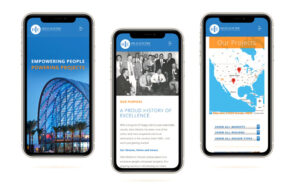
Three mobile phone screens displaying a construction company's responsive website, showcasing their mission, history of excellence, and a map of their nationwide project locations.
A mobile-optimized website is the foundation of the 2026 digital playbook, immediately showcasing brand history, mission, and geographical reach to potential clients.

Pillar 2: Mobile-First Design That Actually Works

Speed and mobile aren’t “nice features”—they’re deal-breakers.

Google punishes slow sites. In fact, in 2016, our CEO Les Kollegian was hired by Google to speak at their conferences about this exact issue. Here’s the stat that should terrify you: for every extra second your page takes to load, your bounce rate jumps 8X higher.

Think about that. One extra second. Eight times more people, gone.

If you don’t know how to optimize your site properly—and most don’t—you’re hemorrhaging traffic and conversions without even realizing it. And with over 70% of construction buyers starting their research on mobile, building for phones isn’t optional anymore. It’s fundamental.

Don’t get us wrong. Desktop design is EXTREMELY important. However, mobile-first in the A/E/C vertical is how all companies should be thinking. Once they’re evaluating a project or issuing a bid, your prospects are likely to switch to a larger screen to review PDFs, drawings, case studies, and detailed qualifications. A robust, desktop-friendly experience helps with credibility, downloads, and document access.

What matters:

Load time under 3 seconds. Period. Every second longer and you’re losing people.

Easy navigation for thumbs, not mouse cursors. Big buttons, smart spacing. Remember, your best trades might be on a job site wearing gloves. Your best prospect may be doing research while waiting for his/her cocktail at the bar. 

Images that look great on small screens. Don’t sacrifice visual impact, but optimize everything so it loads fast.

Simple forms. Mobile users won’t fill out 15 fields. Keep it to name, email, phone, and project type.

Here’s a stat that should scare you: mobile users are 5 times more likely to abandon a site that isn’t optimized. You can’t afford to lose half your audience because your site looks bad on a phone.

The Bottom Line: If your site doesn’t work flawlessly on mobile, you’ve disqualified yourself from the majority of potential clients before they even see your work.

Practical guidance:

  • Start with a mobile-first design mindset:
    • Fast load times (optimized images, compressed videos, lean code).
    • Clear navigation with prominent project gallery, capabilities, and contact.
    • Accessible CTAs (Get a quote, Request a proposal, Call now).
    • Readable typography, concise copy, and scannable sections.
    • Strong, trust-building elements: client logos, case studies highlights, safety records, licenses, certifications.


Pillar 3: Build Trust Before the First Call

Construction is a relationship business–and trust is everything. Your website needs to prove you’re legitimate, capable, and reliable and yes… trustworthy—before someone picks up the phone.

Essential trust-builders:

Show your credentials. Certifications, licenses, insurance, safety records. Display logos from your suppliers and partners. Make it obvious you’re the real deal.

Sounds basic, right?

We’ve worked with companies doing $50 million+ in revenue who don’t do this. Their response? “We have enough business.”

Our response? Do you, though? Because “enough” isn’t the same as “all the business you could have.” What are you leaving on the table by making prospects guess whether you’re legit? Trust signals aren’t just for startups trying to prove themselves. They’re for every company that wants to convert more of the traffic they’re already getting. 

Real testimonials with real details. “Saved us 15% on materials and finished two weeks early” beats “Great to work with!” every time. Use names, titles, photos if possible.

Introduce your team. People want to know who they’re hiring. Real photos of real people build connection.

Highlight your track record. OSHA ratings, safety certifications, project completion rates—these signal operational excellence.

Here’s why this matters: 47% of buyers look at 3-5 pieces of content before they’ll even talk to a salesperson. Make it easy for them to say yes by giving them the proof points they need.

The Bottom Line: Trust isn’t given, it’s earned. Your website should make it effortless for prospects to find the evidence they need to feel confident about working with you.

Pillar 4: Make It Stupid-Easy to Contact You

Every page should have a purpose. Every purpose should have a clear next step.

If someone’s interested, don’t make them hunt for how to reach you.

What converts:

Multiple ways to get in touch. “Request a Bid,” “Schedule a Consultation,” “Get an Estimate,” “Download Our Capabilities Deck.” Different people want different entry points.

Click-to-call on mobile. 61% of mobile users will call during the buying process. Make the phone number tappable everywhere.

Contact options that follow them. Sticky contact bars or chat widgets that stay visible as people scroll.

Forms right where they’re looking. Put inquiry forms directly on portfolio pages so prospects can reach out while viewing relevant work.

The math: you’re paying $165+ per lead from search ads. If your site doesn’t make it easy to convert, you’re wasting that investment.

Pro tip: Keep forms short. Name, email, phone, project type—that’s enough for a first conversation.

The Bottom Line: Every page needs a clear “do this next” moment. The easier you make it to contact you, the more qualified leads you’ll capture.

Pillar 5: Get Found by the Right People

A beautiful website is worthless if no one can find it.

The firms that dominate their markets don’t just build great sites—they make sure those sites show up when potential clients are searching.

The technical stuff (simplified):

Make sure your site is fast, clean, and organized in a way that search engines—and now AI—can understand. This includes things like clear page titles, good site structure, and behind-the-scenes code that helps Google, ChatGPT, Perplexity, and other AI tools figure out what you actually do.

Here’s why this matters more than ever: people aren’t just Googling anymore. They’re asking ChatGPT “who are the best commercial contractors in [city]?” or using AI search tools to compare firms. If your site isn’t structured properly, you won’t show up in those results—even if you’re the perfect fit. AI reads your site differently than humans do, and if it can’t parse your information clearly, you’re invisible in the fastest-growing search channel out there.

The content strategy:

Content marketing generates 54% more leads than traditional marketing. Adding a blog to your site increases your chances of ranking on Google by 434%.

Here’s what to create:

Service pages that match what people search for. Think “commercial general contractor in [your city]” or “design-build services in [your region].”

Project case studies with location details. Construction is local. Make sure every case study includes where the project was and what type of work it involved.

Educational content that answers questions. Blog posts like “How long does commercial construction permitting take?” or “What’s the difference between design-bid-build and design-build?” These attract people early in their research process.

The Bottom Line: SEO isn’t optional—it’s your primary lead source. Build it into your website from day one, target the searches your ideal clients are making, and create content that answers their questions. Do this right and your site becomes a lead-generating machine. And for those of you who don’t believe you are being found via search in any capacity. Aehhhhhhhh (buzzer sound). You have NO idea. At Jacob Tyler, we never thought in a million years that an executive at Sony would be upset with his current agency and “search” for another and find us. Being optimized for search got us that account and assistance developing the VAIO brand for Sony. So yeah, we believe. We will give you some more information on “search” in a little bit.

Design Trends That Actually Matter in 2026

Clean and Simple Wins

Less is more. White space, clean fonts, minimal navigation. Focus attention on what matters—your work.

Large Typography

Use of clean and modern typography in a large point type grabs attention and keeps it. Don’t overdo it though. Remember that people need to be attracted to read more and not yelled at. 

Video Makes a Difference

Time-lapse build videos, drone footage, client testimonials. Video tells stories in ways photos can’t.

Dark Mode Is Here

Dark backgrounds with sharp contrast can make architectural work pop. It’s modern, striking, and effective. With that said, be careful to not have too much body copy in reverse (white on top of black) as it can make paragraph content more difficult to read. 

Subtle Motion Adds Polish

Hover effects, scroll animations, interactive filters. Small details that make the experience feel premium without overwhelming users.

Sustainability Messaging Matters

Affiliations, green building practices, LEED certifications, energy-efficient outcomes—these resonate with commercial clients and conscious homeowners alike.

What a Professional Website Actually Costs

Let’s talk money. Here’s what you should expect to invest:

Small to Mid-Size Firms: $15,000 – $25,000

You get:

  • 15-25 pages
  • Custom design that’s mobile-responsive
  • 10-15 portfolio projects
  • Contact forms and lead capture
  • Basic search optimization
  • Timeline: 10-14 weeks

Best for: Local contractors, small commercial builders, residential remodelers

Mid-Size to Large Firms: $25,000 – $55,000+

You get:

  • 30-50+ pages
  • Advanced functionality and design
  • 25-50 portfolio projects with filtering
  • Integration with your CRM and project tools
  • Comprehensive SEO strategy
  • Blog and content marketing setup
  • Video integration
  • Timeline: 14-20 weeks

Best for: Regional general contractors, design-build firms, commercial construction companies

Enterprise-Level Firms: $55,000 – $100,000+

You get:

  • 50-100+ pages
  • Fully custom everything
  • Multi-location support
  • Project portals and employee logins
  • Interactive maps and advanced showcases
  • Marketing automation
  • Ongoing optimization and testing
  • Timeline: 20-24+ weeks

Best for: National contractors, large commercial builders, industrial construction firms

Ongoing Maintenance: $1,500 – $3,000/month

Includes:

  • Security updates
  • New project additions
  • SEO monitoring
  • Performance optimization
  • Analytics reviews

Think of this as the cost of keeping your best salesperson sharp and effective. Keep in mind that most Websites as mentioned above can be developed in WordPress, which is infinitely scalable so even though you may start with 15 to 20 pages, you can add as many as you like, and it is super easy to do so.

Mistakes That Kill Conversions

  1. Portfolio overload. Quality beats quantity. Show your best 15-25 projects, not every job you’ve done since 1985.
  2. Ignoring mobile. If it doesn’t work on a phone, you’ve lost the lead. Period.
  3. Hiding your call-to-action. Every page should answer: “What should I do next?” Make it obvious.
  4. Treating SEO as an afterthought. 57% of B2B marketers say SEO generates more leads than anything else. Build it in from the start.
  5. Slow load times. Users leave. Google penalizes. You lose.
  6. No way to track results. If you can’t measure it, you can’t improve it. Set up tracking for form submissions, calls, and key pages.
  7. Stale content. A portfolio that stops in 2019 signals a business that stopped growing. Update regularly.

How to Know If It’s Working

Track these numbers to measure your website’s impact:

  • Traffic growth (month-over-month and year-over-year)
  • Conversion rate (forms, calls, downloads as a % of visitors)
  • Bounce rate (target under 40% on key pages)
  • Time on site (longer = more engaged
  • Search rankings for your target terms
  • Leads generated (qualified inquiries)
  • Cost per lead (compared to other channels)
  • Projects won from web inquiries

The goal isn’t to hit industry averages—it’s to beat your own baseline. A 20% lift in traffic or a 0.5% bump in conversion rate translates directly to revenue.

Your 2026 Website Checklist

Use this when evaluating proposals or scoping your project:


Strategy & Planning

  • Audience personas defined
  • Competitor analysis completed
  • Keyword research done
  • Conversion goals established
  • Site structure approved


Design & Experience

  • Mobile-first, responsive design
  • Loads in under 3 seconds
  • Clean layouts with white space
  • High-quality, authentic photos (no stock)
  • Consistent branding throughout


Content & Messaging

  • Clear value proposition on homepage
  • Service pages optimized for search
  • 10-20 featured projects with case studies
  • Client testimonials (text or video)
  • Team bios and photos
  • Trust signals visible (certifications, licenses)


Functionality

  • Contact forms on key pages
  • Click-to-call phone numbers
  • Filterable project portfolio
  • Blog/resources section
  • Secure hosting and backups


SEO & Analytics

  • Google Analytics installed
  • Search Console configured
  • Page titles and descriptions optimized
  • Sitemap submitted
  • Redirects set up (if redesign)


Post-Launch

  • Tested across all devices
  • Monthly analytics reporting
  • Content update plan in place
  • Ongoing optimization strategy defined

Common Questions Answered

How much should I really spend on a website?

For most construction companies, expect to invest $15,000 to $75,000+ depending on complexity and scale.

Think of it this way: if a well-designed site generates even 3-5 additional qualified leads per month, it pays for itself within months. The question isn’t “what’s the cheapest option?” It’s “what delivers the best return?” 

How long does it take to build?

Quality takes time. Most projects run 10-16 weeks from kickoff to launch. Smaller sites might be done in 8-10 weeks. Enterprise sites with complex features can take 20-24 weeks.

Rushing usually means compromising quality. Launch something you’re proud of, not something you’re settling for.

Do I really need mobile optimization?

Absolutely. Over 70% of potential clients browse on mobile before making a decision. Google ranks your mobile site first. Mobile users are 5X more likely to bail on a site that doesn’t work properly.

If your site doesn’t work flawlessly on phones, you’re eliminating the majority of your market.

Can I just use a template?

Sure, if you want to blend in and hope for the best.

Template platforms like Wix or Squarespace are cheap upfront, but they come with hidden costs that kill your competitiveness. Here’s why they fall short for construction companies:

  1. Speed kills your conversions. These platforms are bloated with code you don’t need. They’re slower out of the box, and you can’t optimize them the way a custom site can. Remember: every extra second costs you 8X more bounces.
  2. You’re locked into their limitations. Need a custom project filtering system? Want to integrate with your CRM? Looking to build something unique that sets you apart? Good luck. Templates box you into what everyone else is doing.
  3. SEO is hobbled from the start. Sure, they claim to be “SEO-friendly,” but you can’t control the technical foundation the way you need to. Your ability to rank for competitive local terms is significantly hampered compared to a properly built custom site.
  4. You look like everyone else. Prospects can spot a Squarespace template from a mile away. When you’re competing for six- and seven-figure projects, looking like a DIY startup doesn’t inspire confidence.
  5. AI can’t read it properly. These platforms generate messy code that makes it harder for AI search tools (ChatGPT, Perplexity, etc.) to understand and recommend your business. You’re invisible in the fastest-growing search channel.
  6. Mobile experience is “good enough” at best. Remember that 70% of your prospects start on mobile? Template platforms give you a responsive site, but not an optimized one. There’s a massive difference.

The bottom line: when your average project is worth $50K to millions, a $200/year website isn’t a smart savings—it’s a costly compromise. Investing in a professional custom site delivers exponentially better ROI because it actually converts the traffic you’re working so hard to generate.

How often should I update it?

A website isn’t a “set it and forget it” asset. It’s a living business tool that needs regular attention to stay effective.

At minimum, add new projects quarterly. Fresh content tells both visitors and search engines you’re active and growing. But there’s more to it than that.

Why regular updates actually matter:

Search engines reward fresh content. Google prioritizes sites that consistently publish new material. A site that hasn’t been touched in six months gets buried, while competitors updating regularly climb the rankings. This isn’t theory—it’s how the algorithm works.

AI search needs current data. ChatGPT, Perplexity, and other AI tools pull from recently updated sources. If your site is static, you’re invisible in AI-powered search results—the fastest-growing way people find contractors.

Your prospects are watching. When someone lands on your site and sees your last project is from 2022, what do they think? Either you’re not busy (red flag) or you don’t care about your digital presence (also a red flag). Fresh content signals momentum and success.

SEO compounds over time. Every new blog post is another opportunity to rank for search terms. Every updated project page strengthens your local SEO. This isn’t busy work—it’s building equity that generates leads for years.

Ideal update cadence:

  • New blog posts monthly – drives SEO, answers buyer questions, positions you as an expert
  • Portfolio updates quarterly – keeps your best work front and center
  • Testimonials as you receive them – fresh social proof builds trust faster
  • Service pages refreshed annually – keeps messaging aligned with your current capabilities and market positioning
  • Technical SEO audit quarterly – ensures your site stays optimized as search algorithms evolve

Should you hire someone to manage this?

Unless you have a dedicated marketing person who understands SEO, content strategy, and technical optimization—yes, absolutely.

Here’s why: most construction company owners don’t have time to write optimized blog posts, resize images properly, update meta descriptions, monitor search rankings, or stay current on algorithm changes. And frankly, you shouldn’t. Your time is worth more managing projects and closing deals.

A monthly retainer with a specialized agency or freelancer ($1,500-$5,000/month depending on scope) typically includes:

  • Regular content creation and optimization
  • Portfolio and project page updates
  • SEO monitoring and adjustments
  • Technical performance optimization
  • Analytics reporting so you see what’s working

Think of it this way: if your site generates even 2-3 additional qualified leads per month because it’s consistently updated and optimized, that monthly investment has already paid for itself several times over.

The bottom line: A stale website signals a stale business. But more importantly, an outdated site actively costs you leads, rankings, and revenue. Regular updates aren’t optional maintenance—they’re how your website continues generating ROI long after launch.

What’s the difference between a brochure site and a lead generation site?

Brochure sites build trust and credibility through compelling storytelling, professional imagery, and showcases of your work. When designed thoughtfully, they serve as powerful digital portfolios that help potential clients understand who you are, what you do, and why they should work with you. For smaller businesses especially, a well-crafted brochure site with clear contact options and conversion points can be exactly what’s needed to turn visitors into leads.

Lead generation sites take this foundation further by prioritizing conversion at every turn—with multiple strategic calls-to-action, optimized user journeys, lead capture mechanisms throughout the experience, and content specifically designed to move visitors down the funnel.

Both approaches should ultimately drive leads and conversions. The difference is in emphasis: brochure sites lead with trust-building and storytelling, while lead generation sites lead with conversion optimization—but the best sites often blend elements of both.

We have plenty of business. Does SEO really matter?

Look, I get it. We hear this all the time: “We don’t need to worry about our website because we don’t get business from it anyway.”

But here’s the thing—comfort is the enemy of growth.

Think about it: why would you turn down the chance to be considered for projects you didn’t even know existed? Projects where the prospect finds you instead of you having to chase them down?

When we push back and ask “How do you actually know you’re not getting business from your site?”, there’s usually just crickets. Or worse, assumptions based on… well, nothing.

Here’s a story (in case you missed it earlier) that changed everything for us. Years ago, we won the brand development for Sony VAIO products for college students. Want to know how? A Sony senior executive (fed up with his current agency relationship) literally Googled agencies and found us. We didn’t even think that was possible. But it happened, and we became true believers.

Fast forward to 2025. We redesigned the website for Dempsey Construction. About three months after launch, Michaela Weibel, their Director of Marketing, called us—absolutely shocked. She’d been there over five years and had never received a single lead through their website. Not one.

With the new site and proper optimization? Leads started coming in.. and while just a few, it is certainly better than none. Now they’re actually in the game instead of watching from the sidelines. And get this—just one deal pays for the entire website investment and then some.

But it gets even better. At Jacob Tyler, we’re now landing clients through something most agencies aren’t even thinking about yet: generative search.

Sure, people still Google “Best Web Design Agencies in San Diego” or “Construction Web Designer”—and we show up for those. But recently, an executive asked Gemini (Google’s AI), “Who designed the Hensel Phelps website?” Because we optimized our site for generative search, they got the right answer: us. We won that client.

This is the new reality. In 2026, if you’re in construction and you’re not optimized for generative search—especially around your completed projects—you’re invisible to a massive chunk of potential clients.

Should I hire a construction specialist or a general agency?

Here’s our honest take, and we’d be lying if we told you otherwise: you don’t need an agency that only does construction.

We’ve been doing this for 25 years at Jacob Tyler. In that time, we’ve built high-performing websites for health and life sciences companies, medical product manufacturers, ecommerce brands, financial services firms, and yes—construction and industrial companies. The idea that an agency must be vertically niched to deliver results? That’s marketing spin, not reality.

What you actually need is this:

An agency that takes the time to deeply understand your buyers, your sales cycle, your competitive landscape, and what drives decisions in your market. Whether that’s construction, manufacturing, or healthcare doesn’t matter as much as their commitment to learning what makes your business tick.

That said, industry experience does accelerate results.

When an agency has worked with construction firms before, they come to the table knowing:

  • How to structure project portfolios that actually convert
  • Which trust signals matter most (certifications, safety records, bonding capacity)
  • How to optimize for the long, relationship-driven sales cycles typical in construction
  • What questions prospects ask before they’re ready to request a bid
  • The balance between showcasing capabilities and not overwhelming decision-makers

That expertise means faster onboarding, fewer missteps, and a site that performs from day one instead of needing months of trial and error.

But here’s what matters more than niche experience:

Does the agency have a track record of driving measurable results? Do they understand conversion optimization, SEO, user experience, and content strategy at a deep level? Can they point to specific outcomes—increased leads, higher rankings, improved conversion rates—across any B2B vertical?

Those fundamentals transcend industry. A team that’s driven results in financial services or life sciences can absolutely apply that same rigor and strategic thinking to construction. The principles of effective digital marketing don’t change just because the hard hats do.

The bottom line:

Choose an agency based on their strategic chops, their commitment to understanding your specific market, and their proven ability to deliver ROI—not just their client roster. Industry experience is a plus and can accelerate results, but it’s not a requirement. Deep expertise in digital strategy, combined with genuine curiosity about your business, will always outperform shallow “niche specialist” credentials.

At Jacob Tyler, we bring both: 25 years of cross-industry experience and a proven track record in construction and industrial markets. That combination means we know what works universally and what needs to be tailored specifically for how contractors buy.

How do I measure ROI?

First, let’s be clear about something: your website is a critical piece of your marketing engine, but it’s not the only piece.

We’d be doing you a disservice if we said “build a great website and watch the leads roll in.” That’s not how sustainable growth works. Your website needs to work in concert with your brand, your relationships, your presence at trade shows, your direct mail, your reputation in the community, and yes—even those conversations on the 19th hole.

That said, your website should absolutely be measured and held accountable for ROI.

Here’s what to track:

  • Qualified leads generated – how many serious inquiries came directly from the site
  • Conversion rate – percentage of visitors who take action (form fills, calls, downloads)
  • Revenue from web-sourced inquiries – actual project wins that started with your website
  • Cost per lead – compare what you’re spending on the website against other channels like trade shows, print ads, or pay-per-click

Most construction firms find that once their website is properly optimized, it delivers the lowest cost per qualified lead of any marketing channel. Even modest improvements—like a 1% conversion bump—can generate hundreds of thousands in additional project value annually.

But here’s the bigger picture:

Your website doesn’t exist in a vacuum. It’s the hub where all your other marketing efforts converge:

  • Someone meets you at a trade show → they Google you → your website seals the deal (or kills it)
  • A referral mentions your name → the prospect checks you out online → your site validates the recommendation
  • You run targeted ads → traffic lands on your site → conversion optimization determines if that spend pays off
  • Your brand shows up in their LinkedIn feed → they click through → your website tells the full story

Think of it this way: Your brand is your reputation. Your website is where that reputation gets verified and converted into action. Traditional marketing—networking, events, direct outreach—gets you in the conversation. Your digital presence determines whether that conversation becomes a contract.

So yes, measure your website’s performance religiously. But don’t forget that your entire marketing ecosystem—brand positioning, consistent messaging across channels, strategic relationship building, and traditional outreach—all work together to drive revenue.

The website is your best salesperson. But even the best salesperson needs leads to close. That’s where the rest of your marketing comes in.

Your Website Is Your Competitive Advantage

In 2026, your construction website isn’t a cost center. It’s a strategic asset that either generates revenue or bleeds opportunity.

The firms winning the best projects understand this: your website is a business development engine that works around the clock. While your competitors are still treating their online presence as an afterthought, the leaders in your market are converting browsers into bids—24/7, without a single sales call.

Here’s the math that matters: construction websites average around a 2% conversion rate. That means 98 out of 100 qualified prospects leave without contacting you.

Now imagine cutting that waste in half. Better mobile experience, faster load times, clearer calls-to-action, stronger portfolio presentation—these aren’t cosmetic upgrades. They’re the difference between doubling your lead volume and watching opportunities go to competitors who got the details right.

Combine that with smart SEO and a relentless commitment to showcasing your best work, and you’ve built something that compounds: a platform that gets stronger, ranks higher, and generates more qualified leads every month—without you spending another dollar on traffic.

For owners and marketing leaders evaluating partners, the criteria are simple: find an agency that understands how construction buyers make decisions, builds for conversion not just aesthetics, and measures results in leads and revenue, not likes and page views.

The investment in getting this right pays dividends for years. The cost of getting it wrong? You’re already paying it—you just don’t see the opportunities you’re missing.

Let’s Talk About What’s Possible

If you’ve made it this far, you already know your website could be working harder for you.

Maybe you’re frustrated watching leads go to competitors with slicker digital presence. Maybe you know your site doesn’t represent the quality of work you actually deliver. Or maybe you’re just tired of leaving money on the table because your online experience doesn’t match your reputation in the field.

We get it. We’ve spent 25 years helping companies in construction, industrial, and beyond turn their digital presence into a genuine competitive advantage—not just a prettier version of what everyone else has.

Here’s what we believe:

Your website should earn its keep. It should generate qualified leads, support your sales team, and prove ROI. If it’s not doing that, something’s broken—and it’s fixable.

You shouldn’t have to become a digital marketing expert to make this work. That’s what partners are for. Our job is to understand your business, your buyers, and your goals—then build something that delivers results you can measure.

If you’re ready to explore what’s possible, here’s how we typically start:

  1. Have a real conversation. No sales pitch. No generic proposal. Just an honest discussion about where you are, where you want to be, and whether we’re the right fit to help you get there.
  2. Build a plan that makes sense for your business. Not a one-size-fits-all template. A strategy tailored to your market, your goals, and your timeline.
  3. Execute with accountability. We measure what matters—leads, conversions, revenue—and adjust as we learn what works best for your specific audience.

The firms that are winning in your market aren’t doing anything magical. They’re just committed to making their digital presence as strong as their craftsmanship. And they’re working with partners who understand that construction isn’t sold the same way software or sneakers are.

The best time to fix this was last year.
The second best time? Right now.

If you’re curious about what’s possible for your business, let’s talk. No pressure, no pitch—just a conversation between people who care about building things that work.

Schedule a consultation or reach out and fill out our own lead form at www.jacobtyler.com. Hell… just call our CEO (Les Kollegian) directly at 619-379-0007.  We’re here when you’re ready.

The Web Design Evolution of Jacob Tyler: A Digital Timeline Spanning Two Decades

Well… we did it. We launched a new website. You know how the old business saying goes; “We’re our own worst client”. That’s true for many and very true for us. We seem to always put ourselves last in the “to-do list” pecking order. However, after months of work, back-and-forth, opinions, changes, and procrastination, we have created an experience that we feel works for us AND the people visiting. In other words, this is yet another Web design we are proud of. We (our team) have a saying that websites are like dog years—every year online is equivalent to seven years in technology evolution. It’s a playful metaphor that captures a serious truth about digital longevity in our rapidly changing industry. Yet despite this accelerated aging, both our own websites and those we create for clients have consistently defied the odds, averaging an impressive eight-year lifespan that speaks to thoughtful design and strategic planning.

Today, we’re taking a journey through our own digital evolution, examining how our website has transformed over the years and what these changes reveal about broader trends in web design, user behavior, and technological advancement.

Version 1: The Foundation Years (Early 2000s)

Our first website was a product of its time—clean, corporate, and information-focused. The design featured our signature red branding with a structured layout that prioritized content hierarchy and professional presentation. Navigation was straightforward, with clear sections for services, portfolio, and contact information.

This early iteration reflected the web standards of the early 2000s: fixed-width layouts, table-based structures, and a desktop-first mentality. Users were patient with longer load times and comfortable with scrolling through dense information.


Key characteristics of Version 1:

  • Static, information-rich design
  • Desktop-only optimization
  • Traditional corporate aesthetic
  • Content-heavy approach
  • Clear service differentiation

Version 2: The Interactive Revolution

Our second go-around was a total game-changer (at least to us). We ditched the static, corporate look and went big—think larger images, video content (super high-tech at the time), and interactive stuff that actually made people feel something when they landed on our site. Instead of just showing our work like a boring gallery, our case studies started telling real stories with visuals that packed a punch.

This was right when everyone was really getting overly obsessed with Facebook and Instagram (just getting started), and suddenly every brand needed to be a storyteller. So we flipped the script on how we presented our portfolio. Instead of just saying “Hey, look what we made,” we started showing “Here’s how our creative work actually moved the needle for our clients.” We stopped being an information dump and started creating experiences that people actually wanted to stick around for.

Notable improvements in Version 2:

  • Enhanced visual storytelling
  • Interactive portfolio elements and video
  • Stronger emotional connection
  • Social media integration
  • Results-focused case studies

Version 3: Mobile-First Thinking

The third generation of our website represented our adaptation to the mobile revolution. As smartphones and tablets became ubiquitous, we redesigned with responsive principles at the core. The layout became more flexible, typography scaled appropriately across devices, and navigation transformed to accommodate touch interfaces. At the time, everyone was asking us who designed from mobile phones. And of course, this is extremely important however, a lot of companies that we work with, including us actually have less views on mobile platforms even to this day. That’s because in the business to business environment, many people are doing their research on their laptops and desktop devices.

Also, suddenly, scrolling became natural—people were swiping and scrolling with their thumbs all day long. Mobile screens were small, so longer pages made more sense than trying to cram everything into tiny viewports. That became the norm for desktop as well.

This was also when we started playing around with all the shiny new web tech and jumped on trends like parallax scrolling and those tiny animations that make everything feel more alive. We even spent some time wondering if we should design for the Apple Watch—yeah, that was a thing for about five minutes. Looking back, it’s a good reminder that just because something’s new and buzzy doesn’t mean you need to go all-in, but it’s still worth checking out to see if it’s actually useful or just another flash in the pan.

The mobile-first approach fundamentally changed how we structured content:

  • Responsive design principles
  • Touch-friendly navigation
  • Optimized loading speeds
  • Progressive enhancement
  • Cross-platform compatibility

Version 4: The Current Era – Bold, Creative, and Results-Driven

Our latest website embodies everything we’ve learned about effective digital experiences. The tagline “Our Creative Kicks Ass and Makes Names” was the only copy that stayed from the previous website because it immediately establishes our confident, results-oriented approach while maintaining the professional credibility our global clients expect.

The current design features:

  • Bold Visual Hierarchy: Large typography and strategic use of white space guide users through our story
  • Integrated Case Studies: Portfolio pieces are woven throughout the experience.
  • Multi-Device Optimization: Seamless experiences across desktop, tablet, and mobile devices
  • Performance Focus: Fast loading times and smooth interactions enhance user engagement
  • Conversion-Oriented: Strategic placement of contact forms and calls-to-action drive business results

The Importance of Strategic Redesign

Each evolution of our website wasn’t driven by boredom or aesthetic trends—it responded to fundamental shifts in user behavior, technology capabilities, and business objectives. This strategic approach to redesign offers several key benefits:

Technological Relevance

Keeping pace with web standards, security protocols, and performance expectations ensures your site remains functional and trustworthy.

User Experience Evolution

As user expectations change, websites must adapt to meet new interaction patterns and consumption preferences.

Brand Maturation

Your digital presence should evolve alongside your business, reflecting growth, expanded capabilities, and refined positioning.

Competitive Advantage

Regular updates help maintain differentiation in increasingly crowded markets.

Search Engine Optimization

Fresh content, improved site structure, and modern technical implementation boost search visibility.

Lessons from Our Journey

Our two-decade website evolution offers several insights for businesses considering their own digital transformation:

1. Plan for Longevity: While we joke about dog years, our eight-year average lifespan proves that thoughtful design and solid technical foundation can extend website value significantly.

2. Embrace Change Gradually: Each iteration built upon previous successes rather than starting from scratch, ensuring continuity while enabling innovation.

3. User-Centric Design Wins: Our most successful redesigns prioritized user needs over internal preferences or fleeting design trends. This applies for our clients as well.

4. Technology Should Enable, Not Drive: We adopted new technologies when they enhanced user experience, not simply because they existed.

5. Content Strategy Matters: Effective websites balance engaging presentation with substantial, valuable content that serves user intent.

Looking Forward

As we continue evolving our online presence, we’re already anticipating the next wave of changes: voice interfaces, AI-powered personalization, generative search, and immersive technologies that will reshape how users interact with brands online.

But regardless of technological advancement, our core philosophy remains constant: create experiences that connect with users, drive business results, and stand the test of time. After all, in an industry where dog years apply, longevity is the ultimate measure of success.

The Jacob Tyler website journey demonstrates that strategic redesign isn’t about chasing trends—it’s about thoughtfully evolving to serve users better while achieving business objectives. Whether you’re considering your first major redesign or your fourth, remember that the best websites aren’t just built to impress today’s visitors, but to adapt and thrive for years to come.

Ready to discuss how your website design can evolve to meet changing user expectations and business goals? Let’s start that conversation.

How Social Media Impacts ROI:

Social media is the great leveler of our age, the apotheosis of the shift from the one-to-many to the many-to-many models of communication, the subway train that banker and bus-boy alike all ride. In certain ways, it’s also the most complex innovation in digital marketing, so it’s worth remembering that digital ad spend eclipsed traditional advertising budgets in 2019. By 2023, digital will comprise over two-thirds of total ad spend. Point being, social media seems here to stay, and companies should use it to maintain an ongoing conversation with the world—enhancing their brand awareness and extending their customers’ lifetime value.

Yet even though social media may be the preferred advertising art form of the future, it’s still often so unruly, so hard to track and control. Social content can send shock-waves through the internet, conjuring up a tsunami of likes and shares and reposts, but—was it worth the cost? Hard to say. Or, at least, hard to correlate those intangible results to sales figures on a 1:1 basis. So how do you quantify this most qualitative medium? You’re about to find out.

Calculate Your Investment

If you want to determine how your social media marketing impacts your return on investment, you need to keep a record of your investment. Tab up the cost of the platforms that you’re using. (Most are free, but you may be paying for a premium version of a management tool, etc.) Then take note of the money that you spent on paid digital ads and on labor. Correlating a content creator’s salary to the results that come back probably isn’t arithmetically sound, but it’s worth poring over hours billed per project or how much you’re shelling out to freelancers.

The meaning of the numbers that bubble up may depend on how your social media eventually performs. For the moment, though, tally it up and put it aside.

Match Metrics to Goals

As you track how much you’re spending, determine what you want to accomplish with that money. Do you want to improve your SEO, add new email signups, sell more puppy-training sessions through your ecommerce platform? Pinpoint your goals, then calibrate the results with metrics that are commensurate to the value of those goals. 

Let’s say that you want to improve your SEO. Measure whether your bounce rate goes up or down—but not whether your profits go up or down. Conversions and site traffic and lead generation all tie together, but they’re also distinct returns. So choose the yardstick that you want to plunge into the market, and benchmark your current stats so you can compare them with the outcomes. Knowing how you perform now will give you a sense of how realistic your goals are. Imagine that 100 people have signed up to your email list. Adding another 100 this month is—to put it mildly—ambitious. Adding another 10? Doable, and a good goal.

Bear in mind, though, that there is a bewildering array of objectives that you could achieve and KPIs that you could measure. So, we beg of you, don’t try to measure them all. Track a few metrics—and track the right metrics. A savvy social media marketing agency might tell you that views, likes, retweets, and followers are considered “vanity metrics.” Sure, it feels nice when someone gives your post a thumbs up, but it doesn’t necessarily translate into a business result (like a sale or a new customer). Whereas other insights are more illuminating:

  • Bounce rates tell you if you’re maintaining your audience’s attention. 
  • Engagement rates tell you how many people are commenting on your posts. 
  • Converting click attributions tell you which ad a customer clicked on before making a purchase. (More on this stat later.)

Sharpen Your Tools

Since tracking and measuring are integral skills in social media marketing, it should come as no surprise that instruments galore exist to crunch the numbers on how social impacts ROI. Here are just a few of them:

  • Hootsuite built a calculator where you can plug in data like Facebook visits or landing page conversions and match them against your overall investment. 
  • If you want to get precise about those visits and conversions, let Google Analytics give you a panoramic view of all the numbers flowing through your funnels.
  • Building links with UTM parameters helps you understand which sites your visitors came from, which channels routed them in, which part of a promotion they clicked on, and so on. 

The takeaways that these tools provide, in sum, indicate which of your marketing efforts you should work on because they’re underperforming—as well as which ones are over performing, and need some extra rocket fuel poured on them.

Don’t Wait to Iterate

A good digital marketing agency is always measuring the results of a campaign, but they should also measure different versions of that campaign to gauge which one impacts ROI most effectively. So keep A/B testing. Target different audiences. Experiment with a range of tones. Tinker with the copy and the CTAs. Sub out a carousel for a pulldown ad. See what works, but also adopt the mindset that no one thing “works.” The market’s always in flux, so be ready to pivot on strategies as you monitor which aspects of a campaign your audience responds to the best.

Companies that don’t like how their audience is responding—or that panic because their audience isn’t responding at all—sometimes hose out more content as a quick-fix solution. Beware this tactic, because inundating the market can feel spammy. In a word: Slow it down. People prefer digital experiences that feel well-executed and personalized to them rather than torpedoed willy-nilly in their general direction.

Redefine the Return

You know how much money you’ve piped into your social media plan, and now the results are coming back. But what do the numbers mean? A reasonable business leader might assume that one dollar spent on social media should return at least one dollar in revenue. As we’ve indicated, though, your upfront return might not even be money at all.

Strictly speaking, companies don’t need social media. Factories and restaurants and brokerage offices would pump along just fine without a Facebook account. But having social media imparts legitimacy onto your brand. Think about it: If you’re applying to an engineering firm, but they don’t have a LinkedIn page, wouldn’t they seem behind the times to you? (Like, probably-not-much-career-growth-here behind the times?)

Without a social media presence, you also lose opportunities to stake out what distinguishes you from the competition. Look at this Ben & Jerry’s tweet about how Brown v. Board of Education led to the school-to-prison pipeline. The comments that their post garnered range from “This is why you’re my favorite brand of ice cream” to “Bro, you’re ice cream.” Yet Ben & Jerry’s is at least positioning itself front and center in the public forum. Is this positioning performative or genuine? Up for debate. But it seems that the value of engaging with multiple audiences about a complex topic on social media may be cultural cachet and brand visibility rather than a single line-item amount.

Give it Time

Print advertising was all about big, bold declarations—billboards or magazines plastered with headlines that wowed viewers. Digital advertising is less about seizing an audience’s attention and more about serving them bite-sized reminders across the channels they frequent. One of the difficulties with social media is that it’s snackable, and perfectly suited to serve up those reminders, but it moves so quickly that it can put campaigns into hyperdrive, truncating the lifespan of a marketing investment and making its results too intertwined to unthread.

Remember “last click attributions”? That metric can help you see how a post might lead to 100 people clicking into your site and spending $5,000 on your product. All that’s useful to know, but some marketers argue that the insights it provides are somewhat blindered—it doesn’t take into account the other touchpoints that had previously introduced the customer to a brand. After you Googled, “I want the best vacuum cleaner,” Dyson and Shark ads may have popped up on your social platforms. You did your research. You were leaning toward Dyson. Then you saw one last Dyson ad on Facebook and clicked the link and made the purchase.

That single Dyson ad may not have been the superstar in this scenario. Maybe it was just the last reminder in a series of waves and winks—many of which happen through multiple interactions with Dyson’s social media that are hard to alchemize into dollars. So even though social media is fast-paced, give it enough time to mature and glue together all the collateral that contribute to your brand awareness. The return you get on that may be immeasurable.

How to Dominate the Search Engines (SEO and Paid Media):

Fun fact: This month marks the 15th anniversary that the Oxford English Dictionary first listed “Google” as a verb. Google and other search engines have since become so important to the business world that digital marketers encounter this question from our clients all the time: “Can you get us to the top of the first search results page?”

That’s a steep request, but also a pertinent one: Search engines are the starting-point for 93% of web experiences, yet only about 25% of users venture onto the second results page. We all know that search engines are in the business of selling your data to corporations, but we allow them to commoditize us because they route us to the answers that we’re looking for. (If they didn’t, we’d jump over to their competitors.) So to dominate the search engines, keep in mind these marketing strategies that the engines reward—and the ones they penalize.

Master the Elements

If you want search engines to crawl your site, you need to become proficient in the basics of search engine optimization. Here are just a few tactics to consider:

Plan Out the User Journey

Before you delve into alt tags and meta descriptions and the rest of it, audit your digital identity to gauge how users are interacting with you. Is your bounce rate going up or down? Are you achieving the holy trinity of clicks, likes, and shares? What’s the final conversion that you’re driving your audience toward? Figuring out how your channels connect will help you plan SEO strategies that ladder up to a larger objective, rather than just improving your metrics for the sake of metrics.

Weave in keywords into your digital content, but limit yourself to about one keyword per 100–150 words—and write a few long-tail keywords that contain the entire phrase that someone might be searching for (4–6-word lines like “how to write a cover letter” along with smaller snippets like “resume” and “job application”). Remember, only weave in long-tail phrases if they feel natural. Search bots will lower your SEO score if your long-tail keywords sound like pianos dropped into the middle of sentences that were otherwise flowing along smoothly.

Incorporate Links

Search engines understand that the internet is a hyperlinked database of information and that we’re all clicking through 37 tabs at once to find the answer to our most pressing question right this second. So if you work in links that are specific, sincere, substantial, and succinct, and that connect to relevant content, search engines will consider your site to be “authoritative.” (If that term seems oddly inflated, that’s because it’s a euphemism for sites that aren’t spammy and that don’t annoy the search engines’ product—us.) Avoid linking to content that’s over a year old, and include internal links to improve the visibility of the lesser-known pages of your site.

Don’t Forget Mobile

In 2011, about 35% of Americans owned a cell phone. A decade later, that number has zoomed up to 97%. Worldwide, you’re looking at 5 billion cell phone users, and to top it off, about half of your audience is finding you through their phones. Point being, optimize for mobile. Search engines will filter you into oblivion if you don’t. Besides, a website today that’s riddled with wonky text and misspaced links when it loads on your phone just feels so … 2011.

Never Cry Wolf

Ever heard of “information scent”? That’s a UX concept that holds that internet users are clicking the links and CTAs that give off a palpable whiff of the intel that they’re looking for. But the opposite could occur, too—sites and content can emit a nasty information scent.

Let’s say you’re writing a blog about starting your own business. If your headline is “Learn How to Grow Your Bottom Line 1,000%,” people will click your link, but if you don’t supply a miracle-gro solution to boosting their revenue, you’re going to disappoint them. In the short term, you’ll drive traffic to your site. In the long term, users may call you out for the charlatan that you are, which could result in search engines downgrading you because of misleading content and sneaky redirects.

Act Local

Search engines are a quandary. On one hand, they make the global village even more united and universal. (Every day, people from Nebraska to Nairobi are all Googling, “How do I fix the printer?”) At the same time, they exert the equal and opposite force of localizing the world. People may or may not be thinking globally these days, but they do seem to be buying locally: Searches with the phrase “near me” in them have risen 150% in the last two years, and 28% of online local searches result in a purchase.

Whether you’re a Mom and Pop shop or an international conglomerate, you’re located near someone, so optimize your web presence for local SEO to make it easy for people to find you, digitally and physically. Update your Google local business listing with the pertinent details about your operation (hours, address, phone numbers), and post customer feedback—especially if it’s positive. Search engines will boost your site’s visibility if people rave about you, since you’ve demonstrated your value to their users.

Make Your Content King

To get noticed online, you need to produce something noticeable, like videos or a blog, and push it out on a regular basis, which demonstrates that what you’re saying is timely and current. If people like watching or reading your work enough to linger on your site, search engines will reward you for having a low bounce rate, since that metric tells them that your site is (you guessed it) valuable to their users.

We’ve talked about linking out from your site, but the real goal is to have authoritative sites link to you. Imagine writing a blog about how to harness fusion and National Geographic gives you a shout-out on social media. Search engines will propel your site up their rankings. But you don’t have to solve one of science’s biggest challenges to craft an organic media plan. If you’re an ecommerce entrepreneur, write an article about your market niche on Forbes that links to your site. Upload your videos to YouTube and your music to Spotify. Even guest blogging on less-established domains can drum up the SEO credit that search engines recognize and respect.

Pay to Play

Blogs, videos, backlink hierarchies, designing for mobile—these are all SEO strategies, sometimes termed “owned media” because they appear on channels that companies or users control. (Or that Big Tech lets you think you control.) The other approach you could take is paid media, where you outright pay search engines to rank you higher. One benefit of paid media is that it’s precise: Spend enough, and you can plop your content in front of your target audience, your competition’s target audience, people who are midway down your funnel, and so on.

The main caveat with paid media is that it can feel, well, like you paid for it. Is it really a surprise when Nike serves you an ad about how great Nike is? But when consumers praise Nike on Google Reviews—doesn’t that feel more credible, like humans are recommending a product to each other? Praise like that is called “earned media,” and brands sometimes pay to put that media in front of audiences that their paid media was intended for. Don’t be afraid to pay for ads, just be sure to interweave them with owned and earned media, and keep in mind the old adage about how money can’t buy you likes.

Be Useful to Users

The seven major search engines today are Google, Bing, Baidu, Yahoo!, Yandex, Ask.com, and DuckDuckGo. But let’s not kid ourselves—“Google” has entered the lexicon in a way that “Bing” has not for a reason: Google commands over 70% of the search engine market and 85% of mobile traffic. Google now handles (give or take) two trillion searches each year. Web optimization trends die every season because Google’s webmaster guidelines change all the time, so you’re better served studying their algorithm rather than trying to trick it. Better yet—study what your audience wants. Explain something that users might not know (how to tie a tie, how to interpret case law, how to dominate the search engines) and Google and its brethren are more likely to route them your way rather than to your clickbaity competitors.

Why a Good Logo is So Important

First off, let’s define terms: Your logo is not your brand. As we’ve written before, your brand is the reflection of your products and services, your workplace culture and the totality of your values. Your logo, meanwhile, is the imprimatur of your brand. Think of it as your professional coat of arms—the seal that guarantees the quality that you provide to your customers, the emblem perched at the apex of your brand architecture. Need a few more reasons why a logo is so important? Let’s get granular with it.

A Logo Gets You Noticed

Never forget how busy your consumers are. We’re all sending emails on our tablets, jumping on work calls on our laptops, hopping around between twenty apps on our phones. All that shuttling between tabs and devices tends to obliterate our attention spans into fruitflyish units of a few seconds that your digital marketing has to capture an audience’s interest.

Enter your logo, which amounts to a 1,000-words snapshot of your brand. If an ad pops up on your consumers’ screens and they get the vibe that even the logo isn’t for them—it’s too posh, not posh enough, perfectly posh but more (or less) than they wanted to spend—they’re going to keep on clicking on. Rest assured, this is judge-a-book-by-its-cover territory, and the cover of your book needs to scream, “Buy me. Because this experience, my target audience, is tailored to you.”

A Logo Imparts Legitimacy

Since your logo is the summation of your visual identity, a sloppy logo is akin to a restaurant buffet swarming with flies—that first-impressions moment when a customer thinks, ‘Definitely not spending my money here.’ And even a good product without a logo might seem scammy. Microsoft is an established brand, but if someone tries to sell you a Microsoft laptop that doesn’t have the Microsoft logo on it, would you trust it?

If your answer to that is ‘definitely not,’ then you’ve pinpointed the importance of a logo, which rubber-stamps legitimacy onto a brand—and onto all the collateral that your brand produces. Dedicate some time to perfecting your logo design, because it’s gonna live front and center on your website, tucked in the corner of your business cards and peppered throughout your social media feeds. As the North Star of your brand’s aesthetic, your logo ensures the consistency that consumers need in order to be confident that the same company is talking to them across a medley of platforms and campaigns.

A Logo Communicates Your Brand Personality

A good logo should be eye-catching, but it also needs to hint at what your brand does or convey who you are. For that reason, banks or life insurance companies opt for typography that looks sturdy and reliable. Whereas a business that delivers beauty and wellness products might draw from a palette of yellows and greens and pinks—and throw in a few monstera leaves while they’re at it—to send out vibes of optimism, health, joy. 

Position your logo so that it acts as a harbinger of the experience that consumers are about to receive, be it financial advice or a box of hand lotions and jade rollers. At the same time, bear in mind that some of the most famous logos toe the line between functionality and artistry—getting across what a business does in more subtle messaging. In the Gillete logo, the “G” and the “i” look sliced open, as if by a razor. The yellow arrow in the Amazon logo connects the letters “a” and “z,” implying that Amazon sells and ships everything from A–Z. The ultramodern Apple symbol nods to the Biblical story of the fruits of knowledge (with the bite—or byte—in it representing the tasting of that knowledge).

Because a strong logo should err on the side of coherency and precision, making even one of its design features too abstract can befuddle people. Take the Apple logo again. The bite-of-knowledge motif is clever, but Steve Jobs & Co. were allegedly worried that, without that bite, customers would think the fruit was a cherry tomato. Point taken. If you’re on a mission to build the most urbane tech company in the world, the last thing you want is to overhear someone saying, “Does this thing look like a tomato to you?”

A Logo Welcomes You into the Club

One of the truisms you often hear in marketing is that your customers need to see themselves in your branding. Which means that your logo should tell your audience, on some level, “You’re in the club.” 

Imagine that you own a gym and your logo is a bodybuilder lifting a ponderous barbell above his head. That logo is going to do wonders to attract lunkish fitness fanatics rather than the just-making-a-change crowd, because an effective logo has its own personality and it talks to the personality of its clientele. The Mercedes-Benz logo is refined, silver, sleek. The Nike logo is on a swift upward-and-onward trajectory. The Coca-Cola logo is energetic and bouncy. The iconography of each of these brands tells you what the brands stand for, but it also fulfills a blank-canvas effect of absorbing meaning that customers pour back into them.

One of the most original recent examples of this in-the-club blank canvas may be Disney. The Disney logo is Walt Disney’s signature written against the backdrop of a fairytale castle, but it’s sometimes abbreviated to the silhouette of Mickey Mouse’s head, which is three black circles resembling a Venn diagram that’s drifting apart. Think about that: Three black circles can stir up memories of watching movies and reading books about adventure and friendship. Those memories, in turn, are powerful enough to sway people to subscribe to Disney+, get married at the Happiest Place on Earth, and become annual passholders who fill closets upon closets with Disney merch—which are stamped all over with three black circles.

That’s the power of a logo.

A Logo Champions Your Individuality

Your logo design should be the crowning symbol of your values and beliefs, the shield or flag that your company rallies behind, the signpost that guides consumers along their journey into your fold. All true—but stay flexible enough to change it. Case in point: Check out Apple’s ye olde logo from 1976, a landscape portrait of Isaac Newton reading under an apple tree (with a William Wordsworth quote decorating the frame, to top it off). Pivoting to the minimalist apple with the bite taken out of it was the right move, because Apple is all about sophistication and simplicity. So be honest about who you are and what you want your logo to say about you. Otherwise, you may end up contriving an image rather than consolidating an identity.

How to Optimize Your Web Copy to Drive Conversions

“Print is dead.” “Don’t quit your day job.” “Yeah, because the money’s in writing.” As a writer, you hear it all your life: You’re doomed. High school counselors, your uncle’s friend in the red sweater-vest at the Christmas party a few years back, even your doctor — everybody around you feels the need to let you know that anyone who writes for a living will end up penniless, curled up in a gutter.

The thing is, they’re not wrong (even if they are exaggerating). Writing is not so much a field as a precarious skill that you enter the job market with at your own peril. At the same time, people need to communicate, and that’s when you hire a writer. Blogs, websites, landing pages, retargeting ads, and other tactics in your digital marketing strategy — we copywriters probably handled the language for all that. But if we didn’t, and you’re wondering how to optimize web copy to drive conversions, here are some tips the writers at Jacob Tyler have written for you.

Stay on Point

The term “writer” got batted around a lot in the paragraphs above, so let’s define terms: Slinging digital marketing copy is often way different than crafting an essay or plotting a novel. Print tends to afford writers more space than digital layouts, which are usually functional or parceled out between web pages. Remember, readers on your site might be clicking between 15 tabs at the same time, and they’re likely to only scan 20% of your page’s content, anyway. 

So keep your sentences pithy. Guide your audience to the most relevant info with headers and bold type and bullet points, since people may only be on your site to get an answer (“Should I hire this company for my kitchen remodel? When does this place even open?”). And be consistent. You don’t want to strike a lofty third-person tone on the landing page only to switch to the earnest first-person in the “About Us” section. Maintain the same voice throughout your web copy so users don’t feel like they’ve somehow jumped between those 15 tabs unbeknownst to them.

But What’s the Point?

Let’s return to one of the phrases above: “People may only be on your site to get an answer.” That idea is more pertinent than it may appear. Novels, essays, scripts all give authors the breadth to move characters through countries and centuries, picking up on themes later on that they foreshadowed at the outset — and letting the reader (or viewer) sink into an argument or a narrative. Not so with digital copywriting, which needs to be punchy because it drives toward a CTA. Copywriters, with each page you compose, ask yourself: “What is this accomplishing?”

Are you nudging users to book a resort, enroll in theology school, become a member of a credit union? Craft your content so that it’s smart and fresh, yes, but don’t leave your reader floundering in a sea of pretty descriptions. Effective UX copywriting compels prospective clients to journey further down the funnel, so you should A) have a CTA, and B) make your CTA compelling — and then run A/B testing to make sure it really is driving people to book a resort or enroll in theology school or become a member of a credit union. (Which it is, if you’re wondering. Those are our accounts, and our director of business development would love to tell you all about them.)

Mean What You Say

Even though web copy may be the newest medium in the history of writing, the old verities of how to compose a good sentence still apply to the art of digital marketing: Go heavy on verbs and nouns, light on adjectives and adverbs. Know your grammar, and if you break it, be able to defend it. Read what you’ve written out loud and let your ear guide the phrasing. Be specific — but don’t get prosy with detail. And assume the reader is smarter than you are.

Since web copy does generally hinge on a CTA, copywriters can sometimes trick themselves into taking the attitude that they’re tricking consumers down the funnel. But people know when they’re being talked down to; they sense it if you don’t believe in what you’re saying or selling. So find a way to enter into the copy emotionally. If your client is a nature preserve, conjure up memories of fog raveling fir trees. If your client is a bank, think back to that feeling of security that a customer service rep at your mortgage company gave you when you called about maybe, hopefully waiving late fees. Adopt whatever mindset you need to write with passion, because if you don’t care about the subject at hand, why should your audience? 

Know Your Audience

On that note: Never forget who your target audience is. Imagine you’re a business that makes high-end baby products. Your target audience might be Andy, a thirty-ish accountant who’s about to have his first child. Inhabit Andy’s perspective. This guy is overjoyed, scared, nervous, and impatient all at once for this baby to arrive. He can’t wait — so he’s buying as many baby products as he can to feel like he’s prepared, but baby strollers confuse him (Do they fold up? Can you fit them in a car? Do you really need the accessories they come with?), and he’s willing to pay more for the right one because he doesn’t want to let his wife down.

Talk to Andy. Soothe his worries. Strip out your buzzwords and address him as “you,” as if writer and reader are just having a beer and talking about how baby strollers work. Try out a headline like “Baby Strollers Made Simple.” Then get into some body copy that addresses Andy’s concerns dead-on: “We know what you’re thinking — which baby stroller should I pick? We’ve got some answers.” 

Hear that sigh of relief? That’s the sweet sound of a conversion.

Mix It Up

The best web copy is minimal web copy. We’ve said it before: Be succinct. But also be willing to yield space to developers and designers who optimize conversions with their own skill-sets. A page of copy stamped onto whitespace will look HTML-y to users — like they landed on a blog from the dial-up days, or like you put zero seduction into guiding them through your digital marketing strategy. Nest the copy in a color palette that makes your sentences pop. Break it into modules alongside photos that illustrate what you’re describing. Nail that brand headline for a CBB client, but be cool with a programmer animating it so that it emerges out of a cloud of smoke. Think past the copywriting to visualize how your words — thrilling as they are — complement the talents of the other artists working alongside you. And remember to proofread your site with the rigor of a technician. No matter how svelte that CBD brand line is, it’ll look dazed and confused if even one word is misspelled.

Web copy, a memoir, a brochure for a museum — you can make any piece of copy excellent if you trust in it as an art form that moves people. What does that have to do with conversions? Well, it’s not by accident that Google penalizes websites that stuff the text with keywords. Think about that: Even search engines recognize that writing that talks to an audience like humans is more valuable than jargon that assumes consumers are psychographic profiles. Use keywords and meta descriptions, absolutely, but remember this above all else: Write with soul and sincerity, and people will listen to you.

How to Increase Your Customer Lifetime Value (CLV)

You know how the best time to get a job is when you have a job? Well, the best time to get new business is when you already have business. You can grow your bottom line in two ways: Acquiring new clients, or retaining the clients you already have and increasing their customer lifetime value (or CLV), which is the amount of revenue that you’ll earn off a consumer in the period that they’re using your service or product. Calculating this metric can get complex, but a simple scenario might run like this:

Imagine that you’re a paper-shredding service that cleans out veritable garbage cans full of old documents for a law firm that pays you $100 a month. You’ve been working with said law firm for a year now. Ergo, this customer’s lifetime value is $1,200. If you continue working with them, their CLV only goes up. Some studies have even found that a 5% uptick in retention can increase profits up to 95%, which is one reason that boosting your CLV is a more effective strategy in turning on the spigot of revenue than always being on the hunt for new business. So here are a few tips on how to extend your portfolio’s CLV.

Perfect the Process of Client and Customer Onboarding

Your employees need to be onboarded to understand the parameters of their roles, where to access the server, how everyone takes the fish-in-the-microwave policy seriously no matter where you go. The same process of providing clarification applies to your clients, as well. Even in the top-of-the-funnel stages, take the opportunity to wow your prospective customers with tutorials, leave-behinds, how-to videos, and walkthrough guides that communicate what you do and why your product is worth their money.

Personalizing all of that collateral to the needs of your user personas can help your sales team ace this vital first-impressions moment and ward off the scourge of customer churn. Plus, open communication helps people on both sides of the contract. Research indicates that 8 out of 10 consumers will pay more for a better customer experience, while businesses that know their customers’ motivations and interests can craft digital marketing messages tailored to them, develop precise upselling and cross-selling tactics, and — what often follows — deliver higher ecommerce conversions and a stronger ROI. Which makes sense: Customers who feel courted from the outset are more likely to seek your services for the long-term.

Stay in Touch with Your Customers

All that presale work you’ve done to charm your clients may not result in a sale unless you stay in touch with them. Keep in mind, though, the follow-up is a fine art: You want to pique people’s interest, but you don’t want to bug them. A careful email marketing strategy may be your solution, since it’s one of the most effective ways to maintain your customers’ attention — so long as those emails are worth the read. 

So communicate the benefits of your product or service in a way that doesn’t feel like a one-size-fits-all promotion. Let people know you’re here to help. Send them a birthday hello. You’ve already segmented off your user personas, now be prepared for those personas to change. And when they do, the tone of your messaging should change right along with them — that is, if you want to maintain a relationship with them for the long term.

Switch to an Annual Billing Cycle

One of the foundational questions that any business must ask itself is how to price their services. An equally weighty question is how to bill those services. Those questions overlap, but they’re not exactly the same. Let’s go back to those attorneys who paid you $1,200 for a year of paper-shredding. Whether they fork over the whole amount upfront or $100 on the first of every month hardly matters, right? Wrong. A lump sum of cash allows businesses to forecast revenue, reinvest in operations, and do away with those awkward check-ins meant to chivvy customers across the renewal deadline.

With that said, few of us enjoy handing over a bullfrog of bills to anyone. So incentivize the switch to a yearly payment with a discount — 10–20% off, or a few months of free usage — and talk up the perks of a subscription model (instant access to new product features, multi-tiered offerings tailored to what the customer wants). Annual billing may seem like a lot to ask for, but if you establish a fee structure with a longer lifespan that benefits both merchant and client, you’re almost automatically extending your portfolio’s CLV.

Embrace Upselling and Cross-Selling Tactics

Upselling is the strategy of bumping up the price of a service or a product — a barista asking if you’d like an extra pump of caramel in your latte for $0.30 more, for instance. Cross-selling is offering services or products that complement something that a customer has already bought. Let’s say that you order a hanging planter off Amazon for your newborn’s nursery. Once you’ve filled up your virtual shopping cart, Amazon will cross-sell you with other items related to your purchase. (Wait a minute now, don’t you want a self-watering midcentury bamboo stand to go along with that hanging planter?)

Bundling products, or offering temporary upgrades and free shipping, also help boost revenue. And those tactics can be as beneficial for the company as they are for the customer, since sometimes you need someone to say “Do you need a bike lock?” when you buy a new bike. Just keep your recommendations to a tasteful minimum. Asking customers if they need a new bike lock is one thing. Pressuring them to buy tires and a helmet and a cycling bodysuit may overwhelm them — and cause them to abandon the transaction altogether.

Up Your Prices

Ever hear the old saw about the accountant who audits a business’ books and tells the owner, “I suggest you double your prices”? The owner says, “I can’t do that — I’d lose half my clients.” To which the accountant says: “Then I insist you double your prices.” 

We’re not (necessarily) suggesting that you double your prices, but you do need to give yourself a raise as your company matures. Businesses, like professionals, tend to undersell themselves when they start out. As your operations scale up, however — offering new product options, adding more sophisticated clients, shoring up your clients’ bottom lines — you should reexamine how much you’re charging.

Now, a few things: You gotta earn your raise. (Don’t make your services more expensive if those services aren’t adding value for your consumers.) And let’s say you’ve got an old customer who took a chance on you when you had nada in your portfolio. Maybe don’t stun them with a gargantuan fee hike. Instead, build your pricing models to be flexible: Give them a downgraded service plan at their current price with the option of upgrading for a higher fee. Karma doesn’t always factor into business, but when tinkering around with your prices, you should also keep in mind the old saw about burning bridges.

Listen and Learn

The key to nurturing lasting customer relationships may be to view yourself as a partner to your clients rather than a salesperson who’s got to close a deal, because the least glamorous aspect of a digital marketing strategy may be its most vital part: Listening to your audience. 

Send out surveys to gauge their responses on how to improve your business. Compile the good feedback with the bad, and sift through it for recurring issues. Granted, this means that you’ll be paddling against streams of criticism for the rest of your career. But what you’ll learn from that criticism will help you solve your customers’ problems, which will likely improve their satisfaction, and which, in turn, tends to do wonders for your profitability in the long-term.

Why Branding Matters

What’s In a Brand?

Companies are the sum of their products and services, but they’re also made up of the tesserae of insights and perspectives of the employees who work for them and the audience who buys from them. Those tesserae, taken together, form the mosaic that is your brand — the reflection of your workplace culture and the totality of your values, a beacon of familiarity for consumers who know you and a handshake extending to consumers who don’t. To put it mildly: Branding matters. Here are just a few reasons why.

Branding Tells Your Story

The word “unique” gets overused a lot in these everyone’s-a-winner days, but each person on the planet really is unique from the other 7.8 billion humans we live among. The same goes for your company. Imagine that you’re a coffee roastery. Even if your dark roast has the same lovely arrangement of smoky-chocolate-marshmallow notes as your competitors’ dark roasts, ask yourself: What is it about your coffee company that’s different from Peet’s or Starbucks or Juan Valdez? 

Maybe you had a revelation that you wanted to open your own roastery the moment you took a sip of vintage Colombian coffee in a cobbled plaza in the La Calera hills east of Bogotá. Maybe part of your revenue siphons off into a fund that helps prevent the acidification of coral reefs. Whatever is unique — and true — about your brand will feel likeable to someone who shares your values. That “someone” is your customer base, and one of your first orders of business is to communicate your you-ness to them with a brand design and a number of quick-hitting descriptors that they can absorb in seconds and then somehow work up a hankering for a cup of dark roast.

Branding Establishes Trust

‘Wait a minute,’ you might be thinking. ‘Isn’t branding just a ploy for companies to buddy-buddy up to their consumers, when all those companies really want is to make a buck off us?’ Here’s our answer to that: It can be. But we’d recommend that companies drill into their values and establish trust with their audience rather than regard them as floating dollars to be netted. If a business talks about itself in a way that feels inauthentic, people are going to sniff out its phoniness. So figure out who you are and what you stand for, and hire a brand agency to mold tactics and campaigns that position your brand in a way that people will relate to it.

Let’s say you’re that roastery again. First things first: You’ll get people to trust you if you brew a high-quality cup of coffee every time. But you have to deliver on other articles of faith, as well. If you support Fair Trade to raise the standard of living for coffee farmers in equatorial latitudes, don’t limit your own employees to 29 hours and pay them starvation wages. Live up to your principles in every aspect of your operations and your audience will trust you. Which means you’ve got a shot at establishing brand loyalty with them, so that they’re buying into you as much as they’re buying from you.

Branding Keeps Things Bold

A funny thing often happens on the way to the formation of a brand identity: Companies know they need to say something that’ll help them stand out, so in the final hours before launch, they decide it’s best to say something that’ll help them blend in. Why? Because real is risky.

Don’t get us wrong, there are plenty of cautionary tales out there about how taking risks in the ad world can flop. (Burger King’s “Women belong in the kitchen” tweet, which was phrased ironically to attract attention to their support for a scholarship that helps aspiring female chefs — but which people didn’t find all that appetizing — is only a recent example of cringeworthy chutzpah.) By “risky,” though, we mean embarking on a campaign that’s perhaps even edgier than coming up with a head-swiveling statement: Being yourself.

If you did have a cup of coffee in Bogotá that was so rich and deep that it transported you into visions of opening up your own cafe, tell that story. The last thing you want to do when talking about yourself is to adopt the tone of a corporate comms manual, because no one wants to read that stuff, anyway. Be sensitive to others, yes, but be you. Authenticity and honesty will probably always seem bold, and so long as you mix those two fine traits in with empathy, your branding will feel more genuine and enduring than anyone else’s blanding.

Branding Brings Value

Price is perspective. If you’ve ever given your work away for free, you may have noticed — with horror — that your clients tend to undervalue the thing they’re not paying for. We often trick ourselves into assuming that something’s worth more if it’s more expensive, and the same psychological acrobatics are at play with branding

The world’s most influential brands are pricetagged in the billions, and even a logo can cost hundreds of millions of dollars anymore. All of that valuation imparts legitimacy, legitimacy imparts familiarity, and familiarity is the quintessence of a successful brand, since consumers generally feel more at ease parking their money with people or products they know and trust.

Think about it: If a guy on the street handed you a latte, you might pour it out on the curb. (You don’t know this dude, and the fact that he’s giving away this thing gratis seems suspect.) Whereas if you pass by a Starbucks, the store’s aura of legitimacy assures you that paying five or six dollars for a latte is worth it, because that latte’s been approved through a certain global vetting process. The quality of the latte is important, for sure, but the guy on the street’s latte may be even tastier. What’s the difference? The legitimacy of the branding, which often commands a higher price-point on the market than the quality of the product alone.

Branding Focuses the Company Culture

Books need outlines, buildings need blueprints, and businesses need brands, because they don’t just drum up familiarity in customers — they also help center the employees who uphold those brands. If done right, your brand story and positioning statement should be the end-product of a lot of time spent thinking about your workplace’s vision and why it matters. What does any of this have to do with your employees? Well, if your brand standards faithfully represent your culture, you’re more likely to attract talented folks who thrive in that culture. 

Branding that unites people with a purpose boosts morale, which may lead to employee advocacy, the power of which cannot be overstated. Companies that build excellent reputations often enjoy the perks of positive word-of-mouth. (When someone endorses you — which amounts to a free promotion — someone else is more likely to buy from you.) Glowing reviews, from customers and workers alike, can drive business referrals and increase your revenue. And it all starts with committing to a brand that everyone can rally behind.

Branding Provides Clarity

For people running a business, it’s tempting to sprint forward every day — taking meetings, putting out fires, patching cracks in the bottom line. But whenever you can, slow down and reassess your company’s identity. Branding may seem ephemeral, a feel-goody exercise that’ll end up on some poster about values in the lobby. Yet this process of introspection can help you foresee trends, map your growth patterns, pinpoint solutions to recurring problems, and better communicate your expertise to your clients. Stenciling forth the uniqueness of your brand may serve to guide you forward amid the gales of business cycles and market forces for years to come.

Multi-Channel Advertising and the Consumer Funnel

Enter the Funnel

The world population currently stands at 7.8 billion people — and nearly 630,000 publicly traded companies are vying for their attention every day. So how can your business create messages that cut through the din and turn potential leads into loyal customers? You lure them into the consumer funnel.

Ask a group of advertisers, and they’ll each sketch a different version of the funnel, since it isn’t a sanctioned diagram so much as a representation of the sales cycle that can change according to the marketing strategy applied to any given account. But the classic B2C funnel resembles an inverted pyramid that proceeds top-to-bottom in this order: “Awareness, Interest, Desire, Action.” To really understand the funnel, let’s take a test-run of it ourselves, tumbling from its broadest echelon down to its narrowest point, and touching on the best tactics associated with each stage as we go.

Awareness

When people embark on what’s known as the “customer journey,” they’re often just searching for information about a business or a product. For that reason, the topmost level of the funnel is usually referred to as the “awareness stage.” Consider this the cast-the-net-wide step, in which marketers will advise you to dedicate time to consumer research so you know who your audience is, where to find them, how to appeal to them, and which top-of-the-funnel tactics — such as blogs, webinars, infographics, SEO content, or social media posts, to name a few — you want to push out for the sake of lead generation (that is, stoking interest in people, or gauging how interested they are in continuing on this customer journey with you).

Let’s say your target audience is people who want to sink some money into their house. When they’re at the top of the funnel, they’re probably just Googling, “How much does a home reno cost?” rather than scoping out pictures of herringbone backsplash tile on Pinterest. The ad that a savvy digital marketer should serve them at this juncture needs to communicate that, hi, we’re a construction company, and we can give you an honest quote whenever you need it. ‘How convenient,’ your future clients think, as they click further down the funnel … 

Interest

So now you’ve waved your arms around enough that people are taking notice of you. Leads have been generated. Attention has been captured. Next you’ll need to teach the consumers who you lured in your direction about your company or the services you offer. The “interest” phase is where all the leads that you’ve attracted suss out into only the most “qualified leads,” which you should view as prospective customers. That net you cast in the last step has turned into a lasso, and you’re switching from social posts and webinars to blogs and email campaigns tailored to your qualified leads’ interests.

Desire

Even further down the slide we go into the “desire” phase. Before now, you and your qualified leads have been orbiting each other. But the time for coyness has passed and the terms are clear: You want them, they’re considering buying from you, but they’re still reading reviews and comparing products. Nudge them onward with case studies and customer testimonials, and if you’re an online retailer, build in functionality that lets them drop what they want in a virtual shopping cart — anything that’ll push the customer out of their will-I-won’t-I hesitations and into making a purchase.

Action

If all goes well, we will arrive at the terminus of this customer journey once someone makes a purchase, be it a crib from West Elm or the agreement to hire you to do a home renovation. The immediate goal is a sale, true, but the larger objective of a digital marketing strategy is to fatten up that inverted pyramid so that it better resembles a cylinder or an hourglass: Again, the top echelon is the widest, and it tapers to the “action” (sometimes called the “conversion”) phase. Ideally, however, it enlarges once more after that, swelling into a base of retained customers who buy from you again and again, and who advocate for your brand with glowing reviews left on your site. The tactics at this stage? Try referral programs or re-engagement email campaigns to personalize the relationship and encourage repeat purchases.

The (Omni)Channels

The funnel can be flipped upside-down, turned into a figure-eight, swapped around depending on whether it depicts a B2B or B2C play, and so on. Yet despite all the rungs you can layer into it, the premise remains pretty intuitive: Snag your audience’s attention, whet their curiosity, and convert them into a loyal purveyor of your shop. What distinguishes an old-school marketing strategy from a digital marketing strategy, however, is that today the funnel is piped through with a web of channels — so many that the current lingo for our field is “omnichannel” or “multi-channel” advertising.

Those channels might be TV, radio, computers, cell phones, or some combination of all of the above. People are paying attention to different channels at different times throughout the day, so catching their attention becomes more complex if they’re on multiple devices at once. Which means digital marketers need to place their ads on an array of channels to grab consumers’ attention in a way that still encourages the use of multiple devices.

Here’s an example: Imagine that you’re a “Real Housewives of New York City” fanatic. (Or, at least, someone you live with has it on literally all the time.) TV producers realize that when you’re watching that show, you’re probably also scrolling on your phone or your tablet, so they float out overlays of hashtags (#rhony, anyone?) during an episode to get you to post about it. Then, at the end of a season, when Andy Cohen hosts a “reunion” among the housewives, he reads out a lot of those posts. Sure, he’s stoking tempers and digging into old wounds (and making bingeable TV in the process). But he’s also reinforcing the feedback loop between social and TV channels — asking reality stars how they react to criticism from their audience about their outrageous behavior, even though their audience tuned in just to see that outrageous behavior in the first place. 

And that is merely one dimension of Bravo’s media plan: Encourage viewers to comment on the show, poke more antics out of the housewives with those comments, and keep driving the meta-cycle that blurs the line between audience and actor.

Building Customer Value

All the channels connect. Run a hashtag campaign on Bravo, and someone might post about it on Twitter. Advertise on YouTube, and someone might search for your product on Google. Once you transpose the channels — which are like on-ramps weaving through the funnel — the picture of an inverted pyramid piped with a cluster of extensions can appear dizzyingly 3D. Tempting as it is to assume that this framework will always entice your customers, this is not necessarily a if-you-build-it-they-will-come situation. Customers click around faster than any marketing team can concoct a media plan, which means your analytics need to track them and your strategy needs to adapt to their interests, not the other way around. 

So link up all your channels, but before you hose your audience with content, pinpoint the essential service that you’re giving them: An online selection of tropical plants? A newsletter of haiku and short stories? A minute-by-minute update of stocks that they should invest in? Never forget, their loyalty depends on the value you provide them, which means you need to identify your user personas and hone in on the overlap between what you’re selling and what they’re looking for. Whenever possible, make the consumer journey enjoyable rather than results-obsessed, and you may find that customers are more likely to re-enter the funnel at their next opportunity.