
Your Website Should Be Your Best Salesperson
Let’s be honest: your website is working harder than anyone on your team. It never sleeps, never takes vacation, and it most likely meets every prospect before you do.
The question is—but, is it actually closing deals?
For construction and trades, your website isn’t just a nice-to-have. It’s your most powerful business development tool. Yes, we know it’s about building relationships, being a great “culture” company, and more… but in 2026, the firms winning the best projects are the ones who’ve figured out that their online presence is what makes the difference in closing big deals.
This playbook gives you everything you need: the strategic framework, real numbers, and practical steps to build a website that converts visitors into qualified leads. Whether you’re planning a redesign or starting fresh, think of this guide as your roadmap to turning your website into a revenue machine.
This is real advice–not an AI bot. Jacob Tyler is a brand and creative agency with over 25 years of experience building global brands and watching them succeed. This is not Ai. This is real talk from real experts working with brands from 1 million to over 4 billion in the A/E/C space.
Look, we know our audience here ranges wildly. You might be a one-truck operation just getting started, or a multi-billion dollar firm with offices in 15 states.
It’s impossible to write one playbook that speaks perfectly to everyone. A 25-year-old launching their first contracting business isn’t thinking like a 60-year-old industry veteran with decades of wins under their belt.
But here’s what we’ve learned after working with over 30 construction companies across every size and stage: the fundamentals don’t change. Whether you’re trying to land your first $100K job or your next $10M project, the principles in this guide will help you do it.
Why Your Website Matters More Than Ever
Here’s the reality: there are nearly 4 million construction companies in the U.S. Construction is still a relationship business. Deals happen over lunch, on the golf course, through referrals from guys you’ve known for 20 years.
But here’s what’s happening while you’re shaking hands: 63% of prospects are already sizing you up online. Your website is their first impression—and for most of them (not the guys you have known for 20 years… although they are reviewing your Website. Trust me.), it’s the deciding factor before they even call you back.
You don’t know what you don’t know. But your customers? They’re looking. And they’re looking online.
Today’s site (whether small or large) needs to do two things exceptionally well: build credibility and generate leads.
The Numbers Don’t Lie
You’ve got 3 seconds on average to grab someone’s attention on your homepage. That’s it. And let’s be honest, 3 seconds can seem like a lifetime when you’re waiting for a page to load. The only worse position to be in would be a boxing ring. You need to make it super fast to prove you’re worth talking to (and winning the fight).
Here’s the reality: 70% of prospects start on mobile. They’re browsing your work from the job site, in the truck, between meetings.
But they’re not making decisions there. That happens later, on desktop—when they’re digging into portfolios, comparing firms, and getting ready to reach out.
So if your mobile site is clunky, you’re eliminated before the real evaluation even starts. And if your desktop experience doesn’t deliver? All that mobile interest dies at the finish line.
You need both. Period.
The cost of getting this wrong? Well if you’re paying for ads, the average cost per lead from search ads in construction is $165.67. If your website can’t convert that traffic, you’re literally burning money. If you’re not paying for ads, you just burned money on a Website that people leave.
Bottom line: in a crowded market, your website is where differentiation starts. Get it right, and you’re ahead of the competition before the first conversation.
The 5 Pillars of a High-Performing Construction Website

Pillar 1: Show Off Your Work
Your portfolio is your proof. But dumping 200 random projects on a page doesn’t build confidence—it overwhelms people.
Here’s what actually works:
Professional photography that shows the details. Clients want to see your craftsmanship, the scale of your projects, and the finished results. Skip the generic stock photos of hard hats and blueprints. Show your actual team, your trucks, your job sites.
Make it easy for visitors to find what they’re looking for. Organize your portfolio by project type (commercial, residential, industrial) and service (new construction, renovation, design-build). Let people filter to find projects like theirs.
Tell the full story. Go beyond pretty pictures. For your best 15-25 projects, include the scope, timeline, challenges you solved, and what the client said about it. Make it personal.
Before-and-after shots are absolutely worth the effort. They prove the dramatic change you created in a way nothing else can.
Look, we get it. Remembering to snap that “before” shot when you’re managing a dozen things on day one? Nearly impossible. We’ve been guilty of forgetting to do that with our own client brand projects.
It’s not the end of the world if you miss a few. But when you do capture that contrast—the messy teardown next to the stunning finish—it changes how prospects see your work. That visual proof can be the difference between “looks nice” and “we need to hire them.”
What kills trust:
- Generic stock imagery – It’s okay to have a few images but let’s try to keep it to a minimum
- Walls of text that bury the visuals
- Projects from 40 years ago (save those for your company history page)
The Bottom Line: Your portfolio should tell stories, not just display photos. When someone can see themselves in your work—and see the results you delivered for clients like them—that’s when trust begins.
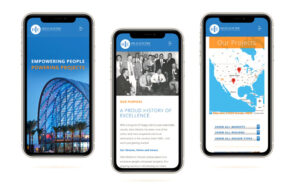
Pillar 2: Mobile-First Design That Actually Works
Speed and mobile aren’t “nice features”—they’re deal-breakers.
Google punishes slow sites. In fact, in 2016, our CEO Les Kollegian was hired by Google to speak at their conferences about this exact issue. Here’s the stat that should terrify you: for every extra second your page takes to load, your bounce rate jumps 8X higher.
Think about that. One extra second. Eight times more people, gone.
If you don’t know how to optimize your site properly—and most don’t—you’re hemorrhaging traffic and conversions without even realizing it. And with over 70% of construction buyers starting their research on mobile, building for phones isn’t optional anymore. It’s fundamental.
Don’t get us wrong. Desktop design is EXTREMELY important. However, mobile-first in the A/E/C vertical is how all companies should be thinking. Once they’re evaluating a project or issuing a bid, your prospects are likely to switch to a larger screen to review PDFs, drawings, case studies, and detailed qualifications. A robust, desktop-friendly experience helps with credibility, downloads, and document access.
What matters:
Load time under 3 seconds. Period. Every second longer and you’re losing people.
Easy navigation for thumbs, not mouse cursors. Big buttons, smart spacing. Remember, your best trades might be on a job site wearing gloves. Your best prospect may be doing research while waiting for his/her cocktail at the bar.
Images that look great on small screens. Don’t sacrifice visual impact, but optimize everything so it loads fast.
Simple forms. Mobile users won’t fill out 15 fields. Keep it to name, email, phone, and project type.
Here’s a stat that should scare you: mobile users are 5 times more likely to abandon a site that isn’t optimized. You can’t afford to lose half your audience because your site looks bad on a phone.
The Bottom Line: If your site doesn’t work flawlessly on mobile, you’ve disqualified yourself from the majority of potential clients before they even see your work.
Practical guidance:
- Start with a mobile-first design mindset:
- Fast load times (optimized images, compressed videos, lean code).
- Clear navigation with prominent project gallery, capabilities, and contact.
- Accessible CTAs (Get a quote, Request a proposal, Call now).
- Readable typography, concise copy, and scannable sections.
- Strong, trust-building elements: client logos, case studies highlights, safety records, licenses, certifications.
Pillar 3: Build Trust Before the First Call
Construction is a relationship business–and trust is everything. Your website needs to prove you’re legitimate, capable, and reliable and yes… trustworthy—before someone picks up the phone.
Essential trust-builders:
Show your credentials. Certifications, licenses, insurance, safety records. Display logos from your suppliers and partners. Make it obvious you’re the real deal.
Sounds basic, right?
We’ve worked with companies doing $50 million+ in revenue who don’t do this. Their response? “We have enough business.”
Our response? Do you, though? Because “enough” isn’t the same as “all the business you could have.” What are you leaving on the table by making prospects guess whether you’re legit? Trust signals aren’t just for startups trying to prove themselves. They’re for every company that wants to convert more of the traffic they’re already getting.
Real testimonials with real details. “Saved us 15% on materials and finished two weeks early” beats “Great to work with!” every time. Use names, titles, photos if possible.
Introduce your team. People want to know who they’re hiring. Real photos of real people build connection.
Highlight your track record. OSHA ratings, safety certifications, project completion rates—these signal operational excellence.
Here’s why this matters: 47% of buyers look at 3-5 pieces of content before they’ll even talk to a salesperson. Make it easy for them to say yes by giving them the proof points they need.
The Bottom Line: Trust isn’t given, it’s earned. Your website should make it effortless for prospects to find the evidence they need to feel confident about working with you.
Pillar 4: Make It Stupid-Easy to Contact You
Every page should have a purpose. Every purpose should have a clear next step.
If someone’s interested, don’t make them hunt for how to reach you.
What converts:
Multiple ways to get in touch. “Request a Bid,” “Schedule a Consultation,” “Get an Estimate,” “Download Our Capabilities Deck.” Different people want different entry points.
Click-to-call on mobile. 61% of mobile users will call during the buying process. Make the phone number tappable everywhere.
Contact options that follow them. Sticky contact bars or chat widgets that stay visible as people scroll.
Forms right where they’re looking. Put inquiry forms directly on portfolio pages so prospects can reach out while viewing relevant work.
The math: you’re paying $165+ per lead from search ads. If your site doesn’t make it easy to convert, you’re wasting that investment.
Pro tip: Keep forms short. Name, email, phone, project type—that’s enough for a first conversation.
The Bottom Line: Every page needs a clear “do this next” moment. The easier you make it to contact you, the more qualified leads you’ll capture.
Pillar 5: Get Found by the Right People
A beautiful website is worthless if no one can find it.
The firms that dominate their markets don’t just build great sites—they make sure those sites show up when potential clients are searching.
The technical stuff (simplified):
Make sure your site is fast, clean, and organized in a way that search engines—and now AI—can understand. This includes things like clear page titles, good site structure, and behind-the-scenes code that helps Google, ChatGPT, Perplexity, and other AI tools figure out what you actually do.
Here’s why this matters more than ever: people aren’t just Googling anymore. They’re asking ChatGPT “who are the best commercial contractors in [city]?” or using AI search tools to compare firms. If your site isn’t structured properly, you won’t show up in those results—even if you’re the perfect fit. AI reads your site differently than humans do, and if it can’t parse your information clearly, you’re invisible in the fastest-growing search channel out there.
The content strategy:
Content marketing generates 54% more leads than traditional marketing. Adding a blog to your site increases your chances of ranking on Google by 434%.
Here’s what to create:
Service pages that match what people search for. Think “commercial general contractor in [your city]” or “design-build services in [your region].”
Project case studies with location details. Construction is local. Make sure every case study includes where the project was and what type of work it involved.
Educational content that answers questions. Blog posts like “How long does commercial construction permitting take?” or “What’s the difference between design-bid-build and design-build?” These attract people early in their research process.
The Bottom Line: SEO isn’t optional—it’s your primary lead source. Build it into your website from day one, target the searches your ideal clients are making, and create content that answers their questions. Do this right and your site becomes a lead-generating machine. And for those of you who don’t believe you are being found via search in any capacity. Aehhhhhhhh (buzzer sound). You have NO idea. At Jacob Tyler, we never thought in a million years that an executive at Sony would be upset with his current agency and “search” for another and find us. Being optimized for search got us that account and assistance developing the VAIO brand for Sony. So yeah, we believe. We will give you some more information on “search” in a little bit.
Design Trends That Actually Matter in 2026
Clean and Simple Wins
Less is more. White space, clean fonts, minimal navigation. Focus attention on what matters—your work.
Large Typography
Use of clean and modern typography in a large point type grabs attention and keeps it. Don’t overdo it though. Remember that people need to be attracted to read more and not yelled at.
Video Makes a Difference
Time-lapse build videos, drone footage, client testimonials. Video tells stories in ways photos can’t.
Dark Mode Is Here
Dark backgrounds with sharp contrast can make architectural work pop. It’s modern, striking, and effective. With that said, be careful to not have too much body copy in reverse (white on top of black) as it can make paragraph content more difficult to read.
Subtle Motion Adds Polish
Hover effects, scroll animations, interactive filters. Small details that make the experience feel premium without overwhelming users.
Sustainability Messaging Matters
Affiliations, green building practices, LEED certifications, energy-efficient outcomes—these resonate with commercial clients and conscious homeowners alike.
What a Professional Website Actually Costs
Let’s talk money. Here’s what you should expect to invest:
Small to Mid-Size Firms: $15,000 – $25,000
You get:
- 15-25 pages
- Custom design that’s mobile-responsive
- 10-15 portfolio projects
- Contact forms and lead capture
- Basic search optimization
- Timeline: 10-14 weeks
Best for: Local contractors, small commercial builders, residential remodelers
Mid-Size to Large Firms: $25,000 – $55,000+
You get:
- 30-50+ pages
- Advanced functionality and design
- 25-50 portfolio projects with filtering
- Integration with your CRM and project tools
- Comprehensive SEO strategy
- Blog and content marketing setup
- Video integration
- Timeline: 14-20 weeks
Best for: Regional general contractors, design-build firms, commercial construction companies
Enterprise-Level Firms: $55,000 – $100,000+
You get:
- 50-100+ pages
- Fully custom everything
- Multi-location support
- Project portals and employee logins
- Interactive maps and advanced showcases
- Marketing automation
- Ongoing optimization and testing
- Timeline: 20-24+ weeks
Best for: National contractors, large commercial builders, industrial construction firms
Ongoing Maintenance: $1,500 – $3,000/month
Includes:
- Security updates
- New project additions
- SEO monitoring
- Performance optimization
- Analytics reviews
Think of this as the cost of keeping your best salesperson sharp and effective. Keep in mind that most Websites as mentioned above can be developed in WordPress, which is infinitely scalable so even though you may start with 15 to 20 pages, you can add as many as you like, and it is super easy to do so.
Mistakes That Kill Conversions
- Portfolio overload. Quality beats quantity. Show your best 15-25 projects, not every job you’ve done since 1985.
- Ignoring mobile. If it doesn’t work on a phone, you’ve lost the lead. Period.
- Hiding your call-to-action. Every page should answer: “What should I do next?” Make it obvious.
- Treating SEO as an afterthought. 57% of B2B marketers say SEO generates more leads than anything else. Build it in from the start.
- Slow load times. Users leave. Google penalizes. You lose.
- No way to track results. If you can’t measure it, you can’t improve it. Set up tracking for form submissions, calls, and key pages.
- Stale content. A portfolio that stops in 2019 signals a business that stopped growing. Update regularly.
How to Know If It’s Working
Track these numbers to measure your website’s impact:
- Traffic growth (month-over-month and year-over-year)
- Conversion rate (forms, calls, downloads as a % of visitors)
- Bounce rate (target under 40% on key pages)
- Time on site (longer = more engaged
- Search rankings for your target terms
- Leads generated (qualified inquiries)
- Cost per lead (compared to other channels)
- Projects won from web inquiries
The goal isn’t to hit industry averages—it’s to beat your own baseline. A 20% lift in traffic or a 0.5% bump in conversion rate translates directly to revenue.
Your 2026 Website Checklist
Use this when evaluating proposals or scoping your project:
Strategy & Planning
- Audience personas defined
- Competitor analysis completed
- Keyword research done
- Conversion goals established
- Site structure approved
Design & Experience
- Mobile-first, responsive design
- Loads in under 3 seconds
- Clean layouts with white space
- High-quality, authentic photos (no stock)
- Consistent branding throughout
Content & Messaging
- Clear value proposition on homepage
- Service pages optimized for search
- 10-20 featured projects with case studies
- Client testimonials (text or video)
- Team bios and photos
- Trust signals visible (certifications, licenses)
Functionality
- Contact forms on key pages
- Click-to-call phone numbers
- Filterable project portfolio
- Blog/resources section
- Secure hosting and backups
SEO & Analytics
- Google Analytics installed
- Search Console configured
- Page titles and descriptions optimized
- Sitemap submitted
- Redirects set up (if redesign)
Post-Launch
- Tested across all devices
- Monthly analytics reporting
- Content update plan in place
- Ongoing optimization strategy defined
Common Questions Answered
How much should I really spend on a website?
For most construction companies, expect to invest $15,000 to $75,000+ depending on complexity and scale.
Think of it this way: if a well-designed site generates even 3-5 additional qualified leads per month, it pays for itself within months. The question isn’t “what’s the cheapest option?” It’s “what delivers the best return?”
How long does it take to build?
Quality takes time. Most projects run 10-16 weeks from kickoff to launch. Smaller sites might be done in 8-10 weeks. Enterprise sites with complex features can take 20-24 weeks.
Rushing usually means compromising quality. Launch something you’re proud of, not something you’re settling for.
Do I really need mobile optimization?
Absolutely. Over 70% of potential clients browse on mobile before making a decision. Google ranks your mobile site first. Mobile users are 5X more likely to bail on a site that doesn’t work properly.
If your site doesn’t work flawlessly on phones, you’re eliminating the majority of your market.
Can I just use a template?
Sure, if you want to blend in and hope for the best.
Template platforms like Wix or Squarespace are cheap upfront, but they come with hidden costs that kill your competitiveness. Here’s why they fall short for construction companies:
- Speed kills your conversions. These platforms are bloated with code you don’t need. They’re slower out of the box, and you can’t optimize them the way a custom site can. Remember: every extra second costs you 8X more bounces.
- You’re locked into their limitations. Need a custom project filtering system? Want to integrate with your CRM? Looking to build something unique that sets you apart? Good luck. Templates box you into what everyone else is doing.
- SEO is hobbled from the start. Sure, they claim to be “SEO-friendly,” but you can’t control the technical foundation the way you need to. Your ability to rank for competitive local terms is significantly hampered compared to a properly built custom site.
- You look like everyone else. Prospects can spot a Squarespace template from a mile away. When you’re competing for six- and seven-figure projects, looking like a DIY startup doesn’t inspire confidence.
- AI can’t read it properly. These platforms generate messy code that makes it harder for AI search tools (ChatGPT, Perplexity, etc.) to understand and recommend your business. You’re invisible in the fastest-growing search channel.
- Mobile experience is “good enough” at best. Remember that 70% of your prospects start on mobile? Template platforms give you a responsive site, but not an optimized one. There’s a massive difference.
The bottom line: when your average project is worth $50K to millions, a $200/year website isn’t a smart savings—it’s a costly compromise. Investing in a professional custom site delivers exponentially better ROI because it actually converts the traffic you’re working so hard to generate.
How often should I update it?
A website isn’t a “set it and forget it” asset. It’s a living business tool that needs regular attention to stay effective.
At minimum, add new projects quarterly. Fresh content tells both visitors and search engines you’re active and growing. But there’s more to it than that.
Why regular updates actually matter:
Search engines reward fresh content. Google prioritizes sites that consistently publish new material. A site that hasn’t been touched in six months gets buried, while competitors updating regularly climb the rankings. This isn’t theory—it’s how the algorithm works.
AI search needs current data. ChatGPT, Perplexity, and other AI tools pull from recently updated sources. If your site is static, you’re invisible in AI-powered search results—the fastest-growing way people find contractors.
Your prospects are watching. When someone lands on your site and sees your last project is from 2022, what do they think? Either you’re not busy (red flag) or you don’t care about your digital presence (also a red flag). Fresh content signals momentum and success.
SEO compounds over time. Every new blog post is another opportunity to rank for search terms. Every updated project page strengthens your local SEO. This isn’t busy work—it’s building equity that generates leads for years.
Ideal update cadence:
- New blog posts monthly – drives SEO, answers buyer questions, positions you as an expert
- Portfolio updates quarterly – keeps your best work front and center
- Testimonials as you receive them – fresh social proof builds trust faster
- Service pages refreshed annually – keeps messaging aligned with your current capabilities and market positioning
- Technical SEO audit quarterly – ensures your site stays optimized as search algorithms evolve
Should you hire someone to manage this?
Unless you have a dedicated marketing person who understands SEO, content strategy, and technical optimization—yes, absolutely.
Here’s why: most construction company owners don’t have time to write optimized blog posts, resize images properly, update meta descriptions, monitor search rankings, or stay current on algorithm changes. And frankly, you shouldn’t. Your time is worth more managing projects and closing deals.
A monthly retainer with a specialized agency or freelancer ($1,500-$5,000/month depending on scope) typically includes:
- Regular content creation and optimization
- Portfolio and project page updates
- SEO monitoring and adjustments
- Technical performance optimization
- Analytics reporting so you see what’s working
Think of it this way: if your site generates even 2-3 additional qualified leads per month because it’s consistently updated and optimized, that monthly investment has already paid for itself several times over.
The bottom line: A stale website signals a stale business. But more importantly, an outdated site actively costs you leads, rankings, and revenue. Regular updates aren’t optional maintenance—they’re how your website continues generating ROI long after launch.
What’s the difference between a brochure site and a lead generation site?
Brochure sites build trust and credibility through compelling storytelling, professional imagery, and showcases of your work. When designed thoughtfully, they serve as powerful digital portfolios that help potential clients understand who you are, what you do, and why they should work with you. For smaller businesses especially, a well-crafted brochure site with clear contact options and conversion points can be exactly what’s needed to turn visitors into leads.
Lead generation sites take this foundation further by prioritizing conversion at every turn—with multiple strategic calls-to-action, optimized user journeys, lead capture mechanisms throughout the experience, and content specifically designed to move visitors down the funnel.
Both approaches should ultimately drive leads and conversions. The difference is in emphasis: brochure sites lead with trust-building and storytelling, while lead generation sites lead with conversion optimization—but the best sites often blend elements of both.
We have plenty of business. Does SEO really matter?
Look, I get it. We hear this all the time: “We don’t need to worry about our website because we don’t get business from it anyway.”
But here’s the thing—comfort is the enemy of growth.
Think about it: why would you turn down the chance to be considered for projects you didn’t even know existed? Projects where the prospect finds you instead of you having to chase them down?
When we push back and ask “How do you actually know you’re not getting business from your site?”, there’s usually just crickets. Or worse, assumptions based on… well, nothing.
Here’s a story (in case you missed it earlier) that changed everything for us. Years ago, we won the brand development for Sony VAIO products for college students. Want to know how? A Sony senior executive (fed up with his current agency relationship) literally Googled agencies and found us. We didn’t even think that was possible. But it happened, and we became true believers.
Fast forward to 2025. We redesigned the website for Dempsey Construction. About three months after launch, Michaela Weibel, their Director of Marketing, called us—absolutely shocked. She’d been there over five years and had never received a single lead through their website. Not one.
With the new site and proper optimization? Leads started coming in.. and while just a few, it is certainly better than none. Now they’re actually in the game instead of watching from the sidelines. And get this—just one deal pays for the entire website investment and then some.
But it gets even better. At Jacob Tyler, we’re now landing clients through something most agencies aren’t even thinking about yet: generative search.
Sure, people still Google “Best Web Design Agencies in San Diego” or “Construction Web Designer”—and we show up for those. But recently, an executive asked Gemini (Google’s AI), “Who designed the Hensel Phelps website?” Because we optimized our site for generative search, they got the right answer: us. We won that client.
This is the new reality. In 2026, if you’re in construction and you’re not optimized for generative search—especially around your completed projects—you’re invisible to a massive chunk of potential clients.
Should I hire a construction specialist or a general agency?
Here’s our honest take, and we’d be lying if we told you otherwise: you don’t need an agency that only does construction.
We’ve been doing this for 25 years at Jacob Tyler. In that time, we’ve built high-performing websites for health and life sciences companies, medical product manufacturers, ecommerce brands, financial services firms, and yes—construction and industrial companies. The idea that an agency must be vertically niched to deliver results? That’s marketing spin, not reality.
What you actually need is this:
An agency that takes the time to deeply understand your buyers, your sales cycle, your competitive landscape, and what drives decisions in your market. Whether that’s construction, manufacturing, or healthcare doesn’t matter as much as their commitment to learning what makes your business tick.
That said, industry experience does accelerate results.
When an agency has worked with construction firms before, they come to the table knowing:
- How to structure project portfolios that actually convert
- Which trust signals matter most (certifications, safety records, bonding capacity)
- How to optimize for the long, relationship-driven sales cycles typical in construction
- What questions prospects ask before they’re ready to request a bid
- The balance between showcasing capabilities and not overwhelming decision-makers
That expertise means faster onboarding, fewer missteps, and a site that performs from day one instead of needing months of trial and error.
But here’s what matters more than niche experience:
Does the agency have a track record of driving measurable results? Do they understand conversion optimization, SEO, user experience, and content strategy at a deep level? Can they point to specific outcomes—increased leads, higher rankings, improved conversion rates—across any B2B vertical?
Those fundamentals transcend industry. A team that’s driven results in financial services or life sciences can absolutely apply that same rigor and strategic thinking to construction. The principles of effective digital marketing don’t change just because the hard hats do.
The bottom line:
Choose an agency based on their strategic chops, their commitment to understanding your specific market, and their proven ability to deliver ROI—not just their client roster. Industry experience is a plus and can accelerate results, but it’s not a requirement. Deep expertise in digital strategy, combined with genuine curiosity about your business, will always outperform shallow “niche specialist” credentials.
At Jacob Tyler, we bring both: 25 years of cross-industry experience and a proven track record in construction and industrial markets. That combination means we know what works universally and what needs to be tailored specifically for how contractors buy.
How do I measure ROI?
First, let’s be clear about something: your website is a critical piece of your marketing engine, but it’s not the only piece.
We’d be doing you a disservice if we said “build a great website and watch the leads roll in.” That’s not how sustainable growth works. Your website needs to work in concert with your brand, your relationships, your presence at trade shows, your direct mail, your reputation in the community, and yes—even those conversations on the 19th hole.
That said, your website should absolutely be measured and held accountable for ROI.
Here’s what to track:
- Qualified leads generated – how many serious inquiries came directly from the site
- Conversion rate – percentage of visitors who take action (form fills, calls, downloads)
- Revenue from web-sourced inquiries – actual project wins that started with your website
- Cost per lead – compare what you’re spending on the website against other channels like trade shows, print ads, or pay-per-click
Most construction firms find that once their website is properly optimized, it delivers the lowest cost per qualified lead of any marketing channel. Even modest improvements—like a 1% conversion bump—can generate hundreds of thousands in additional project value annually.
But here’s the bigger picture:
Your website doesn’t exist in a vacuum. It’s the hub where all your other marketing efforts converge:
- Someone meets you at a trade show → they Google you → your website seals the deal (or kills it)
- A referral mentions your name → the prospect checks you out online → your site validates the recommendation
- You run targeted ads → traffic lands on your site → conversion optimization determines if that spend pays off
- Your brand shows up in their LinkedIn feed → they click through → your website tells the full story
Think of it this way: Your brand is your reputation. Your website is where that reputation gets verified and converted into action. Traditional marketing—networking, events, direct outreach—gets you in the conversation. Your digital presence determines whether that conversation becomes a contract.
So yes, measure your website’s performance religiously. But don’t forget that your entire marketing ecosystem—brand positioning, consistent messaging across channels, strategic relationship building, and traditional outreach—all work together to drive revenue.
The website is your best salesperson. But even the best salesperson needs leads to close. That’s where the rest of your marketing comes in.
Your Website Is Your Competitive Advantage
In 2026, your construction website isn’t a cost center. It’s a strategic asset that either generates revenue or bleeds opportunity.
The firms winning the best projects understand this: your website is a business development engine that works around the clock. While your competitors are still treating their online presence as an afterthought, the leaders in your market are converting browsers into bids—24/7, without a single sales call.
Here’s the math that matters: construction websites average around a 2% conversion rate. That means 98 out of 100 qualified prospects leave without contacting you.
Now imagine cutting that waste in half. Better mobile experience, faster load times, clearer calls-to-action, stronger portfolio presentation—these aren’t cosmetic upgrades. They’re the difference between doubling your lead volume and watching opportunities go to competitors who got the details right.
Combine that with smart SEO and a relentless commitment to showcasing your best work, and you’ve built something that compounds: a platform that gets stronger, ranks higher, and generates more qualified leads every month—without you spending another dollar on traffic.
For owners and marketing leaders evaluating partners, the criteria are simple: find an agency that understands how construction buyers make decisions, builds for conversion not just aesthetics, and measures results in leads and revenue, not likes and page views.
The investment in getting this right pays dividends for years. The cost of getting it wrong? You’re already paying it—you just don’t see the opportunities you’re missing.
Let’s Talk About What’s Possible
If you’ve made it this far, you already know your website could be working harder for you.
Maybe you’re frustrated watching leads go to competitors with slicker digital presence. Maybe you know your site doesn’t represent the quality of work you actually deliver. Or maybe you’re just tired of leaving money on the table because your online experience doesn’t match your reputation in the field.
We get it. We’ve spent 25 years helping companies in construction, industrial, and beyond turn their digital presence into a genuine competitive advantage—not just a prettier version of what everyone else has.
Here’s what we believe:
Your website should earn its keep. It should generate qualified leads, support your sales team, and prove ROI. If it’s not doing that, something’s broken—and it’s fixable.
You shouldn’t have to become a digital marketing expert to make this work. That’s what partners are for. Our job is to understand your business, your buyers, and your goals—then build something that delivers results you can measure.
If you’re ready to explore what’s possible, here’s how we typically start:
- Have a real conversation. No sales pitch. No generic proposal. Just an honest discussion about where you are, where you want to be, and whether we’re the right fit to help you get there.
- Build a plan that makes sense for your business. Not a one-size-fits-all template. A strategy tailored to your market, your goals, and your timeline.
- Execute with accountability. We measure what matters—leads, conversions, revenue—and adjust as we learn what works best for your specific audience.
The firms that are winning in your market aren’t doing anything magical. They’re just committed to making their digital presence as strong as their craftsmanship. And they’re working with partners who understand that construction isn’t sold the same way software or sneakers are.
The best time to fix this was last year.
The second best time? Right now.
If you’re curious about what’s possible for your business, let’s talk. No pressure, no pitch—just a conversation between people who care about building things that work.
Schedule a consultation or reach out and fill out our own lead form at www.jacobtyler.com. Hell… just call our CEO (Les Kollegian) directly at 619-379-0007. We’re here when you’re ready.