Makers & Founders Podcast Episode 5: Adam Daly’s Unfiltered Journey Through High-Stakes Entrepreneurship
Risk & Resilience:
In episode five of the Limitless Growth Podcast, we dive into the unconventional path of Adam Daly—a former Olympic ticket broker turned real estate investor and boutique hotel operator. If you only know Adam from a distance, you might peg him as quiet or stoic. But what unfolds in this episode is a candid, often hilarious, and deeply vulnerable reflection on risk, reinvention, and the unpredictable path to finding your lane.
From Olympic Dreams to a Million-Dollar Mistake
Adam’s entrepreneurial journey began on the track—literally. As a competitive runner who qualified for the 2000 Olympic Trials, he parlayed his access to the games into a high-reward, high-risk business: brokering Olympic travel packages, tickets, and hospitality. For years, he traveled the globe, living in Greece, Italy, Germany, and Canada while building a thriving Olympic travel business.
But in 2012, that ride came to a screeching halt. The night before the London Olympics began, Adam sat in his hotel room and cried—knowing he was about to lose $50,000 a night for the next two weeks. By the end of the games, he’d lost $1 million.
“I got caught up in the wrong metrics. I was chasing culture and revenue instead of watching the fundamentals.”
Adam hired a team of young, energetic staffers but underestimated the need for experience and structure. His honest takeaway? He was trying to build a $10M brand with a $7M break-even point—and ignored the warning signs.
Lessons from the Crash
The fallout was brutal—not just financially but personally. Adam merged with another EOer’s company and moved to Austin, trying to rebuild for the 2014 World Cup. But after another rocky experience—including a business partner getting arrested in Brazil—he was burned out.
“I was miserable. If I was going to spend $12K/month just to be miserable in San Diego, I figured I might as well be miserable traveling the world.”
So he left. Adam and his wife took their four kids on a global sabbatical. With no phone, no address, and mounting credit card debt, he disappeared—only to return months later and settle most of it for pennies on the dollar. The experience wasn’t glamorous. It was survival.
Real Estate: Stability Through Strategy
Back in the U.S., Adam started fresh. He stumbled into short-term rentals almost by accident—an unused office space turned Airbnb that outperformed its commercial lease. That experiment turned into a real estate portfolio of boutique Airbnbs and small hotels across San Diego.
Unlike his Olympic venture, Adam now focuses on operations, optimization, and cash flow. He’s slower to scale, careful with interest rates, and sharp about regulation.
“Airbnb got saturated. Hotels became a hedge. I wanted to own the inventory—not just resell it.”
He’s also building properties with partners—some great, some not. One recurring theme? The critical importance of aligning values and expectations before jumping into bed with anyone in business.
Superpower: The Dot-Connector
When asked what makes him different, Adam offers a telling story. As a high school cross-country coach, he recently texted a local barbecue restaurant and organized a last-minute team dinner that turned into a fundraiser for the school—executed in less than 60 seconds.
“I just see the angle. I’m good at stitching together people, opportunities, and ideas. It’s instinct.”
That instinct, honed through years of chaos and recovery, is what now fuels his success. From coordinating Olympic logistics to automating real estate processes, Adam’s edge is connection—real-time, relational, and always evolving.
Embracing Tech, Family, and Forward Motion
Though he jokes that his business feels like a hobby, Adam is deeply invested in staying ahead of the curve—especially with AI and automation. He’s spending more time experimenting with tools, looking for patterns, and teaching his kids how to think about change before it hits.
He’s also adamant about building communities—within EO, with his high school team, and with his investors. His future? A blend of tech-driven real estate, mentorship, and more thoughtful partnerships.
“I don’t want to do 2023 business in a 2026 world. I’m trying to be proactive, not reactive.”
Final Takeaway
Adam’s story isn’t neat. It’s messy, real, and incredibly valuable. From a million-dollar loss to a slow climb back, his path is proof that entrepreneurship isn’t about avoiding failure—it’s about learning to reframe it, pivot, and keep moving.
Outbuild Your Competition: The 2026 Construction and Trades Digital Playbook to Win Bids
The modern construction firm must “Go Beyond The Build,” demonstrating the full scope of project mastery from sophisticated design and planning to on-site quality control and final delivery.
Your Website Should Be Your Best Salesperson
Let’s be honest: your website is working harder than anyone on your team. It never sleeps, never takes vacation, and it most likely meets every prospect before you do.
The question is—but, is it actually closing deals?
For construction and trades, your website isn’t just a nice-to-have. It’s your most powerful business development tool. Yes, we know it’s about building relationships, being a great “culture” company, and more… but in 2026, the firms winning the best projects are the ones who’ve figured out that their online presence is what makes the difference in closing big deals.
This playbook gives you everything you need: the strategic framework, real numbers, and practical steps to build a website that converts visitors into qualified leads. Whether you’re planning a redesign or starting fresh, think of this guide as your roadmap to turning your website into a revenue machine.
This is real advice–not an AI bot. Jacob Tyler is a brand and creative agency with over 25 years of experience building global brands and watching them succeed. This is not Ai. This is real talk from real experts working with brands from 1 million to over 4 billion in the A/E/C space.
Look, we know our audience here ranges wildly. You might be a one-truck operation just getting started, or a multi-billion dollar firm with offices in 15 states.
It’s impossible to write one playbook that speaks perfectly to everyone. A 25-year-old launching their first contracting business isn’t thinking like a 60-year-old industry veteran with decades of wins under their belt.
But here’s what we’ve learned after working with over 30 construction companies across every size and stage: the fundamentals don’t change. Whether you’re trying to land your first $100K job or your next $10M project, the principles in this guide will help you do it.
Why Your Website Matters More Than Ever
Here’s the reality: there are nearly 4 million construction companies in the U.S. Construction is still a relationship business. Deals happen over lunch, on the golf course, through referrals from guys you’ve known for 20 years.
But here’s what’s happening while you’re shaking hands: 63% of prospects are already sizing you up online. Your website is their first impression—and for most of them (not the guys you have known for 20 years… although they are reviewing your Website. Trust me.), it’s the deciding factor before they even call you back.
You don’t know what you don’t know. But your customers? They’re looking. And they’re looking online.
Today’s site (whether small or large) needs to do two things exceptionally well: build credibility and generate leads.
The Numbers Don’t Lie
You’ve got 3 seconds on average to grab someone’s attention on your homepage. That’s it. And let’s be honest, 3 seconds can seem like a lifetime when you’re waiting for a page to load. The only worse position to be in would be a boxing ring. You need to make it super fast to prove you’re worth talking to (and winning the fight).
Here’s the reality: 70% of prospects start on mobile. They’re browsing your work from the job site, in the truck, between meetings.
But they’re not making decisions there. That happens later, on desktop—when they’re digging into portfolios, comparing firms, and getting ready to reach out.
So if your mobile site is clunky, you’re eliminated before the real evaluation even starts. And if your desktop experience doesn’t deliver? All that mobile interest dies at the finish line.
You need both. Period.
The cost of getting this wrong? Well if you’re paying for ads, the average cost per lead from search ads in construction is $165.67. If your website can’t convert that traffic, you’re literally burning money. If you’re not paying for ads, you just burned money on a Website that people leave.
Bottom line: in a crowded market, your website is where differentiation starts. Get it right, and you’re ahead of the competition before the first conversation.
The 5 Pillars of a High-Performing Construction Website
A strong digital presence is central to the 2026 playbook. Your professional, content-rich website is the foundation for SEO, lead generation, and winning more bids.
Pillar 1: Show Off Your Work
Your portfolio is your proof. But dumping 200 random projects on a page doesn’t build confidence—it overwhelms people.
Here’s what actually works:
Professional photography that shows the details. Clients want to see your craftsmanship, the scale of your projects, and the finished results. Skip the generic stock photos of hard hats and blueprints. Show your actual team, your trucks, your job sites.
Make it easy for visitors to find what they’re looking for. Organize your portfolio by project type (commercial, residential, industrial) and service (new construction, renovation, design-build). Let people filter to find projects like theirs.
Tell the full story. Go beyond pretty pictures. For your best 15-25 projects, include the scope, timeline, challenges you solved, and what the client said about it. Make it personal.
Before-and-after shots are absolutely worth the effort. They prove the dramatic change you created in a way nothing else can.
Look, we get it. Remembering to snap that “before” shot when you’re managing a dozen things on day one? Nearly impossible. We’ve been guilty of forgetting to do that with our own client brand projects.
It’s not the end of the world if you miss a few. But when you do capture that contrast—the messy teardown next to the stunning finish—it changes how prospects see your work. That visual proof can be the difference between “looks nice” and “we need to hire them.”
What kills trust:
Generic stock imagery – It’s okay to have a few images but let’s try to keep it to a minimum
Walls of text that bury the visuals
Projects from 40 years ago (save those for your company history page)
The Bottom Line: Your portfolio should tell stories, not just display photos. When someone can see themselves in your work—and see the results you delivered for clients like them—that’s when trust begins.
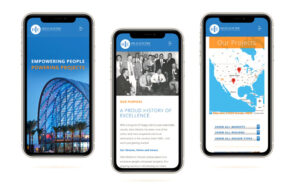
A mobile-optimized website is the foundation of the 2026 digital playbook, immediately showcasing brand history, mission, and geographical reach to potential clients.
Pillar 2: Mobile-First Design That Actually Works
Speed and mobile aren’t “nice features”—they’re deal-breakers.
Google punishes slow sites. In fact, in 2016, our CEO Les Kollegian was hired by Google to speak at their conferences about this exact issue. Here’s the stat that should terrify you: for every extra second your page takes to load, your bounce rate jumps 8X higher.
Think about that. One extra second. Eight times more people, gone.
If you don’t know how to optimize your site properly—and most don’t—you’re hemorrhaging traffic and conversions without even realizing it. And with over 70% of construction buyers starting their research on mobile, building for phones isn’t optional anymore. It’s fundamental.
Don’t get us wrong. Desktop design is EXTREMELY important. However, mobile-first in the A/E/C vertical is how all companies should be thinking. Once they’re evaluating a project or issuing a bid, your prospects are likely to switch to a larger screen to review PDFs, drawings, case studies, and detailed qualifications. A robust, desktop-friendly experience helps with credibility, downloads, and document access.
What matters:
Load time under 3 seconds. Period. Every second longer and you’re losing people.
Easy navigation for thumbs, not mouse cursors. Big buttons, smart spacing. Remember, your best trades might be on a job site wearing gloves. Your best prospect may be doing research while waiting for his/her cocktail at the bar.
Images that look great on small screens. Don’t sacrifice visual impact, but optimize everything so it loads fast.
Simple forms. Mobile users won’t fill out 15 fields. Keep it to name, email, phone, and project type.
Here’s a stat that should scare you: mobile users are 5 times more likely to abandon a site that isn’t optimized. You can’t afford to lose half your audience because your site looks bad on a phone.
The Bottom Line: If your site doesn’t work flawlessly on mobile, you’ve disqualified yourself from the majority of potential clients before they even see your work.
Practical guidance:
Start with a mobile-first design mindset:
Fast load times (optimized images, compressed videos, lean code).
Clear navigation with prominent project gallery, capabilities, and contact.
Accessible CTAs (Get a quote, Request a proposal, Call now).
Readable typography, concise copy, and scannable sections.
Construction is a relationship business–and trust is everything. Your website needs to prove you’re legitimate, capable, and reliable and yes… trustworthy—before someone picks up the phone.
Essential trust-builders:
Show your credentials. Certifications, licenses, insurance, safety records. Display logos from your suppliers and partners. Make it obvious you’re the real deal.
Sounds basic, right?
We’ve worked with companies doing $50 million+ in revenue who don’t do this. Their response? “We have enough business.”
Our response? Do you, though? Because “enough” isn’t the same as “all the business you could have.” What are you leaving on the table by making prospects guess whether you’re legit? Trust signals aren’t just for startups trying to prove themselves. They’re for every company that wants to convert more of the traffic they’re already getting.
Real testimonials with real details. “Saved us 15% on materials and finished two weeks early” beats “Great to work with!” every time. Use names, titles, photos if possible.
Introduce your team. People want to know who they’re hiring. Real photos of real people build connection.
Highlight your track record. OSHA ratings, safety certifications, project completion rates—these signal operational excellence.
Here’s why this matters: 47% of buyers look at 3-5 pieces of content before they’ll even talk to a salesperson. Make it easy for them to say yes by giving them the proof points they need.
The Bottom Line: Trust isn’t given, it’s earned. Your website should make it effortless for prospects to find the evidence they need to feel confident about working with you.
Pillar 4: Make It Stupid-Easy to Contact You
Every page should have a purpose. Every purpose should have a clear next step.
If someone’s interested, don’t make them hunt for how to reach you.
What converts:
Multiple ways to get in touch. “Request a Bid,” “Schedule a Consultation,” “Get an Estimate,” “Download Our Capabilities Deck.” Different people want different entry points.
Click-to-call on mobile. 61% of mobile users will call during the buying process. Make the phone number tappable everywhere.
Contact options that follow them. Sticky contact bars or chat widgets that stay visible as people scroll.
Forms right where they’re looking. Put inquiry forms directly on portfolio pages so prospects can reach out while viewing relevant work.
The math: you’re paying $165+ per lead from search ads. If your site doesn’t make it easy to convert, you’re wasting that investment.
Pro tip: Keep forms short. Name, email, phone, project type—that’s enough for a first conversation.
The Bottom Line: Every page needs a clear “do this next” moment. The easier you make it to contact you, the more qualified leads you’ll capture.
Pillar 5: Get Found by the Right People
A beautiful website is worthless if no one can find it.
The firms that dominate their markets don’t just build great sites—they make sure those sites show up when potential clients are searching.
The technical stuff (simplified):
Make sure your site is fast, clean, and organized in a way that search engines—and now AI—can understand. This includes things like clear page titles, good site structure, and behind-the-scenes code that helps Google, ChatGPT, Perplexity, and other AI tools figure out what you actually do.
Here’s why this matters more than ever: people aren’t just Googling anymore. They’re asking ChatGPT “who are the best commercial contractors in [city]?” or using AI search tools to compare firms. If your site isn’t structured properly, you won’t show up in those results—even if you’re the perfect fit. AI reads your site differently than humans do, and if it can’t parse your information clearly, you’re invisible in the fastest-growing search channel out there.
The content strategy:
Content marketing generates 54% more leads than traditional marketing. Adding a blog to your site increases your chances of ranking on Google by 434%.
Here’s what to create:
Service pages that match what people search for. Think “commercial general contractor in [your city]” or “design-build services in [your region].”
Project case studies with location details. Construction is local. Make sure every case study includes where the project was and what type of work it involved.
Educational content that answers questions. Blog posts like “How long does commercial construction permitting take?” or “What’s the difference between design-bid-build and design-build?” These attract people early in their research process.
The Bottom Line: SEO isn’t optional—it’s your primary lead source. Build it into your website from day one, target the searches your ideal clients are making, and create content that answers their questions. Do this right and your site becomes a lead-generating machine. And for those of you who don’t believe you are being found via search in any capacity. Aehhhhhhhh (buzzer sound). You have NO idea. At Jacob Tyler, we never thought in a million years that an executive at Sony would be upset with his current agency and “search” for another and find us. Being optimized for search got us that account and assistance developing the VAIO brand for Sony. So yeah, we believe. We will give you some more information on “search” in a little bit.
Design Trends That Actually Matter in 2026
Clean and Simple Wins
Less is more. White space, clean fonts, minimal navigation. Focus attention on what matters—your work.
Large Typography
Use of clean and modern typography in a large point type grabs attention and keeps it. Don’t overdo it though. Remember that people need to be attracted to read more and not yelled at.
Video Makes a Difference
Time-lapse build videos, drone footage, client testimonials. Video tells stories in ways photos can’t.
Dark Mode Is Here
Dark backgrounds with sharp contrast can make architectural work pop. It’s modern, striking, and effective. With that said, be careful to not have too much body copy in reverse (white on top of black) as it can make paragraph content more difficult to read.
Subtle Motion Adds Polish
Hover effects, scroll animations, interactive filters. Small details that make the experience feel premium without overwhelming users.
Sustainability Messaging Matters
Affiliations, green building practices, LEED certifications, energy-efficient outcomes—these resonate with commercial clients and conscious homeowners alike.
What a Professional Website Actually Costs
Let’s talk money. Here’s what you should expect to invest:
Small to Mid-Size Firms: $15,000 – $25,000
You get:
15-25 pages
Custom design that’s mobile-responsive
10-15 portfolio projects
Contact forms and lead capture
Basic search optimization
Timeline: 10-14 weeks
Best for: Local contractors, small commercial builders, residential remodelers
Mid-Size to Large Firms: $25,000 – $55,000+
You get:
30-50+ pages
Advanced functionality and design
25-50 portfolio projects with filtering
Integration with your CRM and project tools
Comprehensive SEO strategy
Blog and content marketing setup
Video integration
Timeline: 14-20 weeks
Best for: Regional general contractors, design-build firms, commercial construction companies
Enterprise-Level Firms: $55,000 – $100,000+
You get:
50-100+ pages
Fully custom everything
Multi-location support
Project portals and employee logins
Interactive maps and advanced showcases
Marketing automation
Ongoing optimization and testing
Timeline: 20-24+ weeks
Best for: National contractors, large commercial builders, industrial construction firms
Ongoing Maintenance: $1,500 – $3,000/month
Includes:
Security updates
New project additions
SEO monitoring
Performance optimization
Analytics reviews
Think of this as the cost of keeping your best salesperson sharp and effective. Keep in mind that most Websites as mentioned above can be developed in WordPress, which is infinitely scalable so even though you may start with 15 to 20 pages, you can add as many as you like, and it is super easy to do so.
Mistakes That Kill Conversions
Portfolio overload. Quality beats quantity. Show your best 15-25 projects, not every job you’ve done since 1985.
Ignoring mobile. If it doesn’t work on a phone, you’ve lost the lead. Period.
Hiding your call-to-action. Every page should answer: “What should I do next?” Make it obvious.
Treating SEO as an afterthought. 57% of B2B marketers say SEO generates more leads than anything else. Build it in from the start.
Slow load times. Users leave. Google penalizes. You lose.
No way to track results. If you can’t measure it, you can’t improve it. Set up tracking for form submissions, calls, and key pages.
Stale content. A portfolio that stops in 2019 signals a business that stopped growing. Update regularly.
How to Know If It’s Working
Track these numbers to measure your website’s impact:
Traffic growth (month-over-month and year-over-year)
Conversion rate (forms, calls, downloads as a % of visitors)
Bounce rate (target under 40% on key pages)
Time on site (longer = more engaged
Search rankings for your target terms
Leads generated (qualified inquiries)
Cost per lead (compared to other channels)
Projects won from web inquiries
The goal isn’t to hit industry averages—it’s to beat your own baseline. A 20% lift in traffic or a 0.5% bump in conversion rate translates directly to revenue.
Your 2026 Website Checklist
Use this when evaluating proposals or scoping your project:
Strategy & Planning
Audience personas defined
Competitor analysis completed
Keyword research done
Conversion goals established
Site structure approved
Design & Experience
Mobile-first, responsive design
Loads in under 3 seconds
Clean layouts with white space
High-quality, authentic photos (no stock)
Consistent branding throughout
Content & Messaging
Clear value proposition on homepage
Service pages optimized for search
10-20 featured projects with case studies
Client testimonials (text or video)
Team bios and photos
Trust signals visible (certifications, licenses)
Functionality
Contact forms on key pages
Click-to-call phone numbers
Filterable project portfolio
Blog/resources section
Secure hosting and backups
SEO & Analytics
Google Analytics installed
Search Console configured
Page titles and descriptions optimized
Sitemap submitted
Redirects set up (if redesign)
Post-Launch
Tested across all devices
Monthly analytics reporting
Content update plan in place
Ongoing optimization strategy defined
Common Questions Answered
How much should I really spend on a website?
For most construction companies, expect to invest $15,000 to $75,000+ depending on complexity and scale.
Think of it this way: if a well-designed site generates even 3-5 additional qualified leads per month, it pays for itself within months. The question isn’t “what’s the cheapest option?” It’s “what delivers the best return?”
How long does it take to build?
Quality takes time. Most projects run 10-16 weeks from kickoff to launch. Smaller sites might be done in 8-10 weeks. Enterprise sites with complex features can take 20-24 weeks.
Rushing usually means compromising quality. Launch something you’re proud of, not something you’re settling for.
Do I really need mobile optimization?
Absolutely. Over 70% of potential clients browse on mobile before making a decision. Google ranks your mobile site first. Mobile users are 5X more likely to bail on a site that doesn’t work properly.
If your site doesn’t work flawlessly on phones, you’re eliminating the majority of your market.
Can I just use a template?
Sure, if you want to blend in and hope for the best.
Template platforms like Wix or Squarespace are cheap upfront, but they come with hidden costs that kill your competitiveness. Here’s why they fall short for construction companies:
Speed kills your conversions. These platforms are bloated with code you don’t need. They’re slower out of the box, and you can’t optimize them the way a custom site can. Remember: every extra second costs you 8X more bounces.
You’re locked into their limitations. Need a custom project filtering system? Want to integrate with your CRM? Looking to build something unique that sets you apart? Good luck. Templates box you into what everyone else is doing.
SEO is hobbled from the start. Sure, they claim to be “SEO-friendly,” but you can’t control the technical foundation the way you need to. Your ability to rank for competitive local terms is significantly hampered compared to a properly built custom site.
You look like everyone else. Prospects can spot a Squarespace template from a mile away. When you’re competing for six- and seven-figure projects, looking like a DIY startup doesn’t inspire confidence.
AI can’t read it properly. These platforms generate messy code that makes it harder for AI search tools (ChatGPT, Perplexity, etc.) to understand and recommend your business. You’re invisible in the fastest-growing search channel.
Mobile experience is “good enough” at best. Remember that 70% of your prospects start on mobile? Template platforms give you a responsive site, but not an optimized one. There’s a massive difference.
The bottom line: when your average project is worth $50K to millions, a $200/year website isn’t a smart savings—it’s a costly compromise. Investing in a professional custom site delivers exponentially better ROI because it actually converts the traffic you’re working so hard to generate.
How often should I update it?
A website isn’t a “set it and forget it” asset. It’s a living business tool that needs regular attention to stay effective.
At minimum, add new projects quarterly. Fresh content tells both visitors and search engines you’re active and growing. But there’s more to it than that.
Why regular updates actually matter:
Search engines reward fresh content. Google prioritizes sites that consistently publish new material. A site that hasn’t been touched in six months gets buried, while competitors updating regularly climb the rankings. This isn’t theory—it’s how the algorithm works.
AI search needs current data. ChatGPT, Perplexity, and other AI tools pull from recently updated sources. If your site is static, you’re invisible in AI-powered search results—the fastest-growing way people find contractors.
Your prospects are watching. When someone lands on your site and sees your last project is from 2022, what do they think? Either you’re not busy (red flag) or you don’t care about your digital presence (also a red flag). Fresh content signals momentum and success.
SEO compounds over time. Every new blog post is another opportunity to rank for search terms. Every updated project page strengthens your local SEO. This isn’t busy work—it’s building equity that generates leads for years.
Ideal update cadence:
New blog posts monthly – drives SEO, answers buyer questions, positions you as an expert
Portfolio updates quarterly – keeps your best work front and center
Testimonials as you receive them – fresh social proof builds trust faster
Service pages refreshed annually – keeps messaging aligned with your current capabilities and market positioning
Technical SEO audit quarterly – ensures your site stays optimized as search algorithms evolve
Should you hire someone to manage this?
Unless you have a dedicated marketing person who understands SEO, content strategy, and technical optimization—yes, absolutely.
Here’s why: most construction company owners don’t have time to write optimized blog posts, resize images properly, update meta descriptions, monitor search rankings, or stay current on algorithm changes. And frankly, you shouldn’t. Your time is worth more managing projects and closing deals.
A monthly retainer with a specialized agency or freelancer ($1,500-$5,000/month depending on scope) typically includes:
Regular content creation and optimization
Portfolio and project page updates
SEO monitoring and adjustments
Technical performance optimization
Analytics reporting so you see what’s working
Think of it this way: if your site generates even 2-3 additional qualified leads per month because it’s consistently updated and optimized, that monthly investment has already paid for itself several times over.
The bottom line: A stale website signals a stale business. But more importantly, an outdated site actively costs you leads, rankings, and revenue. Regular updates aren’t optional maintenance—they’re how your website continues generating ROI long after launch.
What’s the difference between a brochure site and a lead generation site?
Brochure sites build trust and credibility through compelling storytelling, professional imagery, and showcases of your work. When designed thoughtfully, they serve as powerful digital portfolios that help potential clients understand who you are, what you do, and why they should work with you. For smaller businesses especially, a well-crafted brochure site with clear contact options and conversion points can be exactly what’s needed to turn visitors into leads.
Lead generation sites take this foundation further by prioritizing conversion at every turn—with multiple strategic calls-to-action, optimized user journeys, lead capture mechanisms throughout the experience, and content specifically designed to move visitors down the funnel.
Both approaches should ultimately drive leads and conversions. The difference is in emphasis: brochure sites lead with trust-building and storytelling, while lead generation sites lead with conversion optimization—but the best sites often blend elements of both.
We have plenty of business. Does SEO really matter?
Look, I get it. We hear this all the time: “We don’t need to worry about our website because we don’t get business from it anyway.”
But here’s the thing—comfort is the enemy of growth.
Think about it: why would you turn down the chance to be considered for projects you didn’t even know existed? Projects where the prospect finds you instead of you having to chase them down?
When we push back and ask “How do you actually know you’re not getting business from your site?”, there’s usually just crickets. Or worse, assumptions based on… well, nothing.
Here’s a story (in case you missed it earlier) that changed everything for us. Years ago, we won the brand development for Sony VAIO products for college students. Want to know how? A Sony senior executive (fed up with his current agency relationship) literally Googled agencies and found us. We didn’t even think that was possible. But it happened, and we became true believers.
Fast forward to 2025. We redesigned the website for Dempsey Construction. About three months after launch, Michaela Weibel, their Director of Marketing, called us—absolutely shocked. She’d been there over five years and had never received a single lead through their website. Not one.
With the new site and proper optimization? Leads started coming in.. and while just a few, it is certainly better than none. Now they’re actually in the game instead of watching from the sidelines. And get this—just one deal pays for the entire website investment and then some.
But it gets even better. At Jacob Tyler, we’re now landing clients through something most agencies aren’t even thinking about yet: generative search.
Sure, people still Google “Best Web Design Agencies in San Diego” or “Construction Web Designer”—and we show up for those. But recently, an executive asked Gemini (Google’s AI), “Who designed the Hensel Phelps website?” Because we optimized our site for generative search, they got the right answer: us. We won that client.
This is the new reality. In 2026, if you’re in construction and you’re not optimized for generative search—especially around your completed projects—you’re invisible to a massive chunk of potential clients.
Should I hire a construction specialist or a general agency?
Here’s our honest take, and we’d be lying if we told you otherwise: you don’t need an agency that only does construction.
We’ve been doing this for 25 years at Jacob Tyler. In that time, we’ve built high-performing websites for health and life sciences companies, medical product manufacturers, ecommerce brands, financial services firms, and yes—construction and industrial companies. The idea that an agency must be vertically niched to deliver results? That’s marketing spin, not reality.
What you actually need is this:
An agency that takes the time to deeply understand your buyers, your sales cycle, your competitive landscape, and what drives decisions in your market. Whether that’s construction, manufacturing, or healthcare doesn’t matter as much as their commitment to learning what makes your business tick.
That said, industry experience does accelerate results.
When an agency has worked with construction firms before, they come to the table knowing:
How to structure project portfolios that actually convert
Which trust signals matter most (certifications, safety records, bonding capacity)
How to optimize for the long, relationship-driven sales cycles typical in construction
What questions prospects ask before they’re ready to request a bid
The balance between showcasing capabilities and not overwhelming decision-makers
That expertise means faster onboarding, fewer missteps, and a site that performs from day one instead of needing months of trial and error.
But here’s what matters more than niche experience:
Does the agency have a track record of driving measurable results? Do they understand conversion optimization, SEO, user experience, and content strategy at a deep level? Can they point to specific outcomes—increased leads, higher rankings, improved conversion rates—across any B2B vertical?
Those fundamentals transcend industry. A team that’s driven results in financial services or life sciences can absolutely apply that same rigor and strategic thinking to construction. The principles of effective digital marketing don’t change just because the hard hats do.
The bottom line:
Choose an agency based on their strategic chops, their commitment to understanding your specific market, and their proven ability to deliver ROI—not just their client roster. Industry experience is a plus and can accelerate results, but it’s not a requirement. Deep expertise in digital strategy, combined with genuine curiosity about your business, will always outperform shallow “niche specialist” credentials.
At Jacob Tyler, we bring both: 25 years of cross-industry experience and a proven track record in construction and industrial markets. That combination means we know what works universally and what needs to be tailored specifically for how contractors buy.
How do I measure ROI?
First, let’s be clear about something: your website is a critical piece of your marketing engine, but it’s not the only piece.
We’d be doing you a disservice if we said “build a great website and watch the leads roll in.” That’s not how sustainable growth works. Your website needs to work in concert with your brand, your relationships, your presence at trade shows, your direct mail, your reputation in the community, and yes—even those conversations on the 19th hole.
That said, your website should absolutely be measured and held accountable for ROI.
Here’s what to track:
Qualified leads generated – how many serious inquiries came directly from the site
Conversion rate – percentage of visitors who take action (form fills, calls, downloads)
Revenue from web-sourced inquiries – actual project wins that started with your website
Cost per lead – compare what you’re spending on the website against other channels like trade shows, print ads, or pay-per-click
Most construction firms find that once their website is properly optimized, it delivers the lowest cost per qualified lead of any marketing channel. Even modest improvements—like a 1% conversion bump—can generate hundreds of thousands in additional project value annually.
But here’s the bigger picture:
Your website doesn’t exist in a vacuum. It’s the hub where all your other marketing efforts converge:
Someone meets you at a trade show → they Google you → your website seals the deal (or kills it)
A referral mentions your name → the prospect checks you out online → your site validates the recommendation
You run targeted ads → traffic lands on your site → conversion optimization determines if that spend pays off
Your brand shows up in their LinkedIn feed → they click through → your website tells the full story
Think of it this way: Your brand is your reputation. Your website is where that reputation gets verified and converted into action. Traditional marketing—networking, events, direct outreach—gets you in the conversation. Your digital presence determines whether that conversation becomes a contract.
So yes, measure your website’s performance religiously. But don’t forget that your entire marketing ecosystem—brand positioning, consistent messaging across channels, strategic relationship building, and traditional outreach—all work together to drive revenue.
The website is your best salesperson. But even the best salesperson needs leads to close. That’s where the rest of your marketing comes in.
Your Website Is Your Competitive Advantage
In 2026, your construction website isn’t a cost center. It’s a strategic asset that either generates revenue or bleeds opportunity.
The firms winning the best projects understand this: your website is a business development engine that works around the clock. While your competitors are still treating their online presence as an afterthought, the leaders in your market are converting browsers into bids—24/7, without a single sales call.
Here’s the math that matters: construction websites average around a 2% conversion rate. That means 98 out of 100 qualified prospects leave without contacting you.
Now imagine cutting that waste in half. Better mobile experience, faster load times, clearer calls-to-action, stronger portfolio presentation—these aren’t cosmetic upgrades. They’re the difference between doubling your lead volume and watching opportunities go to competitors who got the details right.
Combine that with smart SEO and a relentless commitment to showcasing your best work, and you’ve built something that compounds: a platform that gets stronger, ranks higher, and generates more qualified leads every month—without you spending another dollar on traffic.
For owners and marketing leaders evaluating partners, the criteria are simple: find an agency that understands how construction buyers make decisions, builds for conversion not just aesthetics, and measures results in leads and revenue, not likes and page views.
The investment in getting this right pays dividends for years. The cost of getting it wrong? You’re already paying it—you just don’t see the opportunities you’re missing.
Let’s Talk About What’s Possible
If you’ve made it this far, you already know your website could be working harder for you.
Maybe you’re frustrated watching leads go to competitors with slicker digital presence. Maybe you know your site doesn’t represent the quality of work you actually deliver. Or maybe you’re just tired of leaving money on the table because your online experience doesn’t match your reputation in the field.
We get it. We’ve spent 25 years helping companies in construction, industrial, and beyond turn their digital presence into a genuine competitive advantage—not just a prettier version of what everyone else has.
Here’s what we believe:
Your website should earn its keep. It should generate qualified leads, support your sales team, and prove ROI. If it’s not doing that, something’s broken—and it’s fixable.
You shouldn’t have to become a digital marketing expert to make this work. That’s what partners are for. Our job is to understand your business, your buyers, and your goals—then build something that delivers results you can measure.
If you’re ready to explore what’s possible, here’s how we typically start:
Have a real conversation. No sales pitch. No generic proposal. Just an honest discussion about where you are, where you want to be, and whether we’re the right fit to help you get there.
Build a plan that makes sense for your business. Not a one-size-fits-all template. A strategy tailored to your market, your goals, and your timeline.
Execute with accountability. We measure what matters—leads, conversions, revenue—and adjust as we learn what works best for your specific audience.
The firms that are winning in your market aren’t doing anything magical. They’re just committed to making their digital presence as strong as their craftsmanship. And they’re working with partners who understand that construction isn’t sold the same way software or sneakers are.
The best time to fix this was last year. The second best time? Right now.
If you’re curious about what’s possible for your business, let’s talk. No pressure, no pitch—just a conversation between people who care about building things that work.
Schedule a consultation or reach out and fill out our own lead form at www.jacobtyler.com. Hell… just call our CEO (Les Kollegian) directly at 619-379-0007. We’re here when you’re ready.
Makers & Founders Podcast Episode 5: Thoughts from the Field – Paul Rowan (Rowan Electric)
Makers & Founders Podcast Episode 3: Min Egidio – From Survival Mode to Serial Success
From Survival Mode to Serial Success: Min Egidio’s Unexpected Journey to Entrepreneurial Freedom
In episode four of the Limitless Growth Podcast, we hear from Min Egidio, founder of All Time Awards and owner of two AlphaGraphics locations, as she shares her refreshingly honest journey from corporate finance to the chaotic, fulfilling world of entrepreneurship. What began as a desperate attempt to escape the constraints of stay-at-home life turned into a decade-long journey of problem-solving, business growth, and leadership transformation.
From Corporate Finance to a Trophy Shop?
Min never set out to be a business owner. After graduating with a finance degree and landing a job at a biotech firm, she expected to follow the CPA track. But life shifted dramatically when she had her first daughter. Two weeks into being a stay-at-home mom, she realized she was miserable.
“I loved my daughter, but I felt trapped. I wasn’t making a difference in her life—or mine.”
In a twist of fate, her husband’s connection to a retiring trophy vendor sparked an unexpected opportunity: buying a small trophy shop. Though Min knew nothing about the business, she trusted her instincts and said yes.
Buying a Business… and Buying a Job
Min quickly learned that owning a business isn’t the same as having freedom. Without employees, she did everything herself—from invoicing and production to customer pickups. Even after giving birth to her second child, she was back in the shop the next day.
“I realized I didn’t buy a business. I bought myself a job.”
Despite the grind, she pushed through, learning what it truly meant to build something from scratch. And as her confidence grew, so did her curiosity.
Scaling Through Trial and Error
After weathering the early years, Min began expanding. She launched two dessert and boba shops between 2019 and 2020—but quickly learned that even seemingly simple businesses like self-serve yogurt demand full-service effort.
“People think food is easy. It’s not. It’s as hard as a restaurant.”
She opened and sold both locations within three years. One location in suburban Rancho Peñasquitos performed well; the other, in Pacific Beach, struggled. The customer behavior, spending habits, and operational realities were completely different.
“I thought I could copy and paste a model. But you can’t copy customers.”
The lesson? Pivot early, don’t let ego get in the way, and know when to walk away. Min sold both shops and decided to double down on what she now calls tangible marketing and visual communication.
Enter AlphaGraphics: A Franchise Fit
In 2023, Min acquired her first AlphaGraphics location—a move she admits she never expected to make.
“I always said I’d never do a franchise. But the people won me over. It just felt right.”
What sold her was the balance: AlphaGraphics offered systems, national reach, and a built-in peer network—without feeling overly rigid. The franchise world gave her industry-specific support, while EO (Entrepreneurs’ Organization) gave her diverse business insights.
“In EO, we all share wins and losses—but we’re in different industries. In AlphaGraphics, we speak the same language.”
Now her businesses offer full-service brand solutions—from awards to signs, promo materials to print—allowing her to say “yes” to customers rather than send them elsewhere.
From Koreatown to Confidence
Min’s entrepreneurial grit is deeply rooted in her upbringing. The daughter of Korean immigrants, she grew up in Koreatown, Los Angeles, often moving due to financial instability. Her parents divorced when she was young, and she spent much of her childhood fending for herself.
“I was forced to grow up early. There was no stability. That’s where the problem-solving started.”
She credits sports—specifically basketball—for helping her find her voice. On the court, she learned to lead, lose gracefully, and bounce back. She was never the star athlete, but she was always the glue.
“Basketball gave me a coach, a team, and a space where it was okay to be aggressive and emotional. That changed me.”
Finding Her Voice—and Using It
When asked about regrets, Min doesn’t dwell on missed opportunities—only missed chances to speak up.
“I wish I had shown my true self earlier. I was one person at home and another at school. That split carried into adulthood.”
Today, she lives without that burden. Her parenting style encourages her daughters to find and use their voices. She’s also committed to mentoring others who come from untraditional backgrounds, showing them that business ownership isn’t just for the elite.
“I want to write a book someday—something that inspires people like me. The working title? The Trophy Wife.“
Leading with Love and Discipline
Min is the first to admit she comes off tough—but beneath the grit is compassion. Her team knows she has high standards, but also a big heart. She’s the boss who loses sleep over letting someone go, even when it’s the right decision.
“Everything I’ve figured out—business, parenting, life—I’ve done through trial and error. That’s where the learning is.”
Looking Ahead
Min’s long-term goal? More freedom, more impact. She doesn’t want to work until 70, and she wants to spend more time sharing her story, writing, and helping other scrappy underdogs find their way.
“You don’t need a fancy background. You just need a mental shift.”
With a reminder….and it’s the harsh truth (we love you tho) if your website isn’t up to snuff, you’re gonna miss out on the the future.
Look. We know that every business needs to take care of their brands’ messaging and online presence in order to get hires. And now you’re thinking, “Well duh, you get paid to do that!”. Okay, you’re right. We may have a vested interest in giving that advice, BUT WE are the people actually paying attention to the data. We see what’s going on in many different verticals and literally see the effects of what we (and frankly other agencies) do to help businesses evolve and grow.
Right now, we happen to be doing a lot of work in the AEC (Architecture, Engineering, and Construction) space and review many different websites and brands.
We hear the same few sentences when we visit potential clients.
“People come to us”
“We’re already at capacity”
“We have enough business”
“We work on referrals”
But we also hear…
“We are constantly looking for new hires and can’t fill our spots”
“Potential employees coming out of college want a salary more than mine and I’ve been here thirty years”
“We have a great culture”
“Our employees love working here, how do we let people know?”
Look, we get it. But here’s the hard truth (and let’s just focus on attracting talent for now):
Nearly 60% of your best talent won’t apply because they can’t clearly identify who you are or what you stand for from your website.
And in all of our defense, maybe back in the day that was ok, because hiring was accomplished over a steak dinner, or in the lobby of a Homewood suites during the breakfast buffet while the head of HR was visiting from corporate.
But that ain’t the case anymore.
In fact:
Sources like HR Dive, HiringThing, OnHires, and Indeed show most candidates research companies before applying:
61% visit the company website
64% do broader online research
67% check career pages
86% read company reviews
84% say reputation heavily influences their decision
And furthermore, interest in “company culture”, “quality of life” and “paid time off for paternity leave”, while non existent ten years ago, is trending at the forefront of job searching.
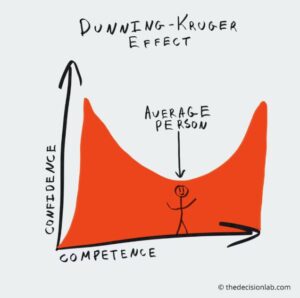
Oh and because we have a few intellects on staff who love facts..here’s a little experiment for you “likeminded, fact seeking” types…basically, some “why” behind the “what”… Don’t wan’t to get into it right now? That’s ok, the bottom line, is most of us overestimate our expertise in awareness and what we know in all areas (see below).
The Dunning-Kruger effect (where the term originated), and not to be confused with the Peter Principle, explains how people sometimes overestimate their knowledge.
For example, let’s take hiring…
For attracting talent, many employers don’t fully realize how crucial their company website really is.
And it’s not just about having a website — quality matters. According to Glassdoor, nearly 60% of candidates avoid applying if your website is poorly designed or lacks culture info. A CareerArc study says 50%+ reject employers with outdated or unprofessional online presence.
Right now, there are about 17,000 active job listings nationwide on LinkedIn, Glassdoor, Indeed, and Recruit.net — plus an estimated 4,200 more on Craigslist and local ads. With so many options, candidates are picky — and your website could be the difference between attracting or losing top talent.
Your messaging also needs to be tailored. Every candidate has unique life experiences and values that influence in what they want from an employer.
When we were initially tasked with changing the brand messaging and positioning for an established electrical firm, Helix Electric (a company with over 800 employees), their Website was an afterthought. They had plenty of business, according to the CEO which was a testament to their capabilities, however, after we dug further, we understood that they were hiring new talent on a weekly basis but needed a bit more consistency and applications to keep up with their demand. The analysis showed that the Website had an extremely high bounce rate (people going to the home page and leaving). Furthermore, their career section was literally just a link to upload a resume with available positions. They did not showcase anything about their company culture.
So, not to brag but we crushed it…
Increased applications
Increased time spent on site
Created higher quality applicants
And yes… everyone was VERY happy.
Jacob Tyler redesigned their entire online presence and focused on the two most important areas which were number one careers and number two case studies. The new design and focus on impactful messaging need a complete difference by lowering their bounce rate over 40% but also attracting more applications.
It was so successful that they have now asked us to do a landing page to celebrate their 40 year anniversary showcase and company culture.
At Jacob Tyler, we understand the power of clear messaging and a compelling presence — and frankly, we know what we’re doing and have been. Let us help you attract the best candidates and build the future your company deserves.
The Web Design Evolution of Jacob Tyler: A Digital Timeline Spanning Two Decades
Well… we did it. We launched a new website. You know how the old business saying goes; “We’re our own worst client”. That’s true for many and very true for us. We seem to always put ourselves last in the “to-do list” pecking order. However, after months of work, back-and-forth, opinions, changes, and procrastination, we have created an experience that we feel works for us AND the people visiting. In other words, this is yet another Web design we are proud of. We (our team) have a saying that websites are like dog years—every year online is equivalent to seven years in technology evolution. It’s a playful metaphor that captures a serious truth about digital longevity in our rapidly changing industry. Yet despite this accelerated aging, both our own websites and those we create for clients have consistently defied the odds, averaging an impressive eight-year lifespan that speaks to thoughtful design and strategic planning.
Today, we’re taking a journey through our own digital evolution, examining how our website has transformed over the years and what these changes reveal about broader trends in web design, user behavior, and technological advancement.
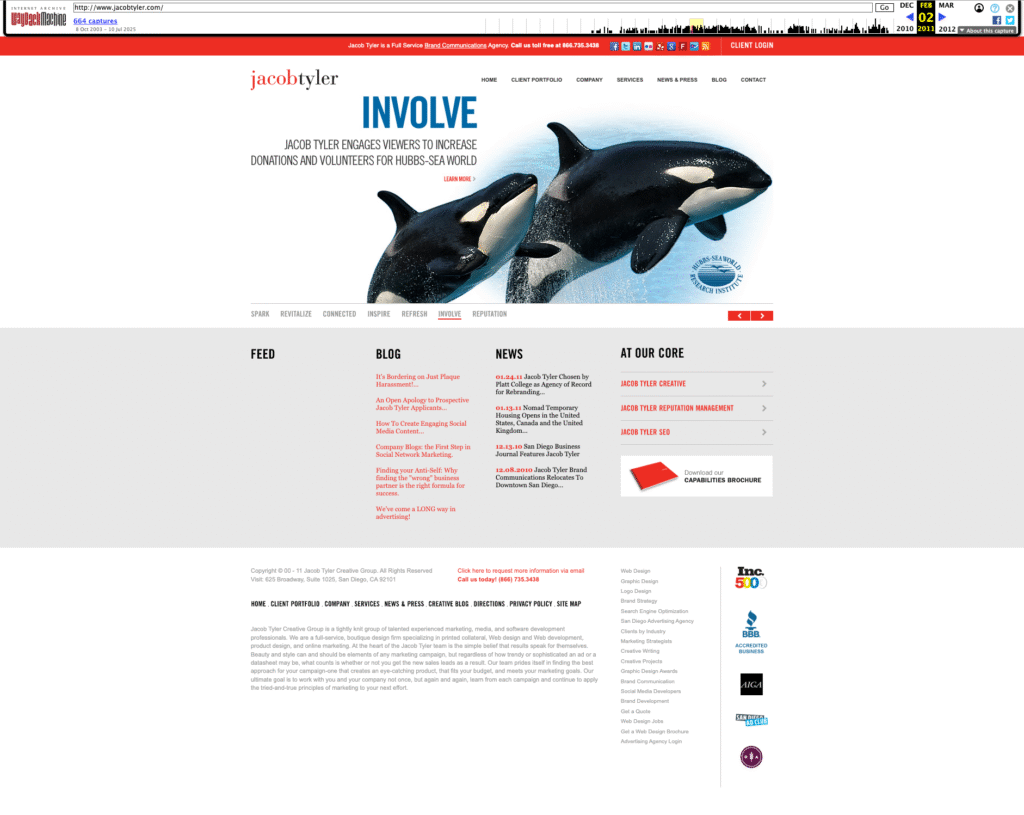
Version 1: The Foundation Years (Early 2000s)
Our first website was a product of its time—clean, corporate, and information-focused. The design featured our signature red branding with a structured layout that prioritized content hierarchy and professional presentation. Navigation was straightforward, with clear sections for services, portfolio, and contact information.
This early iteration reflected the web standards of the early 2000s: fixed-width layouts, table-based structures, and a desktop-first mentality. Users were patient with longer load times and comfortable with scrolling through dense information.
Key characteristics of Version 1:
Static, information-rich design
Desktop-only optimization
Traditional corporate aesthetic
Content-heavy approach
Clear service differentiation
Version 2: The Interactive Revolution
Our second go-around was a total game-changer (at least to us). We ditched the static, corporate look and went big—think larger images, video content (super high-tech at the time), and interactive stuff that actually made people feel something when they landed on our site. Instead of just showing our work like a boring gallery, our case studies started telling real stories with visuals that packed a punch.
This was right when everyone was really getting overly obsessed with Facebook and Instagram (just getting started), and suddenly every brand needed to be a storyteller. So we flipped the script on how we presented our portfolio. Instead of just saying “Hey, look what we made,” we started showing “Here’s how our creative work actually moved the needle for our clients.” We stopped being an information dump and started creating experiences that people actually wanted to stick around for.
Notable improvements in Version 2:
Enhanced visual storytelling
Interactive portfolio elements and video
Stronger emotional connection
Social media integration
Results-focused case studies
Version 3: Mobile-First Thinking
The third generation of our website represented our adaptation to the mobile revolution. As smartphones and tablets became ubiquitous, we redesigned with responsive principles at the core. The layout became more flexible, typography scaled appropriately across devices, and navigation transformed to accommodate touch interfaces. At the time, everyone was asking us who designed from mobile phones. And of course, this is extremely important however, a lot of companies that we work with, including us actually have less views on mobile platforms even to this day. That’s because in the business to business environment, many people are doing their research on their laptops and desktop devices.
Also, suddenly, scrolling became natural—people were swiping and scrolling with their thumbs all day long. Mobile screens were small, so longer pages made more sense than trying to cram everything into tiny viewports. That became the norm for desktop as well.
This was also when we started playing around with all the shiny new web tech and jumped on trends like parallax scrolling and those tiny animations that make everything feel more alive. We even spent some time wondering if we should design for the Apple Watch—yeah, that was a thing for about five minutes. Looking back, it’s a good reminder that just because something’s new and buzzy doesn’t mean you need to go all-in, but it’s still worth checking out to see if it’s actually useful or just another flash in the pan.
The mobile-first approach fundamentally changed how we structured content:
Responsive design principles
Touch-friendly navigation
Optimized loading speeds
Progressive enhancement
Cross-platform compatibility
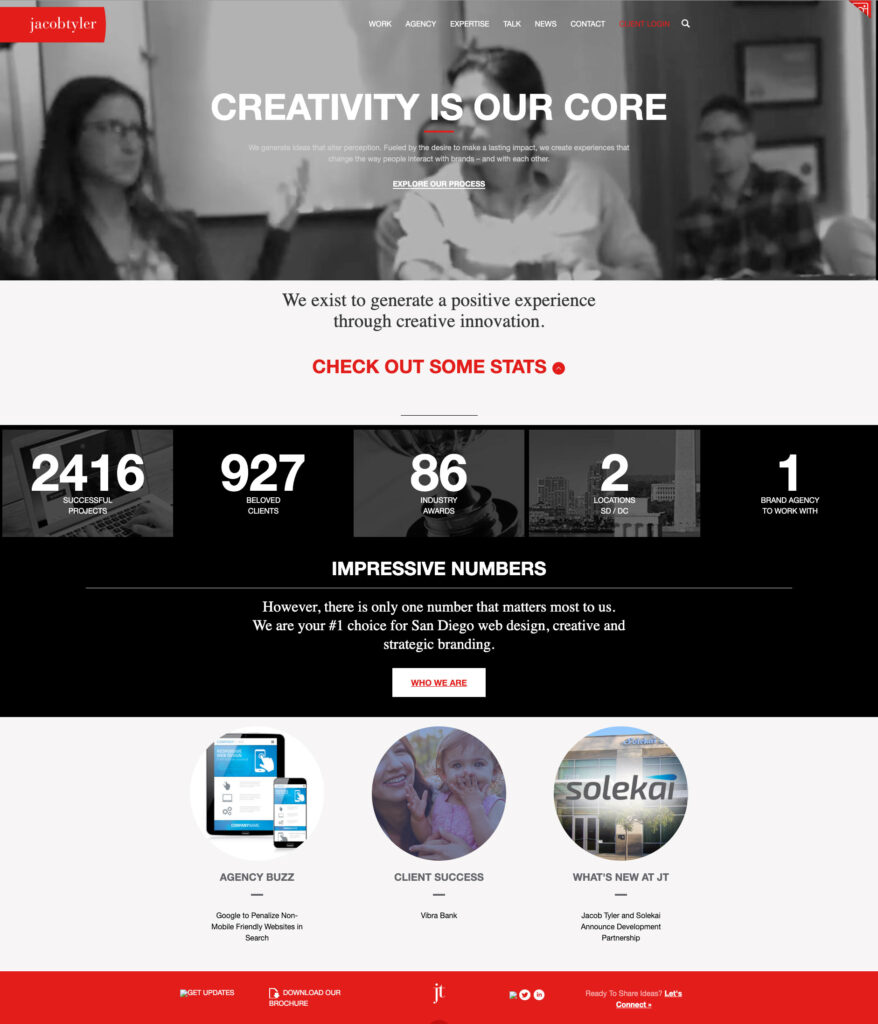
Version 4: The Current Era – Bold, Creative, and Results-Driven
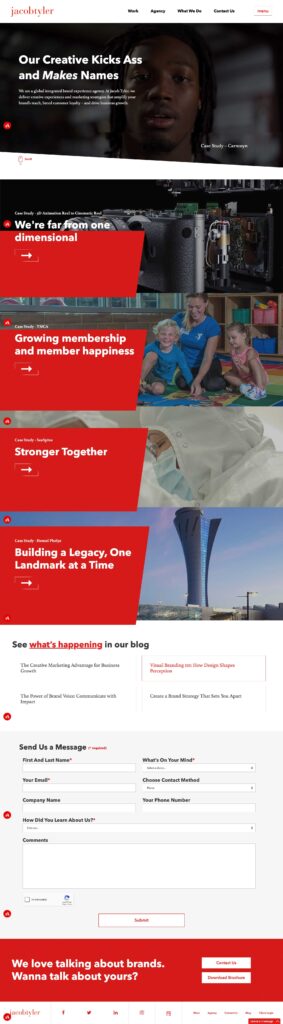
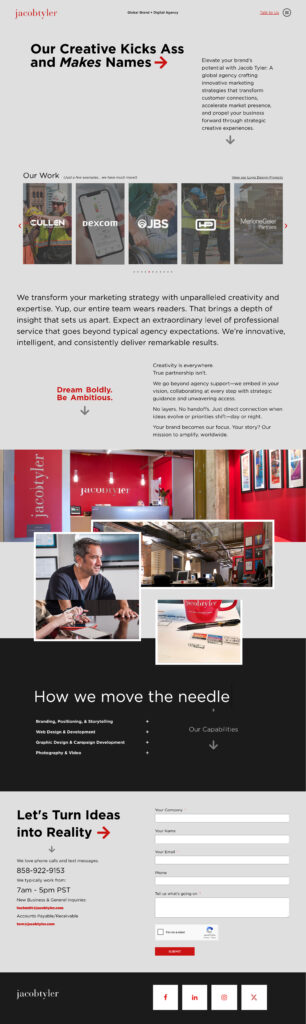
Our latest website embodies everything we’ve learned about effective digital experiences. The tagline “Our Creative Kicks Ass and Makes Names” was the only copy that stayed from the previous website because it immediately establishes our confident, results-oriented approach while maintaining the professional credibility our global clients expect.
The current design features:
Bold Visual Hierarchy: Large typography and strategic use of white space guide users through our story
Integrated Case Studies: Portfolio pieces are woven throughout the experience.
Multi-Device Optimization: Seamless experiences across desktop, tablet, and mobile devices
Performance Focus: Fast loading times and smooth interactions enhance user engagement
Conversion-Oriented: Strategic placement of contact forms and calls-to-action drive business results
The Importance of Strategic Redesign
Each evolution of our website wasn’t driven by boredom or aesthetic trends—it responded to fundamental shifts in user behavior, technology capabilities, and business objectives. This strategic approach to redesign offers several key benefits:
Technological Relevance
Keeping pace with web standards, security protocols, and performance expectations ensures your site remains functional and trustworthy.
User Experience Evolution
As user expectations change, websites must adapt to meet new interaction patterns and consumption preferences.
Brand Maturation
Your digital presence should evolve alongside your business, reflecting growth, expanded capabilities, and refined positioning.
Competitive Advantage
Regular updates help maintain differentiation in increasingly crowded markets.
Search Engine Optimization
Fresh content, improved site structure, and modern technical implementation boost search visibility.
Lessons from Our Journey
Our two-decade website evolution offers several insights for businesses considering their own digital transformation:
1. Plan for Longevity: While we joke about dog years, our eight-year average lifespan proves that thoughtful design and solid technical foundation can extend website value significantly.
2. Embrace Change Gradually: Each iteration built upon previous successes rather than starting from scratch, ensuring continuity while enabling innovation.
3. User-Centric Design Wins: Our most successful redesigns prioritized user needs over internal preferences or fleeting design trends. This applies for our clients as well.
4. Technology Should Enable, Not Drive: We adopted new technologies when they enhanced user experience, not simply because they existed.
5. Content Strategy Matters: Effective websites balance engaging presentation with substantial, valuable content that serves user intent.
Looking Forward
As we continue evolving our online presence, we’re already anticipating the next wave of changes: voice interfaces, AI-powered personalization, generative search, and immersive technologies that will reshape how users interact with brands online.
But regardless of technological advancement, our core philosophy remains constant: create experiences that connect with users, drive business results, and stand the test of time. After all, in an industry where dog years apply, longevity is the ultimate measure of success.
The Jacob Tyler website journey demonstrates that strategic redesign isn’t about chasing trends—it’s about thoughtfully evolving to serve users better while achieving business objectives. Whether you’re considering your first major redesign or your fourth, remember that the best websites aren’t just built to impress today’s visitors, but to adapt and thrive for years to come.
Ready to discuss how your website design can evolve to meet changing user expectations and business goals? Let’s start that conversation.
How to Optimize Your Web Copy to Drive Conversions
“Print is dead.” “Don’t quit your day job.” “Yeah, because the money’s in writing.” As a writer, you hear it all your life: You’re doomed. High school counselors, your uncle’s friend in the red sweater-vest at the Christmas party a few years back, even your doctor — everybody around you feels the need to let you know that anyone who writes for a living will end up penniless, curled up in a gutter.
The thing is, they’re not wrong (even if they are exaggerating). Writing is not so much a field as a precarious skill that you enter the job market with at your own peril. At the same time, people need to communicate, and that’s when you hire a writer. Blogs, websites, landing pages, retargeting ads, and other tactics in your digital marketing strategy — we copywriters probably handled the language for all that. But if we didn’t, and you’re wondering how to optimize web copy to drive conversions, here are some tips the writers at Jacob Tyler have written for you.
Stay on Point
The term “writer” got batted around a lot in the paragraphs above, so let’s define terms: Slinging digital marketing copy is often way different than crafting an essay or plotting a novel. Print tends to afford writers more space than digital layouts, which are usually functional or parceled out between web pages. Remember, readers on your site might be clicking between 15 tabs at the same time, and they’re likely to only scan 20% of your page’s content, anyway.
So keep your sentences pithy. Guide your audience to the most relevant info with headers and bold type and bullet points, since people may only be on your site to get an answer (“Should I hire this company for my kitchen remodel? When does this place even open?”). And be consistent. You don’t want to strike a lofty third-person tone on the landing page only to switch to the earnest first-person in the “About Us” section. Maintain the same voice throughout your web copy so users don’t feel like they’ve somehow jumped between those 15 tabs unbeknownst to them.
But What’s the Point?
Let’s return to one of the phrases above: “People may only be on your site to get an answer.” That idea is more pertinent than it may appear. Novels, essays, scripts all give authors the breadth to move characters through countries and centuries, picking up on themes later on that they foreshadowed at the outset — and letting the reader (or viewer) sink into an argument or a narrative. Not so with digital copywriting, which needs to be punchy because it drives toward a CTA. Copywriters, with each page you compose, ask yourself: “What is this accomplishing?”
Are you nudging users to book a resort, enroll in theology school, become a member of a credit union? Craft your content so that it’s smart and fresh, yes, but don’t leave your reader floundering in a sea of pretty descriptions. Effective UX copywriting compels prospective clients to journey further down the funnel, so you should A) have a CTA, and B) make your CTA compelling — and then run A/B testing to make sure it really is driving people to book a resort or enroll in theology school or become a member of a credit union. (Which it is, if you’re wondering. Those are our accounts, and our director of business development would love to tell you all about them.)
Mean What You Say
Even though web copy may be the newest medium in the history of writing, the old verities of how to compose a good sentence still apply to the art of digital marketing: Go heavy on verbs and nouns, light on adjectives and adverbs. Know your grammar, and if you break it, be able to defend it. Read what you’ve written out loud and let your ear guide the phrasing. Be specific — but don’t get prosy with detail. And assume the reader is smarter than you are.
Since web copy does generally hinge on a CTA, copywriters can sometimes trick themselves into taking the attitude that they’re tricking consumers down the funnel. But people know when they’re being talked down to; they sense it if you don’t believe in what you’re saying or selling. So find a way to enter into the copy emotionally. If your client is a nature preserve, conjure up memories of fog raveling fir trees. If your client is a bank, think back to that feeling of security that a customer service rep at your mortgage company gave you when you called about maybe, hopefully waiving late fees. Adopt whatever mindset you need to write with passion, because if you don’t care about the subject at hand, why should your audience?
Know Your Audience
On that note: Never forget who your target audience is. Imagine you’re a business that makes high-end baby products. Your target audience might be Andy, a thirty-ish accountant who’s about to have his first child. Inhabit Andy’s perspective. This guy is overjoyed, scared, nervous, and impatient all at once for this baby to arrive. He can’t wait — so he’s buying as many baby products as he can to feel like he’s prepared, but baby strollers confuse him (Do they fold up? Can you fit them in a car? Do you really need the accessories they come with?), and he’s willing to pay more for the right one because he doesn’t want to let his wife down.
Talk to Andy. Soothe his worries. Strip out your buzzwords and address him as “you,” as if writer and reader are just having a beer and talking about how baby strollers work. Try out a headline like “Baby Strollers Made Simple.” Then get into some body copy that addresses Andy’s concerns dead-on: “We know what you’re thinking — which baby stroller should I pick? We’ve got some answers.”
Hear that sigh of relief? That’s the sweet sound of a conversion.
Mix It Up
The best web copy is minimal web copy. We’ve said it before: Be succinct. But also be willing to yield space to developers and designers who optimize conversions with their own skill-sets. A page of copy stamped onto whitespace will look HTML-y to users — like they landed on a blog from the dial-up days, or like you put zero seduction into guiding them through your digital marketing strategy. Nest the copy in a color palette that makes your sentences pop. Break it into modules alongside photos that illustrate what you’re describing. Nail that brand headline for a CBB client, but be cool with a programmer animating it so that it emerges out of a cloud of smoke. Think past the copywriting to visualize how your words — thrilling as they are — complement the talents of the other artists working alongside you. And remember to proofread your site with the rigor of a technician. No matter how svelte that CBD brand line is, it’ll look dazed and confused if even one word is misspelled.
Web copy, a memoir, a brochure for a museum — you can make any piece of copy excellent if you trust in it as an art form that moves people. What does that have to do with conversions? Well, it’s not by accident that Google penalizes websites that stuff the text with keywords. Think about that: Even search engines recognize that writing that talks to an audience like humans is more valuable than jargon that assumes consumers are psychographic profiles. Use keywords and meta descriptions, absolutely, but remember this above all else: Write with soul and sincerity, and people will listen to you.
How to Increase Your Customer Lifetime Value (CLV)
You know how the best time to get a job is when you have a job? Well, the best time to get new business is when you already have business. You can grow your bottom line in two ways: Acquiring new clients, or retaining the clients you already have and increasing their customer lifetime value (or CLV), which is the amount of revenue that you’ll earn off a consumer in the period that they’re using your service or product. Calculating this metric can get complex, but a simple scenario might run like this:
Imagine that you’re a paper-shredding service that cleans out veritable garbage cans full of old documents for a law firm that pays you $100 a month. You’ve been working with said law firm for a year now. Ergo, this customer’s lifetime value is $1,200. If you continue working with them, their CLV only goes up. Some studies have even found that a 5% uptick in retention can increase profits up to 95%, which is one reason that boosting your CLV is a more effective strategy in turning on the spigot of revenue than always being on the hunt for new business. So here are a few tips on how to extend your portfolio’s CLV.
Perfect the Process of Client and Customer Onboarding
Your employees need to be onboarded to understand the parameters of their roles, where to access the server, how everyone takes the fish-in-the-microwave policy seriously no matter where you go. The same process of providing clarification applies to your clients, as well. Even in the top-of-the-funnel stages, take the opportunity to wow your prospective customers with tutorials, leave-behinds, how-to videos, and walkthrough guides that communicate what you do and why your product is worth their money.
Personalizing all of that collateral to the needs of your user personas can help your sales team ace this vital first-impressions moment and ward off the scourge of customer churn. Plus, open communication helps people on both sides of the contract. Research indicates that 8 out of 10 consumers will pay more for a better customer experience, while businesses that know their customers’ motivations and interests can craft digital marketing messages tailored to them, develop precise upselling and cross-selling tactics, and — what often follows — deliver higher ecommerce conversions and a stronger ROI. Which makes sense: Customers who feel courted from the outset are more likely to seek your services for the long-term.
Stay in Touch with Your Customers
All that presale work you’ve done to charm your clients may not result in a sale unless you stay in touch with them. Keep in mind, though, the follow-up is a fine art: You want to pique people’s interest, but you don’t want to bug them. A careful email marketing strategy may be your solution, since it’s one of the most effective ways to maintain your customers’ attention — so long as those emails are worth the read.
So communicate the benefits of your product or service in a way that doesn’t feel like a one-size-fits-all promotion. Let people know you’re here to help. Send them a birthday hello. You’ve already segmented off your user personas, now be prepared for those personas to change. And when they do, the tone of your messaging should change right along with them — that is, if you want to maintain a relationship with them for the long term.
Switch to an Annual Billing Cycle
One of the foundational questions that any business must ask itself is how to price their services. An equally weighty question is how to bill those services. Those questions overlap, but they’re not exactly the same. Let’s go back to those attorneys who paid you $1,200 for a year of paper-shredding. Whether they fork over the whole amount upfront or $100 on the first of every month hardly matters, right? Wrong. A lump sum of cash allows businesses to forecast revenue, reinvest in operations, and do away with those awkward check-ins meant to chivvy customers across the renewal deadline.
With that said, few of us enjoy handing over a bullfrog of bills to anyone. So incentivize the switch to a yearly payment with a discount — 10–20% off, or a few months of free usage — and talk up the perks of a subscription model (instant access to new product features, multi-tiered offerings tailored to what the customer wants). Annual billing may seem like a lot to ask for, but if you establish a fee structure with a longer lifespan that benefits both merchant and client, you’re almost automatically extending your portfolio’s CLV.
Embrace Upselling and Cross-Selling Tactics
Upselling is the strategy of bumping up the price of a service or a product — a barista asking if you’d like an extra pump of caramel in your latte for $0.30 more, for instance. Cross-selling is offering services or products that complement something that a customer has already bought. Let’s say that you order a hanging planter off Amazon for your newborn’s nursery. Once you’ve filled up your virtual shopping cart, Amazon will cross-sell you with other items related to your purchase. (Wait a minute now, don’t you want a self-watering midcentury bamboo stand to go along with that hanging planter?)
Bundling products, or offering temporary upgrades and free shipping, also help boost revenue. And those tactics can be as beneficial for the company as they are for the customer, since sometimes you need someone to say “Do you need a bike lock?” when you buy a new bike. Just keep your recommendations to a tasteful minimum. Asking customers if they need a new bike lock is one thing. Pressuring them to buy tires and a helmet and a cycling bodysuit may overwhelm them — and cause them to abandon the transaction altogether.
Up Your Prices
Ever hear the old saw about the accountant who audits a business’ books and tells the owner, “I suggest you double your prices”? The owner says, “I can’t do that — I’d lose half my clients.” To which the accountant says: “Then I insist you double your prices.”
We’re not (necessarily) suggesting that you double your prices, but you do need to give yourself a raise as your company matures. Businesses, like professionals, tend to undersell themselves when they start out. As your operations scale up, however — offering new product options, adding more sophisticated clients, shoring up your clients’ bottom lines — you should reexamine how much you’re charging.
Now, a few things: You gotta earn your raise. (Don’t make your services more expensive if those services aren’t adding value for your consumers.) And let’s say you’ve got an old customer who took a chance on you when you had nada in your portfolio. Maybe don’t stun them with a gargantuan fee hike. Instead, build your pricing models to be flexible: Give them a downgraded service plan at their current price with the option of upgrading for a higher fee. Karma doesn’t always factor into business, but when tinkering around with your prices, you should also keep in mind the old saw about burning bridges.
Listen and Learn
The key to nurturing lasting customer relationships may be to view yourself as a partner to your clients rather than a salesperson who’s got to close a deal, because the least glamorous aspect of a digital marketing strategy may be its most vital part: Listening to your audience.
Send out surveys to gauge their responses on how to improve your business. Compile the good feedback with the bad, and sift through it for recurring issues. Granted, this means that you’ll be paddling against streams of criticism for the rest of your career. But what you’ll learn from that criticism will help you solve your customers’ problems, which will likely improve their satisfaction, and which, in turn, tends to do wonders for your profitability in the long-term.
Why Branding Matters
What’s In a Brand?
Companies are the sum of their products and services, but they’re also made up of the tesserae of insights and perspectives of the employees who work for them and the audience who buys from them. Those tesserae, taken together, form the mosaic that is your brand — the reflection of your workplace culture and the totality of your values, a beacon of familiarity for consumers who know you and a handshake extending to consumers who don’t. To put it mildly: Branding matters. Here are just a few reasons why.
Branding Tells Your Story
The word “unique” gets overused a lot in these everyone’s-a-winner days, but each person on the planet really is unique from the other 7.8 billion humans we live among. The same goes for your company. Imagine that you’re a coffee roastery. Even if your dark roast has the same lovely arrangement of smoky-chocolate-marshmallow notes as your competitors’ dark roasts, ask yourself: What is it about your coffee company that’s different from Peet’s or Starbucks or Juan Valdez?
Maybe you had a revelation that you wanted to open your own roastery the moment you took a sip of vintage Colombian coffee in a cobbled plaza in the La Calera hills east of Bogotá. Maybe part of your revenue siphons off into a fund that helps prevent the acidification of coral reefs. Whatever is unique — and true — about your brand will feel likeable to someone who shares your values. That “someone” is your customer base, and one of your first orders of business is to communicate your you-ness to them with a brand design and a number of quick-hitting descriptors that they can absorb in seconds and then somehow work up a hankering for a cup of dark roast.
Branding Establishes Trust
‘Wait a minute,’ you might be thinking. ‘Isn’t branding just a ploy for companies to buddy-buddy up to their consumers, when all those companies really want is to make a buck off us?’ Here’s our answer to that: It can be. But we’d recommend that companies drill into their values and establish trust with their audience rather than regard them as floating dollars to be netted. If a business talks about itself in a way that feels inauthentic, people are going to sniff out its phoniness. So figure out who you are and what you stand for, and hire a brand agency to mold tactics and campaigns that position your brand in a way that people will relate to it.
Let’s say you’re that roastery again. First things first: You’ll get people to trust you if you brew a high-quality cup of coffee every time. But you have to deliver on other articles of faith, as well. If you support Fair Trade to raise the standard of living for coffee farmers in equatorial latitudes, don’t limit your own employees to 29 hours and pay them starvation wages. Live up to your principles in every aspect of your operations and your audience will trust you. Which means you’ve got a shot at establishing brand loyalty with them, so that they’re buying into you as much as they’re buying from you.
Branding Keeps Things Bold
A funny thing often happens on the way to the formation of a brand identity: Companies know they need to say something that’ll help them stand out, so in the final hours before launch, they decide it’s best to say something that’ll help them blend in. Why? Because real is risky.
Don’t get us wrong, there are plenty of cautionary tales out there about how taking risks in the ad world can flop. (Burger King’s “Women belong in the kitchen” tweet, which was phrased ironically to attract attention to their support for a scholarship that helps aspiring female chefs — but which people didn’t find all that appetizing — is only a recent example of cringeworthy chutzpah.) By “risky,” though, we mean embarking on a campaign that’s perhaps even edgier than coming up with a head-swiveling statement: Being yourself.
If you did have a cup of coffee in Bogotá that was so rich and deep that it transported you into visions of opening up your own cafe, tell that story. The last thing you want to do when talking about yourself is to adopt the tone of a corporate comms manual, because no one wants to read that stuff, anyway. Be sensitive to others, yes, but be you. Authenticity and honesty will probably always seem bold, and so long as you mix those two fine traits in with empathy, your branding will feel more genuine and enduring than anyone else’s blanding.
Branding Brings Value
Price is perspective. If you’ve ever given your work away for free, you may have noticed — with horror — that your clients tend to undervalue the thing they’re not paying for. We often trick ourselves into assuming that something’s worth more if it’s more expensive, and the same psychological acrobatics are at play with branding.
The world’s most influential brands are pricetagged in the billions, and even a logo can cost hundreds of millions of dollars anymore. All of that valuation imparts legitimacy, legitimacy imparts familiarity, and familiarity is the quintessence of a successful brand, since consumers generally feel more at ease parking their money with people or products they know and trust.
Think about it: If a guy on the street handed you a latte, you might pour it out on the curb. (You don’t know this dude, and the fact that he’s giving away this thing gratis seems suspect.) Whereas if you pass by a Starbucks, the store’s aura of legitimacy assures you that paying five or six dollars for a latte is worth it, because that latte’s been approved through a certain global vetting process. The quality of the latte is important, for sure, but the guy on the street’s latte may be even tastier. What’s the difference? The legitimacy of the branding, which often commands a higher price-point on the market than the quality of the product alone.
Branding Focuses the Company Culture
Books need outlines, buildings need blueprints, and businesses need brands, because they don’t just drum up familiarity in customers — they also help center the employees who uphold those brands. If done right, your brand story and positioning statement should be the end-product of a lot of time spent thinking about your workplace’s vision and why it matters. What does any of this have to do with your employees? Well, if your brand standards faithfully represent your culture, you’re more likely to attract talented folks who thrive in that culture.
Branding that unites people with a purpose boosts morale, which may lead to employee advocacy, the power of which cannot be overstated. Companies that build excellent reputations often enjoy the perks of positive word-of-mouth. (When someone endorses you — which amounts to a free promotion — someone else is more likely to buy from you.) Glowing reviews, from customers and workers alike, can drive business referrals and increase your revenue. And it all starts with committing to a brand that everyone can rally behind.
Branding Provides Clarity
For people running a business, it’s tempting to sprint forward every day — taking meetings, putting out fires, patching cracks in the bottom line. But whenever you can, slow down and reassess your company’s identity. Branding may seem ephemeral, a feel-goody exercise that’ll end up on some poster about values in the lobby. Yet this process of introspection can help you foresee trends, map your growth patterns, pinpoint solutions to recurring problems, and better communicate your expertise to your clients. Stenciling forth the uniqueness of your brand may serve to guide you forward amid the gales of business cycles and market forces for years to come.
Five Tips on How to Launch Your eCommerce Brand
One of the most impactful lessons we learned from 2020 was that so many of our everyday activities can now be done online, from shopping to going to college to sitting in on meetings, more easily than a lot of us even realized (and in pajama bottoms, no less).
Take online shopping (or ecommerce — the electronic buying and selling of goods): In 2019, online shoppers spent $598 billion with US merchants. The following year, with all of us stuck at home, that number zoomed up to $861 billion. Analysts estimate that the number of digital buyers worldwide will reach 2.1 billion by 2021, up from 1.66 billion in 2016.
As you can probably imagine, corporate behemoths dominate this space. (According to some estimates, Amazon accounts for 44% of all ecommerce sales.) To survive in today’s market, small and medium-sized entrepreneurs need to siphon off some of the proceeds their larger competitors are raking in, shaping their digital marketing strategy to offer online shopping and mobile payment options to customers. So if you’re not already in this game, here are five tips on how to launch your own ecommerce brand.
Figure Out Who You’re Selling To
“Who is my target audience online?” That’s the first question you need to ask in creating an ecommerce presence. Theoretically, your product options are endless. You could be trafficking in candles, rain barrels, hazmat suits, second-hand Aston Martins, bulk lumber — and you might have a supply of these items already stored away in your family warehouse. But your business nonetheless starts with figuring out who wants all that stuff. So identify your user personas and hone in on what they’re looking for within your service or product category.
Once you’ve sketched out the demographics of your audience and the demand for what you’re selling, decide on a revenue model that you can control. Do you have local or global reach? Are you selling a service or a product? Are you piggybacking off other platforms’ services and products? Answering these questions should nudge you into running a hard-nosed calculus of how much all this will cost. Project your revenue against your expenses so that you can clarify your profit margins and anticipate your breakeven point with some accuracy. Because the last thing you want when starting a business is to be served with a tab of pricey surprises.
Write a Business Plan
You’ve figured out who you’re selling to. You may have even sourced a supplier. Now you need to engage in competitive analysis. A word to the wise: You do want some competition. A market space with no competition can indicate there’s no market. At the same time, be wary of jamming your way into a crowded sector, or buying a slew of products in an attempt to topple the Amazons of the world. Especially if you’re starting out, you probably don’t want to position yourself as everything to everybody.
Instead, focus on a niche that you’re passionate about and that performs well on social media. Let’s say you want to sell plants online. Research other plant nurseries. Look at their prices. Audit their websites. Take note of their shipping timelines. Get a sense of how their marketing strategy works. All of those insights will help you address one of the capstone questions every business must answer: What do you offer that separates you from your competitors?
Exert pressure on your answer until you make it as granular as possible. Then write up a business plan that consolidates your ideas and clarifies how you’ll reach new customers. And while you’re at it, make allies among your competition. Working with other business owners in your space to cross-promote products, or becoming an affiliate of a larger company, can help bring in much-needed dollars as you grow.
Choose a Name
Next, choose a name for your business, one that’s preferably pithy, leaps melodiously off the tongue, and that no one has already claimed as a domain name. A year ago, there were (oh, give or take) 366.8 million domain names registered online, so be sure your business name transfers to a domain name that no one else has called dibs on. If you’re “Plants-a-Million,” you do not want to settle for a URL of Plantz-a-Million, because a disconnect of even a single character may send your prospective customers spiraling into tizzies of frustration.
With that said, if Plants-a-Million.com is taken, you can always use plenty of other extensions — .net, .biz, .me, .co — because people rarely type in full web addresses anymore. They click on an ad or a link, or they dive through a warren of Google’s rabbit-holes, and somehow emerge having ordered half a million bromeliads off your ecommerce site.
Brand Your Brand
After you claim a domain name, hire a brand agency to build a website for you, create a logo and a consistent design, and develop a digital marketing strategy that will drive traffic to your site. Don’t settle for anything less than blogs integrated with keyphrases, metadata built into the backend of the CMS, omnichannel research that identifies where your customers shop and marketing funnels that lure them away from the competition and into your online store. (And give us a shout if you want it done right.)
Prepare for Launch
By this juncture, you’re prepared for perhaps the most vital step of all: Opening up your online store. Especially for entrepreneurs launching their first ecommerce brand, we recommend selling through bona fide ecommerce platforms like Woocommerce, Magento, or Shopify — one-stop-shop interfaces that come with software such as a storefront, a payment processor, a shipping partner, a back office, and a marketing HQ. Those platforms are just three of hundreds of options out there, so research the distinguishing features of a number of them to make sure the platform you’re signing up for is compatible with your business needs.
Throwing open the doors to your online storefront can be exciting — and it’s most likely going to continue to become the preferred bazaar of the future. Budget at least 18–24 months to launch an ecommerce brand and get it into the black, because the adage about spending money to make money applies here. If you come up with a plan and execute it with patience, though, you’re well on your way to branding your baby and converting browsers into buyers.