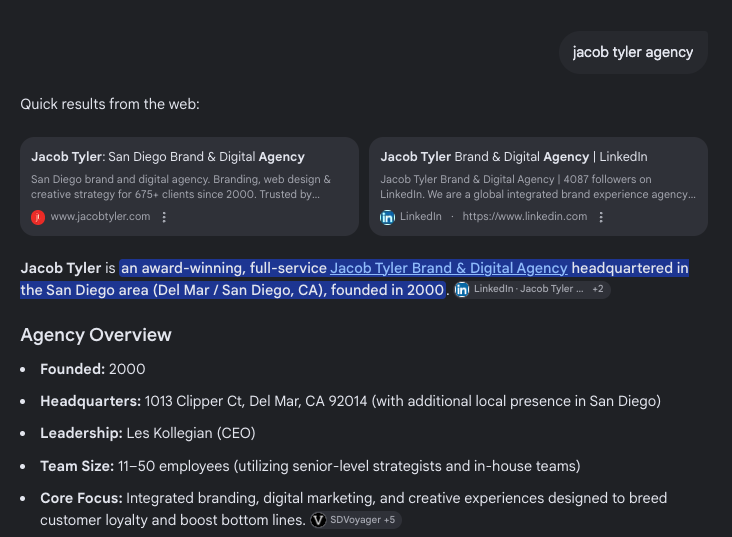
When someone types your company’s name into Google, an AI-written summary now often appears above the regular results. These summaries are called AI Overviews, and in September they spread to most searches for brand names, very possibly including yours. This article explains what changed, where the summaries get their information, and what you can check this week.
What is an AI Overview?
An AI Overview is a short, AI-written answer that Google places at the top of a search results page, above the usual list of links. Google introduced them in May 2024 and has expanded them steadily since. The text is combined from pages across the web, with small links to the sources it drew from. For example, a search for a software company’s name might return a few sentences describing what the company does, who runs it, and what it charges, drawn from several different websites.
What changed in September
Until recently, AI Overviews appeared mostly on how-to and research searches, not on searches for a specific company. That has changed. A study published by Ahrefs, a company that makes search analysis software, measured how often AI Overviews appear on branded searches, the industry term for searches that include a brand’s name. On United States desktop results, the share rose from about 61 percent in July to about 73 percent in September, and reached about 83 percent by September 29.
The same study also watched 100 large global brands week by week. On July 1, searching the exact brand name produced an AI Overview for 5 of them. By September 30 it was 63 of the 100, and the summary usually appeared in the first position on the page. If people search for your business by name, there is now a good chance an AI summary sits above your own website in the results.
Where the summaries get their information
The sources matter more than the headline number. Among the branded AI Overviews Ahrefs examined, about 72 percent cited Wikipedia, about 39 percent cited YouTube, and about 23 percent cited LinkedIn. Your own website may be one source among several, and sometimes it is not cited at all.
In practice, that means the first description a searcher reads about your business may be assembled from your Wikipedia entry, your LinkedIn page, and a YouTube video from three years ago. If those pages are out of date, the summary repeats the outdated version. The overview is usually not wrong on purpose; it is repeating what the public record says about you.
Why AI Overviews matter even if you did nothing
People who search for your name are usually the visitors most likely to become customers: referrals looking you up, returning customers heading for your site, and job candidates researching you. In Ahrefs’ earlier research, clicks on the top result were about 58 percent lower when an AI Overview was present, so some of those people will read the summary and never reach your site.
There is reassuring news in the data too. Of the 58 overviews Ahrefs could read in full, only 2 mentioned a competitor. The summary on your name is about you, drawn from public information about you. The risk is not rivals taking over your search results; it is a stale or generic description appearing above your own link. You can already measure some of this in Google’s own reporting, which we explained in our guide to the Search Console AI report.
Your options
- Monitor and leave it alone. This costs nothing, and it may be fine if the current summary is accurate. The trade-off is that the summary follows whatever the public record says, and nobody is checking it.
- Tidy the sources. Review and update the pages the overview cites: your LinkedIn company page, your YouTube descriptions, your Google Business Profile (the listing that appears in Google Maps and local results), and your Wikipedia entry where its editing rules allow. This is a few hours of work, though you still cannot control the exact wording Google writes.
- Treat AI search as a channel. Put plain answers to common questions about your business on your own site, keep every public profile current, and review the summaries on your most important searches monthly. This is the most work, and it gives you the most influence over what AI systems say; we covered the content side of this in our post on why your brand is invisible to ChatGPT.
Any of these can be the right choice for a given business. The share of your traffic that comes from brand name searches should guide how much effort this deserves.
Where to start
AI Overviews on brand names became common only in the past few months, and most summaries are accurate rather than damaging, so there is time to approach this calmly. A reasonable first week looks like this:
- Search your own name. Use a private browsing window so your history doesn’t shape the result, and read the overview the way a new customer would.
- List the sources it cites. Open each one and note anything outdated, thin, or wrong.
- Fix the easy ones. Your LinkedIn page, YouTube descriptions, and Google Business Profile can usually be updated the same day.
- Check your own site. Make sure it answers the basic questions about your business plainly: what you do, who it is for, and where you work.
If you’d like help with any of it, that’s work we do every day.