Why Rebrands Fail: The Strategy Most Companies Skip

Rebrands almost never fail because of the design. They fail because of what nobody talked about before the design started.

We’ve watched this play out for twenty-six years. A company decides it’s time. Leadership wants something fresh. The agency wins the project, sketches a few directions, the team picks the cleanest mark, and the new identity ships. Six months in, sales hasn’t moved. Customers haven’t noticed, or noticed and pushed back. Internal teams are still using the old templates because the new ones don’t fit how they actually sell. The CEO calls the agency to “tweak” the work. That call is not a creative problem. That call is a strategy problem that arrived dressed as one.

Industry research puts the rebrand failure rate near 40 percent, with another fifth of poorly executed rebrands losing meaningful chunks of their customer base in the months after launch (per analysis of rebrand mistakes across the last decade). The number is too high to be a coincidence, and it doesn’t drop because the next round of agencies are better designers. It drops when companies stop treating rebrands as visual exercises and start treating them as strategic ones.

This is the piece we wish more clients read before the kickoff meeting. Not because we’re trying to scare anyone out of doing the work. The work is worth doing. The cost of doing it wrong is a year of wasted budget, a confused sales team, and a customer base that quietly stops paying attention.
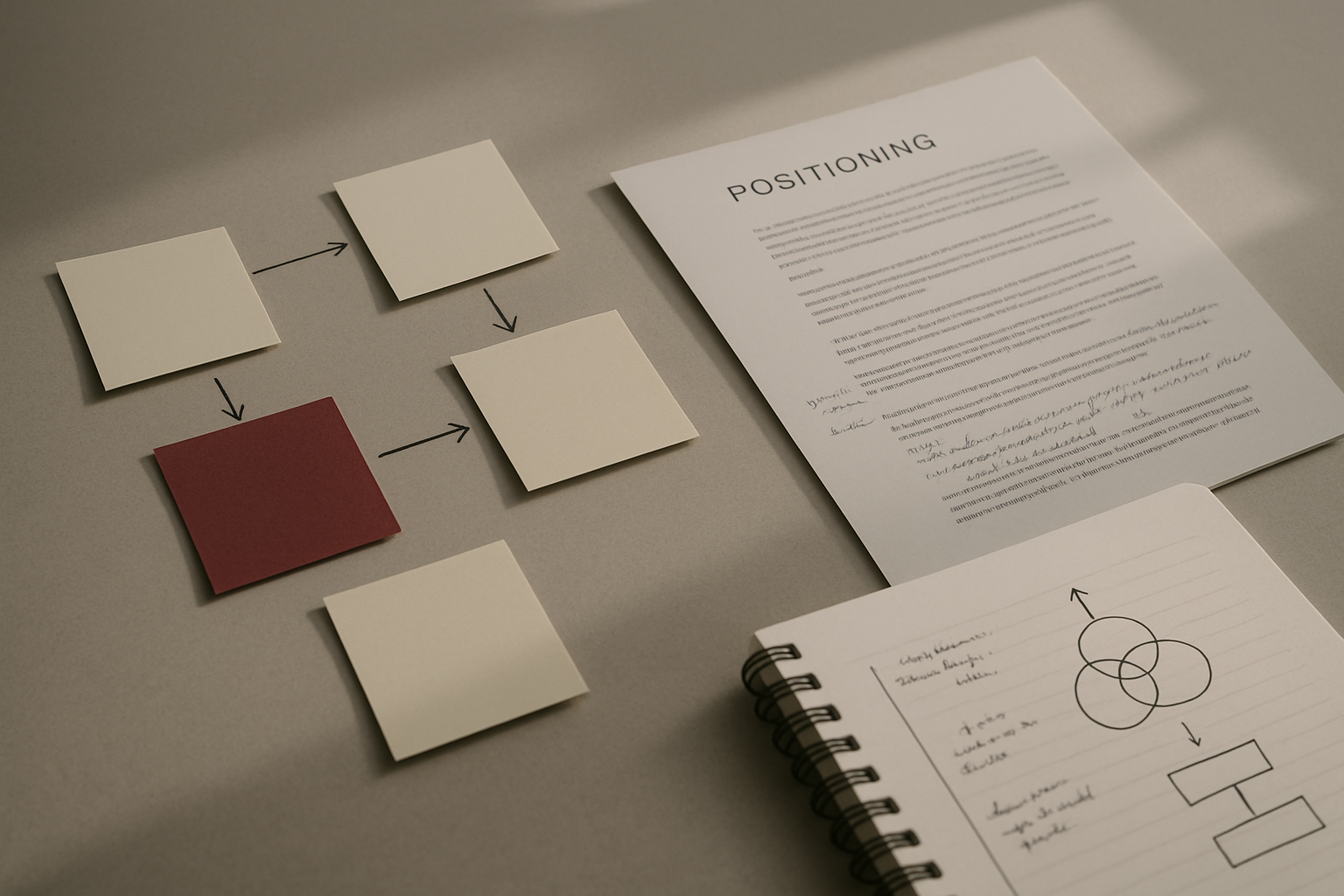
A desk with sticky notes mapping brand strategy paths, a printed positioning document with margin notes, and hand-drawn diagrams on a notepad.

Rebrands don’t fail because of the design

When a rebrand misses, the autopsy almost always blames the new logo. Tropicana lost roughly 20 percent in sales the month after their 2009 redesign. Gap retreated from theirs in six days. Yahoo iterated through three identities in five years and still couldn’t shake the perception of decline. Each of those is a design story on the surface. Underneath, they’re all the same story. The company didn’t know what it stood for, and the new identity made that visible.

Customers don’t reject new logos because the marks are ugly. They reject them because the logo doesn’t match the relationship they had with the brand. The visuals were never the contract. The contract was: this is who you said you’d be, and this is what you said you’d do. When a rebrand reveals that the company hasn’t decided either of those things, customers feel the gap. The design becomes a lightning rod for a problem that lived elsewhere all along.

Strong brands earn the right to change their visuals. Weak brands hide behind new ones. The harder a rebrand fights for attention, the louder it announces that the work underneath wasn’t done.

Why rebrands fail is rarely a creative problem

Read the postmortems on the public rebrand failures of the last few years and the same root causes appear. Customer research that didn’t happen. Stakeholder alignment that broke at the executive level. A positioning shift that nobody on the brand side could explain in a single sentence. A competitive analysis that ended at “we want to look more like X.” Heritage equity discarded for the wrong reason.

None of those are aesthetic problems. They are strategy gaps that the design phase exposes but cannot fix. Brand identity is downstream of brand strategy. When the strategy is missing, the identity has to do the work of two phases at once, and it always shows.

Mid-market companies hit this wall most often. They’re large enough to want the rebrand to feel substantial and small enough that one strong opinion in the executive room can override a decade of customer signal. Enterprise rebrands have more layers of approval, which is its own problem. The mid-market trap is specific. The founder, the new CMO, or the new investor walks in with a clear visual preference, and the strategic conversation gets compressed into a moodboard review. By the time the agency presents identity directions, the conversation that should have happened is six months behind.

Four kinds of rebrands, and why companies pick the wrong one

Not every rebrand is the same animal. Knowing which one you’re actually doing is half the work. Most companies misdiagnose this on day one and spend the next twelve months building the wrong thing.

  1. Refresh. You keep the equity, modernize the system. The wordmark stays recognizable. The palette tightens. Typography catches up with where the brand wanted to be five years ago. This is the right call when the strategy is solid, the audience hasn’t shifted, and the visuals just feel dated. It’s also the right call far more often than companies want to admit, because it’s harder to sell internally as transformation.
  2. Refocus. The strategy has shifted, the audience has narrowed or expanded, and the brand needs to express a new center of gravity. The visual system changes meaningfully, but the company is still recognizable to its existing customers. This is the most common rebrand done well. It’s also the one most often disguised as a refresh because the strategy work feels uncomfortable.
  3. Rebuild. The company is functionally a different business than it was. Acquisition. Pivot. New core product. New buyer entirely. The old name might survive, but everything else gets rethought from positioning down to the URL. Done right, this works. Done because someone is bored with the old brand, this becomes the case study other agencies use to scare clients.
  4. Rename. The rarest and the riskiest. You’re throwing away the equity in the name itself, which means the new brand has to earn recognition from zero while the old one still echoes. Reserve this for genuine reasons. Legal. Geographic expansion. A name that no longer reflects the business at all. Almost never do this for stylistic reasons.

The mistake we see most often is companies who needed a refresh ordering a rebuild, and companies who needed a rebuild ordering a refresh. The rebuild crowd burns equity they didn’t have to. The refresh crowd ships an identity that can’t carry the new strategy and has to redo the work eighteen months later. The first hour of any rebrand engagement should answer this question, not the last.

A clean office wall pinned with rows of design direction printouts, abstract shape studies, and color swatch cards arranged in clean grids.

The audit you keep skipping. What a real one finds.

A brand audit is not a slide of your existing logos with notes about kerning. A real audit is a diagnostic tool. It connects what your brand currently does to what your business actually needs, and it surfaces the gaps you’ll spend the next year trying to close.

What a useful audit looks at, in order:

  • Customer perception. Not what your team thinks the brand stands for. What buyers, lapsed buyers, and prospects actually associate with you. This is where the comfortable assumptions die first.
  • Internal alignment. Whether the executive team, sales, and product can describe the brand the same way without coordinating their answers in advance. This is the single best predictor of whether the rebrand will hold up under pressure.
  • Competitive position. Where you sit in the buyer’s mental map relative to the three or four companies they consider you against. The goal is not to be different in every direction. The goal is to be different in the direction that matters to the buyer’s decision (a useful B2B brand-audit framework lives here).
  • Brand equity inventory. What you’ve already built that’s worth keeping. Most rebrands underweight this. The equity in a familiar name, a recognizable color, or a tone of voice that customers expect is harder to rebuild than to preserve.
  • Activation gap. Where the brand promise lives strongly and where it falls apart. Onboarding. Sales materials. Support touchpoints. The website’s third-level pages. The rebrand has to plan for those, or the new identity dies inside the existing operations.

Companies that run this kind of audit before identity work usually conclude they need less of a rebrand than they thought, and a sharper one. That’s the right outcome. A small, decisive change applied to a clearer position outperforms a large, uncertain change applied to a fuzzy one every time.

The AI-rebrand era is making it worse, not faster

The new wrinkle in 2026 is that AI lets companies generate identity directions in days. That sounds like a productivity gain. In practice, it’s compressing the strategy phase to almost nothing because the visual phase looks so cheap. If a logo costs an afternoon, why spend three months on positioning?

Because the logo is the easy part. Always was.

We’ve seen mid-market clients show up with twenty AI-generated identity directions and a calendar that compresses strategy into a single workshop. The directions look polished. They also look like every other brand running the same prompts on the same tools. Recent research in Trends in Cognitive Sciences confirmed what creative directors have been saying out loud. AI-generated content trends toward statistical similarity over time. Same models. Same prompts. Same training data. Same output pattern. Distinctive isn’t an AI default. Distinctive is what humans force into the work.

This is the next decade’s competitive advantage and it is unglamorous. The brands that will stand out are the ones whose strategy is clear enough that the visual execution can’t dilute it. AI helps if you know what you’re trying to express. AI hurts if you don’t, because it gives you twenty reasonably good directions for a brand whose positioning isn’t reasonable yet.

A useful test: if your company can’t write its positioning in two sentences a board member could repeat, no amount of identity exploration will fix the problem. Spend that month on the positioning. The identity becomes obvious afterward.
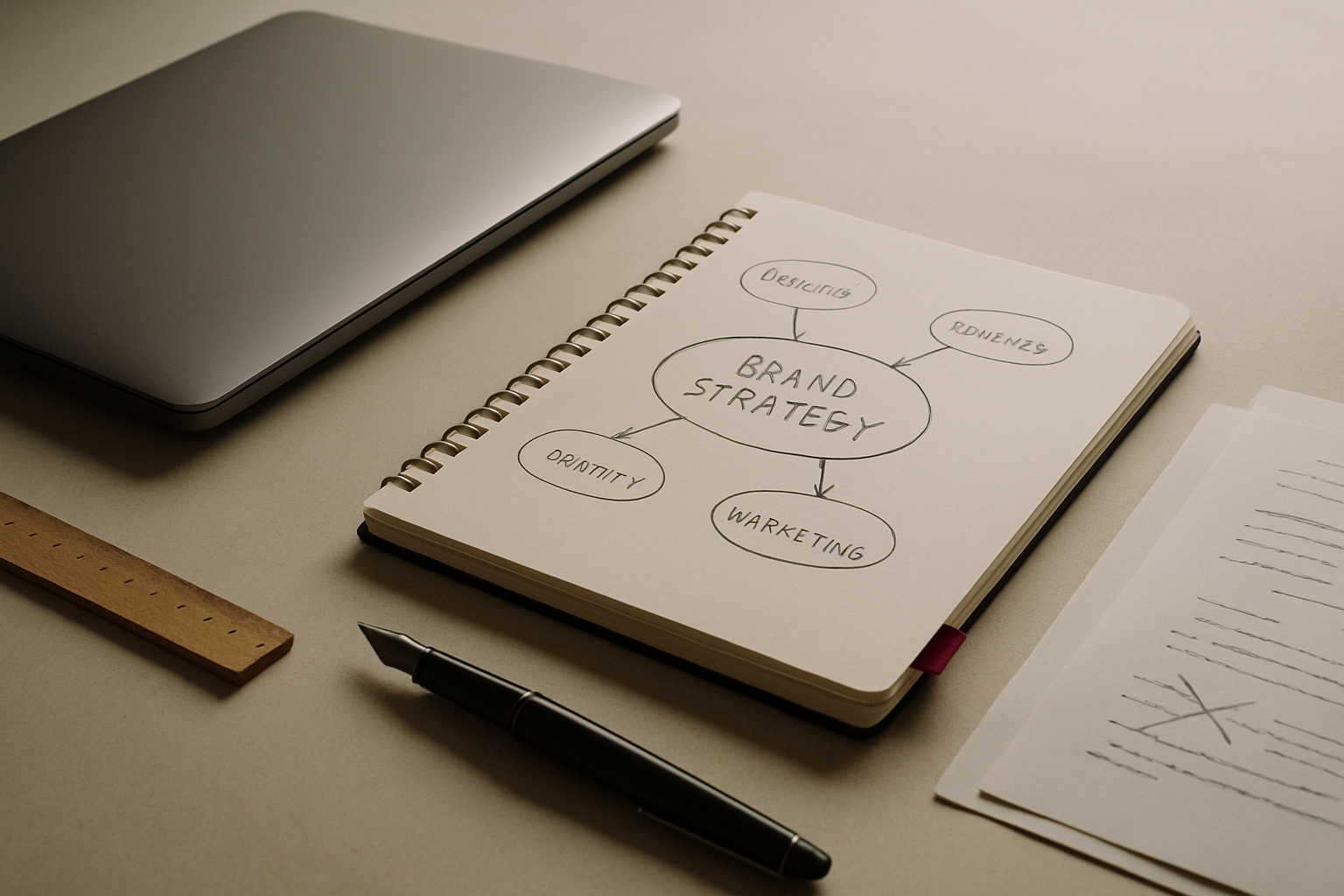
A closed laptop next to a hand-drawn brand strategy diagram in an open notebook, an analog ruler, a fountain pen, and annotated printouts.

The first 90 days of a rebrand that lands

The rebrands that work tend to follow the same arc. None of it is glamorous. All of it is unskippable.

In the first thirty days, the team runs the audit. Customer interviews. Internal stakeholder interviews. Competitive review. Brand equity inventory. The deliverable at the end of this month is not a deck of mood boards. It’s a clear statement of what the brand currently is, what the business needs the brand to become, and what the gap looks like. If the team can’t articulate that gap in one paragraph, the next sixty days will not save the work.

In days thirty to sixty, the strategy lands. Positioning. Voice. The narrative that explains the company to a buyer who has never heard of it. Architecture, if it’s a multi-product company. The deliverable is a strategic platform that can be defended without slides. If the executive team can read it back to each other and not flinch, the team is ready to design.

Days sixty to ninety are when identity work begins, not where it ends. The visual system. The voice in market. The system documentation. The rollout plan. This is the part most companies want to start in week one. Starting it in week nine is what makes it work.

The 90-day arc is not a magic number. Some rebrands need six months for the strategy phase alone. Some need less. The point is the order. Audit, then strategy, then identity, then activation. Skip the order and you become the case study nobody wants to be in.

Brand strategy is the part nobody can outsource to a tool

Rebrands fail in 2026 for the same reason they failed in 2006. Companies decide what the brand should look like before deciding what it should be. The tools have changed. The tools have gotten faster. The mistake hasn’t moved.

If you’re considering a rebrand, you have one decision to make before you talk to any agency, including ours. Decide whether you’re solving a strategy problem or a design problem. If you don’t know, you have a strategy problem. The audit will prove it. The fix is harder than a redesign and worth more than one. If you’d rather not figure that out alone, that’s where we come in.

From Audit to Action: How a Brand Audit Can Revive Your Strategy

Your brand feels stuck. Customer engagement has plateaued, your messaging seems disconnected from market reality, and competitors are gaining ground with strategies that resonate more effectively with your audience. Sound familiar? We see this challenge across industries, from established enterprises to emerging brands seeking their footing in competitive markets.

The solution often lies not in completely reinventing your brand, but in understanding exactly where you stand today. A brand audit is a process of assessing your brand’s current market position, allowing you to identify strengths and opportunities and compare your company to your competitors. When partnering with a skilled branding agency in San Diego, businesses trust, this comprehensive evaluation becomes the foundation for strategic transformation.

We approach brand audits as more than diagnostic exercises. They become roadmaps for growth, revealing hidden opportunities while addressing the gaps that prevent your brand from achieving its full potential. Let’s explore how this process can breathe new life into your strategy.

Understanding the Brand Audit Framework

The brand audit is a process by which you take inventory of brand assets, assess the brand’s performance on different channels, and conduct competitive analyses. This systematic evaluation examines every touchpoint where your brand intersects with customers, stakeholders, and the broader market.

We structure our audits around four core pillars:

  • Brand Identity Assessment: Evaluating visual elements, messaging consistency, and brand voice across all platforms
  • Market Position Analysis: Understanding how customers perceive your brand relative to competitors
  • Performance Metrics Review: Analyzing engagement rates, conversion data, and customer feedback patterns
  • Competitive Landscape Mapping: Identifying opportunities for differentiation and market gaps

A brand audit is a health check: By taking a step back and examining your brand’s performance internally and externally, you ensure it meets company and consumer expectations. This comprehensive approach ensures we capture both the quantitative metrics and qualitative insights that drive strategic decisions.

The Strategic Benefits of Brand Auditing

A brand audit helps you optimize your marketing strategies by providing valuable insights into what works and what doesn’t. By understanding your brand’s performance and customer perceptions, you can create more targeted and effective marketing campaigns. This ensures that your marketing efforts are not only efficient but also yield better returns on investment.

Our clients consistently discover three key advantages through the audit process:

Enhanced Brand Clarity and Consistency

A brand audit helps you refine and enhance your brand identity, making it more appealing and relatable to your target audience. It involves evaluating elements like your logo, tagline, and overall brand messaging. Ensuring consistency across these elements strengthens your brand identity and fosters better brand recall.

Data-Driven Strategic Direction

As a result, you will get a list of actionable insights you can implement to boost your company’s overall results. Rather than making assumptions about market position or customer preferences, we base recommendations on concrete evidence gathered through comprehensive research and analysis.

Competitive Advantage Identification

Competitor analysis helps identify the strengths and weaknesses of your brand compared to your competitors, allowing your brand to capitalize on opportunities and avoid pitfalls. This is about keeping up with the competition and finding ways to innovate and lead in your market space. Analyzing competitor brands can also reveal gaps in the market that your brand can fill.

The Brand Audit Process: From Assessment to Action

Phase One: Discovery and Data Collection

We begin by establishing clear objectives for the audit. The first step involves getting a clear picture of the purpose of your brand audit and establishing a framework. The process starts with a crucial question to clarify your goals. Do you aim to understand your market position, customer perceptions, or brand effectiveness?

Our discovery phase includes:

– Stakeholder interviews across all organizational levels

– Customer feedback analysis from multiple touchpoints

– Digital asset inventory and performance review

– Competitive intelligence gathering

Phase Two: Analysis and Insight Development

Next, work through a SWOT analysis of your brand against your competitors. Cover these key areas: Strengths: What does your brand do better than its challengers? Weaknesses: What do your competitors do better than you? Opportunities: What are the biggest opportunities for your brand right now? Threats: Are there any new brands that could be a threat? The answers will help you identify what sets your brand apart and will provide a core element of your positioning and messaging.

This analytical phase transforms raw data into strategic insights by identifying patterns in customer behavior, market trends, and competitive positioning, which inform actionable recommendations.

Phase Three: Strategy Development and Implementation Planning

The outcome of a successful brand audit should be a plan of action that will highlight the areas for improvement. The program should specify the goals you want to achieve and a timeline of expected results.

We prioritize recommendations based on impact potential and implementation feasibility, ensuring your team can execute changes systematically while maintaining business continuity.

Real-World Impact: When Audits Drive Results

Consider a mid-market technology company we worked with that was struggling with brand recognition despite having superior product capabilities. Our audit revealed that while their technical messaging was accurate, it failed to communicate value in a way that their target audience could understand.

Before: Complex technical jargon dominated their website and marketing materials, leading to a 12% conversion rate from qualified leads and minimal brand recall in market research studies.

Our Intervention: We restructured their messaging hierarchy to lead with business benefits, supported by technical proof points. Visual identity elements were refined to convey innovation while maintaining credibility.

After: Within six months, conversion rates increased to 28%, and brand awareness in their target market improved by 45%. The company secured three major enterprise contracts directly attributed to improved brand clarity and market positioning.

This transformation illustrates how strategic brand audits translate insights into measurable business outcomes.

When to Conduct a Brand Audit

According to industry experts, a brand audit should be conducted at least once a year or during special events such as mergers, acquisitions, changes in brand positions, or the introduction of new market segments. Key signs like dwindling customer loyalty or sales slump may also necessitate reevaluating brand strategies through an audit.

We recommend immediate brand audits when you observe:

  • Declining customer engagement metrics across channels
  • Inconsistent brand representation across departments or locations
  • Market share erosion despite product quality improvements
  • Difficulty attracting top talent or strategic partnerships
  • Upcoming major business transitions or expansion plans

Running a monthly brand audit of the most important metrics can help identify opportunities and quickly adapt to the market and consumer needs. It can also ensure brand and messaging consistency. For ongoing brand health, we establish monitoring systems that track key indicators between comprehensive annual audits.

Overcoming Common Audit Challenges

Internal Resistance to Change

We find resistance to change within an organisation to be a common challenge brands face during brand audits. Internal stakeholders may resist new strategies suggested by the audit due to fear of the unknown or attachment to old, familiar methods. To address this, you need to communicate the benefits of proposed changes and involve team members in the audit process. This fosters a sense of ownership and eases fears.

We address this by involving key stakeholders in the audit process from the beginning, ensuring they understand both the methodology and rationale behind recommendations.

Rapidly Changing Market Dynamics

Rapidly changing market dynamics can make brand audit findings outdated. Today’s fast-paced market demands agility and adaptability in brand strategies. Our approach builds flexibility into recommendations, creating frameworks that can adapt to market shifts rather than rigid tactical prescriptions.

The Path Forward: Transforming Insights into Growth

A well-conducted brand audit paves the way for a robust brand strategy, one that is responsive to market changes and customer needs, ultimately leading to a powerful, enduring brand presence.

The most successful brand transformations begin with understanding the current reality. Through systematic evaluation of brand performance, market position, and competitive landscape, we uncover the strategic insights that drive meaningful growth.

Your brand audit becomes the foundation for everything that follows: refined messaging that resonates with target audiences, visual identity that stands out in crowded markets, and customer experiences that build lasting loyalty.

Ready to discover what your brand audit might reveal? Let’s talk about how we can help you transform insights into action and strategy into sustainable growth.

Frequently Asked Questions

How long does a comprehensive brand audit typically take?

The time it takes to complete a brand audit depends on the size and complexity of your brand. It involves analyzing your current branding, market trends, and customer perceptions, a process that can take anywhere from a few weeks to several months. Level 1: 3–4 weeks, focusing on foundational branding elements. Level 2: 6–8 weeks or longer for a comprehensive market analysis and strategy refinement. We customize timelines based on your specific needs and the depth of analysis required. Most mid-market companies benefit from our thorough approach, which typically takes 6-8 weeks to complete thoroughly.

What specific outcomes can we expect from a brand audit?

An audit provides clarity on your strengths and areas for improvement. By analyzing customer feedback, marketing metrics, and competitor benchmarks, it delivers actionable insights to enhance brand performance and customer experience. You’ll receive a detailed report with prioritized recommendations, implementation timelines, and success metrics. Our clients typically see improvements in brand consistency, customer engagement rates, and market positioning within 3-6 months of implementing audit recommendations.

Can small businesses benefit from brand audits, or are they primarily for larger companies?

Small businesses can benefit from an audit by gaining clarity on their brand identity, understanding their target audience better, and identifying quick wins to improve brand visibility and customer experience. In fact, smaller businesses often see more immediate impact from brand audits because they can implement changes more quickly than larger organizations. We offer scaled approaches that provide maximum value within smaller budgets, focusing on high-impact opportunities that drive growth.