AI Overviews Now Appear on Most Searches for Brand Names

When someone types your company’s name into Google, an AI-written summary now often appears above the regular results. These summaries are called AI Overviews, and in September they spread to most searches for brand names, very possibly including yours. This article explains what changed, where the summaries get their information, and what you can check this week.

What is an AI Overview?

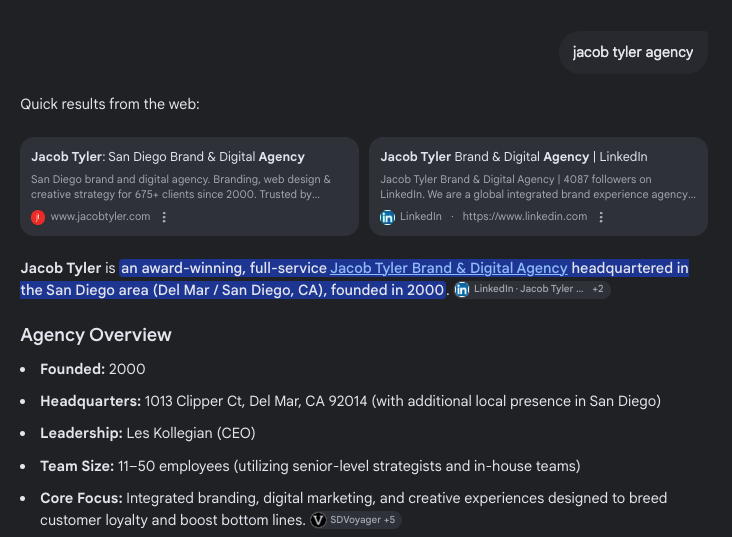
An AI Overview is a short, AI-written answer that Google places at the top of a search results page, above the usual list of links. Google introduced them in May 2024 and has expanded them steadily since. The text is combined from pages across the web, with small links to the sources it drew from. For example, a search for a software company’s name might return a few sentences describing what the company does, who runs it, and what it charges, drawn from several different websites.
What changed in September

Until recently, AI Overviews appeared mostly on how-to and research searches, not on searches for a specific company. That has changed. A study published by Ahrefs, a company that makes search analysis software, measured how often AI Overviews appear on branded searches, the industry term for searches that include a brand’s name. On United States desktop results, the share rose from about 61 percent in July to about 73 percent in September, and reached about 83 percent by September 29.

The same study also watched 100 large global brands week by week. On July 1, searching the exact brand name produced an AI Overview for 5 of them. By September 30 it was 63 of the 100, and the summary usually appeared in the first position on the page. If people search for your business by name, there is now a good chance an AI summary sits above your own website in the results.

Where the summaries get their information

The sources matter more than the headline number. Among the branded AI Overviews Ahrefs examined, about 72 percent cited Wikipedia, about 39 percent cited YouTube, and about 23 percent cited LinkedIn. Your own website may be one source among several, and sometimes it is not cited at all.

In practice, that means the first description a searcher reads about your business may be assembled from your Wikipedia entry, your LinkedIn page, and a YouTube video from three years ago. If those pages are out of date, the summary repeats the outdated version. The overview is usually not wrong on purpose; it is repeating what the public record says about you.

Why AI Overviews matter even if you did nothing

People who search for your name are usually the visitors most likely to become customers: referrals looking you up, returning customers heading for your site, and job candidates researching you. In Ahrefs’ earlier research, clicks on the top result were about 58 percent lower when an AI Overview was present, so some of those people will read the summary and never reach your site.

There is reassuring news in the data too. Of the 58 overviews Ahrefs could read in full, only 2 mentioned a competitor. The summary on your name is about you, drawn from public information about you. The risk is not rivals taking over your search results; it is a stale or generic description appearing above your own link. You can already measure some of this in Google’s own reporting, which we explained in our guide to the Search Console AI report.

Your options

  1. Monitor and leave it alone. This costs nothing, and it may be fine if the current summary is accurate. The trade-off is that the summary follows whatever the public record says, and nobody is checking it.
  2. Tidy the sources. Review and update the pages the overview cites: your LinkedIn company page, your YouTube descriptions, your Google Business Profile (the listing that appears in Google Maps and local results), and your Wikipedia entry where its editing rules allow. This is a few hours of work, though you still cannot control the exact wording Google writes.
  3. Treat AI search as a channel. Put plain answers to common questions about your business on your own site, keep every public profile current, and review the summaries on your most important searches monthly. This is the most work, and it gives you the most influence over what AI systems say; we covered the content side of this in our post on why your brand is invisible to ChatGPT.

Any of these can be the right choice for a given business. The share of your traffic that comes from brand name searches should guide how much effort this deserves.

Where to start

AI Overviews on brand names became common only in the past few months, and most summaries are accurate rather than damaging, so there is time to approach this calmly. A reasonable first week looks like this:

  • Search your own name. Use a private browsing window so your history doesn’t shape the result, and read the overview the way a new customer would.
  • List the sources it cites. Open each one and note anything outdated, thin, or wrong.
  • Fix the easy ones. Your LinkedIn page, YouTube descriptions, and Google Business Profile can usually be updated the same day.
  • Check your own site. Make sure it answers the basic questions about your business plainly: what you do, who it is for, and where you work.

If you’d like help with any of it, that’s work we do every day.

Cloudflare AI Crawler Block: Don’t Lock Out Google by Accident

The Cloudflare AI crawler block is about to do something most site owners never asked it to do. On September 15, Cloudflare changes how it treats crawlers that do more than one job, and a toggle a lot of teams flipped in 2024 or 2025 is going to start meaning something new. If you turned on “Block AI bots” when that felt like the responsible move, read this before Monday.

We’ve spent the last year telling clients the same thing about AI search: being findable matters more than being protected. llms.txt didn’t help. Building for agents did. This change is the first time a default setting can quietly undo that work.

What actually changes on September 15

Cloudflare is splitting AI traffic into three buckets: Search (crawling so you show up in results), Agent (a bot visiting on behalf of a real person, right now), and Training (a bot taking your content to teach a model). Fair enough. Different behaviors deserve different rules.

Two things happen on the 15th. First, for new domains joining Cloudflare, Training and Agent get blocked by default on any page that shows ads, while Search stays allowed. If your site doesn’t run ads, that default mostly leaves you alone.

Second, and this is the one that matters, multi-purpose crawlers get judged by everything they do, not just the friendliest thing. Googlebot crawls for Search and for Google’s AI products. Bingbot and Applebot do the same. Under the new rule, a crawler that does both is governed by the most restrictive rule you’ve set. Cloudflare says it plainly in its own announcement: customers who chose to block Training, whether through the new options or the legacy “Block AI bots” service, will block Googlebot, Applebot, and Bingbot.

Read that twice. The setting you turned on to keep your content out of a training set is about to keep you out of Google. Not because anyone changed their mind about you. Because the definition moved.

Why the old Cloudflare AI crawler block is the trap

When Cloudflare shipped its one-click AI block in 2024, it was a clean idea: one switch, block the scrapers. Thousands of agencies flipped it on client sites during a launch or a migration and moved on. Nobody’s been back to that screen since. That’s not negligence. That’s how infrastructure works.

The problem is that “block AI” in 2024 and “block AI” in September 2026 describe different sets of bots. Cloudflare’s numbers explain why they’re forcing the issue: more than half of all traffic on the internet is now non-human, and over 50% of AI crawler hits are re-fetching pages that haven’t changed. Cloudflare wants the AI companies to split their crawlers into honest, single-purpose bots. To force that, it’s making mixed-use crawlers pay the strictest price. Google is the biggest mixed-use crawler there is.

Cloudflare is squeezing Google. Your site is the collateral.

A default is Cloudflare’s opinion, not yours

We don’t think Cloudflare is wrong to push here. Publishers who live on ad revenue have a real grievance, and a toggle that says “index me, don’t absorb me” is overdue. But the default is written for a news site that monetizes attention. It’s not written for a manufacturer with 40 product pages or a B2B brand whose growth plan runs through search and AI answers.

For most of the businesses we build for, the math is simple. Training crawlers are a minor cost. Search crawlers are the business. Agent crawlers are the next customer, arriving early. Blocking the first is fine. Blocking the second by accident is a bad month. Blocking the third on purpose means the site you just paid for can’t sell to the buyer who’s shopping through Gemini or ChatGPT.

So decide. Don’t inherit.

What to do before Monday

This is a fifteen-minute job if you know where to look, and a very expensive one if you find out from your traffic report in October.

Find out if you’re behind Cloudflare at all. A surprising number of clients don’t know. Check the DNS or ask whoever set up the site. Free plans and recently added domains inherit the new defaults. Paid plans keep their existing settings, but the multi-purpose rule still applies to anyone who blocks Training.

Open Security settings and look for the AI traffic controls. If the legacy “Block AI bots” switch is on, you’re in the affected group. Cloudflare has put an opt-out in that same screen that confirms you want no change to Training crawlers that also crawl for Search. Use it, or switch to the new three-bucket controls and set them deliberately: allow Search, allow Agent, and make a real call on Training.

Put your preference in robots.txt too. Cloudflare is extending Content Signals with a use= field (immediate, reference, or full) that states how a bot may keep and reuse what it fetched. It’s a preference, not a lock, but it’s the layer that survives when you change CDNs. Google also offers Google-Extended for opting out of Gemini training without touching Search. Use the tools that separate the behaviors instead of the one that lumps them.

Then watch the crawl. Search Console’s crawl stats on the 16th will tell you in a day what an analytics report tells you in a month. If Googlebot requests fall off a cliff, you know where to look.

The bigger pattern

Every few months the AI conversation produces a new switch that promises to make the problem go away. Block the bots. Add the file. Opt out of the thing. The switches are easy, which is why they get flipped and forgotten. The decision underneath them, who gets to read your site and what they can do with it, doesn’t stay made. This week it moved again.

Twenty-six years in, we’ve learned that the settings nobody’s looked at since launch are the ones that cost the most. If you’d rather have someone check that screen for you before the 15th, that’s exactly what we’re here for.

Search Console’s New AI Report: Visibility Isn’t Value

Google spent two years pushing AI answers into every results page while giving you no way to see yourself in them. That era just ended. As of August 31, every Search Console property in the world has two new switches: a report that shows how often your pages appear in AI Overviews and AI Mode, and a toggle that pulls your content out of Google’s AI features entirely. One deserves your attention. The other deserves your suspicion.

We’ve spent most of 2026 telling clients that AI search visibility was real but unmeasurable. When we wrote about why brands are invisible to ChatGPT back in April, the honest caveat was that nobody could see the scoreboard. That caveat just expired.

The scoreboard everyone asked for

Google introduced its generative AI performance report in June and finished rolling it out to every site at the end of August. Open Search Console today and you can see the impressions your pages earn inside AI Overviews, AI Mode, and the AI features in Discover, sliced by page, country, device, and date.

If you’re a marketing director who has spent this year answering “how are we doing in AI search” with a shrug, this is a real gift. And yes… we have been asking ourselves this question in our own agency for our own Website. With that said, you can finally point at a number. You can watch it move when you publish something worth quoting. You can see which pages Google’s AI reaches for and which ones it walks past.

What it counts. What it hides.

Now the fine print. The report counts impressions and stops there. No queries. No clicks. No click-through rate, no position, no revenue trail. It answers the question you were asking last year: are we visible? It can’t answer the question your CFO is asking this year: is any of it earning anything?

That gap matters because AI search doesn’t hand off traffic the way blue links did. Someone asks a question, reads the answer, and leaves. If your brand shaped that answer, the report counts it. Everything that happens next, the branded search two days later, the direct visit, the mention in a sales call, lives outside the report entirely.

So treat the new number as a direction check, not a KPI. Pair it with the signals that show intent actually moved: branded search volume, direct traffic, and the “how did you hear about us” field your sales team keeps forgetting to read.

The off switch is a decision focused on business verticals.

The second switch is the one to handle with care. The same rollout gave every site owner a control to block their content from Google’s AI features. Flip it and your pages stop appearing in AI Overviews and AI Mode. Google is explicit about the cost: opted-out sites get no traffic and no impressions from those features. Your regular rankings stay untouched. The AI shelf just goes dark.

If you’re a publisher whose product is the content itself, run that math seriously. An AI answer that substitutes for your article is a real loss, and the toggle is a legitimate business lever.

If you sell anything else, the math points the other way. Your buyers are standing in the AI aisle asking the clerk what to buy. Blocking Google’s AI doesn’t punish Google. It takes your product off the shelf while your competitors stay stocked. Publishers can argue AI answers replace their product. For everyone else, AI answers are the shelf.

Read it monthly. Then get back to work.

Our advice after a few weeks inside these reports: check the trend monthly, note which pages earn citations, and resist the urge to build a dashboard shrine to AI impressions. Teams that chase impressions will produce the same thin, keyword-shaped sludge that chasing rankings produced. Same panic, new metric.

What earns the citation hasn’t changed. When we covered llms.txt in July, the point was never the file. The point was that AI systems quote brands with a sharp point of view, real proof behind their claims, and messaging their own team can repeat without checking notes. Now that work finally shows up on a scoreboard. The scoreboard didn’t change the game. It just turned on the lights.

If you’d rather your brand be the answer instead of the audience, that’s the work we do. Bring us the report. We’ll bring the plan.

AI Search Visibility: Why Your Brand Is Invisible to ChatGPT

Search engine optimization isn’t dead. The scoreboard just changed, and AI search visibility is the new race most brands aren’t running.

Buyers in 2026 don’t always start with Google. They start with ChatGPT. Or Claude. Or Perplexity. They type “best [whatever] for [specific situation],” read a paragraph, and trust the recommendation. Increasingly, that recommendation never mentions you. Industry estimates suggest 73% of brands are invisible when AI tools generate recommendations in their category. Page-one rankings on Google don’t transfer. New rules, same panic, fresh acronyms.

The new AI search visibility problem is real, but it isn’t new

The mechanics are different. Large language models don’t crawl your site for keyword density. They reference what was in their training data and what gets retrieved live by the AI tool’s search layer. They favor brands that are talked about elsewhere — by reviewers, journalists, podcasters, customers, partners — and that have a clear, consistent identity to begin with. That part isn’t new. That’s how a brand has always become recognizable. AI search just made the lack of recognition more visible, faster.

What’s changed is that “first page of Google” no longer doubles as a brand-recognition trophy. A site can rank for its category and still go unmentioned the moment a buyer asks an AI for a recommendation. That’s a new problem for marketing teams. It’s not a new problem for branding.

Why “AEO” is mostly old work in new packaging

The category just spawned its own three-letter acronym pile: AEO (answer engine optimization), GEO (generative engine optimization), and now agentic engine optimization, which is somehow also AEO. April 2026 was openly framed by analysts as the “AEO inflection point”, complete with a wave of agencies relabeling their SEO retainers. The acronyms are profitable. They are not insightful.

Strip the labels and three things determine whether an AI cites you:

  • Whether your brand has a clear point of view that’s easy to summarize.
  • Whether credible third parties have written about you in language that maps to how buyers actually ask.
  • Whether your own content directly answers the question, in plain language, near the top of the page.

That’s the work. It’s the same work a thoughtful brand strategist would have prescribed in 2010. The packaging is louder, but the prescription is older than any of the acronyms describing it.

What actually fixes AI search visibility

Concrete moves, in roughly the order they’ll matter:

Get your brand messaging sharp. One sentence that says what you do, for whom, and why it’s different. If your team can’t agree on it, neither can ChatGPT.

Build third-party authority. Earned mentions on credible sites, podcast appearances, partner write-ups, real customer reviews, expert directories. AI weighs what others say about you more than what you say about yourself. This is PR’s moment, not link-building’s.

Front-load the answers on your top pages. Question-format H2s. A direct answer in the first paragraph. Specifics — numbers, named situations, real outcomes — close behind. AI tools cite the first portion of a page far more often than the rest. Stop burying the lead.

Maintain entity consistency. Your Wikipedia entry, Google Business Profile, schema markup, and major directory listings should all describe the same company in the same words. Fragments confuse the model.

Pick fewer topics and own them. Topical depth beats topical breadth. A handful of well-argued substantive articles are worth more than a year of skim-pieces.

The hardest part to outsource

The brands that win in AI search are mostly the brands that were worth winning before AI search existed. They have a sharp position. They’ve earned credibility. They show up in conversations because they say things worth repeating.

You can buy your way into a directory. You can pay for schema markup. You can hire someone to restructure your H2s. None of that gets ChatGPT to put your name in the answer if your brand has nothing memorable to say. AI search rewards substance because it’s pattern-matching across the substance other people have already produced about you. No substance, no signal.

The good news is that the work isn’t mysterious. It’s brand strategy, plain content, real PR, and the discipline to do those things well over a long enough horizon that the algorithms — the current ones and the next ones — start to notice.

If your brand already has a sharp point of view and a real story to tell, AI search visibility is the easiest part. If it doesn’t, that’s where the work starts. That’s where we come in.