Your Brand Voice Guidelines Can’t Survive Contact With AI

Most brand voice guidelines were written to be admired, not used. Two adjectives, a mood board, a slide that says “confident but approachable,” and everyone nods and files it away. That held up fine when one senior copywriter carried the voice in their head and the guide was a souvenir of the workshop. It stops holding up the moment half your content starts life inside a model.

This year the conversation flipped. Agencies and in-house teams that spent 2024 and 2025 arguing about AI strategy are now arguing about brand voice strategy instead, because the tools turned out to be the easy part. The brand voice guidelines that survive 2026 look less like a personality quiz and more like a spec. If you’re the person responsible for how your brand sounds, that shift is worth getting ahead of.

“Friendly but professional” is the average, not a voice

Open almost any brand book and you’ll find the same four adjectives: friendly, professional, bold, authentic. They feel specific in the workshop. They constrain nothing in practice. “Friendly but professional” describes half the internet, which is exactly why a model handed that phrase produces copy that sounds like everyone else’s. AI regresses to the mean by design. The mean is precisely what those adjectives point at.

Good writers always compensated for this quietly. A copywriter joining your brand (like our Senior Copywriter, Jeff Horn) reads the guide, ignores the adjectives, studies the actual copy, and absorbs the voice from there. The model doesn’t do that unless you make it. It takes “friendly” at face value and hands you exclamation points.

The adjectives were never the voice. The copy was.

A voice is rules you can enforce

A voice guide that works, for humans and machines alike, reads like an editor wrote it rather than a workshop facilitator. It names the words you use and the words you never use. It sets the sentence rhythm: how long, how punchy, where the fragments go. It states your point of view, your stance on hedging, your tolerance for jargon. And it gives situational range, because the voice in a service-outage email isn’t the voice on a billboard, and the guide should say exactly how they differ.

The best way to build one isn’t invention. It’s extraction. Take the ten pieces of published copy that sound most like you and pull the rules out of them: the recurring vocabulary, the average sentence length, the moves your best writer makes without thinking. Then run a blind test. Mix guide-driven drafts in with your real copy and ask your own team to spot the difference. If they can, the guide isn’t finished.

We made this point about vibe marketing in June: automation scales whatever voice you feed it, distinct or generic. The guide is what decides which one you’re scaling.

The editing tax is the tell

Here’s how to know your current guidelines have already failed: watch your editors. Teams without an operable voice guide report spending 15 to 30 minutes re-toning every AI draft by hand. That’s the editing tax, and it quietly eats most of what the tooling was supposed to save. The fix isn’t a better model. It’s a tighter spec.

The stakes stopped being theoretical this year. Valentino and McDonald’s both pulled AI-generated campaigns after audiences called the work flat, while brands like Aerie and Equinox built campaigns around visibly human craft and got rewarded for it. Readers can’t always name what’s off in machine-flavored copy, but they feel it, and they’re sorting brands into two piles: the ones that sound like themselves and the ones that sound like the tool.

Nobody remembers the average. That’s what makes it cheap.

Brand voice guidelines are infrastructure now

We’ve watched brand books get printed, praised, and shelved for twenty-six years. The voice pages were usually the garnish, three slides between the logo rules and the color palette. Not anymore. The voice guide is becoming the one brand document that gets used every day, by every writer and every tool that touches your name. It’s the difference between a thousand pieces of content that compound into a recognizable brand and a thousand pieces that could belong to anyone.

If your voice lives in one writer’s head, you don’t own it. You’re renting it, and the lease ends when they leave. So write it down as rules, test it against your own best copy, and retire the adjectives. If you’d rather not build that spec alone, brand messaging and copywriting are what we do all day.
Anti-AI Design Isn’t a Backlash. It’s a Standards Reset.

Anti-AI design isn’t a backlash against AI. It’s a backlash against average. The two look identical from a distance, but only one of them tells you what to actually do about it.

We’ve watched this play out for twenty-six years, just with different villains. Stock photography was supposed to kill original photography. Squarespace was supposed to kill web design. Now AI is supposed to kill creative work entirely. And every time, the same thing happens. The floor rises. Average gets cheap. Distinction gets expensive. Brands that bought into “good enough” learn what “good enough” buys you.

The 2026 version is louder than the others, because the floor rose faster. The play is the same.

Anti-AI design isn’t the story. Anti-average is.

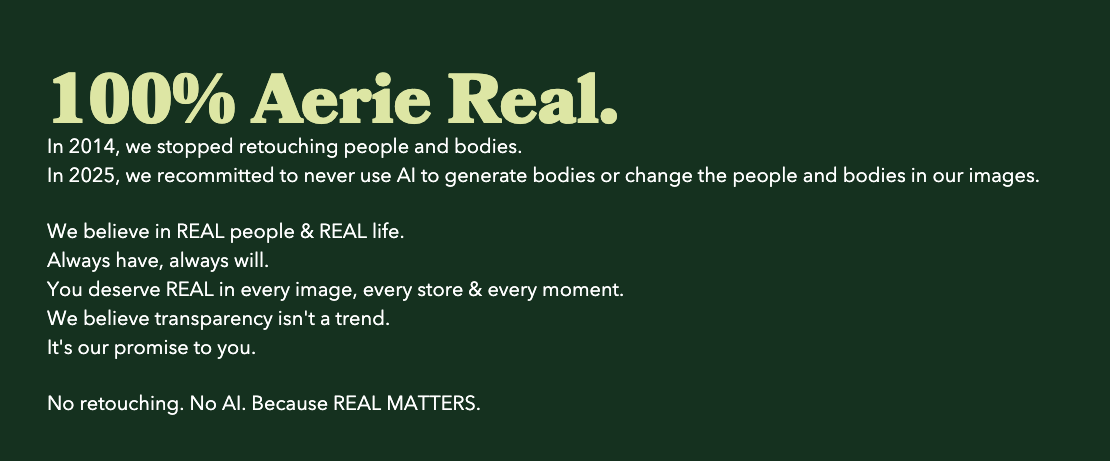
Look at what the brands getting credit for “anti-AI” stances are actually selling. Aerie pledged “No retouching. No AI. 100% real people,” and engagement on the post jumped 75%. Equinox built a 2026 campaign called “Question Everything But Yourself” around unfiltered human portraits set against synthetic ones. Almond Breeze ran cheeky ads about not using AI in its creative. None of these brands are fighting AI. They’re using AI as a foil to say something they could have said any year of the last twenty.

Aerie has been telling this story since 2014. The “100% Aerie Real” line predates ChatGPT by almost a decade. AI didn’t change Aerie’s brand. It changed what Aerie’s brand sounds like in the room.

That’s the whole movement. Brands with a real point of view sound sharper now, because the average around them got blander. Brands without one are still in trouble, only louder.

What “human-made” actually signals to a buyer

The “human-made premium” framing is real, but the diagnosis is off. Customers aren’t paying more because a person’s fingerprint is on the work. They’re paying more because the work is specific. It addresses them. It picks a side. It risks something.

AI-generated copy and AI-generated visuals have a tell, and it isn’t a watermark. The tell is that nothing is at stake. The voice is hedged. The composition is symmetrical. The metaphor is one of the seven any model can produce on demand. Customers can feel the absence of decisions. They might not name it that, but they vote with their attention.

When people say they want “human” content, they usually mean they want content that knows who it’s for and isn’t afraid of being wrong about it. AI can technically do this, with a sharp brief and a strong editorial hand on top. The brands getting it right aren’t anti-AI. They’re anti-default.

The work the polish can’t fake

Here’s the part that matters for anyone building a brand right now.

The cheap parts of design got cheaper. Layout, color, type pairing, basic illustration, photo retouching, mood-board generation. Anything that was a craft skill in 2020 is a slider in 2026. That’s real, and it isn’t going back.

The expensive parts got more expensive. A point of view the company can defend in a board meeting. Naming that earns trademark protection and survives a Google search. A voice that sounds like one specific company, not a category. A visual identity that’s recognizable from a quarter-mile away with the logo cropped off. None of these get easier because the production layer got faster.

Twenty-six years in, the failures rhyme. The brands scrambling right now didn’t get killed by AI. They got exposed by it. The average work was carrying them. Now it isn’t.

What this means if you’re building a brand right now

Stop benchmarking your work against last year’s average. Last year’s average is now free. If your creative output looks like what a model produces on the second prompt, it’s not creative output anymore. It’s a placeholder.

Spend the saved time on the parts that don’t get cheaper. A defensible position. A brand voice that picks a fight, however small. A visual system that holds up when stripped to one element. The work that was always good is suddenly the only work that survives.

If you’re using AI, say so. If you aren’t, say that too. The brands winning right now aren’t winning because they’re anti-AI. Frankly, the team at Jacob Tyler is not anti-AI. We are anti -average. Our clients are winning because they decided what they actually believe before anyone wrote the brief.

If you’d rather not figure that out alone, that’s where we come in.