Why Rebrands Fail: The Strategy Most Companies Skip
Rebrands almost never fail because of the design. They fail because of what nobody talked about before the design started.
We’ve watched this play out for twenty-six years. A company decides it’s time. Leadership wants something fresh. The agency wins the project, sketches a few directions, the team picks the cleanest mark, and the new identity ships. Six months in, sales hasn’t moved. Customers haven’t noticed, or noticed and pushed back. Internal teams are still using the old templates because the new ones don’t fit how they actually sell. The CEO calls the agency to “tweak” the work. That call is not a creative problem. That call is a strategy problem that arrived dressed as one.
Industry research puts the rebrand failure rate near 40 percent, with another fifth of poorly executed rebrands losing meaningful chunks of their customer base in the months after launch (per analysis of rebrand mistakes across the last decade). The number is too high to be a coincidence, and it doesn’t drop because the next round of agencies are better designers. It drops when companies stop treating rebrands as visual exercises and start treating them as strategic ones.
This is the piece we wish more clients read before the kickoff meeting. Not because we’re trying to scare anyone out of doing the work. The work is worth doing. The cost of doing it wrong is a year of wasted budget, a confused sales team, and a customer base that quietly stops paying attention.
Rebrands don’t fail because of the design
When a rebrand misses, the autopsy almost always blames the new logo. Tropicana lost roughly 20 percent in sales the month after their 2009 redesign. Gap retreated from theirs in six days. Yahoo iterated through three identities in five years and still couldn’t shake the perception of decline. Each of those is a design story on the surface. Underneath, they’re all the same story. The company didn’t know what it stood for, and the new identity made that visible.
Customers don’t reject new logos because the marks are ugly. They reject them because the logo doesn’t match the relationship they had with the brand. The visuals were never the contract. The contract was: this is who you said you’d be, and this is what you said you’d do. When a rebrand reveals that the company hasn’t decided either of those things, customers feel the gap. The design becomes a lightning rod for a problem that lived elsewhere all along.
Strong brands earn the right to change their visuals. Weak brands hide behind new ones. The harder a rebrand fights for attention, the louder it announces that the work underneath wasn’t done.
Why rebrands fail is rarely a creative problem
Read the postmortems on the public rebrand failures of the last few years and the same root causes appear. Customer research that didn’t happen. Stakeholder alignment that broke at the executive level. A positioning shift that nobody on the brand side could explain in a single sentence. A competitive analysis that ended at “we want to look more like X.” Heritage equity discarded for the wrong reason.
None of those are aesthetic problems. They are strategy gaps that the design phase exposes but cannot fix. Brand identity is downstream of brand strategy. When the strategy is missing, the identity has to do the work of two phases at once, and it always shows.
Mid-market companies hit this wall most often. They’re large enough to want the rebrand to feel substantial and small enough that one strong opinion in the executive room can override a decade of customer signal. Enterprise rebrands have more layers of approval, which is its own problem. The mid-market trap is specific. The founder, the new CMO, or the new investor walks in with a clear visual preference, and the strategic conversation gets compressed into a moodboard review. By the time the agency presents identity directions, the conversation that should have happened is six months behind.
Four kinds of rebrands, and why companies pick the wrong one
Not every rebrand is the same animal. Knowing which one you’re actually doing is half the work. Most companies misdiagnose this on day one and spend the next twelve months building the wrong thing.
Refresh. You keep the equity, modernize the system. The wordmark stays recognizable. The palette tightens. Typography catches up with where the brand wanted to be five years ago. This is the right call when the strategy is solid, the audience hasn’t shifted, and the visuals just feel dated. It’s also the right call far more often than companies want to admit, because it’s harder to sell internally as transformation.
Refocus. The strategy has shifted, the audience has narrowed or expanded, and the brand needs to express a new center of gravity. The visual system changes meaningfully, but the company is still recognizable to its existing customers. This is the most common rebrand done well. It’s also the one most often disguised as a refresh because the strategy work feels uncomfortable.
Rebuild. The company is functionally a different business than it was. Acquisition. Pivot. New core product. New buyer entirely. The old name might survive, but everything else gets rethought from positioning down to the URL. Done right, this works. Done because someone is bored with the old brand, this becomes the case study other agencies use to scare clients.
Rename. The rarest and the riskiest. You’re throwing away the equity in the name itself, which means the new brand has to earn recognition from zero while the old one still echoes. Reserve this for genuine reasons. Legal. Geographic expansion. A name that no longer reflects the business at all. Almost never do this for stylistic reasons.
The mistake we see most often is companies who needed a refresh ordering a rebuild, and companies who needed a rebuild ordering a refresh. The rebuild crowd burns equity they didn’t have to. The refresh crowd ships an identity that can’t carry the new strategy and has to redo the work eighteen months later. The first hour of any rebrand engagement should answer this question, not the last.
The audit you keep skipping. What a real one finds.
A brand audit is not a slide of your existing logos with notes about kerning. A real audit is a diagnostic tool. It connects what your brand currently does to what your business actually needs, and it surfaces the gaps you’ll spend the next year trying to close.
What a useful audit looks at, in order:
Customer perception. Not what your team thinks the brand stands for. What buyers, lapsed buyers, and prospects actually associate with you. This is where the comfortable assumptions die first.
Internal alignment. Whether the executive team, sales, and product can describe the brand the same way without coordinating their answers in advance. This is the single best predictor of whether the rebrand will hold up under pressure.
Competitive position. Where you sit in the buyer’s mental map relative to the three or four companies they consider you against. The goal is not to be different in every direction. The goal is to be different in the direction that matters to the buyer’s decision (a useful B2B brand-audit framework lives here).
Brand equity inventory. What you’ve already built that’s worth keeping. Most rebrands underweight this. The equity in a familiar name, a recognizable color, or a tone of voice that customers expect is harder to rebuild than to preserve.
Activation gap. Where the brand promise lives strongly and where it falls apart. Onboarding. Sales materials. Support touchpoints. The website’s third-level pages. The rebrand has to plan for those, or the new identity dies inside the existing operations.
Companies that run this kind of audit before identity work usually conclude they need less of a rebrand than they thought, and a sharper one. That’s the right outcome. A small, decisive change applied to a clearer position outperforms a large, uncertain change applied to a fuzzy one every time.
The AI-rebrand era is making it worse, not faster
The new wrinkle in 2026 is that AI lets companies generate identity directions in days. That sounds like a productivity gain. In practice, it’s compressing the strategy phase to almost nothing because the visual phase looks so cheap. If a logo costs an afternoon, why spend three months on positioning?
Because the logo is the easy part. Always was.
We’ve seen mid-market clients show up with twenty AI-generated identity directions and a calendar that compresses strategy into a single workshop. The directions look polished. They also look like every other brand running the same prompts on the same tools. Recent research in Trends in Cognitive Sciences confirmed what creative directors have been saying out loud. AI-generated content trends toward statistical similarity over time. Same models. Same prompts. Same training data. Same output pattern. Distinctive isn’t an AI default. Distinctive is what humans force into the work.
This is the next decade’s competitive advantage and it is unglamorous. The brands that will stand out are the ones whose strategy is clear enough that the visual execution can’t dilute it. AI helps if you know what you’re trying to express. AI hurts if you don’t, because it gives you twenty reasonably good directions for a brand whose positioning isn’t reasonable yet.
A useful test: if your company can’t write its positioning in two sentences a board member could repeat, no amount of identity exploration will fix the problem. Spend that month on the positioning. The identity becomes obvious afterward.
The first 90 days of a rebrand that lands
The rebrands that work tend to follow the same arc. None of it is glamorous. All of it is unskippable.
In the first thirty days, the team runs the audit. Customer interviews. Internal stakeholder interviews. Competitive review. Brand equity inventory. The deliverable at the end of this month is not a deck of mood boards. It’s a clear statement of what the brand currently is, what the business needs the brand to become, and what the gap looks like. If the team can’t articulate that gap in one paragraph, the next sixty days will not save the work.
In days thirty to sixty, the strategy lands. Positioning. Voice. The narrative that explains the company to a buyer who has never heard of it. Architecture, if it’s a multi-product company. The deliverable is a strategic platform that can be defended without slides. If the executive team can read it back to each other and not flinch, the team is ready to design.
Days sixty to ninety are when identity work begins, not where it ends. The visual system. The voice in market. The system documentation. The rollout plan. This is the part most companies want to start in week one. Starting it in week nine is what makes it work.
The 90-day arc is not a magic number. Some rebrands need six months for the strategy phase alone. Some need less. The point is the order. Audit, then strategy, then identity, then activation. Skip the order and you become the case study nobody wants to be in.
Brand strategy is the part nobody can outsource to a tool
Rebrands fail in 2026 for the same reason they failed in 2006. Companies decide what the brand should look like before deciding what it should be. The tools have changed. The tools have gotten faster. The mistake hasn’t moved.
If you’re considering a rebrand, you have one decision to make before you talk to any agency, including ours. Decide whether you’re solving a strategy problem or a design problem. If you don’t know, you have a strategy problem. The audit will prove it. The fix is harder than a redesign and worth more than one. If you’d rather not figure that out alone, that’s where we come in.
Outbuild Your Competition: The 2026 Construction and Trades Digital Playbook to Win Bids
The modern construction firm must “Go Beyond The Build,” demonstrating the full scope of project mastery from sophisticated design and planning to on-site quality control and final delivery.
Your Website Should Be Your Best Salesperson
Let’s be honest: your website is working harder than anyone on your team. It never sleeps, never takes vacation, and it most likely meets every prospect before you do.
The question is—but, is it actually closing deals?
For construction and trades, your website isn’t just a nice-to-have. It’s your most powerful business development tool. Yes, we know it’s about building relationships, being a great “culture” company, and more… but in 2026, the firms winning the best projects are the ones who’ve figured out that their online presence is what makes the difference in closing big deals.
This playbook gives you everything you need: the strategic framework, real numbers, and practical steps to build a website that converts visitors into qualified leads. Whether you’re planning a redesign or starting fresh, think of this guide as your roadmap to turning your website into a revenue machine.
This is real advice–not an AI bot. Jacob Tyler is a brand and creative agency with over 25 years of experience building global brands and watching them succeed. This is not Ai. This is real talk from real experts working with brands from 1 million to over 4 billion in the A/E/C space.
Look, we know our audience here ranges wildly. You might be a one-truck operation just getting started, or a multi-billion dollar firm with offices in 15 states.
It’s impossible to write one playbook that speaks perfectly to everyone. A 25-year-old launching their first contracting business isn’t thinking like a 60-year-old industry veteran with decades of wins under their belt.
But here’s what we’ve learned after working with over 30 construction companies across every size and stage: the fundamentals don’t change. Whether you’re trying to land your first $100K job or your next $10M project, the principles in this guide will help you do it.
Why Your Website Matters More Than Ever
Here’s the reality: there are nearly 4 million construction companies in the U.S. Construction is still a relationship business. Deals happen over lunch, on the golf course, through referrals from guys you’ve known for 20 years.
But here’s what’s happening while you’re shaking hands: 63% of prospects are already sizing you up online. Your website is their first impression—and for most of them (not the guys you have known for 20 years… although they are reviewing your Website. Trust me.), it’s the deciding factor before they even call you back.
You don’t know what you don’t know. But your customers? They’re looking. And they’re looking online.
Today’s site (whether small or large) needs to do two things exceptionally well: build credibility and generate leads.
The Numbers Don’t Lie
You’ve got 3 seconds on average to grab someone’s attention on your homepage. That’s it. And let’s be honest, 3 seconds can seem like a lifetime when you’re waiting for a page to load. The only worse position to be in would be a boxing ring. You need to make it super fast to prove you’re worth talking to (and winning the fight).
Here’s the reality: 70% of prospects start on mobile. They’re browsing your work from the job site, in the truck, between meetings.
But they’re not making decisions there. That happens later, on desktop—when they’re digging into portfolios, comparing firms, and getting ready to reach out.
So if your mobile site is clunky, you’re eliminated before the real evaluation even starts. And if your desktop experience doesn’t deliver? All that mobile interest dies at the finish line.
You need both. Period.
The cost of getting this wrong? Well if you’re paying for ads, the average cost per lead from search ads in construction is $165.67. If your website can’t convert that traffic, you’re literally burning money. If you’re not paying for ads, you just burned money on a Website that people leave.
Bottom line: in a crowded market, your website is where differentiation starts. Get it right, and you’re ahead of the competition before the first conversation.
The 5 Pillars of a High-Performing Construction Website
A strong digital presence is central to the 2026 playbook. Your professional, content-rich website is the foundation for SEO, lead generation, and winning more bids.
Pillar 1: Show Off Your Work
Your portfolio is your proof. But dumping 200 random projects on a page doesn’t build confidence—it overwhelms people.
Here’s what actually works:
Professional photography that shows the details. Clients want to see your craftsmanship, the scale of your projects, and the finished results. Skip the generic stock photos of hard hats and blueprints. Show your actual team, your trucks, your job sites.
Make it easy for visitors to find what they’re looking for. Organize your portfolio by project type (commercial, residential, industrial) and service (new construction, renovation, design-build). Let people filter to find projects like theirs.
Tell the full story. Go beyond pretty pictures. For your best 15-25 projects, include the scope, timeline, challenges you solved, and what the client said about it. Make it personal.
Before-and-after shots are absolutely worth the effort. They prove the dramatic change you created in a way nothing else can.
Look, we get it. Remembering to snap that “before” shot when you’re managing a dozen things on day one? Nearly impossible. We’ve been guilty of forgetting to do that with our own client brand projects.
It’s not the end of the world if you miss a few. But when you do capture that contrast—the messy teardown next to the stunning finish—it changes how prospects see your work. That visual proof can be the difference between “looks nice” and “we need to hire them.”
What kills trust:
Generic stock imagery – It’s okay to have a few images but let’s try to keep it to a minimum
Walls of text that bury the visuals
Projects from 40 years ago (save those for your company history page)
The Bottom Line: Your portfolio should tell stories, not just display photos. When someone can see themselves in your work—and see the results you delivered for clients like them—that’s when trust begins.
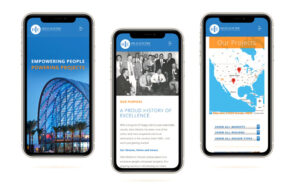
A mobile-optimized website is the foundation of the 2026 digital playbook, immediately showcasing brand history, mission, and geographical reach to potential clients.
Pillar 2: Mobile-First Design That Actually Works
Speed and mobile aren’t “nice features”—they’re deal-breakers.
Google punishes slow sites. In fact, in 2016, our CEO Les Kollegian was hired by Google to speak at their conferences about this exact issue. Here’s the stat that should terrify you: for every extra second your page takes to load, your bounce rate jumps 8X higher.
Think about that. One extra second. Eight times more people, gone.
If you don’t know how to optimize your site properly—and most don’t—you’re hemorrhaging traffic and conversions without even realizing it. And with over 70% of construction buyers starting their research on mobile, building for phones isn’t optional anymore. It’s fundamental.
Don’t get us wrong. Desktop design is EXTREMELY important. However, mobile-first in the A/E/C vertical is how all companies should be thinking. Once they’re evaluating a project or issuing a bid, your prospects are likely to switch to a larger screen to review PDFs, drawings, case studies, and detailed qualifications. A robust, desktop-friendly experience helps with credibility, downloads, and document access.
What matters:
Load time under 3 seconds. Period. Every second longer and you’re losing people.
Easy navigation for thumbs, not mouse cursors. Big buttons, smart spacing. Remember, your best trades might be on a job site wearing gloves. Your best prospect may be doing research while waiting for his/her cocktail at the bar.
Images that look great on small screens. Don’t sacrifice visual impact, but optimize everything so it loads fast.
Simple forms. Mobile users won’t fill out 15 fields. Keep it to name, email, phone, and project type.
Here’s a stat that should scare you: mobile users are 5 times more likely to abandon a site that isn’t optimized. You can’t afford to lose half your audience because your site looks bad on a phone.
The Bottom Line: If your site doesn’t work flawlessly on mobile, you’ve disqualified yourself from the majority of potential clients before they even see your work.
Practical guidance:
Start with a mobile-first design mindset:
Fast load times (optimized images, compressed videos, lean code).
Clear navigation with prominent project gallery, capabilities, and contact.
Accessible CTAs (Get a quote, Request a proposal, Call now).
Readable typography, concise copy, and scannable sections.
Construction is a relationship business–and trust is everything. Your website needs to prove you’re legitimate, capable, and reliable and yes… trustworthy—before someone picks up the phone.
Essential trust-builders:
Show your credentials. Certifications, licenses, insurance, safety records. Display logos from your suppliers and partners. Make it obvious you’re the real deal.
Sounds basic, right?
We’ve worked with companies doing $50 million+ in revenue who don’t do this. Their response? “We have enough business.”
Our response? Do you, though? Because “enough” isn’t the same as “all the business you could have.” What are you leaving on the table by making prospects guess whether you’re legit? Trust signals aren’t just for startups trying to prove themselves. They’re for every company that wants to convert more of the traffic they’re already getting.
Real testimonials with real details. “Saved us 15% on materials and finished two weeks early” beats “Great to work with!” every time. Use names, titles, photos if possible.
Introduce your team. People want to know who they’re hiring. Real photos of real people build connection.
Highlight your track record. OSHA ratings, safety certifications, project completion rates—these signal operational excellence.
Here’s why this matters: 47% of buyers look at 3-5 pieces of content before they’ll even talk to a salesperson. Make it easy for them to say yes by giving them the proof points they need.
The Bottom Line: Trust isn’t given, it’s earned. Your website should make it effortless for prospects to find the evidence they need to feel confident about working with you.
Pillar 4: Make It Stupid-Easy to Contact You
Every page should have a purpose. Every purpose should have a clear next step.
If someone’s interested, don’t make them hunt for how to reach you.
What converts:
Multiple ways to get in touch. “Request a Bid,” “Schedule a Consultation,” “Get an Estimate,” “Download Our Capabilities Deck.” Different people want different entry points.
Click-to-call on mobile. 61% of mobile users will call during the buying process. Make the phone number tappable everywhere.
Contact options that follow them. Sticky contact bars or chat widgets that stay visible as people scroll.
Forms right where they’re looking. Put inquiry forms directly on portfolio pages so prospects can reach out while viewing relevant work.
The math: you’re paying $165+ per lead from search ads. If your site doesn’t make it easy to convert, you’re wasting that investment.
Pro tip: Keep forms short. Name, email, phone, project type—that’s enough for a first conversation.
The Bottom Line: Every page needs a clear “do this next” moment. The easier you make it to contact you, the more qualified leads you’ll capture.
Pillar 5: Get Found by the Right People
A beautiful website is worthless if no one can find it.
The firms that dominate their markets don’t just build great sites—they make sure those sites show up when potential clients are searching.
The technical stuff (simplified):
Make sure your site is fast, clean, and organized in a way that search engines—and now AI—can understand. This includes things like clear page titles, good site structure, and behind-the-scenes code that helps Google, ChatGPT, Perplexity, and other AI tools figure out what you actually do.
Here’s why this matters more than ever: people aren’t just Googling anymore. They’re asking ChatGPT “who are the best commercial contractors in [city]?” or using AI search tools to compare firms. If your site isn’t structured properly, you won’t show up in those results—even if you’re the perfect fit. AI reads your site differently than humans do, and if it can’t parse your information clearly, you’re invisible in the fastest-growing search channel out there.
The content strategy:
Content marketing generates 54% more leads than traditional marketing. Adding a blog to your site increases your chances of ranking on Google by 434%.
Here’s what to create:
Service pages that match what people search for. Think “commercial general contractor in [your city]” or “design-build services in [your region].”
Project case studies with location details. Construction is local. Make sure every case study includes where the project was and what type of work it involved.
Educational content that answers questions. Blog posts like “How long does commercial construction permitting take?” or “What’s the difference between design-bid-build and design-build?” These attract people early in their research process.
The Bottom Line: SEO isn’t optional—it’s your primary lead source. Build it into your website from day one, target the searches your ideal clients are making, and create content that answers their questions. Do this right and your site becomes a lead-generating machine. And for those of you who don’t believe you are being found via search in any capacity. Aehhhhhhhh (buzzer sound). You have NO idea. At Jacob Tyler, we never thought in a million years that an executive at Sony would be upset with his current agency and “search” for another and find us. Being optimized for search got us that account and assistance developing the VAIO brand for Sony. So yeah, we believe. We will give you some more information on “search” in a little bit.
Design Trends That Actually Matter in 2026
Clean and Simple Wins
Less is more. White space, clean fonts, minimal navigation. Focus attention on what matters—your work.
Large Typography
Use of clean and modern typography in a large point type grabs attention and keeps it. Don’t overdo it though. Remember that people need to be attracted to read more and not yelled at.
Video Makes a Difference
Time-lapse build videos, drone footage, client testimonials. Video tells stories in ways photos can’t.
Dark Mode Is Here
Dark backgrounds with sharp contrast can make architectural work pop. It’s modern, striking, and effective. With that said, be careful to not have too much body copy in reverse (white on top of black) as it can make paragraph content more difficult to read.
Subtle Motion Adds Polish
Hover effects, scroll animations, interactive filters. Small details that make the experience feel premium without overwhelming users.
Sustainability Messaging Matters
Affiliations, green building practices, LEED certifications, energy-efficient outcomes—these resonate with commercial clients and conscious homeowners alike.
What a Professional Website Actually Costs
Let’s talk money. Here’s what you should expect to invest:
Small to Mid-Size Firms: $15,000 – $25,000
You get:
15-25 pages
Custom design that’s mobile-responsive
10-15 portfolio projects
Contact forms and lead capture
Basic search optimization
Timeline: 10-14 weeks
Best for: Local contractors, small commercial builders, residential remodelers
Mid-Size to Large Firms: $25,000 – $55,000+
You get:
30-50+ pages
Advanced functionality and design
25-50 portfolio projects with filtering
Integration with your CRM and project tools
Comprehensive SEO strategy
Blog and content marketing setup
Video integration
Timeline: 14-20 weeks
Best for: Regional general contractors, design-build firms, commercial construction companies
Enterprise-Level Firms: $55,000 – $100,000+
You get:
50-100+ pages
Fully custom everything
Multi-location support
Project portals and employee logins
Interactive maps and advanced showcases
Marketing automation
Ongoing optimization and testing
Timeline: 20-24+ weeks
Best for: National contractors, large commercial builders, industrial construction firms
Ongoing Maintenance: $1,500 – $3,000/month
Includes:
Security updates
New project additions
SEO monitoring
Performance optimization
Analytics reviews
Think of this as the cost of keeping your best salesperson sharp and effective. Keep in mind that most Websites as mentioned above can be developed in WordPress, which is infinitely scalable so even though you may start with 15 to 20 pages, you can add as many as you like, and it is super easy to do so.
Mistakes That Kill Conversions
Portfolio overload. Quality beats quantity. Show your best 15-25 projects, not every job you’ve done since 1985.
Ignoring mobile. If it doesn’t work on a phone, you’ve lost the lead. Period.
Hiding your call-to-action. Every page should answer: “What should I do next?” Make it obvious.
Treating SEO as an afterthought. 57% of B2B marketers say SEO generates more leads than anything else. Build it in from the start.
Slow load times. Users leave. Google penalizes. You lose.
No way to track results. If you can’t measure it, you can’t improve it. Set up tracking for form submissions, calls, and key pages.
Stale content. A portfolio that stops in 2019 signals a business that stopped growing. Update regularly.
How to Know If It’s Working
Track these numbers to measure your website’s impact:
Traffic growth (month-over-month and year-over-year)
Conversion rate (forms, calls, downloads as a % of visitors)
Bounce rate (target under 40% on key pages)
Time on site (longer = more engaged
Search rankings for your target terms
Leads generated (qualified inquiries)
Cost per lead (compared to other channels)
Projects won from web inquiries
The goal isn’t to hit industry averages—it’s to beat your own baseline. A 20% lift in traffic or a 0.5% bump in conversion rate translates directly to revenue.
Your 2026 Website Checklist
Use this when evaluating proposals or scoping your project:
Strategy & Planning
Audience personas defined
Competitor analysis completed
Keyword research done
Conversion goals established
Site structure approved
Design & Experience
Mobile-first, responsive design
Loads in under 3 seconds
Clean layouts with white space
High-quality, authentic photos (no stock)
Consistent branding throughout
Content & Messaging
Clear value proposition on homepage
Service pages optimized for search
10-20 featured projects with case studies
Client testimonials (text or video)
Team bios and photos
Trust signals visible (certifications, licenses)
Functionality
Contact forms on key pages
Click-to-call phone numbers
Filterable project portfolio
Blog/resources section
Secure hosting and backups
SEO & Analytics
Google Analytics installed
Search Console configured
Page titles and descriptions optimized
Sitemap submitted
Redirects set up (if redesign)
Post-Launch
Tested across all devices
Monthly analytics reporting
Content update plan in place
Ongoing optimization strategy defined
Common Questions Answered
How much should I really spend on a website?
For most construction companies, expect to invest $15,000 to $75,000+ depending on complexity and scale.
Think of it this way: if a well-designed site generates even 3-5 additional qualified leads per month, it pays for itself within months. The question isn’t “what’s the cheapest option?” It’s “what delivers the best return?”
How long does it take to build?
Quality takes time. Most projects run 10-16 weeks from kickoff to launch. Smaller sites might be done in 8-10 weeks. Enterprise sites with complex features can take 20-24 weeks.
Rushing usually means compromising quality. Launch something you’re proud of, not something you’re settling for.
Do I really need mobile optimization?
Absolutely. Over 70% of potential clients browse on mobile before making a decision. Google ranks your mobile site first. Mobile users are 5X more likely to bail on a site that doesn’t work properly.
If your site doesn’t work flawlessly on phones, you’re eliminating the majority of your market.
Can I just use a template?
Sure, if you want to blend in and hope for the best.
Template platforms like Wix or Squarespace are cheap upfront, but they come with hidden costs that kill your competitiveness. Here’s why they fall short for construction companies:
Speed kills your conversions. These platforms are bloated with code you don’t need. They’re slower out of the box, and you can’t optimize them the way a custom site can. Remember: every extra second costs you 8X more bounces.
You’re locked into their limitations. Need a custom project filtering system? Want to integrate with your CRM? Looking to build something unique that sets you apart? Good luck. Templates box you into what everyone else is doing.
SEO is hobbled from the start. Sure, they claim to be “SEO-friendly,” but you can’t control the technical foundation the way you need to. Your ability to rank for competitive local terms is significantly hampered compared to a properly built custom site.
You look like everyone else. Prospects can spot a Squarespace template from a mile away. When you’re competing for six- and seven-figure projects, looking like a DIY startup doesn’t inspire confidence.
AI can’t read it properly. These platforms generate messy code that makes it harder for AI search tools (ChatGPT, Perplexity, etc.) to understand and recommend your business. You’re invisible in the fastest-growing search channel.
Mobile experience is “good enough” at best. Remember that 70% of your prospects start on mobile? Template platforms give you a responsive site, but not an optimized one. There’s a massive difference.
The bottom line: when your average project is worth $50K to millions, a $200/year website isn’t a smart savings—it’s a costly compromise. Investing in a professional custom site delivers exponentially better ROI because it actually converts the traffic you’re working so hard to generate.
How often should I update it?
A website isn’t a “set it and forget it” asset. It’s a living business tool that needs regular attention to stay effective.
At minimum, add new projects quarterly. Fresh content tells both visitors and search engines you’re active and growing. But there’s more to it than that.
Why regular updates actually matter:
Search engines reward fresh content. Google prioritizes sites that consistently publish new material. A site that hasn’t been touched in six months gets buried, while competitors updating regularly climb the rankings. This isn’t theory—it’s how the algorithm works.
AI search needs current data. ChatGPT, Perplexity, and other AI tools pull from recently updated sources. If your site is static, you’re invisible in AI-powered search results—the fastest-growing way people find contractors.
Your prospects are watching. When someone lands on your site and sees your last project is from 2022, what do they think? Either you’re not busy (red flag) or you don’t care about your digital presence (also a red flag). Fresh content signals momentum and success.
SEO compounds over time. Every new blog post is another opportunity to rank for search terms. Every updated project page strengthens your local SEO. This isn’t busy work—it’s building equity that generates leads for years.
Ideal update cadence:
New blog posts monthly – drives SEO, answers buyer questions, positions you as an expert
Portfolio updates quarterly – keeps your best work front and center
Testimonials as you receive them – fresh social proof builds trust faster
Service pages refreshed annually – keeps messaging aligned with your current capabilities and market positioning
Technical SEO audit quarterly – ensures your site stays optimized as search algorithms evolve
Should you hire someone to manage this?
Unless you have a dedicated marketing person who understands SEO, content strategy, and technical optimization—yes, absolutely.
Here’s why: most construction company owners don’t have time to write optimized blog posts, resize images properly, update meta descriptions, monitor search rankings, or stay current on algorithm changes. And frankly, you shouldn’t. Your time is worth more managing projects and closing deals.
A monthly retainer with a specialized agency or freelancer ($1,500-$5,000/month depending on scope) typically includes:
Regular content creation and optimization
Portfolio and project page updates
SEO monitoring and adjustments
Technical performance optimization
Analytics reporting so you see what’s working
Think of it this way: if your site generates even 2-3 additional qualified leads per month because it’s consistently updated and optimized, that monthly investment has already paid for itself several times over.
The bottom line: A stale website signals a stale business. But more importantly, an outdated site actively costs you leads, rankings, and revenue. Regular updates aren’t optional maintenance—they’re how your website continues generating ROI long after launch.
What’s the difference between a brochure site and a lead generation site?
Brochure sites build trust and credibility through compelling storytelling, professional imagery, and showcases of your work. When designed thoughtfully, they serve as powerful digital portfolios that help potential clients understand who you are, what you do, and why they should work with you. For smaller businesses especially, a well-crafted brochure site with clear contact options and conversion points can be exactly what’s needed to turn visitors into leads.
Lead generation sites take this foundation further by prioritizing conversion at every turn—with multiple strategic calls-to-action, optimized user journeys, lead capture mechanisms throughout the experience, and content specifically designed to move visitors down the funnel.
Both approaches should ultimately drive leads and conversions. The difference is in emphasis: brochure sites lead with trust-building and storytelling, while lead generation sites lead with conversion optimization—but the best sites often blend elements of both.
We have plenty of business. Does SEO really matter?
Look, I get it. We hear this all the time: “We don’t need to worry about our website because we don’t get business from it anyway.”
But here’s the thing—comfort is the enemy of growth.
Think about it: why would you turn down the chance to be considered for projects you didn’t even know existed? Projects where the prospect finds you instead of you having to chase them down?
When we push back and ask “How do you actually know you’re not getting business from your site?”, there’s usually just crickets. Or worse, assumptions based on… well, nothing.
Here’s a story (in case you missed it earlier) that changed everything for us. Years ago, we won the brand development for Sony VAIO products for college students. Want to know how? A Sony senior executive (fed up with his current agency relationship) literally Googled agencies and found us. We didn’t even think that was possible. But it happened, and we became true believers.
Fast forward to 2025. We redesigned the website for Dempsey Construction. About three months after launch, Michaela Weibel, their Director of Marketing, called us—absolutely shocked. She’d been there over five years and had never received a single lead through their website. Not one.
With the new site and proper optimization? Leads started coming in.. and while just a few, it is certainly better than none. Now they’re actually in the game instead of watching from the sidelines. And get this—just one deal pays for the entire website investment and then some.
But it gets even better. At Jacob Tyler, we’re now landing clients through something most agencies aren’t even thinking about yet: generative search.
Sure, people still Google “Best Web Design Agencies in San Diego” or “Construction Web Designer”—and we show up for those. But recently, an executive asked Gemini (Google’s AI), “Who designed the Hensel Phelps website?” Because we optimized our site for generative search, they got the right answer: us. We won that client.
This is the new reality. In 2026, if you’re in construction and you’re not optimized for generative search—especially around your completed projects—you’re invisible to a massive chunk of potential clients.
Should I hire a construction specialist or a general agency?
Here’s our honest take, and we’d be lying if we told you otherwise: you don’t need an agency that only does construction.
We’ve been doing this for 25 years at Jacob Tyler. In that time, we’ve built high-performing websites for health and life sciences companies, medical product manufacturers, ecommerce brands, financial services firms, and yes—construction and industrial companies. The idea that an agency must be vertically niched to deliver results? That’s marketing spin, not reality.
What you actually need is this:
An agency that takes the time to deeply understand your buyers, your sales cycle, your competitive landscape, and what drives decisions in your market. Whether that’s construction, manufacturing, or healthcare doesn’t matter as much as their commitment to learning what makes your business tick.
That said, industry experience does accelerate results.
When an agency has worked with construction firms before, they come to the table knowing:
How to structure project portfolios that actually convert
Which trust signals matter most (certifications, safety records, bonding capacity)
How to optimize for the long, relationship-driven sales cycles typical in construction
What questions prospects ask before they’re ready to request a bid
The balance between showcasing capabilities and not overwhelming decision-makers
That expertise means faster onboarding, fewer missteps, and a site that performs from day one instead of needing months of trial and error.
But here’s what matters more than niche experience:
Does the agency have a track record of driving measurable results? Do they understand conversion optimization, SEO, user experience, and content strategy at a deep level? Can they point to specific outcomes—increased leads, higher rankings, improved conversion rates—across any B2B vertical?
Those fundamentals transcend industry. A team that’s driven results in financial services or life sciences can absolutely apply that same rigor and strategic thinking to construction. The principles of effective digital marketing don’t change just because the hard hats do.
The bottom line:
Choose an agency based on their strategic chops, their commitment to understanding your specific market, and their proven ability to deliver ROI—not just their client roster. Industry experience is a plus and can accelerate results, but it’s not a requirement. Deep expertise in digital strategy, combined with genuine curiosity about your business, will always outperform shallow “niche specialist” credentials.
At Jacob Tyler, we bring both: 25 years of cross-industry experience and a proven track record in construction and industrial markets. That combination means we know what works universally and what needs to be tailored specifically for how contractors buy.
How do I measure ROI?
First, let’s be clear about something: your website is a critical piece of your marketing engine, but it’s not the only piece.
We’d be doing you a disservice if we said “build a great website and watch the leads roll in.” That’s not how sustainable growth works. Your website needs to work in concert with your brand, your relationships, your presence at trade shows, your direct mail, your reputation in the community, and yes—even those conversations on the 19th hole.
That said, your website should absolutely be measured and held accountable for ROI.
Here’s what to track:
Qualified leads generated – how many serious inquiries came directly from the site
Conversion rate – percentage of visitors who take action (form fills, calls, downloads)
Revenue from web-sourced inquiries – actual project wins that started with your website
Cost per lead – compare what you’re spending on the website against other channels like trade shows, print ads, or pay-per-click
Most construction firms find that once their website is properly optimized, it delivers the lowest cost per qualified lead of any marketing channel. Even modest improvements—like a 1% conversion bump—can generate hundreds of thousands in additional project value annually.
But here’s the bigger picture:
Your website doesn’t exist in a vacuum. It’s the hub where all your other marketing efforts converge:
Someone meets you at a trade show → they Google you → your website seals the deal (or kills it)
A referral mentions your name → the prospect checks you out online → your site validates the recommendation
You run targeted ads → traffic lands on your site → conversion optimization determines if that spend pays off
Your brand shows up in their LinkedIn feed → they click through → your website tells the full story
Think of it this way: Your brand is your reputation. Your website is where that reputation gets verified and converted into action. Traditional marketing—networking, events, direct outreach—gets you in the conversation. Your digital presence determines whether that conversation becomes a contract.
So yes, measure your website’s performance religiously. But don’t forget that your entire marketing ecosystem—brand positioning, consistent messaging across channels, strategic relationship building, and traditional outreach—all work together to drive revenue.
The website is your best salesperson. But even the best salesperson needs leads to close. That’s where the rest of your marketing comes in.
Your Website Is Your Competitive Advantage
In 2026, your construction website isn’t a cost center. It’s a strategic asset that either generates revenue or bleeds opportunity.
The firms winning the best projects understand this: your website is a business development engine that works around the clock. While your competitors are still treating their online presence as an afterthought, the leaders in your market are converting browsers into bids—24/7, without a single sales call.
Here’s the math that matters: construction websites average around a 2% conversion rate. That means 98 out of 100 qualified prospects leave without contacting you.
Now imagine cutting that waste in half. Better mobile experience, faster load times, clearer calls-to-action, stronger portfolio presentation—these aren’t cosmetic upgrades. They’re the difference between doubling your lead volume and watching opportunities go to competitors who got the details right.
Combine that with smart SEO and a relentless commitment to showcasing your best work, and you’ve built something that compounds: a platform that gets stronger, ranks higher, and generates more qualified leads every month—without you spending another dollar on traffic.
For owners and marketing leaders evaluating partners, the criteria are simple: find an agency that understands how construction buyers make decisions, builds for conversion not just aesthetics, and measures results in leads and revenue, not likes and page views.
The investment in getting this right pays dividends for years. The cost of getting it wrong? You’re already paying it—you just don’t see the opportunities you’re missing.
Let’s Talk About What’s Possible
If you’ve made it this far, you already know your website could be working harder for you.
Maybe you’re frustrated watching leads go to competitors with slicker digital presence. Maybe you know your site doesn’t represent the quality of work you actually deliver. Or maybe you’re just tired of leaving money on the table because your online experience doesn’t match your reputation in the field.
We get it. We’ve spent 25 years helping companies in construction, industrial, and beyond turn their digital presence into a genuine competitive advantage—not just a prettier version of what everyone else has.
Here’s what we believe:
Your website should earn its keep. It should generate qualified leads, support your sales team, and prove ROI. If it’s not doing that, something’s broken—and it’s fixable.
You shouldn’t have to become a digital marketing expert to make this work. That’s what partners are for. Our job is to understand your business, your buyers, and your goals—then build something that delivers results you can measure.
If you’re ready to explore what’s possible, here’s how we typically start:
Have a real conversation. No sales pitch. No generic proposal. Just an honest discussion about where you are, where you want to be, and whether we’re the right fit to help you get there.
Build a plan that makes sense for your business. Not a one-size-fits-all template. A strategy tailored to your market, your goals, and your timeline.
Execute with accountability. We measure what matters—leads, conversions, revenue—and adjust as we learn what works best for your specific audience.
The firms that are winning in your market aren’t doing anything magical. They’re just committed to making their digital presence as strong as their craftsmanship. And they’re working with partners who understand that construction isn’t sold the same way software or sneakers are.
The best time to fix this was last year. The second best time? Right now.
If you’re curious about what’s possible for your business, let’s talk. No pressure, no pitch—just a conversation between people who care about building things that work.
Schedule a consultation or reach out and fill out our own lead form at www.jacobtyler.com. Hell… just call our CEO (Les Kollegian) directly at 619-379-0007. We’re here when you’re ready.
Top 5 Qualities to Look for in a Creative Agency
Selecting the wrong brand experience agency can derail your growth trajectory and waste valuable resources for years. With around 80% of companies increasing their experiential marketing budgets, and these campaigns now representing 10-30% of overall marketing spend, finding the right creative partner has become a critical strategic decision that demands careful evaluation.
The stakes have never been higher. Brands are no longer satisfied with high production value alone. They want creativity that converts, scales, and delivers measurable ROI. Yet with thousands of agencies promising transformative results, how do you separate genuine strategic partners from those offering surface-level solutions?
We’ve worked with hundreds of brands navigating this exact challenge, and we’ve identified five non-negotiable qualities that distinguish exceptional creative agencies from the rest. These criteria go beyond portfolio aesthetics to focus on the strategic capabilities and measurable outcomes that drive real business growth.
1. Proven Data-Driven Creative Performance
The best creative agencies understand that creativity is proven to be the biggest driver of ROI, driving half of ROI, but they also know how to measure and optimize it systematically. A performance creative agency focuses on producing ad creatives that are specifically designed to drive measurable business outcomes. Unlike traditional creative agencies, where the priority might be brand expression or visual impact alone, performance creative agencies are built around one core goal: conversion.
Look for agencies that demonstrate clear measurement frameworks from day one. Brands want to see clear results from their marketing spend. Agencies now use real-time data to track interactions, measure conversions, and calculate the ROI of their experiential marketing efforts. The strongest partners will show you exactly how they track performance across multiple touchpoints and connect creative decisions to business outcomes.
We’ve seen this approach deliver exceptional results. When we partnered with a B2B software client, our data-driven creative testing increased their demo conversion rate by 38% within the first quarter. The key was establishing clear performance benchmarks and continuously optimizing creative elements based on real user behavior data.
What to look for:
– Detailed case studies showing before/after performance metrics
– Clear measurement methodologies for tracking creative impact
– Integration with analytics platforms and attribution models
– Regular reporting cadence with actionable insights
2. Strategic Brand Experience Architecture
As markets grow increasingly saturated and competitive, businesses are challenged to differentiate themselves and connect meaningfully with their audience. One way to achieve this is by offering an unparalleled brand experience that extends far beyond visual identity.
The most effective brand experience agencies approach creativity through a strategic lens, building comprehensive experience architectures that guide every touchpoint. Known for their strategic thinking and creative depth, these agencies help companies develop distinctive brand systems that connect meaningfully with audiences and evolve across digital and physical touchpoints.
This means evaluating how agencies think about the entire customer journey, not just individual campaigns. Do they understand how brand experiences compound over time? Can they articulate how creative decisions support broader positioning objectives? The best partners will present a clear framework for how creative work ladders up to strategic business goals.
During our recent rebrand project for a fintech startup, we mapped 23 different touchpoints where customers interact with the brand. By designing a cohesive experience architecture, we increased brand recall by 45% and reduced customer acquisition cost by 22% over six months.
What to look for:
– Comprehensive discovery processes that uncover brand positioning opportunities
– Clear frameworks for connecting creative execution to strategic objectives
– Experience mapping capabilities across multiple touchpoints
– Understanding of how brand experiences evolve over time
3. Technology Integration and AI Readiness
AI, AR, and VR are becoming a core part of activations. Agencies use these tools to make experiences more interactive and engaging. The leading agencies aren’t just experimenting with new technologies—they’re strategically integrating them to enhance creative effectiveness and operational efficiency.
The rise of AI design tools has revolutionized how creative agencies approach campaigns. From generating initial concepts to optimizing designs for performance, AI enables top creative agencies to deliver faster and smarter solutions. However, the key differentiator is how agencies balance technological capabilities with human creativity and strategic thinking.
Look for agencies that demonstrate thoughtful technology adoption rather than just following trends. The use of generative AI in creative agencies is revolutionising creative processes and automating repetitive tasks, allowing teams to deliver faster and more innovative solutions for brands. The strongest partners will show you how technology enhances their creative process without replacing the strategic thinking and emotional intelligence that drives meaningful brand connections.
We recently implemented an AI-assisted content optimization system for a retail client that automatically tests and refines creative elements based on performance data. This approach increased engagement rates by 32% while reducing creative production time by 40%.
What to look for:
– Clear AI and automation strategies that enhance rather than replace human creativity
– Integration capabilities with existing marketing technology stacks
– Understanding of emerging technologies relevant to your industry
– Demonstrated ability to scale creative production efficiently
4. Cultural Alignment and Collaborative Process
Clients buy certainty, not creativity. The most successful agency partnerships happen when there’s genuine cultural alignment and transparent communication throughout the process. They’ve been praised for their ability to stick to deadlines and innovative ideas. Needless to say, these are two critical qualities when it comes to experiential marketing specifically.
Evaluate agencies based on their collaborative approach and communication style. Show exactly what happens week 1, month 1, quarter 1. Vague timelines lose deals. “We’ll develop strategy” loses to “Week 1: audit. Week 2: strategy draft. Week 3: approval.” The best partners will demonstrate clear processes, defined milestones, and regular check-in cadences.
Cultural fit extends beyond process to values alignment. Top US marketing agencies value your time and opinion. They listen to your requirements, communicate transparently, and will keep you in the loop at all times. Look for agencies that demonstrate genuine curiosity about your business challenges and show evidence of long-term client relationships.
What to look for:
– Detailed process documentation with clear milestones and deliverables
– Evidence of long-term client relationships and low churn rates
– Transparent communication style and regular reporting cadence
– Values alignment with your organization’s culture and objectives
5. Scalable Expertise Across Multiple Disciplines
Business needs can shift, so the agency should have the ability to scale campaigns, expand activations, or pivot strategies when required. A flexible agency can handle multi-location events, hybrid activations, or evolving brand objectives without compromising execution quality.
The strongest creative agencies offer integrated expertise across multiple disciplines while maintaining depth in each area. They typically operate much closer to the brand’s growth team, performance marketers, and media buyers. This integrated approach ensures creative work is aligned with broader marketing objectives and can scale effectively across different channels and campaigns.
Look for agencies that demonstrate both breadth and depth of capabilities. Can they handle brand strategy, visual identity, digital experience design, and campaign execution at the same level of excellence? Do they have proven experience scaling creative programs across multiple markets or product lines?
We recently worked with a healthcare technology company that needed to launch in three new markets simultaneously. Our integrated approach—combining brand positioning, digital experience design, and performance marketing—resulted in a 156% increase in qualified leads across all markets within the first six months.
What to look for:
– Integrated service offerings that work cohesively rather than in silos
– Proven experience scaling creative programs across multiple markets or channels
– Team depth with senior-level expertise across key disciplines
– Ability to adapt quickly to changing business requirements
Evaluating Agency Capabilities: A Practical Framework
When assessing potential creative partners, use this systematic evaluation approach:
Portfolio Analysis Beyond Aesthetics
Evaluating an agency’s portfolio and client testimonials is a crucial step in selecting the right branding agency and partner for your business. By examining the work they’ve done for other clients, you can gain valuable insights into their capabilities, experience, expertise, and success stories. This can help you determine whether their style and approach align with your business objectives and brand vision.
Reference Checks with Strategic Focus
The best performance marketing agencies have a good track record of delivering results for their clients. The right performance based marketing agency will be able to back its claims with case studies and client testimonials.
Process Documentation Review
Agencies promise results. Few show how they’ll measure them. Define KPIs upfront. Explain tracking methods. Show reporting samples.
The ROI Impact of Strategic Agency Selection
Investing in a creative agency is not just a cost; it’s a strategic investment with measurable returns. In 2025, brands are increasingly relying on top creative agencies to navigate a saturated market, build lasting impressions and drive growth.
The financial impact of selecting the right agency partner extends far beyond project costs. A creative agency can improve your brand’s ROI by delivering data-driven strategies, optimising campaigns for measurable results, and providing cost-effective access to specialised talents. Their expertise allows for faster time to market and effective resource allocation, driving better returns on your marketing investments.
We’ve consistently seen that brands working with strategically aligned creative partners achieve 2-3x better performance across key metrics compared to those focused primarily on cost optimization. The key is evaluating agencies based on their ability to deliver measurable business outcomes rather than just creative output.
Making Your Selection Decision
The best agency partnerships happen when your goals and their expertise truly line up. Find an agency that balances creative ideas with solid data skills—they should show you real results, not promises.
Remember that creative matters least. Show work quality through results, not beauty shots. One great campaign with ROI beats ten pretty concepts. Focus your evaluation on agencies that demonstrate clear connections between creative decisions and business outcomes.
The right brand experience agency becomes more than a vendor—they become a strategic partner invested in your long-term success. Take the time to find that partner using these five criteria, and your brand will benefit from their expertise for years to come.
FAQ Section
How do I evaluate an agency’s data-driven capabilities?
Look for agencies that provide clear before-and-after metrics, demonstrate analytics integration, and use structured measurement frameworks. Data-driven creative agencies tie design decisions to measurable business outcomes. Request case studies, reporting templates, and examples showing how they optimize creative performance over time.
What’s the difference between a creative agency and a brand experience agency?
A creative agency focuses on visual storytelling, campaigns, and advertising deliverables. A brand experience agency, on the other hand, designs holistic brand ecosystems—connecting identity, digital experiences, and emotional engagement across all touchpoints. The latter integrates creativity with strategy to drive long-term brand growth.
How important is industry experience when selecting a creative agency?
Industry experience provides contextual understanding, but innovation often comes from outside perspectives. Choose agencies that blend relevant market expertise with fresh creative thinking. Evaluate prior work in your sector, but also look for adaptability and strategic insight gained from diverse industry collaborations.
From Audit to Action: How a Brand Audit Can Revive Your Strategy
Your brand feels stuck. Customer engagement has plateaued, your messaging seems disconnected from market reality, and competitors are gaining ground with strategies that resonate more effectively with your audience. Sound familiar? We see this challenge across industries, from established enterprises to emerging brands seeking their footing in competitive markets.
The solution often lies not in completely reinventing your brand, but in understanding exactly where you stand today. A brand audit is a process of assessing your brand’s current market position, allowing you to identify strengths and opportunities and compare your company to your competitors. When partnering with a skilled branding agency in San Diego, businesses trust, this comprehensive evaluation becomes the foundation for strategic transformation.
We approach brand audits as more than diagnostic exercises. They become roadmaps for growth, revealing hidden opportunities while addressing the gaps that prevent your brand from achieving its full potential. Let’s explore how this process can breathe new life into your strategy.
Understanding the Brand Audit Framework
The brand audit is a process by which you take inventory of brand assets, assess the brand’s performance on different channels, and conduct competitive analyses. This systematic evaluation examines every touchpoint where your brand intersects with customers, stakeholders, and the broader market.
We structure our audits around four core pillars:
Brand Identity Assessment: Evaluating visual elements, messaging consistency, and brand voice across all platforms
Market Position Analysis: Understanding how customers perceive your brand relative to competitors
Competitive Landscape Mapping: Identifying opportunities for differentiation and market gaps
A brand audit is a health check: By taking a step back and examining your brand’s performance internally and externally, you ensure it meets company and consumer expectations. This comprehensive approach ensures we capture both the quantitative metrics and qualitative insights that drive strategic decisions.
The Strategic Benefits of Brand Auditing
A brand audit helps you optimize your marketing strategies by providing valuable insights into what works and what doesn’t. By understanding your brand’s performance and customer perceptions, you can create more targeted and effective marketing campaigns. This ensures that your marketing efforts are not only efficient but also yield better returns on investment.
Our clients consistently discover three key advantages through the audit process:
Enhanced Brand Clarity and Consistency
A brand audit helps you refine and enhance your brand identity, making it more appealing and relatable to your target audience. It involves evaluating elements like your logo, tagline, and overall brand messaging. Ensuring consistency across these elements strengthens your brand identity and fosters better brand recall.
Data-Driven Strategic Direction
As a result, you will get a list of actionable insights you can implement to boost your company’s overall results. Rather than making assumptions about market position or customer preferences, we base recommendations on concrete evidence gathered through comprehensive research and analysis.
Competitive Advantage Identification
Competitor analysis helps identify the strengths and weaknesses of your brand compared to your competitors, allowing your brand to capitalize on opportunities and avoid pitfalls. This is about keeping up with the competition and finding ways to innovate and lead in your market space. Analyzing competitor brands can also reveal gaps in the market that your brand can fill.
The Brand Audit Process: From Assessment to Action
Phase One: Discovery and Data Collection
We begin by establishing clear objectives for the audit. The first step involves getting a clear picture of the purpose of your brand audit and establishing a framework. The process starts with a crucial question to clarify your goals. Do you aim to understand your market position, customer perceptions, or brand effectiveness?
Our discovery phase includes:
– Stakeholder interviews across all organizational levels
– Customer feedback analysis from multiple touchpoints
– Digital asset inventory and performance review
– Competitive intelligence gathering
Phase Two: Analysis and Insight Development
Next, work through a SWOT analysis of your brand against your competitors. Cover these key areas: Strengths: What does your brand do better than its challengers? Weaknesses: What do your competitors do better than you? Opportunities: What are the biggest opportunities for your brand right now? Threats: Are there any new brands that could be a threat? The answers will help you identify what sets your brand apart and will provide a core element of your positioning and messaging.
This analytical phase transforms raw data into strategic insights by identifying patterns in customer behavior, market trends, and competitive positioning, which inform actionable recommendations.
Phase Three: Strategy Development and Implementation Planning
The outcome of a successful brand audit should be a plan of action that will highlight the areas for improvement. The program should specify the goals you want to achieve and a timeline of expected results.
We prioritize recommendations based on impact potential and implementation feasibility, ensuring your team can execute changes systematically while maintaining business continuity.
Real-World Impact: When Audits Drive Results
Consider a mid-market technology company we worked with that was struggling with brand recognition despite having superior product capabilities. Our audit revealed that while their technical messaging was accurate, it failed to communicate value in a way that their target audience could understand.
Before: Complex technical jargon dominated their website and marketing materials, leading to a 12% conversion rate from qualified leads and minimal brand recall in market research studies.
Our Intervention: We restructured their messaging hierarchy to lead with business benefits, supported by technical proof points. Visual identity elements were refined to convey innovation while maintaining credibility.
After: Within six months, conversion rates increased to 28%, and brand awareness in their target market improved by 45%. The company secured three major enterprise contracts directly attributed to improved brand clarity and market positioning.
This transformation illustrates how strategic brand audits translate insights into measurable business outcomes.
When to Conduct a Brand Audit
According to industry experts, a brand audit should be conducted at least once a year or during special events such as mergers, acquisitions, changes in brand positions, or the introduction of new market segments. Key signs like dwindling customer loyalty or sales slump may also necessitate reevaluating brand strategies through an audit.
We recommend immediate brand audits when you observe:
Declining customer engagement metrics across channels
Inconsistent brand representation across departments or locations
Difficulty attracting top talent or strategic partnerships
Upcoming major business transitions or expansion plans
Running a monthly brand audit of the most important metrics can help identify opportunities and quickly adapt to the market and consumer needs. It can also ensure brand and messaging consistency. For ongoing brand health, we establish monitoring systems that track key indicators between comprehensive annual audits.
Overcoming Common Audit Challenges
Internal Resistance to Change
We find resistance to change within an organisation to be a common challenge brands face during brand audits. Internal stakeholders may resist new strategies suggested by the audit due to fear of the unknown or attachment to old, familiar methods. To address this, you need to communicate the benefits of proposed changes and involve team members in the audit process. This fosters a sense of ownership and eases fears.
We address this by involving key stakeholders in the audit process from the beginning, ensuring they understand both the methodology and rationale behind recommendations.
Rapidly Changing Market Dynamics
Rapidly changing market dynamics can make brand audit findings outdated. Today’s fast-paced market demands agility and adaptability in brand strategies. Our approach builds flexibility into recommendations, creating frameworks that can adapt to market shifts rather than rigid tactical prescriptions.
The Path Forward: Transforming Insights into Growth
A well-conducted brand audit paves the way for a robust brand strategy, one that is responsive to market changes and customer needs, ultimately leading to a powerful, enduring brand presence.
The most successful brand transformations begin with understanding the current reality. Through systematic evaluation of brand performance, market position, and competitive landscape, we uncover the strategic insights that drive meaningful growth.
Your brand audit becomes the foundation for everything that follows: refined messaging that resonates with target audiences, visual identity that stands out in crowded markets, and customer experiences that build lasting loyalty.
Ready to discover what your brand audit might reveal? Let’s talk about how we can help you transform insights into action and strategy into sustainable growth.
Frequently Asked Questions
How long does a comprehensive brand audit typically take?
The time it takes to complete a brand audit depends on the size and complexity of your brand. It involves analyzing your current branding, market trends, and customer perceptions, a process that can take anywhere from a few weeks to several months. Level 1: 3–4 weeks, focusing on foundational branding elements. Level 2: 6–8 weeks or longer for a comprehensive market analysis and strategy refinement. We customize timelines based on your specific needs and the depth of analysis required. Most mid-market companies benefit from our thorough approach, which typically takes 6-8 weeks to complete thoroughly.
What specific outcomes can we expect from a brand audit?
An audit provides clarity on your strengths and areas for improvement. By analyzing customer feedback, marketing metrics, and competitor benchmarks, it delivers actionable insights to enhance brand performance and customer experience. You’ll receive a detailed report with prioritized recommendations, implementation timelines, and success metrics. Our clients typically see improvements in brand consistency, customer engagement rates, and market positioning within 3-6 months of implementing audit recommendations.
Can small businesses benefit from brand audits, or are they primarily for larger companies?
Small businesses can benefit from an audit by gaining clarity on their brand identity, understanding their target audience better, and identifying quick wins to improve brand visibility and customer experience. In fact, smaller businesses often see more immediate impact from brand audits because they can implement changes more quickly than larger organizations. We offer scaled approaches that provide maximum value within smaller budgets, focusing on high-impact opportunities that drive growth.
The Importance of Responsive Web Design in 2025 and Beyond
The digital landscape has reached a tipping point. As of July 2025, 64.35% of global web traffic comes from mobile devices, and businesses that haven’t embraced responsive design are hemorrhaging potential customers every day. For companies seeking a web design agency in San Diego, understanding the critical role of responsive design in 2025 success isn’t optional—it’s survival.
We’ve witnessed firsthand how responsive design transforms business outcomes. When executed strategically, it doesn’t just accommodate different screen sizes; it creates cohesive experiences that drive measurable results across every touchpoint. The stakes have never been higher, and the opportunity has never been clearer.
The Mobile-First Reality Reshaping Business Strategy
The numbers tell an unambiguous story. In 2025, 90% of all websites, corresponding to 1.2 billion worldwide, have implemented responsive design. Yet implementation alone doesn’t guarantee success. The gap between having responsive design and delivering exceptional mobile experiences continues to widen, creating competitive advantages for businesses that get it right.
Mobile commerce data shows that responsive frameworks drive 11% higher conversion rates than traditional layouts, while non-responsive websites lose 73% of visitors within seconds. These aren’t marginal improvements—they’re business-defining differences that compound over time.
Consider the user journey: As of 2025, the global average screen time on mobile devices has hit 4 hours and 37 minutes per day. Your audience isn’t occasionally checking their phones; they’re living in mobile-first environments where seamless experiences determine brand perception and purchase decisions.
Performance Metrics That Drive Revenue Impact
Responsive design’s value extends far beyond aesthetic appeal. Web design influences 94% of potential customers’ first impressions of a page, and those impressions form within milliseconds. When responsive design fails, the consequences cascade through every business metric that matters.
Slow image loading causes 39% of users to lose interest and move on, while retailers lose $2.6 billion annually due to slow websites. These performance issues become magnified on mobile devices, where network conditions vary and user patience runs thin.
The conversion impact proves equally compelling. Responsive design increases conversions by 11%, but the methodology behind these improvements reveals deeper strategic opportunities. Responsive design that prioritizes mobile-first thinking doesn’t just scale down desktop experiences—it reimagines user flows for thumb navigation, simplified decision-making, and context-aware interactions.
Technical Excellence Drives Business Outcomes
Modern responsive design requires sophisticated technical implementation. Adopt a flexible grid layout using relative units like percentages and CSS Grid or Flexbox, optimize images and media with responsive images and scalable vector graphics, and implement fluid typography using CSS techniques like rem or vw units to adjust font sizes dynamically based on screen size.
These technical foundations enable the performance characteristics that users expect. Websites that load in just one second can triple conversion rates compared to sluggish competitors, while lower bounce rates keep visitors from leaving out of frustration, and higher SEO rankings improve search visibility since Google rewards speed.
Regional Variations and Strategic Implications
Mobile usage patterns vary significantly across markets, creating strategic opportunities for businesses that understand these nuances. Africa leads with 73.6% mobile traffic, followed by Asia at 69%, with Nigeria having the highest mobile traffic share at 86.2%, followed by India at 78.6%.
These variations influence everything from design priorities to content strategy. Markets with higher mobile penetration require different approaches to navigation, content hierarchy, and conversion optimization. In the United States of America, mobile makes up 47.3% of total web traffic, with desktop still slightly ahead at 50.2% of all internet traffic, suggesting a more balanced approach may serve American businesses effectively.
Understanding these patterns helps businesses allocate resources appropriately. A web design agency in San Diego serving local markets might approach responsive design differently than one targeting international audiences, but the fundamental principles remain consistent: mobile experiences must be exceptional, not afterthoughts.
User Experience Architecture for 2025
Responsive design in 2025 demands sophisticated user experience thinking. 73.1% of people say that a website’s lack of responsiveness is a key reason they leave, while mobile users are 67% more likely to make a purchase from a mobile-friendly site, and mobile-optimized websites can experience up to 40% higher conversion rates than non-optimized ones.
These statistics reveal user expectations that extend beyond basic functionality. Modern responsive design must anticipate user intent, streamline complex processes, and deliver value immediately. Content needs to grab attention in under 6 seconds, requiring design systems that prioritize clarity and immediate comprehension.
Navigation and Interaction Design
Use collapsible menus, touch-friendly buttons, and intuitive navigation structures to improve usability on smaller screens. These interface elements must feel natural rather than constrained, creating experiences that leverage mobile capabilities rather than fighting against platform limitations.
50% of smartphone users prefer shopping on a company’s mobile site rather than downloading its app, emphasizing the importance of web-based mobile experiences that rival native applications in functionality and performance.
ROI and Investment Justification
The financial case for responsive design continues strengthening. Every $1 invested in UX yields an average return of $100 (ROI = 9,900%), with the impressive ROI of UX investment underscoring its value in the web design process. These returns materialize through multiple channels: improved conversion rates, reduced bounce rates, enhanced SEO performance, and increased customer lifetime value.
A well-designed user interface could boost website conversions by 200%, and better UX design could increase them by 400%. These improvements compound across customer touchpoints, creating sustainable competitive advantages that justify significant investment in responsive design excellence.
The cost of inaction grows daily. Poor design and content drive 38% of web visitors away, while 88% of web users are unlikely to return after a poor experience, and 89% of shoppers will switch to a competitor following a bad interaction.
Strategic Implementation Framework
Successful responsive design requires systematic thinking that aligns technical capabilities with business objectives. We approach every project through a framework that prioritizes measurable outcomes over aesthetic preferences.
Discovery and Strategy Development: Understanding audience behavior patterns, device preferences, and conversion pathways before making design decisions. Around 62% of top-ranking websites on Google are optimized for mobile, but optimization must serve specific business goals rather than generic best practices.
Performance-First Design: Building experiences that load quickly and function smoothly across device categories. 90.6% of all Google Lens image results come from mobile-friendly websites, indicating how technical excellence influences discoverability and user acquisition.
Conversion Optimization: Creating user flows that guide visitors toward desired actions regardless of device or context. E-commerce statistics prove that responsive breakpoints and flexible containers can boost mobile conversion rates by up to 400%.
Testing and Iteration
Regularly check your site on different screen sizes to ensure consistent experiences across device categories. This testing extends beyond visual verification to include performance monitoring, usability assessment, and conversion tracking across multiple scenarios.
Modern responsive design requires ongoing optimization rather than one-time implementation. User behavior continues evolving, device capabilities expand, and business requirements change. Successful responsive design adapts to these shifts while maintaining performance standards and user experience quality.
Future-Proofing Responsive Design Strategy
The responsive design landscape continues evolving rapidly. More than 2 billion 5G connections are expected by 2025, with adoption expanding rapidly worldwide, while progressive web apps (PWAs) can deliver up to 36% uplift in mobile conversions.
These technological advances create opportunities for more sophisticated responsive experiences. Faster networks support richer content, enhanced interactivity, and more complex functionality without sacrificing performance. Progressive web applications blur the lines between web and native experiences, offering installation, offline functionality, and push notifications through responsive web interfaces.
The role of AI tools has grown in this industry, with developers and designers embracing AI to complete projects more efficiently and achieve better quality results. These tools enable more sophisticated personalization, automated optimization, and predictive user experience improvements that enhance responsive design effectiveness.
Ready to explore how a new website design could accelerate your growth? Contact us for a discovery call where we’ll assess your current website and identify new opportunities that align with your goals.
Frequently Asked Questions
What percentage of websites use responsive design in 2025?
In 2025, 90% of all websites—around 1.2 billion globally—use responsive design. However, implementation quality varies. Many businesses adopt responsive layouts but fail to deliver optimized mobile experiences that meet modern performance and usability standards. The focus has shifted toward responsive excellence that drives measurable business results.
How much can responsive design improve conversion rates?
Responsive design increases conversions by 11% on average, but when executed strategically, improvements can reach up to 400%. Effective responsive frameworks align with user behavior, mobile-first navigation, and device context. The impact depends on the quality of implementation and the depth of UX optimization behind the design.
Why do users abandon non-responsive websites so quickly?
Non-responsive websites lose 73% of visitors within seconds, and 73.1% of users cite poor responsiveness as a reason for leaving. Mobile users expect seamless, intuitive experiences on every device. When websites fail to meet these expectations, 88% of users don’t return, and 89% switch to competitors offering better mobile usability.
How Brand Architecture Impacts Business Growth
When Topgolf Callaway Brands announced their split into two separate companies in 2024, it wasn’t just a corporate restructuring—it was a strategic brand architecture decision designed to unlock growth potential. This real-time example from Carlsbad demonstrates how thoughtful brand organization can reshape business trajectories and create new pathways for expansion.
For companies working with a branding agency in San Diego or anywhere else, understanding how brand architecture impacts business growth has become essential. The Global Brand Architecture Service market is witnessing a CAGR of 4.8% during the forecast period (2024-2030), reflecting growing recognition that strategic brand organization drives measurable business outcomes.
We’ve seen firsthand how the right architectural framework transforms fragmented brand portfolios into growth engines. From San Diego’s thriving tech ecosystem to enterprise clients across industries, companies that master brand architecture consistently outperform competitors in market expansion, customer acquisition, and revenue growth.
The Foundation: What Brand Architecture Really Means for Growth
Brand architecture is the hierarchal structure of a company’s externally-facing products and services and their relationship to the parent company. It’s an organizational tool that provides logic and definition, helping audiences understand a company’s offering.
But beyond definitions, brand architecture serves as a strategic growth catalyst. Establishing brand architecture helps brands to manage the perception of their business, their growth potential, and their relationships within their business. This management capability directly translates to competitive advantages that fuel expansion.
Companies that actively manage their brand architecture are more relevant to customers, build and protect brand equity, and facilitate business growth. The emphasis on “actively manage” is crucial—brand architecture isn’t a one-time exercise but an ongoing strategic framework that evolves with your business.
The Growth Connection: How Architecture Drives Results
Research reveals compelling evidence for brand architecture’s growth impact. A 2016 study published in Journal of the Academy of Marketing Science found that sub-brand and branded house architectures deliver superior stock returns, and house of brands architecture is associated with lower firm-specific risk.
These findings align with what we observe in practice. Companies with clear architectural frameworks can:
Accelerate market expansion through strategic brand positioning
Optimize resource allocation across portfolio components
Reduce competitive risk through diversified brand strategies
Enable faster decision-making during growth initiatives
Strategic Framework: Five Architecture Models That Drive Growth
Understanding the relationship between different architectural approaches and growth outcomes helps companies select the optimal structure for their expansion goals.
Branded House: Unified Growth Strategy
A branded house architecture combines several house brands under a single umbrella brand, leveraging the well-established master brand for its equity, awareness, and customer loyalty. Oftentimes, the house brands are designed to target different audience segments to maximize reach and revenue.
Apple exemplifies this approach perfectly. Apple uses a branded house architecture to create a seamless look and feel across its sub-brands: iPad, iPhone, iMac, Watch, and TV. By leaning on Apple’s loyal customer base, the sub-brands increase their equity and more easily attract buyers.
Growth advantages:
– Streamlined marketing investments
– Cross-selling opportunities between products
– Accelerated new product adoption
– Unified customer experience across touchpoints
House of Brands: Portfolio Diversification
This model creates independent brand identities that can target distinct market segments without overlap. If you have products or services aimed at significantly different markets, multiple brands can help to protect each market from the other, mitigating risk and ensuring differentiated messaging.
Growth advantages:
– Market segmentation precision
– Risk distribution across the portfolio
– Premium positioning protection
– Acquisition integration flexibility
Hybrid Architecture: Complex Growth Solutions
Often the result of acquisition and/or rapid growth, a hybrid architecture is ideal when the existing brand equity of an acquired brand needs to be maintained, or when the system includes some level of nuance or complexity.
Alphabet’s structure demonstrates hybrid architecture in action. Google is allowed to operate in the space it knows best, search and advertising, while smaller brands, like Nest, Sidewalk Labs, and Calico, operate as individual companies in their own specialized verticals.
Growth Enablers: How Architecture Unlocks Business Potential
Market Expansion and Segmentation
A thoughtful brand architecture strategy offers several benefits: Protects premium brands: Sub-brands or lower-priced brands help reach broader markets while preserving the value of premium offerings
This protection mechanism enables companies to pursue growth in multiple market tiers simultaneously. We’ve guided clients through this process, helping them maintain premium positioning while capturing broader market opportunities through strategic sub-brand development.
Revenue Generation Through Cross-Promotion
Brand architecture helps identify cross-promotion and cross-selling opportunities, allowing related brands to support each other’s success — as exemplified by the successful relationship between Taco Bell and Mountain Dew’s Baja Blast.
Strategic brand relationships create revenue synergies that compound over time. When brands within a portfolio complement rather than compete, they generate collective value greater than individual contributions.
Operational Efficiency and Scalability
The modular nature of an intuitive brand architecture makes it vastly easier to add brand extensions like new products or services as your company grows. And well-managed, growth-oriented brands are a reassuring sign for investors and employees alike.
This modularity becomes particularly valuable during rapid expansion phases. Companies can integrate new offerings, enter new markets, or accommodate acquisitions without disrupting existing brand relationships.
Implementation Strategy: Building Growth-Oriented Architecture
Research-Driven Foundation
Conducting research is an essential step to developing brand architecture because it gives you the information you need to organize offerings in a way that makes sense for your company, customers, and industry. The more data, the better. But gathering the following information will provide the insights you need to get started.
Critical research components include:
Brand audit analysis covering loyalty, awareness, perception, and equity metrics
Market research encompassing buyer personas, segmentation, and competitive analysis
Customer journey mapping to identify touchpoint optimization opportunities
Growth scenario planning for future expansion considerations
Strategic Alignment and Future Planning
Growth strategy should be front of mind when determining brand architecture. Your brand architecture should support and enable successful growth by providing strategic latitude for each brand.
This forward-thinking approach prevents architectural constraints from limiting future opportunities. We work with clients to model various growth scenarios and ensure their brand structure can accommodate expansion without requiring complete reorganization.
Customer-Centric Design
Design your brand architecture with your customers in mind. Segment Your Audience: Identify key demographics, behaviors, and needs to understand different expectations across segments. Analyze Customer Journeys: Map how customers interact with your brands to identify cross-promotion opportunities or areas to streamline experiences.
Customer understanding drives architectural decisions that enhance rather than complicate the buying experience. Clear brand relationships help customers navigate offerings and discover relevant solutions.
Perhaps the most useful part of establishing a brand architecture is generating brand equity. Brand equity is the value that a company gets from being recognizable, being perceived as of a higher value than a generic product or service provided by an unknown brand. Better brand equity leads to: Customers choosing to do business with that brand over competitors · Customers being willing to spend more on that brand, or on other brands that are related underneath a parent brand or umbrella brand
Tracking brand equity across portfolio components reveals architecture effectiveness and identifies optimization opportunities.
Portfolio Performance Metrics
Conduct a Brand Audit: Gather data on each brand’s market performance, customer perceptions, and overall brand equity. Assess metrics like market share, brand awareness, and customer loyalty. Identify Brand Roles: Categorize each brand as core, niche, or underperforming. Decide which brands drive revenue and which may need repositioning or consolidation.
Creating a visual representation of a brand’s hierarchy allows you to highlight gaps in product and service offerings. And that, in turn, makes it easier to find new avenues for potential business growth and create a realistic plan to pursue them.
Architecture visualization reveals expansion opportunities that might otherwise remain hidden within complex brand relationships.
San Diego Market Context: Local Growth Opportunities
San Diego’s dynamic business environment provides compelling examples of brand architecture in action. The region’s tech ecosystem includes 32 notable companies, each navigating brand positioning challenges as they scale. From Comic-Con’s annual demonstration of experiential branding, with over 130,000 attendees, to corporate restructuring decisions like the Topgolf-Callaway split, local examples illustrate the impact of architecture on growth.
For companies working with a branding agency in San Diego, understanding these local dynamics helps inform architectural decisions that resonate with regional market conditions while supporting broader expansion goals.
Future-Proofing Your Architecture
Scalability and Flexibility
Plan for Future Scalability: Design a flexible architecture to accommodate future growth, including new products or acquisitions.
Growth-oriented architecture anticipates change rather than reacting to it. This proactive approach prevents architectural constraints from limiting expansion opportunities.
Risk Management Through Diversification
By defining the boundaries and relationships between brands, companies can manage risks more effectively. For instance, if one brand faces a crisis, a well-constructed brand architecture can contain the damage and prevent it from spilling over into other parts of the brand portfolio.
Strategic brand separation protects overall portfolio value while enabling aggressive growth strategies for individual components.
Implementation Excellence: From Strategy to Execution
Organizational Alignment
Equally important is communicating the brand architecture across your organization. Everyone should understand each brand’s strategic role and how to convey it effectively to customers and stakeholders.
Internal alignment ensures architectural decisions translate into consistent customer experiences across all touchpoints.
Continuous Optimization
It’s vital to update your brand architecture any time your business experiences a major change in its strategy — especially when entering (or leaving) markets, expanding offerings, retiring products, or acquiring a new brand.
Architecture requires ongoing management to maintain growth-supporting capabilities as business conditions evolve.
Brand architecture isn’t just organizational structure—it’s a growth catalyst that transforms how companies expand, compete, and create value. Whether you prioritize consistency across your offerings or prefer each brand to tell its own story, a well-crafted architecture lays the foundation for high-value profitability and sustainable growth.
Companies that master architectural strategy gain competitive advantages that compound over time: clearer market positioning, more efficient resource allocation, reduced risk exposure, and accelerated expansion capabilities. The investment in strategic brand organization pays dividends across every aspect of business growth.
Ready to explore how brand architecture could accelerate your growth? Contact us for a discovery call where we’ll assess your current brand portfolio and identify architectural opportunities that align with your expansion goals.
Frequently Asked Questions
FAQ Section
What is brand architecture and why does it matter for business growth?
Brand architecture defines how a company’s brands, products, and services relate to one another. When structured strategically, it strengthens brand equity, clarifies market positioning, and enhances customer understanding—directly influencing growth, scalability, and profitability.
What are the main types of brand architecture?
The five most common models include:
Branded House: One unified master brand (e.g., Apple)
House of Brands: Multiple standalone brands (e.g., Procter & Gamble)
Hybrid: A mix of both (e.g., Alphabet and Google)
Endorsed: Sub-brands linked by an endorsement from the parent brand
Sub-Brand: Product brands under a core master identity Each structure supports specific business goals, from risk diversification to portfolio synergy.
How does brand architecture improve operational efficiency?
A well-organized brand hierarchy enables better resource allocation, faster decision-making, and simplified integration during mergers or expansions. It also streamlines marketing, reduces overlap between offerings, and supports scalability—helping companies grow without diluting their core identity.
When should a company review or update its brand architecture?
Businesses should reassess brand architecture during major strategic shifts such as mergers, acquisitions, new product launches, or market expansions. Regular audits every 2–3 years ensure the structure remains aligned with business goals and market dynamics.
Can small or mid-sized businesses benefit from brand architecture?
Absolutely. Even smaller companies gain clarity and consistency from structured brand relationships. Clear architecture improves marketing efficiency, customer perception, and long-term growth—ensuring every product or service supports the company’s broader goals.
How to Choose the Right Branding Agency for Your Business
Selecting the wrong branding agency can derail your company’s growth trajectory, waste valuable resources, and damage your market position for years to come. With consistent brand presentation across all platforms leading to revenue increases of up to 23%, finding the best branding agency for your business becomes a critical strategic decision that demands careful consideration and thorough evaluation.
The stakes have never been higher. Marketplace shifts often create the need to revisit your brand, and selecting the right branding agency partner is crucial for success. Because what’s worse than a rebrand is a rebrand that goes awry. Yet with thousands of agencies claiming expertise and promising transformative results, how do you separate genuine strategic partners from those offering surface-level solutions?
This comprehensive guide provides CMOs, marketing directors, and founders with a systematic approach to identifying, evaluating, and selecting a branding agency that aligns with your business objectives and delivers measurable results. From understanding different agency types to crafting effective RFPs and recognizing critical red flags, we’ll equip you with the knowledge needed to make this pivotal decision with confidence.
Understanding the Branding Agency Landscape
Types of Branding Agencies
The modern branding agency landscape offers diverse specializations, each bringing unique strengths to different business challenges. Understanding these distinctions helps narrow your search to agencies best suited for your specific needs.
Full-Service Branding Agencies provide comprehensive brand strategy, visual identity development, messaging, and implementation across all touchpoints. These agencies help companies develop distinctive brand systems that connect meaningfully with audiences and evolve across digital and physical touchpoints. They’re ideal for complete rebrands or when launching new ventures requiring holistic brand development.
Boutique and Specialized Agencies focus on specific industries, services, or creative approaches. Mission Control, in San Francisco, is recognized for creativity-first branding designed for startups. Their approach blends design excellence with strategic clarity, making them ideal for founders who want a brand that truly speaks to their audience from day one. These agencies often provide more personalized attention and deep sector expertise.
Digital-First Agencies prioritize online brand experiences, combining traditional branding with digital strategy, UX design, and technology implementation. They excel when your brand primarily exists in digital spaces or requires sophisticated online customer journeys.
Enterprise-Level Agencies serve large corporations with complex brand architectures, multiple product lines, and global market presence. Among the top B2B branding agencies in 2025 are Clay, Siegel+Gale, Landor, DeSantis Breindel, and Studio WBP. Known for their strategic clarity and expertise in complex brand architecture, these agencies help B2B companies craft identities that communicate trust, scale across platforms, and resonate with decision-makers.
Emerging Trends Shaping Agency Selection
The branding industry continues evolving rapidly, with several key trends influencing how agencies deliver value and how businesses should evaluate potential partners.
AI and Automation Integration represents a significant shift in agency capabilities. Creativity tops the charts for brand agencies, but so does innovation. Are they discussing the impact of AI? Do they take a consultative approach to your brand? Forward-thinking agencies leverage AI for research, personalization, and efficiency while maintaining human creativity for strategic thinking and emotional connection.
Poly-Sensory Branding expands beyond visual identity to encompass scent, sound, and tactile experiences. Agencies exploring these dimensions can create more immersive, memorable brand experiences that differentiate your business in crowded markets.
Personal Branding Services have grown significantly, particularly for executives and entrepreneurs who recognize their personal brand’s impact on business success. This specialization requires different skills and approaches from traditional corporate branding.
Essential Vetting Criteria for Agency Selection
Portfolio Assessment and Industry Experience
A comprehensive portfolio evaluation reveals more than creative capability—it demonstrates strategic thinking, problem-solving ability, and results delivery. Examine the agency’s portfolio to assess its versatility and success across various industries. Do they work with clients like you? Or, does their experience cater to bringing you a fresh perspective? A diverse portfolio with clients of the same size as your brand will showcase your capability to envision and execute forward-thinking strategies.
Look beyond surface-level aesthetics to understand the strategic rationale behind each project. Request case studies that detail challenges faced, strategic approaches taken, and measurable outcomes achieved. Check out the branding agency’s portfolio to see their previous work and clients. Make sure that they have experience in your industry and can provide samples that resonate with your brand.
Pay particular attention to how agencies present their work. Do they lead with creative execution or strategic thinking? The best agencies balance both, demonstrating how creative decisions support business objectives rather than existing purely for aesthetic appeal.
Strategic Framework and Process Evaluation
An effective agency should offer a clear strategic framework that guides its creative process. Emphasizing the use of human insights to unlock brand truths exemplifies a methodical approach to branding, ensuring that campaigns are both innovative and grounded in consumer reality.
Evaluate agencies based on their ability to articulate their process clearly and demonstrate how each phase builds toward your business objectives. Strong agencies will have documented methodologies for research, strategy development, creative execution, and measurement.
Look for a branding agency that has a well-defined process for developing a brand strategy. This will ensure that they will be able to create a brand that accurately represents your business. The process should include comprehensive discovery, competitive analysis, audience research, and strategic positioning before moving to creative development.
Team Expertise and Cultural Alignment
Do your digging on the partners and team, their philosophy, and the way they show up in the world. Chances are, the people behind the agency will make the difference. Assess not just technical capabilities but also cultural fit, communication style, and shared values.
You can benefit from partnering with a brand agency that cares for causes similar to the ones your small business advocates. If you stand for green packaging, for instance, a branding agency that’s vocal about environmental issues can understand your needs much better.
Evaluate the team’s thought leadership through published content, speaking engagements, and industry recognition. Double-check if the key leaders from the agency are thought leaders or just followers. This indicates their commitment to staying current with industry developments and their ability to bring fresh perspectives to your brand challenges.
Innovation and Technology Capabilities
Pretty pictures and logos are easy, but deep brand insights take intelligence and creativity. The ability to craft culturally disruptive ideas in a crowded marketplace is what will set your brand apart. Assess agencies’ innovation capabilities through their use of research methodologies, technology integration, and approach to solving complex brand challenges.
Look for agencies that demonstrate curiosity about your business beyond surface-level requirements. They should ask probing questions about your market position, competitive landscape, customer behavior, and business model to develop truly differentiated positioning.
Crafting an Effective RFP Process
Pre-RFP Preparation and Internal Alignment
Before starting your search for a branding partner, make sure your internal teams are on the same page about the branding goals, budget, and partner needs. Get your digital marketing, sales, and product teams together to ensure consensus.
Different stakeholders from the beginning avoid clashes later. Your digital marketing and product engineering teams, for instance, may have different goals and different views on what the brand identity should be or which demographic groups you should target.
Establish clear decision-making authority and evaluation criteria before beginning the RFP process. This prevents confusion and ensures consistent evaluation across all submissions.
Essential RFP Components
Start your branding RFP with an accurate and detailed overview of your company. Prospective branding agencies need to understand your business, offerings, and market position to craft relevant proposals. Provide an exhaustive description of what your business does, your product or service offerings, and how they address your customers’ needs.
Company Background and Context: Include your history, current market position, competitive landscape, and growth objectives. Providing a high-level overview of your company and its history is important to help the branding companies understand more about your business. Talk about your “perceived” mission, vision, and value proposition statements. I say “perceived” because you may be a start-up and need these defined, or you are rebranding because they are no longer relevant.
Challenge Definition: Clearly define the challenges and issues your company is having. An example could be inconsistent messaging from business unit to business unit, or the fact that your brand is perceived as dated or irrelevant in the current marketplace. Explain the immediate problems as well as potential long-term problems that you foresee.
Scope and Deliverables: Clearly list specific deliverables you require, such as conducting research (such as interviews, focus groups, surveys). You will want to identify the volume of content, number of applications, quantity of interviews, or any other specifics the branding company should consider. Conversely, you can have the branding company define the scope as they see it as part of the RFP.
Timeline and Budget Parameters: Include your expectations when it comes to your project’s timeline, along with important milestones or deadlines to help potential branding agencies determine whether they can meet your requirements. From the start of your project to your expected launch date, make sure the timeline you include is reasonable.
Clearly outline your budget for your rebranding project and explain whether your budget is open for negotiation or if you have budget constraints. This is where your must-have vs. nice-to-have list comes in. Instead of ignoring your RFP if your budget seems too low, this list will allow agencies to create a detailed proposal on what they can deliver within your budget.
Evaluation Criteria and Process Design
Clearly defined evaluation criteria ensure a fair, objective selection process and help vendors focus on the aspects that matter most to the organization. Objective review: Clearly defined criteria support a systematic evaluation of proposals. Vendor guidance: Helps agencies understand which proposal aspects are prioritized.
Apply a weighted percentage against the evaluation criteria of what is more important vs. less important. For example, if creative examples are more important than experience in your category, indicate that.
Two-Stage Process Design: We advise our clients to approach the RFP process in two stages, so we only take the most relevant and suitable agencies to the final pitch stage. Written Proposal: The first stage is typically a written proposal to understand more about the agency, their experience, and credentials.
Ask for a proposal first, then ask questions to clarify, and select 2-3 finalists to have an in-person presentation. This will allow you to judge personalities as well as talent and pricing.
Timeline and Communication Best Practices
Don’t expect a proposal in a week. If you write a good RFP, it’s going to take three weeks to return a really thorough proposal. We always recommend giving agencies at least two weeks to prepare their final pitch presentations. That way, you can make sure you’re getting their best ideas, not their first ideas.
Be transparent as to why you are issuing an RFP. Are you publicly funded, and is this mandatory? Not happy with your current agency? Testing the waters to see what’s out there? This helps agencies know what their chances are.
Have a Q&A session with participants, then publish the Q&As for everyone to read (anonymously, of course) to ensure all potential partners have access to the same information and clarifications.
Critical Red Flags to Avoid
Communication and Process Warning Signs
If your initial meeting feels more like a sales monologue than a genuine conversation, beware. Top ad agencies understand that listening is the foundation of good strategy. If they’re not asking about your goals, audience, or past marketing experiences, they’re probably selling a template rather than building a tailored plan.
Agencies that don’t ask a lot of questions about your business’s background, your target audience, or past marketing campaigns and results can be a red flag. Strong agencies demonstrate genuine curiosity about your business challenges and market context.
Lack of Defined Processes: The lack of clear processes in place signifies that your chosen agency is an inexperienced agency. If they don’t have a process in place for the services you want to hire them for, it’s possible that they haven’t taken on a project like that before. Please know that doesn’t mean that they can’t do a great job, but beware if they market themselves as being a pro at that specific thing.
Poor Communication Practices: Ambiguity signals either a lack of internal organization or an attempt to be everything to everyone; neither scenario ends well. Always push for specifics upfront. Detailed responses demonstrate preparedness and reliability.
Unrealistic Promises and Guarantees
Another big red flag is an agency that promises supersonic success. Any company guaranteeing quick results, whether a flood of leads, instant outcomes, or securing the top search rankings in a specific time frame, should raise a red flag. These types of claims often lead to untrustworthy tactics like purchasing a lead list or acquiring low-quality backlinks.
Beware of agencies that promise instant viral success, triple sales, or 10x leads before even reviewing your analytics or market conditions. True marketing effectiveness provided by the best advertising agencies involves consistent, targeted strategies, not flashy shortcuts.
“Going viral” is not the key to success, and agencies that focus on viral potential over strategic brand building demonstrate a fundamental misunderstanding of sustainable brand development.
Strategic and Expertise Concerns
A key indicator of a poor agency partner is the lack of a deep understanding of your unique business model. If an agency is offering generalized, off-the-shelf solutions rather than customizing their approach based on your unique needs, they’re not providing real value. Anything less could lead to ineffective campaigns that fail to resonate with your audience.
Phrases like “data-first omnichannel brand amplification” might sound impressive, but they’re usually camouflage for unclear or shallow strategies. Genuine experts can simplify complex ideas into clear, understandable terms, demonstrating confidence in their approach and genuine mastery of their craft.
Generic or Template Approaches: Have you perused a potential partner’s website only to find content that seems a little…rinse and repeat? An agency that delivers one-size-fits-all content without industry-specific insights isn’t providing real value. Reused or repurposed content across multiple clients? Also, a sign of low effort. Your agency should be capable of creating content that aligns with your brand and audience, from scratch!
Financial and Contractual Red Flags
If an agency isn’t upfront about pricing or services, proceed cautiously. Vague pricing structures, reluctance to provide detailed breakdowns, or hidden fees? All red flags. Bottom line: A trustworthy agency should be clear about costs and exactly what you’re getting.
Before signing an agreement with a marketing agency, read the entire document, especially the fine print. As an example, FindLaw, a popular law firm marketing agency, has an ownership clause in its contract saying that it retains all rights to its client’s data, which includes their website, domain name, and content. Other agencies like Scorpion have a proprietary content management system (CMS) that manages their clients’ websites.
When long contracts, 12 months or longer, are involved, agencies often perform because they’ve signed the dotted line. Be cautious of agencies that require lengthy commitments without proven results or clear performance milestones.
ROI Metrics and Success Measurement
Establishing Baseline Measurements
Because branding is, by definition, a longer-term initiative than marketing, it isn’t as easy to measure the ROI of branding as it is to measure the financial impact of a digital marketing campaign, for example. But establishing and tracking brand metrics can give you actionable insights as to the relative value of your branding initiatives.
There is no one-size-fits-all approach to calculating branding ROI. The true value of a brand depends on factors like industry, target market, customer base, and specific business goals. However, several core metrics provide meaningful insights into branding effectiveness.
Brand Awareness and Recognition Metrics: Start by setting benchmarks for website traffic before your branding efforts, and compare them to the numbers you see afterward. Track customer acquisition rates through your website by analyzing the customer journey alongside your brand-building timeline.
Key Performance Indicators for Branding Success
Customer Retention and Loyalty: Customers who feel a strong connection with a brand are more likely to stay loyal — and, most importantly, spend more. One study found that when customers feel connected to a brand, 57% will increase their spending, and 76% will choose that brand over a competitor. Track your customer retention rates (CRR) — the percentage of customers who return over a given period — before and after your branding efforts.
Customer Lifetime Value (CLV): Customer Lifetime Value (CLV) is an important metric because it can predict the future success of your brand. There are different ways to calculate CLV, but a simple equation factors in average order value, purchase frequency, and customer value.
Financial Impact Metrics: Profit margin is arguably the most important metric to executives when it comes to measuring branding’s ROI. Profit margin is a good measure of branding’s effectiveness in making sales and marketing efforts more efficient.
Market share is a measure of your brand’s performance relative to other brands in your industry. Market share is ultimately the upshot of brand preference, indicating the extent to which customers prefer your brand over the competition.
Long-Term vs. Short-Term ROI Considerations
Short-term profit ROI of £1.87 for each £1 of investment. When the sustained effects are measured, this figure increases to £4.11. Traditional attribution models, however, struggle to capture the long-term effects of brand building. That’s why tracking brand metrics like awareness and consideration over time is essential.
By tracking these KPIs and collecting performance data over time, you can make more informed decisions about further investments in your brand. Review Trends: Regularly review your key metrics and look for trends that show the positive impact of branding on your business performance. Set Targets: Establish benchmarks and discuss them with stakeholders to gain buy-in for future branding investments.
Measurement Tools and Methodologies
Leveraging the right tools and systems is essential to effectively measure and track these crucial metrics. Google Analytics: Provides comprehensive data on user behavior and conversion tracking. Hotjar: Offers insights through heatmaps and session recordings to understand user interactions.
After implementing your branding or rebranding initiative, complete another pass at measurement, collecting precisely the same data you did in step 2. Collecting the same data by the same methodology ensures statistical integrity and actionable figures. Differential analysis will allow you to see where your brand is outperforming expectations and where it is struggling.
Making the Final Selection Decision
Comprehensive Agency Evaluation Framework
Once you’ve clearly articulated your needs and brought your teams on the same page, start evaluating agencies based on three factors: values, services, and clientele. Following this process will help your small business shortlist potential partners, keeping in mind the creative as well as strategic needs of building a brand strategy.
Create a standardized scorecard that weights different evaluation criteria according to your priorities. Create a scorecard and questionnaire for each person in your company who is participating in the review so that each agency is being evaluated the same. Use common questions with each agency.
Reference Checks and Due Diligence
Insights from previous clients provide valuable perspectives on the agency’s performance and reliability. Collaborations that focus on comprehensive brand experiences highlight an agency’s commitment to delivering more than just products or services. Branding can be hard to measure, but the voices of clients who’ve been through it before can ensure you’ll get a similar result.
Look for a branding agency with a good reputation in the industry. Read reviews from previous clients to get a sense of their level of satisfaction with the agency’s work.
Request references from clients with similar business challenges, company size, and industry context. Ask specific questions about the agency’s process, communication style, ability to meet deadlines, and most importantly, the measurable impact of their work.
Contract Negotiation and Partnership Structure
You may need help with your brand in a particular area right now, but you should also focus on building a relationship with the branding company for the long haul. Assess if the agency is capable of meeting not only your short-term branding needs but also your long-term requirements.
Negotiate contracts that protect your interests while allowing for flexibility as your brand evolves. Ensure clear ownership of all brand assets, intellectual property rights, and data access. Before signing up with an agency, clarify that your platforms, like your website and Google Ads account, as well as your social media accounts, remain yours even if you decide to part ways with them in the future.
Establish clear performance milestones, review periods, and termination clauses that protect both parties while maintaining accountability for results delivery.
Unlock the insights your brand needs to grow with confidence. Schedule a brand audit to identify what’s working, what’s holding you back, and where new opportunities await.
Frequently Asked Questions
How long should the agency selection process take?
Those who have been involved with or run an RFP process will know how time-consuming it can be due to the level of due diligence that’s required. Our international clients don’t always have the luxury of time on their hands. So, when they need to find the right ‘spoke’ partners to represent them on the ground, they turn to us for our strategic guidance and support.
A thorough agency selection process typically requires 6-12 weeks from initial RFP distribution to final contract signing. This includes 2-3 weeks for initial proposals, 1-2 weeks for evaluation and shortlisting, 2-3 weeks for finalist presentations and reference checks, and 1-2 weeks for final decision-making and contract negotiation. If you write a good RFP, it’s going to take three weeks to return a really thorough proposal. Rushing this process often leads to poor partner selection and costly mistakes.
What budget range should I expect for professional branding services?
Branding agency costs vary significantly based on scope, agency size, and project complexity. Boutique agencies might charge $25,000-$75,000 for comprehensive brand development, while top-tier agencies can command $100,000-$500,000+ for enterprise-level projects. Evaluate the agency’s pricing structure and make sure that it fits within your budget. Factor in not just initial development costs but ongoing support, implementation, and potential revisions. Remember that the cheapest option rarely delivers the best long-term value—focus on ROI potential rather than upfront cost minimization.
How do I evaluate an agency’s creative work objectively?
When vetting an agency, demand specifics. Have them detail an actual campaign from start to finish: the platforms used, creative tested, challenges faced, and critical insights gained. Clear explanations indicate real expertise; vague language and jargon suggest superficial understanding at best. Look beyond aesthetic appeal to understand strategic rationale, target audience alignment, and measurable business impact. Request case studies that demonstrate how creative decisions supported specific business objectives and delivered quantifiable results. Ask for detailed case studies or examples of how they’ve customized strategies for similar clients. The best creative work solves business problems, not just visual challenges.
The path to finding the best branding agency for your business requires systematic evaluation, clear communication, and strategic thinking. By understanding agency types, establishing thorough vetting criteria, crafting comprehensive RFPs, recognizing critical red flags, and implementing robust measurement frameworks, you position your organization for a successful partnership that drives meaningful business growth.
Remember that the right agency becomes more than a vendor—they become a strategic partner invested in your long-term success. Take the time to find that partner, and your brand will benefit from their expertise for years to come.
The Web Design Evolution of Jacob Tyler: A Digital Timeline Spanning Two Decades
Well… we did it. We launched a new website. You know how the old business saying goes; “We’re our own worst client”. That’s true for many and very true for us. We seem to always put ourselves last in the “to-do list” pecking order. However, after months of work, back-and-forth, opinions, changes, and procrastination, we have created an experience that we feel works for us AND the people visiting. In other words, this is yet another Web design we are proud of. We (our team) have a saying that websites are like dog years—every year online is equivalent to seven years in technology evolution. It’s a playful metaphor that captures a serious truth about digital longevity in our rapidly changing industry. Yet despite this accelerated aging, both our own websites and those we create for clients have consistently defied the odds, averaging an impressive eight-year lifespan that speaks to thoughtful design and strategic planning.
Today, we’re taking a journey through our own digital evolution, examining how our website has transformed over the years and what these changes reveal about broader trends in web design, user behavior, and technological advancement.
Version 1: The Foundation Years (Early 2000s)
Our first website was a product of its time—clean, corporate, and information-focused. The design featured our signature red branding with a structured layout that prioritized content hierarchy and professional presentation. Navigation was straightforward, with clear sections for services, portfolio, and contact information.
This early iteration reflected the web standards of the early 2000s: fixed-width layouts, table-based structures, and a desktop-first mentality. Users were patient with longer load times and comfortable with scrolling through dense information.
Key characteristics of Version 1:
Static, information-rich design
Desktop-only optimization
Traditional corporate aesthetic
Content-heavy approach
Clear service differentiation
Version 2: The Interactive Revolution
Our second go-around was a total game-changer (at least to us). We ditched the static, corporate look and went big—think larger images, video content (super high-tech at the time), and interactive stuff that actually made people feel something when they landed on our site. Instead of just showing our work like a boring gallery, our case studies started telling real stories with visuals that packed a punch.
This was right when everyone was really getting overly obsessed with Facebook and Instagram (just getting started), and suddenly every brand needed to be a storyteller. So we flipped the script on how we presented our portfolio. Instead of just saying “Hey, look what we made,” we started showing “Here’s how our creative work actually moved the needle for our clients.” We stopped being an information dump and started creating experiences that people actually wanted to stick around for.
Notable improvements in Version 2:
Enhanced visual storytelling
Interactive portfolio elements and video
Stronger emotional connection
Social media integration
Results-focused case studies
Version 3: Mobile-First Thinking
The third generation of our website represented our adaptation to the mobile revolution. As smartphones and tablets became ubiquitous, we redesigned with responsive principles at the core. The layout became more flexible, typography scaled appropriately across devices, and navigation transformed to accommodate touch interfaces. At the time, everyone was asking us who designed from mobile phones. And of course, this is extremely important however, a lot of companies that we work with, including us actually have less views on mobile platforms even to this day. That’s because in the business to business environment, many people are doing their research on their laptops and desktop devices.
Also, suddenly, scrolling became natural—people were swiping and scrolling with their thumbs all day long. Mobile screens were small, so longer pages made more sense than trying to cram everything into tiny viewports. That became the norm for desktop as well.
This was also when we started playing around with all the shiny new web tech and jumped on trends like parallax scrolling and those tiny animations that make everything feel more alive. We even spent some time wondering if we should design for the Apple Watch—yeah, that was a thing for about five minutes. Looking back, it’s a good reminder that just because something’s new and buzzy doesn’t mean you need to go all-in, but it’s still worth checking out to see if it’s actually useful or just another flash in the pan.
The mobile-first approach fundamentally changed how we structured content:
Responsive design principles
Touch-friendly navigation
Optimized loading speeds
Progressive enhancement
Cross-platform compatibility
Version 4: The Current Era – Bold, Creative, and Results-Driven
Our latest website embodies everything we’ve learned about effective digital experiences. The tagline “Our Creative Kicks Ass and Makes Names” was the only copy that stayed from the previous website because it immediately establishes our confident, results-oriented approach while maintaining the professional credibility our global clients expect.
The current design features:
Bold Visual Hierarchy: Large typography and strategic use of white space guide users through our story
Integrated Case Studies: Portfolio pieces are woven throughout the experience.
Multi-Device Optimization: Seamless experiences across desktop, tablet, and mobile devices
Performance Focus: Fast loading times and smooth interactions enhance user engagement
Conversion-Oriented: Strategic placement of contact forms and calls-to-action drive business results
The Importance of Strategic Redesign
Each evolution of our website wasn’t driven by boredom or aesthetic trends—it responded to fundamental shifts in user behavior, technology capabilities, and business objectives. This strategic approach to redesign offers several key benefits:
Technological Relevance
Keeping pace with web standards, security protocols, and performance expectations ensures your site remains functional and trustworthy.
User Experience Evolution
As user expectations change, websites must adapt to meet new interaction patterns and consumption preferences.
Brand Maturation
Your digital presence should evolve alongside your business, reflecting growth, expanded capabilities, and refined positioning.
Competitive Advantage
Regular updates help maintain differentiation in increasingly crowded markets.
Search Engine Optimization
Fresh content, improved site structure, and modern technical implementation boost search visibility.
Lessons from Our Journey
Our two-decade website evolution offers several insights for businesses considering their own digital transformation:
1. Plan for Longevity: While we joke about dog years, our eight-year average lifespan proves that thoughtful design and solid technical foundation can extend website value significantly.
2. Embrace Change Gradually: Each iteration built upon previous successes rather than starting from scratch, ensuring continuity while enabling innovation.
3. User-Centric Design Wins: Our most successful redesigns prioritized user needs over internal preferences or fleeting design trends. This applies for our clients as well.
4. Technology Should Enable, Not Drive: We adopted new technologies when they enhanced user experience, not simply because they existed.
5. Content Strategy Matters: Effective websites balance engaging presentation with substantial, valuable content that serves user intent.
Looking Forward
As we continue evolving our online presence, we’re already anticipating the next wave of changes: voice interfaces, AI-powered personalization, generative search, and immersive technologies that will reshape how users interact with brands online.
But regardless of technological advancement, our core philosophy remains constant: create experiences that connect with users, drive business results, and stand the test of time. After all, in an industry where dog years apply, longevity is the ultimate measure of success.
The Jacob Tyler website journey demonstrates that strategic redesign isn’t about chasing trends—it’s about thoughtfully evolving to serve users better while achieving business objectives. Whether you’re considering your first major redesign or your fourth, remember that the best websites aren’t just built to impress today’s visitors, but to adapt and thrive for years to come.
Ready to discuss how your website design can evolve to meet changing user expectations and business goals? Let’s start that conversation.
The Creative Marketing Advantage for Business Growth
How does creative marketing impact business growth?
Creative marketing strategies deliver 2-11x greater ROI than conventional approaches by combining originality with strategic relevance. Successful creative campaigns balance surprise elements with brand consistency, leading to 37% higher memorability scores and 68% better brand recall after six months compared to standard campaigns.
In today’s oversaturated digital landscape, conventional marketing approaches don’t cut it anymore. The difference between campaigns that fade into obscurity and those that drive measurable business growth often comes down to one critical factor: creativity.
The Measurable Impact of Creative Marketing
When marketing directors and business owners hear the term “creative marketing,” many still mistakenly see creativity as an unmeasurable, subjective quality—nice to have but secondary to analytics and optimization. The data tells a very different story.
According to comprehensive research from WARC analyzing 367 campaigns, creatively-awarded marketing efforts deliver seven times greater market share growth per advertising dollar compared to their non-creative counterparts. Even more striking, the efficiency multiplier for creative campaigns can reach up to 11x the ROI of standard marketing approaches.
This isn’t just about short-term gains. The IPA Databank shows that truly creative campaigns produce 52% of their total business impact in the second year post-launch, compared to just 21% for conventional marketing efforts. This long-tail effect translates directly to sustained business growth and customer loyalty.
Data clearly shows that organizations prioritizing creativity in their marketing strategies see more than just aesthetic benefits—they achieve smarter, more effective business outcomes with measurable returns.
What scientific principles drive creative marketing success?
What makes creative marketing so effective? The answer lies in understanding the psychological and strategic foundations that drive consumer engagement.
Divergent vs. Convergent Thinking
Harvard Professional Development research identifies divergent thinking—the ability to generate multiple unique ideas—as the engine of creative marketing. Teams using divergent thinking methods generate 58% more innovative campaign concepts compared to purely analytical approaches.
Creativity in marketing isn’t just about wild, out-of-the-box ideas. Columbia University research shows that the most effective campaigns balance surprise elements (divergent thinking) with regularity (convergent brand consistency), achieving 37% higher memorability scores.
This balance is critical. Campaigns scoring high in both originality and appropriateness generate 42% greater purchase intent than those excelling in only one dimension, according to a meta-analysis published in the Journal of Marketing.
The neurological response to creative content
When consumers encounter truly creative marketing, their brains process the information differently. Neurocreative testing using fMRI technology can now predict campaign success with 89% accuracy by measuring specific patterns of brain activation linked to engagement, emotional response, and memory formation.
Creative content that triggers these neurological patterns achieves:
68% brand recall after six months (vs. 29% for standard campaigns)
4.2% social sharing rate (vs. 0.7% for conventional content)
37% higher emotional connection scores
These neurological responses translate directly to consumer behavior. When marketing content surprises, delights, or challenges expectations in relevant ways, consumers are much more likely to remember, share, and—most importantly—act on the messaging.
How can businesses effectively implement creative marketing strategies?
Understanding creativity’s value is one thing; implementing it effectively is another. The most successful organizations treat creative marketing as a structured discipline rather than an artistic free-for-all.
Data-inspired creativity
Northwestern University’s Medill IMC program shows that organizations combining analytics with creative intuition achieve 39% higher campaign performance. This “data-inspired creativity” approach uses consumer insights to guide creative direction without limiting innovative thinking.
At Jacob Tyler, data and creativity go hand in hand. The team uses data to uncover insights about human behavior, then applies strategic creative thinking to craft concepts that connect with people in fresh, meaningful ways. This integration is central to their approach, driving both innovation and impact.
How can businesses navigate regulatory compliance in creative marketing?
In today’s complex marketing landscape, creative campaigns must navigate increasingly strict regulatory requirements. The Federal Trade Commission’s 2023 endorsement guidelines create both constraints and opportunities for creative marketers.
Organizations that develop compliance-driven creative frameworks can reduce legal challenges by 83% while maintaining 91% of original creative impact. Key considerations include:
Clear disclosure of material connections in social media campaigns
Ethical use of user-generated content
Avoidance of review manipulation tactics prohibited under Section 5 of the FTC Act
These regulatory considerations don’t have to stifle creativity. They often spark innovative approaches to transparent, authentic marketing that builds deeper consumer trust.
What are the latest standards and best practices in creative marketing?
As creative marketing evolves, several industry standards are emerging to guide best practices and measurement.
ISO Digital Marketing Standards
The proposed ISO/TC 225 standards emphasize measurement rigor for creative marketing, requiring:
Standardized ROI calculation methods across 14 key metrics
Cross-platform engagement tracking with minimal data variance
Ethical AI use in automated creative processes
Early adopters of these proto-standards report 31% faster client onboarding and 19% higher satisfaction scores in beta implementations.
What new technologies are shaping creative marketing?
The Interactive Advertising Bureau’s 2024 creative principles show how immersive formats achieve 4.8x higher engagement than traditional ads. Key innovations include contextual ad placements matching game narratives, dynamic creative optimization, and player-controlled ad experiences that reduce opt-outs by 42%.
These emerging standards provide valuable frameworks for organizations looking to implement creative marketing strategies with consistency and measurable results.
How does creative marketing influence the economy?
The value of creative marketing goes beyond individual campaigns to broader economic impact. According to U.S. Bureau of Economic Analysis data, arts and cultural production contributed $1.10 trillion (4.3% of GDP) in 2022, with creative marketing services growing 18.2% year-over-year.
While overall U.S. GDP grew 1.9% in 2022, creative industries expanded at 4.8%, building on 2021’s 10.8% rebound. This accelerated growth highlights the increasing economic value placed on creativity across industries.
For organizations investing in creative marketing, this economic trend translates to competitive advantage. Brands that harness creativity effectively don’t just outperform competitors—they help drive broader economic growth and innovation.
What are the future trends in creative marketing?
Looking ahead, several key trends and challenges are emerging:
The creativity paradox in marketing
Despite strong evidence of creativity’s impact on marketing ROI, 63% of marketers report pressure to prioritize short-term metrics over creative quality. This “creativity paradox” presents both a challenge and an opportunity for organizations willing to invest in creative excellence.
How is measurement evolving in creative marketing?
Current gaps in cross-platform creative attribution leave about 41% of creative impact unmeasured. As measurement technology improves, organizations that develop sophisticated creative attribution models will gain significant competitive advantage.
What new technologies are shaping creative marketing?
Several technological innovations are reshaping creative marketing possibilities:
Quantum computing-enabled dynamic creative optimization with 17x faster iteration speeds
Holographic brand experiences achieving 93% immersion scores in beta tests
AI-powered creative tools that augment (rather than replace) human creativity
Organizations that integrate these technologies thoughtfully while keeping human creative direction will define the next generation of marketing success.
Why is creative marketing essential for business success?
The evidence is clear: creative marketing isn’t just a nice-to-have aesthetic—it’s a business imperative with measurable impact on ROI, brand equity, and long-term growth.
Organizations that treat creativity as a strategic discipline, balancing innovation with relevance and measurement with intuition, consistently outperform those relying on conventional approaches. As consumer attention becomes scarcer and more valuable, this creative advantage will only grow.
Ultimately, creative marketing is not about standing out just to be different—it’s about using innovation to connect authentically with people, address their needs, and deliver brand experiences that lead to real business outcomes.
Ready to explore how creative marketing strategies could transform your brand’s performance? Contact Jacob Tyler to discuss your unique challenges and opportunities.
Visual Branding 101: How Design Shapes Perception
In a marketplace saturated with competing messages, your brand’s voice is often the difference between blending in and standing out. While visual elements like logos and color schemes catch the eye, it’s your brand voice that captures hearts and minds. This distinctive personality expressed through your communications can transform casual browsers into loyal customers and passionate advocates.
Brand voice encompasses more than just words on a page – it’s the consistent personality and tone that permeates all your communications, from website copy to social media posts, customer service interactions, and beyond. When strategically developed and consistently implemented, your brand voice becomes a powerful business asset that builds recognition, fosters trust, and creates meaningful connections with your audience.
The Science of Effective Brand Voice
Research confirms what marketers have long suspected: how you communicate matters just as much as what you say. According to studies on conversational human voice (CHV), brands that adopt an engaging, natural communication style see measurable benefits. Experimental studies demonstrate that a conversational human voice increases factual knowledge retention by 18% among consumers, while boosting trust scores by 22% compared to formal corporate tones.
The neurological impact is equally significant. Functional MRI studies reveal that casual, approachable brand voices activate the prefrontal cortex – the brain region associated with decision-making and emotional engagement – 27% more intensely than formal tones. Conversely, bureaucratic language triggers amygdala responses associated with distrust, reducing purchase intent by nearly one-fifth.
These findings underscore why brands like Mailchimp have embraced friendly, approachable tones that make complex topics feel accessible. Their style guide famously advises writers to “be clear, be useful, be genuine” and to “imagine you’re explaining something to a friend who’s smart but doesn’t know this particular subject.” This approach has helped them build exceptional rapport with their small business audience.
“A consistent brand voice is the verbal equivalent of your visual identity,” explains Les Kollegian, CEO of Jacob Tyler. “It creates immediate recognition and builds trust through familiarity. When customers recognize your voice across channels, you’re reinforcing who you are with every interaction.”
Brand Voice vs. Tone: Key Differences Explained
Before diving deeper, it’s important to distinguish between brand voice and tone. While often used interchangeably, they serve different functions in your communication strategy.
Brand voice is your consistent, unchanging personality. It’s built on your core values and remains stable across all communications. If your brand were a person, voice would be their fundamental character traits – whether they’re serious, playful, authoritative, or compassionate.
Tone, however, is how that voice adapts to specific situations while maintaining its essential character. Your tone might shift depending on context – more celebratory in announcing achievements, more empathetic when addressing customer concerns, or more educational when explaining complex concepts.
Consider Harley-Davidson, whose brand voice consistently embodies freedom, rebellion, and authenticity. Their tone shifts from bold and powerful when describing their motorcycles to supportive and community-focused when addressing their rider groups, but the underlying voice of rugged independence remains constant.
According to the Stanford Brand Voice Guidelines, effective brands maintain a recognizable voice while allowing tone to flex appropriately. This approach creates a brand that feels authentic rather than robotic – capable of reading the room while staying true to its core personality.
Developing Your Brand Voice Framework
Developing a distinctive brand voice requires strategic thinking and a deep understanding of both your brand’s values and your audience’s preferences. Here’s a research-backed approach to crafting a voice that resonates:
Start with your brand strategy. Your voice should be a natural extension of your mission, values, and positioning. If your brand stands for innovation and cutting-edge thinking, a traditional, formal voice would create cognitive dissonance. Instead, you might adopt a voice that’s forward-thinking, confident, and dynamic.
The University of North Dakota’s brand voice development demonstrates this alignment effectively. Their brand personality traits – proud, open, and honest – directly inform their communication approach, which emphasizes active voice (used in 94% of external communications) and straightforward language that reduces perceived institutional barriers.
Next, understand your audience deeply. Different demographics respond to different communication styles. Research from Edelman’s Trust Barometer reveals that while 85% of consumers prioritize trustworthiness when engaging with brands, how that trustworthiness is conveyed varies significantly across demographics and cultures.
For instance, high-context cultures like Japan and the UAE respond better to narrative storytelling, while low-context cultures like Germany and the United States prefer direct communication with transparent data. Similarly, different generations have distinct communication preferences – what resonates with Baby Boomers may fall flat with Gen Z.
Once you understand these foundations, create a voice chart that defines your brand’s key attributes. A typical voice chart includes:
Brand Voice Characteristics: Define 3-5 core traits that describe your brand’s personality (e.g., knowledgeable, friendly, straightforward).
How We Sound: For each characteristic, describe how it manifests in your communication.
How We Don’t Sound: Equally important, clarify what your brand avoids (e.g., “We’re knowledgeable but never condescending”).
This framework provides clear guidance for anyone creating content for your brand. For example, if “approachable” is a core voice characteristic, you might specify: “We sound conversational and use simple language to explain complex concepts. We don’t use unnecessary jargon or talk down to our audience.”
Successful Brand Voice Examples and Characteristics
Examining how successful brands implement distinctive voices provides valuable insights for developing your own. These examples showcase how voice characteristics translate into actual communication:
Mailchimp (Friendly, Helpful, Uncomplicated): Mailchimp’s voice is consistently warm and supportive, using plain language to make email marketing accessible. Their success demonstrates how a friendly voice can demystify technical subjects. In practice, they might say “Let’s figure this out together” rather than “Troubleshooting procedures are outlined below.”
According to their style guide, they deliberately avoid being “cutesy” despite their playful visual identity, showing how a voice can balance a brand’s visual elements. Their approach has helped them build exceptional rapport with small business owners who might otherwise feel intimidated by marketing technology.
Old Spice (Bold, Irreverent, Confident): Old Spice’s dramatic voice transformation from traditional to boldly humorous demonstrates how voice can revitalize a brand. Their absurdist humor and over-the-top confidence created a distinctive personality that cut through marketplace noise.
Research on their famous “The Man Your Man Could Smell Like” campaign shows that this voice shift contributed to a 107% sales increase. Their success underscores how a distinctive voice can transform market perception and create cultural relevance for even the most established brands.
Apple (Simple, Passionate, Innovative): Apple’s voice consistently emphasizes clarity and emotional connection. They use short sentences, active verbs, and accessible language to make technology feel human. Their product descriptions focus on how technology improves lives rather than technical specifications.
This approach aligns with research showing that brands combining competence and excitement attributes achieve 34% higher customer lifetime value in competitive markets. Apple’s voice makes complex technology feel accessible while maintaining an aspirational quality that supports premium pricing.
Ensuring Consistent Brand Voice Across Channels
Developing a great brand voice is only the beginning – the real challenge lies in maintaining consistency across all touchpoints. According to the Lucidpress Brand Consistency Report, consistent brand presentation across platforms can increase revenue by up to 33%. This substantial impact makes voice consistency a business imperative rather than merely a stylistic preference.
To achieve this consistency, create comprehensive guidelines that address channel-specific considerations:
Social Media: Each platform has its own communication norms. Your voice should remain consistent while adapting to these environments. For instance, LinkedIn typically calls for a more professional tone than Twitter or Instagram, but your fundamental voice characteristics should remain recognizable across all platforms.
Customer Service: Support teams need clear guidance on how your brand voice translates to customer interactions. Create scripts and response templates that embody your voice while addressing common scenarios. For example, if your brand voice is friendly and solution-oriented, your support team might use phrases like “I’d be happy to help solve this” rather than “This issue will be addressed according to our procedures.”
Internal Communications: Often overlooked, internal communications should also reflect your brand voice. When employees experience consistent messaging internally, they’re better equipped to represent your brand externally. This alignment creates what the Edelman Trust Barometer identifies as authentic advocacy – employees who naturally embody your brand values and voice because they experience them firsthand.
Technology can support consistency efforts. AI-driven voice analysis tools now achieve 91% accuracy in sentiment matching across channels and can detect jargon that doesn’t align with your brand voice. These tools can help identify inconsistencies before they reach your audience.
Training Your Team for Voice Consistency
Even the most comprehensive guidelines won’t ensure consistency without proper team training and buy-in. The 2024 Edelman Trust Barometer identifies a 52% employee-brand disconnect in Fortune 500 companies – a gap that directly impacts how consistently brand voice is implemented.
Effective voice training programs include:
Immersive Workshops: Interactive sessions that help team members internalize your brand voice through practical exercises. Research shows that gamified brand training increases participation by 73% and improves retention of key concepts.
Real Examples: Provide before-and-after examples of content rewritten in your brand voice. These concrete illustrations help writers understand how abstract voice characteristics translate into actual communication.
Feedback Mechanisms: Establish clear processes for reviewing content against voice guidelines. This might include peer review systems or designated brand guardians who ensure consistency.
Regular Refreshers: Brand voice training shouldn’t be a one-time event. Schedule regular sessions to reinforce guidelines and address new communication challenges as they arise.
The U.S. government’s Grants.gov provides an excellent case study in voice implementation. By adopting what they call an “approachable concierge tone” and establishing clear feedback channels through threaded Slack communications, they increased user completion rates by 29% and reduced misalignment incidents by 41%.
Measuring the Success of Your Brand Voice
Like any strategic initiative, brand voice should be measured to evaluate its impact and guide refinement. Both quantitative and qualitative metrics can provide valuable insights:
Engagement Metrics: Monitor how audiences respond to content that embodies your brand voice. Higher engagement rates (comments, shares, time on page) often indicate that your voice is resonating.
Sentiment Analysis: Track how your audience perceives your communications. Social listening tools can measure sentiment shifts over time as your brand voice becomes more consistent.
Recognition Testing: Survey your audience to determine if they can identify your brand based solely on communication style. This measures how distinctive and memorable your voice has become.
Conversion Impact: Test different voice approaches against conversion metrics to determine which aspects of your voice drive desired actions most effectively.
Northern Illinois University’s framework provides a useful model, showing that personalized communication (using name-based customization) increases engagement by 22%, while action-oriented language boosts conversion by 14%.
Evolving Your Brand Voice Strategically
While consistency is crucial, brand voice isn’t static. As your business grows and markets evolve, your voice may need to adapt while maintaining its core identity. The key is to evolve deliberately rather than drifting unintentionally.
Major shifts in brand voice should be approached with caution and research. Before implementing significant changes, test new approaches with segments of your audience and measure their response. This helps avoid situations like Tropicana’s packaging redesign disaster, where a dramatic change without adequate testing led to a 20% sales decline.
Regulatory considerations also impact voice evolution. The FTC’s 2023 Endorsement Guides establish clear requirements for transparency in brand communications, including clear material connection disclosures and prohibitions against review suppression. As these regulations evolve, your brand voice must adapt to maintain compliance while preserving its essential character.
Looking forward, emerging technologies will continue to influence brand voice implementation. Voice biometrics that match tone to customer stress levels and EEG-powered content testing that optimizes language patterns are already being developed. These innovations promise more personalized and effective brand communications in the coming years.
Building Trust with an Authentic Brand Voice
Perhaps the most compelling reason to invest in brand voice development is its impact on trust. In an era where consumers are increasingly skeptical of marketing messages, an authentic, consistent voice becomes a powerful trust signal.
Research from the 2024 Edelman Trust Barometer reveals that 81% of consumers consider trust a deciding factor in purchase decisions. Your brand voice plays a crucial role in building this trust by demonstrating consistency (you are who you say you are), transparency (you communicate honestly), and values alignment (you stand for something meaningful).
When your voice authentically reflects your brand’s values and consistently delivers on your promises, it creates what psychologists call cognitive ease – a sense of familiarity and reliability that makes decision-making simpler for consumers. This familiarity builds confidence in your brand and reduces the perceived risk of choosing your products or services.
As Mailchimp’s Chief Marketing Officer has noted, “Our voice is the most direct expression of our respect for our customers.” This perspective highlights how voice goes beyond stylistic preferences to become a fundamental expression of your relationship with your audience.
Your Brand Voice Action Plan: Implementation Tips
Developing a powerful brand voice requires intentional effort and ongoing attention. To move forward effectively:
Audit your current communications across all channels to identify inconsistencies and opportunities for improvement. Look for patterns in how you currently communicate and note where your voice aligns with or diverges from your brand strategy.
Define your core voice characteristics based on your brand strategy and audience preferences. Create a comprehensive voice chart with clear examples of how each characteristic manifests in your communications.
Develop channel-specific guidelines that maintain your core voice while adapting appropriately to different contexts and platforms.
Train your team thoroughly and establish feedback mechanisms to ensure consistent implementation.
Measure impact using both quantitative metrics (engagement, conversion) and qualitative assessments (audience perception, brand recognition).
Refine continuously based on measurement insights and evolving market conditions.
Your brand voice is a strategic asset that requires investment and attention. When developed thoughtfully and implemented consistently, it becomes a powerful differentiator that builds recognition, fosters trust, and creates meaningful connections with your audience.
In a marketplace where consumers are bombarded with thousands of messages daily, a distinctive, authentic voice cuts through the noise and creates lasting impressions. As you refine your brand’s voice, focus not just on what you say, but how you say it – because in the conversation between brands and consumers, how you speak matters just as much as what you have to say.
Ready to develop a brand voice that resonates with your audience and drives business results? Contact Jacob Tyler to learn how our branding experts can help you craft a distinctive voice that sets your brand apart.