llms.txt Is Everywhere. The Bots Aren’t Reading It.

Your SEO platform flagged a missing llms.txt file and called it a site issue. It isn’t one. Somewhere in the last year, a small Markdown file at the root of your domain turned into the thing every audit tool nags you about and every other LinkedIn post swears you need. The pitch is tidy. Robots.txt tells crawlers where they can go, sitemaps tell them what exists, so llms.txt must be the file that gets your brand into ChatGPT. That logic is clean. The crawler data says it’s also wrong.

What llms.txt actually promises

llms.txt is a proposal from Jeremy Howard, published in September 2024. The idea is reasonable. Raw HTML is a mess of navigation, cookie banners, pop-ups, and scripts, and a language model has to strip all of that away before it can read your actual content. An llms.txt file hands the model a clean, curated Markdown overview of your site so it can skip the cleanup. That’s the whole design. It helps a model use your site at inference time. It was never built to change your ranking inside an AI answer box.

Somewhere between the proposal and the pitch deck, that got lost. Tools started treating llms.txt like the next robots.txt. It reads like progress. It’s mostly a category error.

The crawler data is in, and it isn’t close

OtterlyAI ran the experiment everyone kept theorizing about. They put a correctly built llms.txt at the root of a site and watched the server logs for 90 days. Out of more than 62,000 AI bot visits, 84 touched the llms.txt file. That’s about a tenth of a percent. An average content page on the same site pulled roughly 265 bot visits in the same window, so the file the whole industry keeps nagging you about performed three times worse than a normal page, and no better than a stray PDF. The logs tell the story the theorizing couldn’t.

It’s not one study, either. Search Engine Land tracked llms.txt across ten sites and found two with AI traffic gains, neither traceable to the file. Google has said plainly that Search doesn’t use llms.txt, and John Mueller compared it to the old keywords meta tag, which is about the most polite way an engineer can call something dead. Adoption keeps climbing, north of a hundred thousand files indexed this spring, and the bots keep not reading them. Publishing a file isn’t the same as being read. The gap between those two is the whole story.

Where llms.txt actually earns its place

This is where the honest answer splits from the hot take. llms.txt isn’t useless. It’s just aimed at a different target than the one marketers keep firing at.

If you run documentation, an API, or a product that other people’s AI tools plug into, llms.txt is a genuinely good idea. Stripe, Vercel, Cloudflare, and Anthropic all ship one, and none of them are chasing a ranking. They’re making it cheap for a third-party AI assistant to pull a clean version of their docs instead of scraping and de-noising a page on every request. When a tool has to hit a search API at ten to fourteen dollars per thousand queries, a pre-built Markdown snapshot saves real money and returns better answers. That’s an integration decision. It’s an engineering courtesy to the developers building on top of you.

So the test is simple. If people build AI products on top of your content, llms.txt does something real. If you just want Perplexity to mention your brand, it does nothing. Same file, two very different jobs.

What actually moves your AI visibility

The uncomfortable part is that the things that get you cited by an AI engine are the same things that have always worked, which is why nobody’s selling them as a shortcut. Write content with a real point of view. Structure it so a machine can tell what the page is about. Mark it up with clean, honest schema. Earn references from places that already carry authority. We’ve made this argument before, from the strategy side: if your team can’t agree on what you stand for, neither can ChatGPT.

None of that fits in a file you drop at your root and forget. It’s slower, it’s harder, and it’s the actual work. A tidy llms.txt on a thin, forgettable site is a clean label on an empty jar.

If you want a site that AI engines can actually read and want to quote, that’s a content and build problem, not a config file. That part we can help with. Add the llms.txt too, if you like. Just don’t file it under strategy.

Makers & Founders Podcast Episode 7: Nick Apostolopoulos – From Hacker to Bootlegger

Makers & Founders Business Podcast

Okay, we are back for another podcast. It is the, Elevated podcast. Technically, I’m calling it Makers and Founders Podcast now because we’re going to keep changing this thing and that’s what we are. We’re makers and founders. It’s coming from a true brand professional. Yes. So I am less collegian. I am with my co-host Mark Gallo.

And today we have the pleasure of interviewing Nick Apostolopoulos. Yeah, I can spell it, dude. I can spell it. I’ve known the guy for 30 years. So, which is the crazy thing is actually almost 30 years I’ve known Nick. Well, it’s disgusting. I don’t like to talk about it. Yeah, exactly. Exactly. So when I was, what, 28 were, right around 28, we worked at a San Diego Web Design agency together called, Echo Link Interactive, which then turned into mass hysteria.

He was the, head of development. I was the head of creative. And we worked on a few projects together. We actually met in Madison Square Garden, which was a weird spot. Like he had been hired to do this, and I didn’t really know. And then I was creative directing a project for Intel showed up, and I was like, I don’t know, that was actually became his boss.

Right. And they they made me responsible for this. And it was total Peter Principle. I thought they were trying to fire me. I walked up to Nick and I’m like, I have no idea what I’m doing. Please just don’t make me look bad. And he’s like, who are you? So that’s how we met. We became really good friends ever since.

So I’m excited to, you know, sit and chat with you, obviously. So, couple of quick things. If you’re not an EO and you’re watching this for some reason. So we have what’s called forum. And in forum you have a bunch of, you know, up to ten people, let’s say, and, and everything is confidential within that capacity.

Mark is in next forum. So, you know, there’s things that Mark couldn’t say about Nick that only he could say. I know probably more than Mark, and I’m not in his forum, so I can say it, but I probably won’t. So. So, so, Nick, just real quick, I mean, I kind of said you’re our background in how we met, but just go back to what you used to do.

I mean, I know you wrote a book on, like, SQL or something crazy. I mean, going way back in the programing days and and then bring us up to speed. You know, I, I joke that my previous life was, was. Yeah, I was a software developer, software architect, had a company, worked worked with you at, on Madison Square Garden project and did much of it.

Yeah, yeah. For him. Yeah. Yeah. That’s true. Yeah. I’d love to bring that up. I really, I it is one of the pride and joys of my life. It’s like, it’s like but. And his pride and joy is he’s like three months younger than me, so I do I got what I was so I did that. Had a couple of software companies that did the development, like the stuff we did at the Echo Link and, you know, it was I enjoyed it and I’ve but, the market had gotten to the point where there wasn’t a lot of new stuff happening.

You know, the big.com bubble happened. We lost a bunch of money during that. I lost a company during that, kept going with consulting and, and, you know, doing various other things. But after the bubble crashed, the at least back then, the market got really not the market that, the industry got really fearful of doing new things.

So it just ended up being a lot of maintenance work and, and like, being in that world. By the way, you’re just another quick tip, you know, so a puzzle, a puzzle up was 13 letters. So his company name was a 13 when he when he spun off a 12 and he owns a 13 dot.com he still own now it’s still on it.

I mean, is that worth a zillion dollars case that’s worth like ten grand? That’s wow. I’ve got like the three letter domains were like, you know, I busy maybe I’ll anything. It’s not. Yeah, yeah, but it’s not that expensive anyway. But yeah I thought that was that was pretty cool. So, so I was kind of fast forwarding. I mean you were doing programing for years and years and years, and that’s how you were making, EO money.

Right? For sure. You know, you were doing a great job. You had a team under you, you learned all the lessons and owning an agency from the development side back then. The ones that I live to this day, every day and learn every day. And it was one fateful night, I believe I was with you in, at your place in Hillcrest where you were talking about vaca.

Can you can we get into how you got into this business? Sure. I mean, so for me, it was like you’d go down this path. Yeah. It’s a, it was kind of a silly story, because what happened was, is I just was tired of the software industry, and I was trying to figure out if there was some other thing I could do.

And then I had also. Well, you remember, I’d been a homebrewer forever doing homebrewing, make a beer. And many times throughout the years I tried to talk friends into starting, brewery with me. Breweries are a little bit more capital intensive than a distillery, so I could never talk anyone to do it because they were always like, oh, there’s already 40 breweries in San Diego.

Oh, there’s already 60 breweries. There’s already 80 breweries. And of course, now there’s like 140, although that’s number starting to cream backwards a little bit. Yeah. But somewhere along the way, you know, I drink less beer and more spirits, and I thought, I wonder what it would. I wonder if there’s anything such a thing as craft spirits.

I really didn’t even know. And I started researching it and found out. Oh, yeah, there is that world. It is possible it’s not as big as craft beer. And then, yeah, my stupid story about how I decided to start the company was I was at an event, I had friends in the industry, and I was at an event for a tequila brand.

They had bought out the bar and, this thing where they were trying to to promote their brand to the bartenders and stuff like that, the industry. And, so we all went to this event, drink free tequila, eight free food bar, hopped afterward in the back of but a friend’s apartment, and nobody could remember the name of the tequila.

And I thought, these guys just spent, you know, 50 grand, 80 grand on the party, and nobody remembers the name of the tequila. Somebody should do something simple, like 619 vodka. And everyone in the room was like, that’s a great idea. And I’m like, no, it’s a stupid drunk idea, but it’s somehow stuck. And I was like, I really want out of this software world, and I want to see if I can do this other thing.

And so that’s how it started. Yeah. And then for the first 4 or 5 years, it was still just a hobby. I was still doing my consulting gig. Yeah, I was trying to get the company off the ground. Well, yeah. I mean, one of the things I know about Nick, I mean, he is a risk taker. I mean, the true definition of an entrepreneur.

I mean, you know this too. Like, he’ll just go all in for these problems over. Yeah. Yeah. Well, he’s able to he’s able to stick with it like he’s, he’s he’s got resilience that no one else has. Because in the joke that you know, and ironically, Dominic, Carnevale will be coming in to do a podcast sometime soon and, you know, he had the he had the best joke ever when we were talking about, you know, your business.

He was like, you know, you know how you make $1 million in the vodka business? Start with 10 million, you know, and and so and so suck. Talk about living that right now. Right. So talk about some of those challenges. And I think, you know, like I remember in the beginning, I, you know, you kind of found a flow when you got into flavors, you know, and in the very beginning, you were just focused on creating a really great vodka, I believe.

Yeah. And, and by the way, was, correct me if I’m wrong, but, like, you know, you you basically were like, shit, there’s tons of companies making great vodka or and then they have so much distribution power, they can sell it for less. So I can’t get in Wells, I can’t, you know, so just talk about kind of what your thought was and how to grow the business.

And this is pre 619 spirits in distillery. Right. For pre the bar. Pre the bar. Yeah. Pre the book because well that was the problem is I had no idea what I was doing right. Yeah. Okay I can go do this thing and it’ll be easy. And I’ll, I’ll create a local spirit and and every, every everybody will carry it because they’re already carrying all these local beers.

Yeah. And that turned out to be the dumbest thing I ever thought, right. So I went to hotels and whatnot, and I learned really quickly that that’s really stupid because the the local if you, you know, I joke with people, even to this day, if you walked into a bar anywhere in San Diego and they said, we have.

But like Miller, like if they didn’t list a local beer, you’d be like, what the fuck? Yeah. How do you guys not have local beers? And I thought that at some point that would catch on the spirits. And it may be kind of sort of, but not really. Yeah. And so what happens is, is in the spirits world, also, people are much more, settled on what they drink.

Beer drinkers go out looking for something new. Oh, look at Chocolate Porter. And they want to try it. Sure. In the spirits world, that doesn’t happen very much. And so I ran into this brick wall where these bartenders and bar manager for like, yeah, you know, if nobody’s coming in and asking for your product, we’re not going to spend time trying to educate them.

But they go, I want to Tito’s and Soda. We’re just going to promote Tito’s and soda. I’m not going to be like, oh, you should try this other thing. We’re under three deep in the weeds, right? Yeah. And so that was a hard lesson to learn. So we thought, okay, maybe we can pivot to retail. Well, that’s even harder unless you’re doing billboard ads and things like that.

Dude sitting on a shelf, nobody’s going to notice it. And part of the reason I started vodka in the first place is because I thought, okay, there’s nothing really, you know, we’re not a whiskey town or something like that, but I thought, vodka is very California. When you’re sitting by the pool, you’re drinking a vodka soda or something like that, and that’s where.

And I was honestly a friend of mine. We were kind of brainstorming and. Yeah, yeah, yeah. It’s generally not an old fashioned, you know? So, and we were brainstorming that. Okay, what can make us unique and differentiated? And it’s like, well, California refresh, we’re local. We could do flavors and real infusion flavors, right? So that’s why we chose it.

And that seemed to work pretty well, which was, you know, trying to do fresh, local ingredients, real, real ingredients. You know, our coffee vodka is real coffee. Rose petal has real rose petals, by the way. Rose petal. I mean, who the hell thinks of that, right? I mean, that’s a crazy. And it was it’s great. And and, in the female market particularly really like that.

Yeah. Yeah, totally. And so in fact, it was you know, it’s probably a little bit of a curse, but we purposely I purposely angled away from raspberry and other things like that that we could have done that would have been much more approachable because I was trying to figure out, find that point of being unique in the market.

Well, there’s I hold what, 20 I want to say 2012, 2015 period where vodkas were just really starting to play with the infusion. Yeah. You know, and I remember that with like Absolut. They were like they had every flavor. Yeah man. Yeah. And it was I mean it was all the rage for, for a minute. And it’s still kind of is I mean Sky has all the crazy flavors, but you know, the thing we were trying to do and I don’t know how successful we’ve been, is to try and say, hey, look, we’re not artificially flavored.

We’re not artificially colored. We’re using real or full creative. And this goes back to that $10 million comment mark. And if you think about it, because, you know, we’re all about the same age here and, and and when we were in the late 80s, early 90s, you would get an absolute and tonic or an absolute and soda. Right now you’re saying Tito’s and soda or Gray goose, right.

And so it’s a marketing game. It’s 100% a marketing game. And one of the challenges, you know, that I know Nick has had is, you know, like, so he has, first of all, and I’m not just saying this is vodkas are great. I mean, you name a flavor, they’re all great. There’s a but before the before this, before this, he has, so the he has a pickle vodka and a scorpion pepper vodka.

Okay, now, the scorpion Pepper vodka is, like, too hot for me. But if you, like, take a half ounce of that and, a half ounce of the pickle and a hat and that full ounce of the regular. That’s a bloody Mary that you cannot be. And so I’ve, you know, I’ve said, how do we how do oh, hell yeah, I’ve done the research.

How do we get a restaurant, you know, and this is your challenge to your point where they’re like, hey, we’re not going to educate people, but to put it on the menu, you know, in with the recipe, you know, get the scorpion Mary. Right. You know, and and get that, locally that it around. And I think the challenge becomes they don’t want to pay for it.

Right. It’s just the bottles are too expensive. And so what are the challenges you face of tracing the problem on the spot? Yeah, yeah I know, I wish I knew somebody. Yeah. So the pricing, is it a pricing issue or. Honestly it used to be a pricing issue. We haven’t raised our prices in a while and the market’s kind of caught up to us.

So pricing wise we’re still a lot more expensive than a well but we’re not more expensive than the other brands at the at our level. Yeah. Call brands. Yeah. And to to your point, I, I don’t know if you know this or not, but we are in the spot in La Hoya and one of the cool, the coolest things I ever saw is that so the spot in La Hoya uses that recipe basically, I think I don’t I think it’s half bloody.

I mean, half pickle, half pepper. Right. To make their Bloody Mary got it. And then on their menu. And I wish I could get this in every restaurant San Diego on their menu. They say this is our Bloody Mary. And if you really want you don’t want this. We can make it a Tito’s. And I’m like, oh shit, we’re above the fold on Tito’s, right?

That’s the one place we’ve had a success. But and we’ve slowly started knocking some other, things down. Like, are you getting relator’s art right or are they, are you getting reorders? In other words, you’re going through your flusher. They go through it. Yeah. Great cases I don’t. Yeah, yeah. Yeah. But it’s, you know, it’s a case or two a month.

Well, yeah. It was. Yeah. Crazy. That’s what you need in every restaurant. Yeah, exactly. And that’s what we’re working on, you know. But but Covid really put a damper in that, right? Everybody shut down when our sales went through the floor. And, I spent all kinds of time trying to run a restaurant. And so, yeah, that’s that’s the challenge is trying to and that’s the you know, the thing is, it takes a lot of, a lot of cash to make that happen.

You need a you need a rep out there walking into every restaurant all the time. Hey, you guys ready to pick up that? That peck of pickled? Yeah. You guys ready to do this? Are you guys ready to do that? And we just don’t have that presence on the street, right? And that’s the other thing the brands the other big brands have, and they have pricing power, like you said, because they can go in and say, you know, the big guys are all portfolios of brands, right?

Yeah. They go and say, hey, if you break up, pick up this new goose flavor we have or this new kettle flavor we have, we’ll give you a discount on your on your, bullet. Right. Or whatever it is. Right. Yeah. You know, we know you’re using you know, you’re using this in the. Well, we’ll give you a discount on that if you bring in these other flavors.

Yeah. And I’ve seen a lot of those things come and go too. But they have the they have the muscle to do that. We just don’t. Yeah. You know, and we’ve talked to people about trying, you know, we talked to the shell about getting in there. But they want a pretty big spend, and the ROI just doesn’t seem to be worth it, you know?

And the question is, is okay, well, would being in the shell and people seeing them pour the bottle, would that be a good good. Would that be worth it. Right. Is that oh hey, the shells boring. 619I gotta go find this in the store. That is the challenge of. It’s a tough one. It is. Because I know that actually Blowfish tequila is the shells.

Yeah. And that’s what. That’s why I brought it up. Because I know the guys who got it in there. Yeah. He said, and I know what they paid and I know. And so we were. And they don’t have a tequila sponsor. I mean, I’m sorry, a vodka sponsor. And so he talked to them about being the vodka for the, the, the irony is they won’t talk about they won’t touch the flavors because they just want to do it faster, I’m sure a quarter what I mean.

And so then the question is, yeah, would it be worth it? Would they move enough cases and would it be enough for people to see the vodka being poured to start going, oh shit, the shelf was 6 or 9. What’s that? Or or if you have heard of it here, I gotta go get that. Well, let’s talk about the math on that real quick.

So, so what, would you have to pay to be the selected vodka? And then how do they pay you back based on sales? Yeah. So? So I mean, the deal that got bandied around to us was 15 k to be in for a year. Okay. That’s a marine’s reasonable. It seems reasonable. The question is, would we make that back in sales?

Right, right. And so if the answer’s no, then it’s like, okay, well, that’s 50 K marketing spend, right? Or two I care ten K whatever the over is on. Sure. Because certainly our, you know, even if we get a 15 K buy, that’s not our profit margin. So, so at some point we have to look at it as a marketing spend.

And that’s the question right. Yeah. Yeah. We I mean is it worth it to move 15 K for the product because we probably would because they’re number one seller obviously. Yeah. And Blowfish did the math and thought it was worth it. And so, you know, we’d be featured not only there at every event there, but also at the, at the symphony because it’s the same concession.

The suppliers sell that much, but again, so it’s a that’s the question is, is it worth it? And, you know, if we had the if we had the money, we would probably do it. But right now it’s just, you know, it doesn’t make sense, doesn’t make. Well but again, like, can you see like so Blowfish I know is I think on the low end what, 30 or 40 bucks.

And then the high end 100, I know that I’ve probably I’ve done the narrows there, but but how I know your bottles a little less right. You know, and I, you know, I generally know your profit margin, but why can’t you make it seems to me with all the events they have, all the people there, all the, the liquor sales, they would be able to tell you pretty much data wise, we could figure out what they sell.

Yeah. They haven’t given us that information, but we would know. Yeah. Well, so then why don’t you know, like a like is it legit? You exit. It’s one of those things we’re still trying to. Yeah. Come on. And I don’t know yet. Yeah. You know, the biggest issue for us right now, as you know, is it’s just it’s just even if they came tomorrow and said, okay, here’s the contract sign, blah, blah, blah, it’s cash flow.

We’re working on that, on the new space we’re going to get. Yeah, he’s coming in. I just don’t have well yeah. Hopefully. Yeah. Okay. Yeah. Well we’re going to get into. Yes. Yeah. So that’s the problem. So so to answer your question. Yeah. All things being equal, that would be a no brainer deal. Right. If we didn’t make the money back, it would be worth it to say, oh, we’re in the show and people are seeing it.

And like, you know, like, did you know Blowfish was there just from seeing it? No, no, actually, I, I know the owner, or, you know, so so that was one of those things I just found out. Yeah, yeah. So let’s, let’s get into, you know, Mark had to bring it up, so. Well, first of all, how how long, how long have you had?

Well, let’s before we go there, Mark and Nick, how long have you had the restaurant? Let’s. And, if you haven’t been to listen, I’m solicit. You’re not allowed to do this. No, I’m saying go to this goddamn restaurant and I’ll. I’ll tell you why. The food is unbelievable. Like, really good. I mean, yeah, yeah, yeah. Nick’s back there cooking.

You know, he’s making the English muffins while everything else has gone. Yeah. No, but it’s really, really good food and really good cocktails. And, frankly, a good atmosphere, too. I mean, I know the problem is, is so open, like, when it’s crappy weather, you’re screwed, like, today, you’re not going to be a good day, but, it’s a it’s a great it’s a good atmosphere, games, all this kind of stuff to hang out.

You’ve had it to talk about the evolution of that. And, and then before we get to the new space tour, how many years the maker of spirits face. Yeah. And some mistakes that were maybe made there. All of them, opening up a restaurant and it’s only 45. Well, I mean, I could go back to and and I’ll take you back, like, you found that space, and I was remember thinking to myself, I’m sure we talked about it, but like you’ve heard from chefs and all these, you know, don’t get a space that doesn’t have a kitchen because it’s costs that you have to spend that could have been pre-built somewhere else.

And someone that you did not do that you got an empty shell and you built a full custom space and frankly, a lot by yourself and Jason, a great guy, really built your steel and your bar and all that. And so just. I’m sorry. Go ahead. No, I mean, so, you know, like I said, it was a it was I was learning really hard way that it was a struggle to just be a brand.

Right. And, and, and only be selling to bars and restaurants and not have any kind of location. And, so prior to 2017, in California, distilleries weren’t allowed to do what we’re doing. You could you could have brewpubs and wineries, but distilleries weren’t allowed to be open to the public at all. 2017 that changed. They passed, they stayed, they added a craft distiller license.

And then you could be open to the public and you could have a restaurant bar do all that. And so running into all these brick walls. And then I happened to find that location. I thought, I have friends who owned bars, and bars are busy. How hard can it be to run a bar? Right. And that’s a not that I didn’t know.

Restaurants are hard. Yeah, but I thought, okay, we have the space. The space is inexpensive. We can build it out even. And you know. But again, that was my naivete, right? I thought we could build the space out for 50 K. Yeah, well, I don’t know where I got that number. But it is a signal and 250, right?

Yeah. Yeah, exactly. Yeah, yeah. No tables, but, you know, and it’s not the first time. Might not even taste. Got me in trouble. But, you know, I was like, okay, we’ll figure out how to do this. And then the the city had never permitted one of these before. And so we signed the lease in 2016. We didn’t open it till 2018, which cost me an absolute fortune because we were paying rent the whole time.

We could do the buildout. Not unlike what we’re running into again right now. And so anyway, so we went through that process. I, we signed the lease, we opened the we finally opened the restaurant in July of 2018. So it’s been what’s that going to be eight years now. Nine years. I can’t do that. Yeah. This July.

And so, yeah, that’s how we got there. And then you know, I thought, this is, this is the way I think, which again, gets me in trouble. I thought, okay, what I really am trying to do is build this vodka brand, and if I can just, oh, get the bar and restaurant to break even. Then I have a marketing tool because people are going to be coming in and seeing the vodka and buying it and trying it, and I have a free place from which to run the distillery from which to run the other business.

Right, right. Obviously, again, stupid and naive because I still need to make money and I didn’t calculate that into the into the mix. Right. But I was still working consulting and so I didn’t need it. Yeah. But quickly after opening the restaurant, I realized, okay, this isn’t going to work. I got to go in full steam and dive in with both feet.

And yeah, the hijinx ensued from there. Well, and then 19 months after opening Covid, right, we’re just getting our legs under us, and I go for kicks. I’ll tell you, the Knicks did find one of the biggest loopholes in bar ownership history. So, yeah, I mean, and, if you could explain that. Relevant to the distillery.

Yeah. So that the nice little loophole of this craft distillers license is that if you have a craft distillery and you have a kitchen, which, again, we knew we needed anyway. Yeah, but had to build from scratch, which was again, dumbest thing. That if you have those two things, you can operate as though you have a regular full liquor license without buying a full liquor license, which right now they’re probably about 100 and 5060.

Right. So we did get a avoid that expense, right? Yeah. And so we operate as though we have a full liquor license because we’re a distillery, in fact. Side note, and that may be where we pivot too soon. Yeah. Is, you know, I’ve thought that I’ve, I’ve thought for years now that the good side hustle might be trying to find places that can’t afford a liquor license.

It’s not if I can help them become a distillery so they take advantage of this loophole. I mean, it saves a lot of money, right? Like you’re you’re immediately. It’s like a turnkey operation at that point. You’re going to I mean, this the cost associated with starting a business at any level, any time you can look for efficiencies and well, or even if you find a place that’s currently doing beer and wine and lost a liquor license, they don’t have 150 grand.

Right? But and it’s not as easy as it sounds, there’s federal licensing involved in stuff which they don’t normally have to deal with. So there is a component to it. But as a consulting thing, it’d be easy to go in and say, hey, I’ve already run this up. I know how to get the federal license, I know how to do this.

I know how to do that. Well, for 30-40 K, we can set you up as a distillery, and then not only can you operate as a full bar restaurant, you can make your own spirits. You can have your own branded, you know, whatever lessons, you know. Vodka, right. Whiskey that. Well, one of the things, you know, like because he was so.

And listen, this could be my naivete too, because we talked about this and we, we, you know, said, look, let’s be the local bar, meaning all the spirits are local, all the beers are local, and, and and because of 619. Right. It’s San Diego based. And so you want to talk about like, you know, sticking to the, religiously knit cats.

Right. Everything in the bar, whether it’s a bourbon, a gin, tequila, it’s all local stuff. Now, the question I have for you was that a mistake? And do you think sales could have increased if you abandon that? Did we did we make a mistake? And did I make it a single? Yeah, that’s a good idea, right?

No, that’s a great question. I mean, like, if you could do a rum and club after party and coke, we could do a Jameson, and we can’t do Macallan right? Yeah, we don’t get that. So. Okay. The answer to your question is, is it’s not a mistake. Well, it is a mistake in the location we’re at. That’s the answer.

Your question in the new location. I don’t think it’ll be a mistake at all. And why? Because our current location, as much as I. As much as this pains me to say, we’ve been trying to make it an elevated craft cocktail distillery for eight years. And it’s a dive bar. Yeah. And so people walk in now? No, no, that’s, people walk in once a year.

Somebody will walk in and say, can I get a Jagermeister? Can I get something? We don’t have 90% of the time if they come in is, oh, can I get a Jack and Coke? We go, hey, we don’t have that. We have local things. We will. Oh that’s great. So we don’t lose customers because of it. Oh, I don’t know if we gain customers because of it, to be honest with you.

Yeah. But the it doesn’t it doesn’t work well in our current location, and only because that strategy prohibits us from being able to do Dollar Bud Lights during the game because we don’t have Bud Light. Right? Yeah. So that’s where it gets in the way is we can’t we we we compete well on price with the neighborhood, but we can’t do the hey, you know, during this event, can we get a bucket of beers or get this or get or do we do a Boilermaker.

Yeah, yeah. If you’re and we look like a dive bar. And so, you know, we if we, if we could do like a, you know, an $8 boilermaker, that’d be great. But we can’t afford that because the beer cost too much on the spirits cost too much. So in our current space, it doesn’t work very well. Right. It hasn’t been a it hasn’t been a horrible thing.

We’ve been doing fine. But, you know, I think I think one of the biggest mistakes we’ve made is not that space per se, but it’s that we spent so long trying to turn that space into something it’s not. Which is why I spent the last two years trying to find a new space. Right? Right. Because as much as I love that space, and as much as people love it, it’s just it.

It just doesn’t scream high end spot, right? We tried to do caviar tastings in there and stuff, and the event went well, but if I told you that and then you walked in and look, the place would be like, you did what? You’re. Yeah. So it doesn’t really fit, right? Right. Be at the tables as it is.

And it was, it was, it was, it was the opportunity in front of us at the time. But yeah, I think I think all told, that strategy probably wasn’t the best for that spot. Got it. Well, and then moving into the to the news so I know, how much more years lease you have on that too.

Okay. And so, that’s a 2000ft² Sparc. Yeah. Like 2300. Okay. So then you spot eight. Correct. So that’s a monster, right? I know you, Nick, and I know that your thought is if I the money will come right? And that the spot I’ve got to pay will come. And you kind of thought that with this previous space, I know that your thought on the new space is to make it elevated.

Right? Right. So that you can follow that dream and then hopefully stick with the current space and do a dive bar. But let’s just talk about what do you think the real math is on this and how will it pan out and will it happen? And what mistakes have you made there? I could just, you know, keep going stuff out.

Yeah. And I mean yeah, yeah. Let them problem solve through it if you for. Yeah yeah yeah. But but that said you know me well right. And and and I, you know full disclosure I talked to les last week and I literally said to him, I sent him a text and I’m like, I think I might be done pulling rabbits out of my hat.

I’m. I’m running out of I’m running out of that problem solving runway. Right? Yeah. And, you know, when we opened at the first spot again, I totally underestimated how much would cost. I didn’t have the money. I signed the lease before I knew how I was going to do anything with it. Then we fought the city forever and paid a bunch of rent.

And so, you know, I had to figure out how to how to build that space out. And we, we did a, we did a crowdfunding thing. And luckily we raised about 190 grand through crowdfunding at the time, which was crazy because we were zero revenue. Our balance sheet literally had zero on it when we posted it on the side.

But we got like 400 or 200 and some people to, to invest, you know, between 100 and $5000 or whatever. And we raised 190 grand. And so I, you know, I’m working with somebody now who’s trying to help us raise financing for the new space. And, and every time I talk to him, he just laughs and he goes, you do everything backward.

He’s like, you should have gone out, gotten the funding for us for for together and then gone and found a space. Hey, that’s something we accept. That’s not how I work. Right. Unfortunately. And so I spent two years looking for a space, figuring, okay, I can find something, and then I’ll figure out what it’s going to take to make that space.

And so the answer to your question is, I don’t know what this new space is going to work because I think the projections are fair. They’re probably aggressive. But the space, using pictures of it, it’s it’s it’s night and day from the current space. Right. It’ll be an amazing space. If we could pull it off.

It would be incredible if you can pull it off. But you’re in the same boat, Nick. You still have to create a kitchen. You have to do all that. Sure. Yeah, I have to do all that. I again, that that and that. And the mistake we made was signing up before we got into it. And we’re a year in now.

And you know, we I thought, okay, I’ve been through this before. We are we need to build as a kitchen and blah blah blah blah. How much can that possibly cost? Right. And I wasn’t an idiot this time. I went out and talked to some people and you’re like, oh, you’re probably looking at this much per square foot, blah, blah, blah.

So we thought the build out budget would come in around 1.2 million. I have about 800 coming from the landlord in tie. So I thought, okay, I’m gonna need 2 or 4 grand to finish this build out. Yeah. Which again, I thought, okay, I raised 200 last time, but nothing I could go. I can go crowdfund that.

Yeah, you have that. You have a proof of concept. Yeah. And then and, and what happened was that budget came in at originally the first time, 1.8. It’s been whittled down some now because there was porcelain countertops and crazy stuff specked into it that we don’t need. But yeah, I’m running into this problem where now we’re at that point where we even we’re ironically, the city’s all on board this time, but we just we’re just trying to lock up the financing for, and we’re struggling to do that.

And we launched a new crowdfunding, which I thought, okay, we’ve been open eight years. We have is we really have a history. We have tons of gas, we have lots of loyal customers. We have we’re known in the space the Serial Business Journal article, you know, stuff like that. Right. We’re getting exposure. I thought, okay, we can we can easily get.

304 hundred and 800 people to even if they only throw in 100 bucks, it’s a hundred bucks. And yeah, that’s only 80 grand. But if I can get five, six, 800 people to throw in a hundred bucks, then we can go. Hey, guys. Look, we’re doing this. You know, some of those people will throw in 500. A thousand, isn’t that.

I thought we could raise half a million in that thing. No problem. And right now, we’re stuck at about 140, I think, you know, the crazy part is, is in the last, we stopped promoting it altogether, not just because we’ve there’s been no movement at the new space. And in the last three weeks we’ve done like six investments.

I’m like, oh, shit. Okay. People kind of it died off last year. And it looks like now the New year, people are like, oh, okay. Yeah. You know, so, so and a couple of those were $10,000. So it’s like, oh okay, there’s some movement now. So maybe we really start need to start pushing that again. But it’s a struggle because I feel like it’s a chicken and egg.

00:30:04:07 – 00:30:26:14
Unknown
The space has been sitting empty for a year. If I could walk in and start showing like, hey, look, we did this. We’re building the floors. Look, they’re framing this. And I know I think we could drive that, that more, but it’s a matter of trying to find the funding to get it going. Right. And and, you know, in the meantime, we’ve just been borrowing against the, the existing business and my house and whatever to try and keep paying the rent and all the other stuff on the new space.

And this is the story of a business owner at the end in a shirt, you know, when you start talking about the journey of a business owner, the things that a business owner goes through, it’s cause you put yourself out there, put yourself at risk, put your family at risk, right, you know, and then still try to sleep at night, right?

You know. Yeah. And that’s and yes, I mean this story I’m sure resonates with. Yeah. Everybody. Well and on top of it and this is goes back to your backwards thing. Right. Whereas your, your occupying a space you’re not using and paying rent on that space which becomes essentially debt service to your profit. Yeah, right. It’s totally.

Yeah. Right. And well, again, all we’re doing right now is accumulating debt. Right? And since you’re not like a Chili’s or whatever, you know, like you don’t have a well, they’re probably out of business now or I don’t even know. Maybe you are like, you know, so you know, you since you’re not since you don’t have that much revenue to support that, it becomes a much bigger challenge to run your own business.

Yeah. Is was would you say that’s the biggest challenge you’re facing right now? Like what’s happening. Yeah. That’s the bigger that’s actually the biggest challenge are facing right now. We can’t service the debt we’ve been taking on. You know, we have some potential outside investors. But you know, the good in the bad is that in the, in the without going into a long story during this process, it’s it’s turned out that both properties, our current one and our new one are are available to buy.

They’re not listed on the market. But both land both owners have in the last six weeks said, hey, if you want to make us an offer we’re interested in and entertaining it, which they weren’t before, right? So that’s good because now I can say, oh, okay, if I can find investors, I can say, look, you can help me build this space out and own part of the building, right?

Yeah. Well, that’s a it’s a way to be able to cover their leverage. Exactly. Yeah. So but again, I naively thought, oh, this will make everything way easier. And it’s not because we still have to we still have to buy the properties as owner occupied. Right. The good news is the good news is I control, for lack of a better term, both properties because I have leases on.

So I’m the only one currently that could get an SBA 5 or 4. Nobody else can or not. Somebody else can buy the property, but they’d have to buy it at a regular commercial out. Right. So I have some leverage there. But at the same time, thanks to the way, the way I’ve gone about this completely backward is it’s going to be really, really hard to get SBA 5 or 4 loan right now.

Our books will look ridiculous because all they’ve been doing is borrowing money to, you know, so now I have to tell the story where, hey, look, yeah, this thing is upside down, but it’s because I’ve been borrowing money to put into this other space. So this is what we’re trying to do. And again, full disclosure, we had, we we found we thought we found a bank, that would that would because that’s the other thing is there’s no to try and do a 500 for in the new place.

It’s not built out yet. It’s not open. It has no cash flow to to base it on. We did find the lender. We did find a lender who said, that’s okay, we’ll do it based on projections. Yeah. And they denied us yesterday. So they they went through and they said yeah send us this and the stats. And that’s the other thing.

And, and then we got a note back saying, no, we’re not going to we’re going to pass right now. It doesn’t fit our credit box, whatever that means. And they said, they said based on historical cash flows, we think your projections for the new space are a little aggressive. And I’m like, yeah, again, I can explain this story.

Yeah, yeah. The cash flow here is horrible because we’ve been trying to fund it. This new location. Yeah. And yeah, maybe the projections are aggressive, but I don’t think so. I mean, for the projections for an 8000 square foot space, that’s an event space and this and that and the other. Yeah. They’re not that aggressive that you also have to deal with.

Are you doing a million to where we’re at. And that and and so I mean I know the math isn’t a straight line. Sure. But you go to three and a half four times the space. I, I, we should be able to go from 1.2 million to 2.4 million. Yeah, maybe not 3 or 4 million, but we should be able to double our revenue in the space of 3 to 3 times the size.

Well, especially with the event. That’s right. And because that’s the biggest problem with the space we have right now. But always there’s nobody nobody wants to hear that story, which is that we turned down 30 and 40 person events all the time, because that is a buyout in our current location. And the new location, we could do a 30 person event, still be open for dinner service, still be doing a cocktail class in the distillery.

Yeah, you could do all three of those things at the same time. Yeah. We can’t do we can only do one thing at a time where we’re at and that really messes with our ability to to leverage the brand and to do the things we want to do. And so, you know, even when we do a cocktail class, it, it takes up half the bar.

So, yeah, you know. Yeah. And so but, but you know, trying to tell that story to a bank is really tough. Yeah. They need to like come in and see it. And so I mean we have some investors who get the story right. But even then they’re still, you know, wanting to hedge their bets. And and you know, one of the options we’re looking at right now or we’ve been looking at is trying to get a hard money loan to buy the space, get it open, season it for 3 to 6 months so we can go back to the SBA or whatever lender and cash flow.

Right. But but that requires putting 2,030% down to the hard money lender upfront. Right. There’s the loan. So it’s it’s all a mess. Is that loan you’re talking about that you just like to, to buy the building or just to operate. So that has to buy the building to complete the building. So attraction loan and open. Why?

I’m just curious and I don’t know, I mean, what about the asset itself as, as leverage? I mean, great for that. Think like beyond the projections, like, you know, the, so so I’m not a banker. Yeah. That’s down then. Yeah. Yeah. But, I that it I think the answer to that question is, is that. Yeah.

The asset it’s not like when we build the asset out, it’s going to be worth 5 or 6 million bucks or. Yeah, yeah, yeah. I think the answer to that question is the bank still doesn’t want to own it. Right. Or like, yeah, it’s something other. Yeah. It’s like okay, great. It might we might not lose money.

But then we all know we have to try. And so we don’t want to deal with this real story like this. Like what. How house item. Yeah. But still the bank’s going to say, well, we still want 20% down and we want this and we want that because they don’t want they don’t actually want the asset. That’s a there isn’t just a backstop.

Right. Because that’s where I thought too. I’m like, oh, now that this thing’s here, it was my investors. Hey, if everything goes, goes, goes totally sideways and my projections are a total mess, which I don’t think they are. Then you own the building. Yeah. And the maybe the bank world, but investors probably won’t. You know, I’m hoping their appetite is a little more like, okay, if we own if we do end up owning the building, we’ll just find another operator.

Right. The bank’s not going to do that. The banks gonna want to get off their balance sheet. The others, other owners might be like, okay, well, Nick can’t run it. We’ll just go find an operator who can run this thing, right? Yeah. So, you know, and that’s the problem is trying to prove that that I, we are good operators is really difficult because I leveraged myself so hard in the last 12 months trying to do this that are, you know, 20, 24 books look great or 2025 books look horrible.

Yeah. You know, we’ve done. Yeah. Just I mean, I, you know, we’ve we just they just look for. Yeah. Yeah. And so it’s really hard to get that, which I was maybe in a space like next month, we thought we are, we thought we’d be, we thought I thought, well, but again the problem is the two fold is I thought like an idiot that I would only need a couple hundred grand to do it.

So when we got the numbers, they were just way too high. Yes. My agreement with the landlord, which I, you know, I agreed to. So it’s it’s there. But, they said, hey, look, we have, you know, I have they have 800 grand in tis committed, but they’re like, we’re not going to spend any money into this until whenever, whenever the bid comes out, you need to have the, the the room balance out upfront.

And so, you know again that goes against Nick. I’m going. No, no, no. If you guys start spending your 800 grand right now, I’ll, I can don’t get it because I can I can create excitement and energy and you know, I can go get this crowdfunding thing up if I start showing things like, hey guys, it’s not too late to be involved.

Right. But they’re going, yeah, that’s not how we work. And so again, as, as Mike likes to say, I’m doing everything backward. And yeah, so I literally was talking to him yesterday and I’m like, I might have learned this lesson now. I might have learned, like, don’t do this backward. Although I don’t know if that’s true because, you know, we we we founded this space and I guess I could have said, hey, I’ve got this space, here’s the potential lease, and tried to go find some investors for it.

But at the time, it just seemed like an opportunity we couldn’t pass up. It was a great thing. You didn’t want to lose out on this, but I didn’t want to lose out on the space. Yeah. Tons of parking. Yeah, it’s hard to bear. Yeah. Just want to lose out on the space and. And also, like, an idiot, I sort of thought, you know, and this should have been a telling clue, right?

I thought, wow, based on our books, this landlord’s being like, I’m surprised they’re they’re offering us a lease, because, again, even the landlord was taking a leap on. Hey, you’re only doing 1,000,002 over here. Yeah, we see your space, but you’ve never operated eight grand before. You know, 8000ft. But the landlord was willing to take a leap on us because they liked our concept.

They saw that they saw everything. And so I thought, okay, well, if they’re willing to take a leap, let’s go. And I remember telling people at the time, I’ve said this a dozen times, and because people are like, oh, it’s going to be great, I’m like, no, it’s either going to be spectacular or it’s going to be a spectacular failure.

It’s going to be one of the two, because and right now we’re leaning towards the failure side because I don’t I’m running out of rabbits. I don’t know what’s going on. The decline yesterday was not was not good because I, because I had some investors really excited about that possibility. I have a postmortem with them later today to see where they’re at.

We’re talking about, you know, they were they were the last couple of weeks, they’ve been talking about a 250 K bridge loan to help us get there. Yeah. I don’t know if that where that is right now. I’ll find out this afternoon. Yeah. You know, and hopefully that’s still possible because again, at the end of the day and this is, this is just my naivete, or maybe it’s my eternal optimism.

I’m like, look, there’s real estate involved in this deal. Now, at worst case, you end up owning a building. And yeah, the bank doesn’t want to. But hopefully the investors investors are like, okay, well yeah, worst case we want to build it. You know, I and and not only that, but this is one this is a bank that said we won’t do it.

Our projections. Fine. I was surprised they said they would do that in the first place. Right. This was amazing. Yeah. Oh, so I got my house. So I was amazed. I said like the first place. So my thing is, hey, look. Okay. Yeah, that was kind of a long shot. And the long shot didn’t pan out. But you know, let’s build this space out.

And then once we get open again, even if you take my projections, I cut them in half. There’s plenty of cash flow to service the to service the loan. And then at that point, it should be a no brainer to go get an SBA loan right on this thing. Once it’s cash flowing and we can show, hey, yeah, that’s not that’s this place was doing that.

This place is actually generating this revenue. Right. So, but again, that’s a story I have to tell the investors and hope they bite. And so we’ll see what’s our what’s our. Okay. So I think I know our best case scenario here. You know building gets bought. Money comes in, you get to build to the build out and you you suffer through till that gets opened and we grow that that that’s the best.

What’s our worst case scenario? Right. Today? Worst case scenario is everything goes away because I’ve leveraged everything to the hilt. Right. So, you know, a business owner story. Yeah, yeah. Worst case, everything goes away, you know? Well, even the current location, or only because it’s saddled with the debt of the new location. Right? So it’s currently servicing the debt of the of, you know, we’ve paid in a year.

We paid and you know, we’re into the new space. How did you oh 25 oh, wow. Roughly. Right. Okay. And very soon it’ll be 250. And so and that’s just going to keep growing. Right. And so to, to to make that happen, we’ve taken lots of short term debt, which was really expensive. And so we’ve the current business is saddled with a lot of debt.

Right. And it can service a lot of it, but not all of it. So, you know, to be as judicious about this as possible, we could try and restructure a lot of that debt and just say, hey, this is where we’re at work with us. That’s the option I’m working on now. But again, even even even looking at that, when I was talking to the investors yesterday, they’re excited because not excited, but they’re like, well, the, you know, the the curd building, I mean, is up for sale too, right?

So we could buy that. Again, I mean, that’s more debt. But if they if they’re willing to come in and help us buy that building, and, and give us some cash to make that keep going, then we could probably keep that. But I mean that do the absolute worst case is everything goes away 3036 going back to that, I it’s it’s, you know, it’s it’s full disclosure I’ve talked to you and I yeah.

And you know, it’s it’s I’ve been we’ve been on the precipice of that for, for for for. Yeah for a couple of years. Well what’s with the current building though. There’s another building attached that already has a lease so as well. Right. So I should speak better at the current property rights, the current property, three buildings we occupy, two crazy I guess one.

Right. And so that would be purchasing the whole property. Right. Hitting the leasehold there and then the leasehold there. That helps to guarantee some of that revenue. It seems like a smart purchase, but as where I’m going right as because we’re not the we’re not the only tenant in the building. Right. Yeah. Yeah. It’s so, so it it’s a little easier for them to swallow because.

Yeah. Crazy Burger has all these crazy burgers already paying part of the rent. They would be paying part of the mortgage. Yeah. Yes. So easier to swallow. Again the difficulty is going to be is going to be finding a lender to even loan on that building with the current state of our financials because, well, and explaining to them all.

But yeah. But even honestly our sales are up this year over last year already January was up like 10% over last year. Oh it’s great. It’s things have things. Things, you know, it’s it’s probably that little had been that too little too late thing. Things are shifting around like I’ve been. I was really surprised by sales this year and January sales.

And I’ve talked to some other people and, and it seems to be rebounding. Right. That’s why I think people are finally putting a little money into the, into the refund or etc.. But yeah, too little too late, right? I mean, that’s not enough to cover everything. And so, you know, and again, trying to explain to a lender this business looks like crap because we’ve been trying to do this other thing.

Right. Yeah. It’s just really hard to do I think I mean, I and I’d be interested to know too, just of the direct correlation to the business in January because we had an incredibly warm January. And, you know, his face is so killer from an outdoor, you know, it’s like it’s like if you’re in California and you want a drink, this is the place to go because you’re outdoors and you’re indoors, you know, and that’s it’s kind of that, that whole thing.

So I wonder what that’s like some other people. And it’s funny because, you know, my, my, I say my investors, there’s a guy he’s retired. He he’s done this for years and he’s, he’s working for free right now. He’s doing it. He jokes that sometimes he’s doing I. How are you doing? He’s like a lot of work for free.

But, but, you know, he likes the idea, is interested in the thing. And so he’s the one trying to talk to various people and trying to help raise this money. And he’s constantly ask me, how are sales? How are sales? Because he he is very, he’s very sour on. He thinks there’s everything’s going to kind of fall apart in the next year or two.

And I’m like, no, no, no, no, no, I, I don’t again, I’m overly optimistic. I think, I think hospitality is going to rebound to this year because last year couldn’t be any worse in the last two years. And regardless how you feel about the administration etc., etc., things, you know, gas prices are coming down, things are, you know, things are starting to settle.

Yeah. And and so I think people are being more optimistic. And so January kind of proved that. And then even Mike even called me, you know, at the end of the month and said, how are you doing? How’s sales? I’m like this. And he goes, yeah. He goes, you know, I because I don’t understand it. I talked to a couple people.

I talked to a beer operator I know, and his sales are up 30% over last year. Yeah. And I’m like, yeah, I think it is going to turn around right now. This week’s going to this week going to suck. It’s raining. I think February will probably prove to be better than last February. So as your business cycle right is the cycle is usually around 18 to 24 months.

And if you look at the stance that our cool, you know, the hospitality industry took a little bit of a head last year for, you know, definitely, you know, some 2044 year. It’s it’s funny because I guess, you know, everyone can look at it from their own perspective. But a lot, you know, at the end of the the last six months of last year, it was, oh, this place closed.

Oh that place closure. Oh that place closed or that place closed. There was a lot of those. But then if you look at all the places that are opening in the next 3 or 4 months, it’s crazy. And I mean, not small properties. I lost to North Park, which is like a $5 million bill down Bakari, which took over the old, urban solace.

I mean, there’s just there’s just if you go to San Diego Magazine, they got 26 or 28 of the new openings coming, and they’re all huge projects. So these guys are all betting like, hey, this, this is coming back around, right? And our new project fits in that world, right? It fits in this way because I think, honestly and this is I don’t you know, I’m not an expert, but I feel like what’s happening is, is people are don’t have the money they used to have.

But I feel like because of that the market’s bifurcating. I feel like people are either going for, for, you know, hey, I just want to go get a burrito and a beer and the cheapest thing I can find, or they’re looking for an experience. They’re looking to spend money at a at a, at a, at a French restaurant, have a thing or come to a distillery and have a, have a cocktail class and appearing in a thing or a tasting dinner.

And that’s what we can’t do at our current space that we want to do with the new space. And so, you know, I could be completely wrong, but that’s what I keep trying to pitch is like, look, this the reason we’re trying to do this is because I think we can offer this as experience caviar pairings and, and have, have, distillers come in and do a, do a whiskey class and meet the actual distiller from whichever distillery in Southern California, things like that.

I think people will pay up for. I think they’ll pay 150 bucks to come in and have that. Well, let me compliment you for one second, because a lot of times, you see, you can be wrong. And I feel like, you know, your optimism, optimism has manifested continually staying alive for a long freaking time. Right. And you you turn, you turn, you turn Ron into right somehow.

Maybe you’re wrong, but you’ll still make that happen. And, absolutely. And so. Well, I mean, this could be like a Howard Stern 3 or 4 hour interview. We’ve got to wind down. I need to ask you this. You’ve kind of said it. I think in many different ways. But, you know, where where do you what is some of the biggest regret you have over like that you’ve done maybe, maybe this past year over the course that you’ve learned like, hey man, don’t do that.

Maybe it’s going backward, I don’t know. And then where do you think you want to where do you think you’re going to be in three years? Should this work out or not work out? Like what’s going to happen? And I know these are tough questions. And Mark, feel free to interrupt. And I feel like my biggest I’m doing all right.

I mean well it just because I’m in the middle of right now my biggest regret is signing this lease without knowing how I was going to do it. Right. Yeah. And just figuring, thinking I could make it happen. I don’t know if I had much of another choice. Because where we were at wasn’t sustainable for the long term either, right?

It just wasn’t going to I mean, the revenue that we could make it, but it doesn’t make to make the revenue to support me or support whatever it it was, you know, and we’ve been trying to grow the, the sales to bars and restaurants since Covid and that’s picking up. But it’s, it’s, it’s, you know, it’s 42 grand, five grand, ten grand, not even ten grand a month, right?

Yeah. So I would say my biggest regret is signing that lease, but I also feel like I didn’t have a choice. And, because while we did have proof of concept and we did kind of show that this could work, and I showed that a bar could work, you know, you know, Steve told me, dude, you’re you’re never going to nobody’s going to go there if you don’t have it.

Jack Daniels right. Well, I proved that’s wrong. We packed for New Year’s Eve, and everyone’s drinking local spirits, and we’re not drinking anything natural. Right. But, while there was a proof of concept, I still.

I don’t think I had, and maybe I was wrong. The bona fides to go out and say to go, to go do it the right way to go to go to a group of investors and say, this is what I’ve got, this is what I’m doing. Because the financials at the current place aren’t amazing. They’re okay, but they’re not amazing.

Or they were. So I don’t think I could have convinced anyone, even two years ago that, hey, you should help me find an 8000 square foot space. So for the record, we weren’t looking for that big of a space, right? We were looking at 4 or 5, 4 or 5. We found a bunch. They fell through. And then this space, you know, I, I don’t mean to belabor it.

Even my contractors, like the other spaces you looked at, I was trying to convince you not to do them. This space is amazing, right? It’s great. Bones, it’s 2015. It’s an amazing space. And so, I, I biggest regrets doing it backward, but I don’t think I had another choice. My choice was to go. This isn’t working.

And and and give it up or try and try and go big or go home. Right. So, Yeah, I don’t know, ask me in a week because it might be totally different, but because I, you know, this is I mean, I, you know, I literally message you. I’m like, are we still doing a podcast this week? Because this might not be a good time because I don’t I’m a I might be coming and go, I so I had this business.

Yeah, yeah. So, you know, it’s, we can always say. Right. Exactly. Yeah. So. Yeah. Anyway, that’s probably the biggest regret. And then, I don’t know, going forward three years. I mean, if this works out, I think, I hoped if this works out, that I will have established that I know what the fuck I’m doing and that I can pull these things off.

So hopefully next time I don’t have to do it backwards, right? Yeah. I mean, even with Mike. So who? Because Mike I met through 117, which is the other story I’m a part of, and he’s like 75. He’s retired. He golfs every day. He was there. He worked for Wells Fargo, he blah, blah, blah. And but he, you know, he calls them like he sees them.

And everyone’s always like, hey, I’m sorry. I’m like, no, Mike, I don’t I don’t want you to tell me, sugarcoat shit. I need to know if we’re, you know, and and so, he’s he’s he said to me multiple times, he goes, you know, if you pull this off, he goes, it’ll be he you won’t have to worry about writing your next check, right?

You’re right. You’ll be able to go, hey, look, we did this 8000ft². Some 3 million a year. Yeah. Let’s move this along. Right. So that’s where I think it will be in three years if we can pull it out. Awesome. I worry about your cortisol levels. Let’s do. Yeah, yeah, I mean, I just. Yeah. The last. Yeah.

Just. Yeah. All right. Three years ago, I had. Yeah, yeah. It’s the only thing I wish the only thing I, I don’t know how as why as I feel like a stressed out as I been, I should have lost a bunch of weight. And I’m simply like, the upside, the upside still kind of there. You’re reaching. You’re not this good food.

It I just so that’s it. That’s all. You’re like, oh man, that was maybe if I was maybe like a diet bar, then I think it’d be fine. Yeah. Yeah. It’s it’s so funny. Normally when we do these, we kind of have some questions that we go through. And I think he just said them all without us asking the questions.

Right. Like the lessons learned, you know. Exactly. Yeah. Right. Yes. Nick, dude, like, you know, I love you. I wish nothing but the best for you. I don’t want to see this go out of business, frankly, because, I want to get good. I like that chicken sandwich you have. So, you know, I really I really hope this works out.

And I don’t know if you think about it. I mean, podcasts like this are truly the basis of the way your runs. Yeah. You know, it’s this isn’t Instagram where it’s all, you know, unicorns and rainbows and things of that nature. This is truly getting into the founders vision and shit that happen. But you know, the one thing I would also say, and Nick, I’ll say this to you, I’ll say this to me because, you know, I started a business, the CBD.

I should have asked, you know, we were all optimistic and stuff, and it’s and it takes longer to work out and is to lean on. Oh, you know, you’ve got guys in here that are killer commercial. These guys killer have a killer tool. Are finance guys, killer attorneys and like, maybe to. And this is just a lesson, not just for you.

It’s for all of us to, you know, like, if I have a question, just ask. And that’s the one thing I love about this community, is, is, you know, is, is that information that you get out of that? So but dude, man, let’s make this work. And, you know, however I can out your lips, dude.

Yeah. Let me if I just pull up 8 million bucks out of my ass, I’ll get that over to you. And we’ll we’ll make this happen. But now, thank you for coming in today. And you. Oh, and one more thing you should know is Nick also was a sponsor of EO, and so all the vodka you were drinking was Nick.

So thank you for that. So, all right, thanks a lot. And have a good one. We’ll see you next time. Thanks. All right. One down to a new, I don’t know that we’re down this way. It’s, every day, everything’s a fucking disaster. This. I don’t know how you that you know. Well, this. Yeah. This, I had to cure a three day or quit today, which I don’t know how I’m gonna do a who, what the, the the.

We haven’t paid rent that current space, so they gave us a three day notice. I don’t I don’t pay today. They start. They

start evicting tomorrow. I mean, I’ll figure it out. We’ll help you move your stuff up. We’ll just double check it. But. Yeah, I mean, the one question, though, and I could use those chairs in the corner, you know, it was.

Hey. Oh, yeah. What a building. So I bro. Yeah. It’s got it. Yeah. I always laugh it. Yeah. So a trip. I mean, it’s, we is no rigid. Yeah. Yeah, that was mostly. I was going to need it if you for toast. They picked the. You got pre-approved for a loan.


 

Outbuild Your Competition: The 2026 Construction and Trades Digital Playbook to Win Bids

Dual image showcasing a luxurious commercial interior design ("Go Beyond The Build") juxtaposed with construction trades workers on a steel rooftop structure, representing full project lifecycle management.
The modern construction firm must “Go Beyond The Build,” demonstrating the full scope of project mastery from sophisticated design and planning to on-site quality control and final delivery.

Your Website Should Be Your Best Salesperson

Let’s be honest: your website is working harder than anyone on your team. It never sleeps, never takes vacation, and it most likely meets every prospect before you do.

The question is—but, is it actually closing deals?

For construction and trades, your website isn’t just a nice-to-have. It’s your most powerful business development tool. Yes, we know it’s about building relationships, being a great “culture” company, and more… but in 2026, the firms winning the best projects are the ones who’ve figured out that their online presence is what makes the difference in closing big deals.

This playbook gives you everything you need: the strategic framework, real numbers, and practical steps to build a website that converts visitors into qualified leads. Whether you’re planning a redesign or starting fresh, think of this guide as your roadmap to turning your website into a revenue machine.

This is real advice–not an AI bot. Jacob Tyler is a brand and creative agency with over 25 years of experience building global brands and watching them succeed. This is not Ai. This is real talk from real experts working with brands from 1 million to over 4 billion in the A/E/C space. 

Look, we know our audience here ranges wildly. You might be a one-truck operation just getting started, or a multi-billion dollar firm with offices in 15 states.

It’s impossible to write one playbook that speaks perfectly to everyone. A 25-year-old launching their first contracting business isn’t thinking like a 60-year-old industry veteran with decades of wins under their belt.

But here’s what we’ve learned after working with over 30 construction companies across every size and stage: the fundamentals don’t change. Whether you’re trying to land your first $100K job or your next $10M project, the principles in this guide will help you do it.

Why Your Website Matters More Than Ever

Here’s the reality: there are nearly 4 million construction companies in the U.S. Construction is still a relationship business. Deals happen over lunch, on the golf course, through referrals from guys you’ve known for 20 years.

But here’s what’s happening while you’re shaking hands: 63% of prospects are already sizing you up online. Your website is their first impression—and for most of them (not the guys you have known for 20 years… although they are reviewing your Website. Trust me.), it’s the deciding factor before they even call you back.

You don’t know what you don’t know. But your customers? They’re looking. And they’re looking online.

Today’s site (whether small or large) needs to do two things exceptionally well: build credibility and generate leads.

The Numbers Don’t Lie

You’ve got 3 seconds on average to grab someone’s attention on your homepage. That’s it. And let’s be honest, 3 seconds can seem like a lifetime when you’re waiting for a page to load. The only worse position to be in would be a boxing ring. You need to make it super fast to prove you’re worth talking to (and winning the fight).

Here’s the reality: 70% of prospects start on mobile. They’re browsing your work from the job site, in the truck, between meetings.

But they’re not making decisions there. That happens later, on desktop—when they’re digging into portfolios, comparing firms, and getting ready to reach out.

So if your mobile site is clunky, you’re eliminated before the real evaluation even starts. And if your desktop experience doesn’t deliver? All that mobile interest dies at the finish line.

You need both. Period.

The cost of getting this wrong? Well if you’re paying for ads, the average cost per lead from search ads in construction is $165.67. If your website can’t convert that traffic, you’re literally burning money. If you’re not paying for ads, you just burned money on a Website that people leave.

Bottom line: in a crowded market, your website is where differentiation starts. Get it right, and you’re ahead of the competition before the first conversation.

The 5 Pillars of a High-Performing Construction Website

Digital screens showcasing a modern construction and trades website, emphasizing the firm's portfolio, content strategy, and digital marketing playbook.
A strong digital presence is central to the 2026 playbook. Your professional, content-rich website is the foundation for SEO, lead generation, and winning more bids.

Pillar 1: Show Off Your Work

Your portfolio is your proof. But dumping 200 random projects on a page doesn’t build confidence—it overwhelms people.

Here’s what actually works:

Professional photography that shows the details. Clients want to see your craftsmanship, the scale of your projects, and the finished results. Skip the generic stock photos of hard hats and blueprints. Show your actual team, your trucks, your job sites.

Make it easy for visitors to find what they’re looking for. Organize your portfolio by project type (commercial, residential, industrial) and service (new construction, renovation, design-build). Let people filter to find projects like theirs.

Tell the full story. Go beyond pretty pictures. For your best 15-25 projects, include the scope, timeline, challenges you solved, and what the client said about it. Make it personal.

Before-and-after shots are absolutely worth the effort. They prove the dramatic change you created in a way nothing else can.

Look, we get it. Remembering to snap that “before” shot when you’re managing a dozen things on day one? Nearly impossible. We’ve been guilty of forgetting to do that with our own client brand projects.

It’s not the end of the world if you miss a few. But when you do capture that contrast—the messy teardown next to the stunning finish—it changes how prospects see your work. That visual proof can be the difference between “looks nice” and “we need to hire them.”

What kills trust:

  • Generic stock imagery – It’s okay to have a few images but let’s try to keep it to a minimum
  • Walls of text that bury the visuals
  • Projects from 40 years ago (save those for your company history page)

The Bottom Line: Your portfolio should tell stories, not just display photos. When someone can see themselves in your work—and see the results you delivered for clients like them—that’s when trust begins.

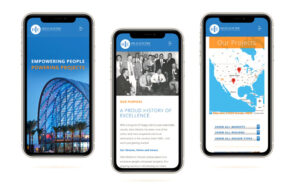
Three mobile phone screens displaying a construction company's responsive website, showcasing their mission, history of excellence, and a map of their nationwide project locations.
A mobile-optimized website is the foundation of the 2026 digital playbook, immediately showcasing brand history, mission, and geographical reach to potential clients.

Pillar 2: Mobile-First Design That Actually Works

Speed and mobile aren’t “nice features”—they’re deal-breakers.

Google punishes slow sites. In fact, in 2016, our CEO Les Kollegian was hired by Google to speak at their conferences about this exact issue. Here’s the stat that should terrify you: for every extra second your page takes to load, your bounce rate jumps 8X higher.

Think about that. One extra second. Eight times more people, gone.

If you don’t know how to optimize your site properly—and most don’t—you’re hemorrhaging traffic and conversions without even realizing it. And with over 70% of construction buyers starting their research on mobile, building for phones isn’t optional anymore. It’s fundamental.

Don’t get us wrong. Desktop design is EXTREMELY important. However, mobile-first in the A/E/C vertical is how all companies should be thinking. Once they’re evaluating a project or issuing a bid, your prospects are likely to switch to a larger screen to review PDFs, drawings, case studies, and detailed qualifications. A robust, desktop-friendly experience helps with credibility, downloads, and document access.

What matters:

Load time under 3 seconds. Period. Every second longer and you’re losing people.

Easy navigation for thumbs, not mouse cursors. Big buttons, smart spacing. Remember, your best trades might be on a job site wearing gloves. Your best prospect may be doing research while waiting for his/her cocktail at the bar. 

Images that look great on small screens. Don’t sacrifice visual impact, but optimize everything so it loads fast.

Simple forms. Mobile users won’t fill out 15 fields. Keep it to name, email, phone, and project type.

Here’s a stat that should scare you: mobile users are 5 times more likely to abandon a site that isn’t optimized. You can’t afford to lose half your audience because your site looks bad on a phone.

The Bottom Line: If your site doesn’t work flawlessly on mobile, you’ve disqualified yourself from the majority of potential clients before they even see your work.

Practical guidance:

  • Start with a mobile-first design mindset:
    • Fast load times (optimized images, compressed videos, lean code).
    • Clear navigation with prominent project gallery, capabilities, and contact.
    • Accessible CTAs (Get a quote, Request a proposal, Call now).
    • Readable typography, concise copy, and scannable sections.
    • Strong, trust-building elements: client logos, case studies highlights, safety records, licenses, certifications.


Pillar 3: Build Trust Before the First Call

Construction is a relationship business–and trust is everything. Your website needs to prove you’re legitimate, capable, and reliable and yes… trustworthy—before someone picks up the phone.

Essential trust-builders:

Show your credentials. Certifications, licenses, insurance, safety records. Display logos from your suppliers and partners. Make it obvious you’re the real deal.

Sounds basic, right?

We’ve worked with companies doing $50 million+ in revenue who don’t do this. Their response? “We have enough business.”

Our response? Do you, though? Because “enough” isn’t the same as “all the business you could have.” What are you leaving on the table by making prospects guess whether you’re legit? Trust signals aren’t just for startups trying to prove themselves. They’re for every company that wants to convert more of the traffic they’re already getting. 

Real testimonials with real details. “Saved us 15% on materials and finished two weeks early” beats “Great to work with!” every time. Use names, titles, photos if possible.

Introduce your team. People want to know who they’re hiring. Real photos of real people build connection.

Highlight your track record. OSHA ratings, safety certifications, project completion rates—these signal operational excellence.

Here’s why this matters: 47% of buyers look at 3-5 pieces of content before they’ll even talk to a salesperson. Make it easy for them to say yes by giving them the proof points they need.

The Bottom Line: Trust isn’t given, it’s earned. Your website should make it effortless for prospects to find the evidence they need to feel confident about working with you.

Pillar 4: Make It Stupid-Easy to Contact You

Every page should have a purpose. Every purpose should have a clear next step.

If someone’s interested, don’t make them hunt for how to reach you.

What converts:

Multiple ways to get in touch. “Request a Bid,” “Schedule a Consultation,” “Get an Estimate,” “Download Our Capabilities Deck.” Different people want different entry points.

Click-to-call on mobile. 61% of mobile users will call during the buying process. Make the phone number tappable everywhere.

Contact options that follow them. Sticky contact bars or chat widgets that stay visible as people scroll.

Forms right where they’re looking. Put inquiry forms directly on portfolio pages so prospects can reach out while viewing relevant work.

The math: you’re paying $165+ per lead from search ads. If your site doesn’t make it easy to convert, you’re wasting that investment.

Pro tip: Keep forms short. Name, email, phone, project type—that’s enough for a first conversation.

The Bottom Line: Every page needs a clear “do this next” moment. The easier you make it to contact you, the more qualified leads you’ll capture.

Pillar 5: Get Found by the Right People

A beautiful website is worthless if no one can find it.

The firms that dominate their markets don’t just build great sites—they make sure those sites show up when potential clients are searching.

The technical stuff (simplified):

Make sure your site is fast, clean, and organized in a way that search engines—and now AI—can understand. This includes things like clear page titles, good site structure, and behind-the-scenes code that helps Google, ChatGPT, Perplexity, and other AI tools figure out what you actually do.

Here’s why this matters more than ever: people aren’t just Googling anymore. They’re asking ChatGPT “who are the best commercial contractors in [city]?” or using AI search tools to compare firms. If your site isn’t structured properly, you won’t show up in those results—even if you’re the perfect fit. AI reads your site differently than humans do, and if it can’t parse your information clearly, you’re invisible in the fastest-growing search channel out there.

The content strategy:

Content marketing generates 54% more leads than traditional marketing. Adding a blog to your site increases your chances of ranking on Google by 434%.

Here’s what to create:

Service pages that match what people search for. Think “commercial general contractor in [your city]” or “design-build services in [your region].”

Project case studies with location details. Construction is local. Make sure every case study includes where the project was and what type of work it involved.

Educational content that answers questions. Blog posts like “How long does commercial construction permitting take?” or “What’s the difference between design-bid-build and design-build?” These attract people early in their research process.

The Bottom Line: SEO isn’t optional—it’s your primary lead source. Build it into your website from day one, target the searches your ideal clients are making, and create content that answers their questions. Do this right and your site becomes a lead-generating machine. And for those of you who don’t believe you are being found via search in any capacity. Aehhhhhhhh (buzzer sound). You have NO idea. At Jacob Tyler, we never thought in a million years that an executive at Sony would be upset with his current agency and “search” for another and find us. Being optimized for search got us that account and assistance developing the VAIO brand for Sony. So yeah, we believe. We will give you some more information on “search” in a little bit.

Design Trends That Actually Matter in 2026

Clean and Simple Wins

Less is more. White space, clean fonts, minimal navigation. Focus attention on what matters—your work.

Large Typography

Use of clean and modern typography in a large point type grabs attention and keeps it. Don’t overdo it though. Remember that people need to be attracted to read more and not yelled at. 

Video Makes a Difference

Time-lapse build videos, drone footage, client testimonials. Video tells stories in ways photos can’t.

Dark Mode Is Here

Dark backgrounds with sharp contrast can make architectural work pop. It’s modern, striking, and effective. With that said, be careful to not have too much body copy in reverse (white on top of black) as it can make paragraph content more difficult to read. 

Subtle Motion Adds Polish

Hover effects, scroll animations, interactive filters. Small details that make the experience feel premium without overwhelming users.

Sustainability Messaging Matters

Affiliations, green building practices, LEED certifications, energy-efficient outcomes—these resonate with commercial clients and conscious homeowners alike.

What a Professional Website Actually Costs

Let’s talk money. Here’s what you should expect to invest:

Small to Mid-Size Firms: $15,000 – $25,000

You get:

  • 15-25 pages
  • Custom design that’s mobile-responsive
  • 10-15 portfolio projects
  • Contact forms and lead capture
  • Basic search optimization
  • Timeline: 10-14 weeks

Best for: Local contractors, small commercial builders, residential remodelers

Mid-Size to Large Firms: $25,000 – $55,000+

You get:

  • 30-50+ pages
  • Advanced functionality and design
  • 25-50 portfolio projects with filtering
  • Integration with your CRM and project tools
  • Comprehensive SEO strategy
  • Blog and content marketing setup
  • Video integration
  • Timeline: 14-20 weeks

Best for: Regional general contractors, design-build firms, commercial construction companies

Enterprise-Level Firms: $55,000 – $100,000+

You get:

  • 50-100+ pages
  • Fully custom everything
  • Multi-location support
  • Project portals and employee logins
  • Interactive maps and advanced showcases
  • Marketing automation
  • Ongoing optimization and testing
  • Timeline: 20-24+ weeks

Best for: National contractors, large commercial builders, industrial construction firms

Ongoing Maintenance: $1,500 – $3,000/month

Includes:

  • Security updates
  • New project additions
  • SEO monitoring
  • Performance optimization
  • Analytics reviews

Think of this as the cost of keeping your best salesperson sharp and effective. Keep in mind that most Websites as mentioned above can be developed in WordPress, which is infinitely scalable so even though you may start with 15 to 20 pages, you can add as many as you like, and it is super easy to do so.

Mistakes That Kill Conversions

  1. Portfolio overload. Quality beats quantity. Show your best 15-25 projects, not every job you’ve done since 1985.
  2. Ignoring mobile. If it doesn’t work on a phone, you’ve lost the lead. Period.
  3. Hiding your call-to-action. Every page should answer: “What should I do next?” Make it obvious.
  4. Treating SEO as an afterthought. 57% of B2B marketers say SEO generates more leads than anything else. Build it in from the start.
  5. Slow load times. Users leave. Google penalizes. You lose.
  6. No way to track results. If you can’t measure it, you can’t improve it. Set up tracking for form submissions, calls, and key pages.
  7. Stale content. A portfolio that stops in 2019 signals a business that stopped growing. Update regularly.

How to Know If It’s Working

Track these numbers to measure your website’s impact:

  • Traffic growth (month-over-month and year-over-year)
  • Conversion rate (forms, calls, downloads as a % of visitors)
  • Bounce rate (target under 40% on key pages)
  • Time on site (longer = more engaged
  • Search rankings for your target terms
  • Leads generated (qualified inquiries)
  • Cost per lead (compared to other channels)
  • Projects won from web inquiries

The goal isn’t to hit industry averages—it’s to beat your own baseline. A 20% lift in traffic or a 0.5% bump in conversion rate translates directly to revenue.

Your 2026 Website Checklist

Use this when evaluating proposals or scoping your project:


Strategy & Planning

  • Audience personas defined
  • Competitor analysis completed
  • Keyword research done
  • Conversion goals established
  • Site structure approved


Design & Experience

  • Mobile-first, responsive design
  • Loads in under 3 seconds
  • Clean layouts with white space
  • High-quality, authentic photos (no stock)
  • Consistent branding throughout


Content & Messaging

  • Clear value proposition on homepage
  • Service pages optimized for search
  • 10-20 featured projects with case studies
  • Client testimonials (text or video)
  • Team bios and photos
  • Trust signals visible (certifications, licenses)


Functionality

  • Contact forms on key pages
  • Click-to-call phone numbers
  • Filterable project portfolio
  • Blog/resources section
  • Secure hosting and backups


SEO & Analytics

  • Google Analytics installed
  • Search Console configured
  • Page titles and descriptions optimized
  • Sitemap submitted
  • Redirects set up (if redesign)


Post-Launch

  • Tested across all devices
  • Monthly analytics reporting
  • Content update plan in place
  • Ongoing optimization strategy defined

Common Questions Answered

How much should I really spend on a website?

For most construction companies, expect to invest $15,000 to $75,000+ depending on complexity and scale.

Think of it this way: if a well-designed site generates even 3-5 additional qualified leads per month, it pays for itself within months. The question isn’t “what’s the cheapest option?” It’s “what delivers the best return?” 

How long does it take to build?

Quality takes time. Most projects run 10-16 weeks from kickoff to launch. Smaller sites might be done in 8-10 weeks. Enterprise sites with complex features can take 20-24 weeks.

Rushing usually means compromising quality. Launch something you’re proud of, not something you’re settling for.

Do I really need mobile optimization?

Absolutely. Over 70% of potential clients browse on mobile before making a decision. Google ranks your mobile site first. Mobile users are 5X more likely to bail on a site that doesn’t work properly.

If your site doesn’t work flawlessly on phones, you’re eliminating the majority of your market.

Can I just use a template?

Sure, if you want to blend in and hope for the best.

Template platforms like Wix or Squarespace are cheap upfront, but they come with hidden costs that kill your competitiveness. Here’s why they fall short for construction companies:

  1. Speed kills your conversions. These platforms are bloated with code you don’t need. They’re slower out of the box, and you can’t optimize them the way a custom site can. Remember: every extra second costs you 8X more bounces.
  2. You’re locked into their limitations. Need a custom project filtering system? Want to integrate with your CRM? Looking to build something unique that sets you apart? Good luck. Templates box you into what everyone else is doing.
  3. SEO is hobbled from the start. Sure, they claim to be “SEO-friendly,” but you can’t control the technical foundation the way you need to. Your ability to rank for competitive local terms is significantly hampered compared to a properly built custom site.
  4. You look like everyone else. Prospects can spot a Squarespace template from a mile away. When you’re competing for six- and seven-figure projects, looking like a DIY startup doesn’t inspire confidence.
  5. AI can’t read it properly. These platforms generate messy code that makes it harder for AI search tools (ChatGPT, Perplexity, etc.) to understand and recommend your business. You’re invisible in the fastest-growing search channel.
  6. Mobile experience is “good enough” at best. Remember that 70% of your prospects start on mobile? Template platforms give you a responsive site, but not an optimized one. There’s a massive difference.

The bottom line: when your average project is worth $50K to millions, a $200/year website isn’t a smart savings—it’s a costly compromise. Investing in a professional custom site delivers exponentially better ROI because it actually converts the traffic you’re working so hard to generate.

How often should I update it?

A website isn’t a “set it and forget it” asset. It’s a living business tool that needs regular attention to stay effective.

At minimum, add new projects quarterly. Fresh content tells both visitors and search engines you’re active and growing. But there’s more to it than that.

Why regular updates actually matter:

Search engines reward fresh content. Google prioritizes sites that consistently publish new material. A site that hasn’t been touched in six months gets buried, while competitors updating regularly climb the rankings. This isn’t theory—it’s how the algorithm works.

AI search needs current data. ChatGPT, Perplexity, and other AI tools pull from recently updated sources. If your site is static, you’re invisible in AI-powered search results—the fastest-growing way people find contractors.

Your prospects are watching. When someone lands on your site and sees your last project is from 2022, what do they think? Either you’re not busy (red flag) or you don’t care about your digital presence (also a red flag). Fresh content signals momentum and success.

SEO compounds over time. Every new blog post is another opportunity to rank for search terms. Every updated project page strengthens your local SEO. This isn’t busy work—it’s building equity that generates leads for years.

Ideal update cadence:

  • New blog posts monthly – drives SEO, answers buyer questions, positions you as an expert
  • Portfolio updates quarterly – keeps your best work front and center
  • Testimonials as you receive them – fresh social proof builds trust faster
  • Service pages refreshed annually – keeps messaging aligned with your current capabilities and market positioning
  • Technical SEO audit quarterly – ensures your site stays optimized as search algorithms evolve

Should you hire someone to manage this?

Unless you have a dedicated marketing person who understands SEO, content strategy, and technical optimization—yes, absolutely.

Here’s why: most construction company owners don’t have time to write optimized blog posts, resize images properly, update meta descriptions, monitor search rankings, or stay current on algorithm changes. And frankly, you shouldn’t. Your time is worth more managing projects and closing deals.

A monthly retainer with a specialized agency or freelancer ($1,500-$5,000/month depending on scope) typically includes:

  • Regular content creation and optimization
  • Portfolio and project page updates
  • SEO monitoring and adjustments
  • Technical performance optimization
  • Analytics reporting so you see what’s working

Think of it this way: if your site generates even 2-3 additional qualified leads per month because it’s consistently updated and optimized, that monthly investment has already paid for itself several times over.

The bottom line: A stale website signals a stale business. But more importantly, an outdated site actively costs you leads, rankings, and revenue. Regular updates aren’t optional maintenance—they’re how your website continues generating ROI long after launch.

What’s the difference between a brochure site and a lead generation site?

Brochure sites build trust and credibility through compelling storytelling, professional imagery, and showcases of your work. When designed thoughtfully, they serve as powerful digital portfolios that help potential clients understand who you are, what you do, and why they should work with you. For smaller businesses especially, a well-crafted brochure site with clear contact options and conversion points can be exactly what’s needed to turn visitors into leads.

Lead generation sites take this foundation further by prioritizing conversion at every turn—with multiple strategic calls-to-action, optimized user journeys, lead capture mechanisms throughout the experience, and content specifically designed to move visitors down the funnel.

Both approaches should ultimately drive leads and conversions. The difference is in emphasis: brochure sites lead with trust-building and storytelling, while lead generation sites lead with conversion optimization—but the best sites often blend elements of both.

We have plenty of business. Does SEO really matter?

Look, I get it. We hear this all the time: “We don’t need to worry about our website because we don’t get business from it anyway.”

But here’s the thing—comfort is the enemy of growth.

Think about it: why would you turn down the chance to be considered for projects you didn’t even know existed? Projects where the prospect finds you instead of you having to chase them down?

When we push back and ask “How do you actually know you’re not getting business from your site?”, there’s usually just crickets. Or worse, assumptions based on… well, nothing.

Here’s a story (in case you missed it earlier) that changed everything for us. Years ago, we won the brand development for Sony VAIO products for college students. Want to know how? A Sony senior executive (fed up with his current agency relationship) literally Googled agencies and found us. We didn’t even think that was possible. But it happened, and we became true believers.

Fast forward to 2025. We redesigned the website for Dempsey Construction. About three months after launch, Michaela Weibel, their Director of Marketing, called us—absolutely shocked. She’d been there over five years and had never received a single lead through their website. Not one.

With the new site and proper optimization? Leads started coming in.. and while just a few, it is certainly better than none. Now they’re actually in the game instead of watching from the sidelines. And get this—just one deal pays for the entire website investment and then some.

But it gets even better. At Jacob Tyler, we’re now landing clients through something most agencies aren’t even thinking about yet: generative search.

Sure, people still Google “Best Web Design Agencies in San Diego” or “Construction Web Designer”—and we show up for those. But recently, an executive asked Gemini (Google’s AI), “Who designed the Hensel Phelps website?” Because we optimized our site for generative search, they got the right answer: us. We won that client.

This is the new reality. In 2026, if you’re in construction and you’re not optimized for generative search—especially around your completed projects—you’re invisible to a massive chunk of potential clients.

Should I hire a construction specialist or a general agency?

Here’s our honest take, and we’d be lying if we told you otherwise: you don’t need an agency that only does construction.

We’ve been doing this for 25 years at Jacob Tyler. In that time, we’ve built high-performing websites for health and life sciences companies, medical product manufacturers, ecommerce brands, financial services firms, and yes—construction and industrial companies. The idea that an agency must be vertically niched to deliver results? That’s marketing spin, not reality.

What you actually need is this:

An agency that takes the time to deeply understand your buyers, your sales cycle, your competitive landscape, and what drives decisions in your market. Whether that’s construction, manufacturing, or healthcare doesn’t matter as much as their commitment to learning what makes your business tick.

That said, industry experience does accelerate results.

When an agency has worked with construction firms before, they come to the table knowing:

  • How to structure project portfolios that actually convert
  • Which trust signals matter most (certifications, safety records, bonding capacity)
  • How to optimize for the long, relationship-driven sales cycles typical in construction
  • What questions prospects ask before they’re ready to request a bid
  • The balance between showcasing capabilities and not overwhelming decision-makers

That expertise means faster onboarding, fewer missteps, and a site that performs from day one instead of needing months of trial and error.

But here’s what matters more than niche experience:

Does the agency have a track record of driving measurable results? Do they understand conversion optimization, SEO, user experience, and content strategy at a deep level? Can they point to specific outcomes—increased leads, higher rankings, improved conversion rates—across any B2B vertical?

Those fundamentals transcend industry. A team that’s driven results in financial services or life sciences can absolutely apply that same rigor and strategic thinking to construction. The principles of effective digital marketing don’t change just because the hard hats do.

The bottom line:

Choose an agency based on their strategic chops, their commitment to understanding your specific market, and their proven ability to deliver ROI—not just their client roster. Industry experience is a plus and can accelerate results, but it’s not a requirement. Deep expertise in digital strategy, combined with genuine curiosity about your business, will always outperform shallow “niche specialist” credentials.

At Jacob Tyler, we bring both: 25 years of cross-industry experience and a proven track record in construction and industrial markets. That combination means we know what works universally and what needs to be tailored specifically for how contractors buy.

How do I measure ROI?

First, let’s be clear about something: your website is a critical piece of your marketing engine, but it’s not the only piece.

We’d be doing you a disservice if we said “build a great website and watch the leads roll in.” That’s not how sustainable growth works. Your website needs to work in concert with your brand, your relationships, your presence at trade shows, your direct mail, your reputation in the community, and yes—even those conversations on the 19th hole.

That said, your website should absolutely be measured and held accountable for ROI.

Here’s what to track:

  • Qualified leads generated – how many serious inquiries came directly from the site
  • Conversion rate – percentage of visitors who take action (form fills, calls, downloads)
  • Revenue from web-sourced inquiries – actual project wins that started with your website
  • Cost per lead – compare what you’re spending on the website against other channels like trade shows, print ads, or pay-per-click

Most construction firms find that once their website is properly optimized, it delivers the lowest cost per qualified lead of any marketing channel. Even modest improvements—like a 1% conversion bump—can generate hundreds of thousands in additional project value annually.

But here’s the bigger picture:

Your website doesn’t exist in a vacuum. It’s the hub where all your other marketing efforts converge:

  • Someone meets you at a trade show → they Google you → your website seals the deal (or kills it)
  • A referral mentions your name → the prospect checks you out online → your site validates the recommendation
  • You run targeted ads → traffic lands on your site → conversion optimization determines if that spend pays off
  • Your brand shows up in their LinkedIn feed → they click through → your website tells the full story

Think of it this way: Your brand is your reputation. Your website is where that reputation gets verified and converted into action. Traditional marketing—networking, events, direct outreach—gets you in the conversation. Your digital presence determines whether that conversation becomes a contract.

So yes, measure your website’s performance religiously. But don’t forget that your entire marketing ecosystem—brand positioning, consistent messaging across channels, strategic relationship building, and traditional outreach—all work together to drive revenue.

The website is your best salesperson. But even the best salesperson needs leads to close. That’s where the rest of your marketing comes in.

Your Website Is Your Competitive Advantage

In 2026, your construction website isn’t a cost center. It’s a strategic asset that either generates revenue or bleeds opportunity.

The firms winning the best projects understand this: your website is a business development engine that works around the clock. While your competitors are still treating their online presence as an afterthought, the leaders in your market are converting browsers into bids—24/7, without a single sales call.

Here’s the math that matters: construction websites average around a 2% conversion rate. That means 98 out of 100 qualified prospects leave without contacting you.

Now imagine cutting that waste in half. Better mobile experience, faster load times, clearer calls-to-action, stronger portfolio presentation—these aren’t cosmetic upgrades. They’re the difference between doubling your lead volume and watching opportunities go to competitors who got the details right.

Combine that with smart SEO and a relentless commitment to showcasing your best work, and you’ve built something that compounds: a platform that gets stronger, ranks higher, and generates more qualified leads every month—without you spending another dollar on traffic.

For owners and marketing leaders evaluating partners, the criteria are simple: find an agency that understands how construction buyers make decisions, builds for conversion not just aesthetics, and measures results in leads and revenue, not likes and page views.

The investment in getting this right pays dividends for years. The cost of getting it wrong? You’re already paying it—you just don’t see the opportunities you’re missing.

Let’s Talk About What’s Possible

If you’ve made it this far, you already know your website could be working harder for you.

Maybe you’re frustrated watching leads go to competitors with slicker digital presence. Maybe you know your site doesn’t represent the quality of work you actually deliver. Or maybe you’re just tired of leaving money on the table because your online experience doesn’t match your reputation in the field.

We get it. We’ve spent 25 years helping companies in construction, industrial, and beyond turn their digital presence into a genuine competitive advantage—not just a prettier version of what everyone else has.

Here’s what we believe:

Your website should earn its keep. It should generate qualified leads, support your sales team, and prove ROI. If it’s not doing that, something’s broken—and it’s fixable.

You shouldn’t have to become a digital marketing expert to make this work. That’s what partners are for. Our job is to understand your business, your buyers, and your goals—then build something that delivers results you can measure.

If you’re ready to explore what’s possible, here’s how we typically start:

  1. Have a real conversation. No sales pitch. No generic proposal. Just an honest discussion about where you are, where you want to be, and whether we’re the right fit to help you get there.
  2. Build a plan that makes sense for your business. Not a one-size-fits-all template. A strategy tailored to your market, your goals, and your timeline.
  3. Execute with accountability. We measure what matters—leads, conversions, revenue—and adjust as we learn what works best for your specific audience.

The firms that are winning in your market aren’t doing anything magical. They’re just committed to making their digital presence as strong as their craftsmanship. And they’re working with partners who understand that construction isn’t sold the same way software or sneakers are.

The best time to fix this was last year.
The second best time? Right now.

If you’re curious about what’s possible for your business, let’s talk. No pressure, no pitch—just a conversation between people who care about building things that work.

Schedule a consultation or reach out and fill out our own lead form at www.jacobtyler.com. Hell… just call our CEO (Les Kollegian) directly at 619-379-0007.  We’re here when you’re ready.

What Sets a Digital Agency Apart in a Crowded Market?

The digital agency landscape has never been more saturated. From our last check in 2023, we estimate that there are just over 45,000 digital agencies in the United States and Canada. With such fierce competition, the question becomes: what transforms an ordinary digital service provider into a standout brand experience agency that clients actively seek out?

We’ve witnessed firsthand how the most successful agencies differentiate themselves not through flashy promises or rock-bottom pricing, but through strategic positioning and measurable value creation. The agencies that thrive understand that differentiation goes beyond surface-level marketing—it requires a fundamental shift in how they approach client relationships, deliver services, and measure success.

The Evolution of Agency Differentiation

Brand differentiation is about grabbing the attention of potential clients and making your brand stand out in a crowded marketplace by communicating what it is that makes it unique. However, the digital agency world has evolved far beyond the traditional “unique selling proposition” model.

Today, brand differentiation is about defining and projecting a differentiated brand narrative – a combination of features and attributes that are woven together into a single, coherent story. Instead of the differentiation being about ‘feature X’ the whole package is differentiated.

For a modern brand experience agency, this means creating a comprehensive ecosystem where strategy, creativity, and technology converge to deliver transformative client outcomes. We’ve moved past the era where agencies could succeed by simply offering “great design” or “expert development”—clients now expect integrated solutions that address their complete digital presence.

Strategic Specialization: The Power of Focused Expertise

One of the most effective ways to differentiate your digital marketing agency from the competition is through specialization. By focusing on mastering digital marketing for a specific industry, you can establish your agency as the go-to expert in that particular niche. This approach allows you to develop a deep understanding of the unique challenges and opportunities facing that industry, enabling you to provide tailored solutions that meet the specific needs of clients within that sector.

We’ve observed that the most successful brand experience agencies don’t try to be everything to everyone. Instead, they identify specific verticals or service areas where they can deliver exceptional value. This focused approach allows them to:

  • Develop deep industry expertise that generalist agencies cannot match
  • Build case studies and testimonials within targeted sectors
  • Command premium pricing for specialized knowledge
  • Create more efficient internal processes and team structures

Consider how Clay leverages emerging technologies like AI, AR/VR, and Web3 to help brands create immersive experiences. This technology-forward specialization positions them as the go-to agency for brands seeking cutting-edge digital experiences.

Data-Driven Decision Making as a Competitive Advantage

The most successful agencies share three key characteristics, which have consistently driven their growth and reputation: These agencies rely on data to craft and refine campaigns. Whether it’s analytics for SEO, click-through rates for PPC, or consumer behavior insights, they use measurable metrics to make informed decisions.

The agencies that stand out understand that intuition and creativity must be balanced with concrete data. Data-driven strategies and personalization will continue to dominate the digital landscape. Agencies that excel in harnessing data analytics and AI to drive personalized customer experiences will likely thrive. The ability to interpret and leverage data insights will remain a critical differentiator for agencies seeking to stay relevant in 2024 and beyond.

We implement this philosophy by establishing clear KPIs for every client engagement, conducting regular performance reviews, and using insights to continuously optimize our strategies. This approach transforms client relationships from subjective creative partnerships into objective, results-focused collaborations.

Technology Integration and Innovation Leadership

Staying up-to-date on AI technologies might be a key differentiator that sets the most successful digital marketing agencies apart from their competition. The agencies leading the market aren’t just using technology—they’re pioneering new applications and methodologies.

AI isn’t going away, and putting our heads in the sand won’t help. We need to look at how we can use these new tools to create a competitive advantage. The most forward-thinking brand experience agencies are already integrating AI into their workflows for content creation, data analysis, and campaign optimization.

However, technology adoption alone doesn’t create differentiation. The key lies in how agencies apply these tools to solve specific client challenges and deliver measurable improvements in brand performance.

Comprehensive Service Integration

Juggling multiple service providers is time-consuming and makes it difficult to achieve a cohesive market strategy. That’s likely why more than half of clients opt for 3+ services when working with a marketing agency.

Modern clients prefer working with agencies that can handle their complete digital ecosystem rather than managing multiple vendor relationships. Branding agencies bring together professionals from various fields—strategists, designers, content creators, and market researchers—providing a comprehensive skill set that may not be available in-house.

We’ve structured our services to provide seamless integration across:

  • Brand strategy and positioning
  • Visual identity and design systems
  • Website development and optimization
  • Digital marketing and growth strategies
  • Performance measurement and optimization

This integrated approach allows us to maintain consistency across all client touchpoints while delivering more efficient project management and better overall results.

Client-Centric Culture and Relationship Building

Irrespective of the changes in models or technology, a client-centric approach will remain the cornerstone of successful agencies. Understanding clients’ needs, providing tailored solutions, and delivering measurable results will continue to be the driving force behind the longevity of digital agencies.

The agencies that consistently win and retain clients understand that relationships matter more than transactions. Whatever marketing strategies you come up with, delivering exceptional customer experiences will always serve you well, helping you achieve that elusive competitive edge. And it all starts with understanding customer preferences and expectations, and continues all the way through the customer journey. Client satisfaction is vital to building trust over time.

We invest heavily in understanding our clients’ businesses, industries, and growth objectives. This deep understanding allows us to proactively identify opportunities and challenges, positioning ourselves as strategic partners rather than service providers.

Measurable Results and Transparent Reporting

As a TechCrunch-verified growth expert, we use performance analytics to measure the success of our branding campaigns and make calculated improvements that move the needle for your brand. The most successful brand experience agencies don’t just promise results—they deliver them consistently and transparently.

We’ve implemented comprehensive reporting systems that provide clients with real-time visibility into campaign performance, budget utilization, and ROI metrics. This transparency builds trust and demonstrates the tangible value of our partnership.

Key metrics we track include:

  • Brand awareness and sentiment improvements
  • Website traffic and conversion rate optimization
  • Lead generation and customer acquisition costs
  • Revenue attribution and lifetime value increases

Adaptability and Future-Proofing

Agencies that can pivot, innovate, and evolve in response to these changing dynamics will not just survive but thrive in the digital ecosystem of 2024 and beyond. The essence of creativity, problem-solving, and strategic thinking that underpins the foundation of digital agencies will remain invaluable regardless of the form they take in the future.

The digital landscape changes rapidly, and the agencies that succeed are those that can adapt quickly while maintaining their core value proposition. Brands with a clear and differentiated identity find it easier to adapt to changes in the market. Whether responding to new trends, consumer preferences, or industry shifts, a well-differentiated brand can navigate changes more effectively while maintaining its core identity.

We maintain our competitive edge by continuously investing in team development, staying ahead of industry trends, and experimenting with new technologies and methodologies. This commitment to evolution ensures we can meet our clients’ changing needs while maintaining the quality and consistency they expect.

Building Long-Term Strategic Partnerships

Their unique subscription-based model offers ongoing support and services, making them a great long-term partner for businesses. The most successful brand experience agencies understand that sustainable growth comes from long-term client relationships rather than one-off projects.

We structure our engagements to provide ongoing value through:

  • Continuous optimization and improvement initiatives
  • Regular strategic planning and goal-setting sessions
  • Proactive market analysis and opportunity identification
  • Flexible service scaling based on client growth

This approach transforms client relationships from project-based transactions into strategic partnerships that grow and evolve over time.

Frequently Asked Questions

What sets a brand experience agency apart from a traditional digital agency?

A brand experience agency focuses on creating cohesive, memorable experiences across all digital touchpoints rather than offering isolated services. These agencies unify brand strategy, design, content, and digital performance to ensure every customer interaction reinforces your brand’s core message and values. The result is stronger emotional connections, higher engagement, and measurable business growth.

How can an agency prove real differentiation?

True differentiation shows in the agency’s work and process, not just its marketing claims. Look for niche specialization, clear methodologies, and case studies with tangible results—such as improved client retention, lead quality, and ROI. The best agencies also provide direct access to senior strategists, transparent reporting dashboards, and measurable KPIs that tie branding efforts to real business outcomes.

Why is specialization so powerful for agencies?

Specialization allows agencies to master a specific industry or service area, building deeper expertise and sharper insights than generalists. Focused agencies can solve unique problems faster, develop repeatable frameworks, and command premium pricing because they consistently deliver higher-quality, targeted results for their niche.

How do top agencies use data and AI without losing creativity?

Leading agencies pair human strategy and storytelling with advanced analytics and AI-driven tools. Data is used to uncover insights, personalize experiences, and guide creative direction—not replace it. This balance ensures campaigns remain authentic, innovative, and performance-oriented while still grounded in audience behavior and measurable outcomes.

What should I require in agency reporting?

Insist on transparent reporting that tracks the metrics most relevant to your goals—such as brand awareness, conversion rates, customer retention, and ROI. The best agencies provide real-time dashboards, budget pacing updates, and quarterly strategy reviews outlining performance, learnings, and next steps for continuous optimization.

The Web Design Evolution of Jacob Tyler: A Digital Timeline Spanning Two Decades

Well… we did it. We launched a new website. You know how the old business saying goes; “We’re our own worst client”. That’s true for many and very true for us. We seem to always put ourselves last in the “to-do list” pecking order. However, after months of work, back-and-forth, opinions, changes, and procrastination, we have created an experience that we feel works for us AND the people visiting. In other words, this is yet another Web design we are proud of. We (our team) have a saying that websites are like dog years—every year online is equivalent to seven years in technology evolution. It’s a playful metaphor that captures a serious truth about digital longevity in our rapidly changing industry. Yet despite this accelerated aging, both our own websites and those we create for clients have consistently defied the odds, averaging an impressive eight-year lifespan that speaks to thoughtful design and strategic planning.

Today, we’re taking a journey through our own digital evolution, examining how our website has transformed over the years and what these changes reveal about broader trends in web design, user behavior, and technological advancement.

Version 1: The Foundation Years (Early 2000s)

Our first website was a product of its time—clean, corporate, and information-focused. The design featured our signature red branding with a structured layout that prioritized content hierarchy and professional presentation. Navigation was straightforward, with clear sections for services, portfolio, and contact information.

This early iteration reflected the web standards of the early 2000s: fixed-width layouts, table-based structures, and a desktop-first mentality. Users were patient with longer load times and comfortable with scrolling through dense information.


Key characteristics of Version 1:

  • Static, information-rich design
  • Desktop-only optimization
  • Traditional corporate aesthetic
  • Content-heavy approach
  • Clear service differentiation

Version 2: The Interactive Revolution

Our second go-around was a total game-changer (at least to us). We ditched the static, corporate look and went big—think larger images, video content (super high-tech at the time), and interactive stuff that actually made people feel something when they landed on our site. Instead of just showing our work like a boring gallery, our case studies started telling real stories with visuals that packed a punch.

This was right when everyone was really getting overly obsessed with Facebook and Instagram (just getting started), and suddenly every brand needed to be a storyteller. So we flipped the script on how we presented our portfolio. Instead of just saying “Hey, look what we made,” we started showing “Here’s how our creative work actually moved the needle for our clients.” We stopped being an information dump and started creating experiences that people actually wanted to stick around for.

Notable improvements in Version 2:

  • Enhanced visual storytelling
  • Interactive portfolio elements and video
  • Stronger emotional connection
  • Social media integration
  • Results-focused case studies

Version 3: Mobile-First Thinking

The third generation of our website represented our adaptation to the mobile revolution. As smartphones and tablets became ubiquitous, we redesigned with responsive principles at the core. The layout became more flexible, typography scaled appropriately across devices, and navigation transformed to accommodate touch interfaces. At the time, everyone was asking us who designed from mobile phones. And of course, this is extremely important however, a lot of companies that we work with, including us actually have less views on mobile platforms even to this day. That’s because in the business to business environment, many people are doing their research on their laptops and desktop devices.

Also, suddenly, scrolling became natural—people were swiping and scrolling with their thumbs all day long. Mobile screens were small, so longer pages made more sense than trying to cram everything into tiny viewports. That became the norm for desktop as well.

This was also when we started playing around with all the shiny new web tech and jumped on trends like parallax scrolling and those tiny animations that make everything feel more alive. We even spent some time wondering if we should design for the Apple Watch—yeah, that was a thing for about five minutes. Looking back, it’s a good reminder that just because something’s new and buzzy doesn’t mean you need to go all-in, but it’s still worth checking out to see if it’s actually useful or just another flash in the pan.

The mobile-first approach fundamentally changed how we structured content:

  • Responsive design principles
  • Touch-friendly navigation
  • Optimized loading speeds
  • Progressive enhancement
  • Cross-platform compatibility

Version 4: The Current Era – Bold, Creative, and Results-Driven

Our latest website embodies everything we’ve learned about effective digital experiences. The tagline “Our Creative Kicks Ass and Makes Names” was the only copy that stayed from the previous website because it immediately establishes our confident, results-oriented approach while maintaining the professional credibility our global clients expect.

The current design features:

  • Bold Visual Hierarchy: Large typography and strategic use of white space guide users through our story
  • Integrated Case Studies: Portfolio pieces are woven throughout the experience.
  • Multi-Device Optimization: Seamless experiences across desktop, tablet, and mobile devices
  • Performance Focus: Fast loading times and smooth interactions enhance user engagement
  • Conversion-Oriented: Strategic placement of contact forms and calls-to-action drive business results

The Importance of Strategic Redesign

Each evolution of our website wasn’t driven by boredom or aesthetic trends—it responded to fundamental shifts in user behavior, technology capabilities, and business objectives. This strategic approach to redesign offers several key benefits:

Technological Relevance

Keeping pace with web standards, security protocols, and performance expectations ensures your site remains functional and trustworthy.

User Experience Evolution

As user expectations change, websites must adapt to meet new interaction patterns and consumption preferences.

Brand Maturation

Your digital presence should evolve alongside your business, reflecting growth, expanded capabilities, and refined positioning.

Competitive Advantage

Regular updates help maintain differentiation in increasingly crowded markets.

Search Engine Optimization

Fresh content, improved site structure, and modern technical implementation boost search visibility.

Lessons from Our Journey

Our two-decade website evolution offers several insights for businesses considering their own digital transformation:

1. Plan for Longevity: While we joke about dog years, our eight-year average lifespan proves that thoughtful design and solid technical foundation can extend website value significantly.

2. Embrace Change Gradually: Each iteration built upon previous successes rather than starting from scratch, ensuring continuity while enabling innovation.

3. User-Centric Design Wins: Our most successful redesigns prioritized user needs over internal preferences or fleeting design trends. This applies for our clients as well.

4. Technology Should Enable, Not Drive: We adopted new technologies when they enhanced user experience, not simply because they existed.

5. Content Strategy Matters: Effective websites balance engaging presentation with substantial, valuable content that serves user intent.

Looking Forward

As we continue evolving our online presence, we’re already anticipating the next wave of changes: voice interfaces, AI-powered personalization, generative search, and immersive technologies that will reshape how users interact with brands online.

But regardless of technological advancement, our core philosophy remains constant: create experiences that connect with users, drive business results, and stand the test of time. After all, in an industry where dog years apply, longevity is the ultimate measure of success.

The Jacob Tyler website journey demonstrates that strategic redesign isn’t about chasing trends—it’s about thoughtfully evolving to serve users better while achieving business objectives. Whether you’re considering your first major redesign or your fourth, remember that the best websites aren’t just built to impress today’s visitors, but to adapt and thrive for years to come.

Ready to discuss how your website design can evolve to meet changing user expectations and business goals? Let’s start that conversation.

Why Partnering with a Digital Marketing and Creative Agency Helps Businesses Grow

Keeping your business competitive in today’s digital world isn’t easy. Customers have endless options, and their attention is harder than ever to capture. Without the right tools or expertise, it’s easy to feel like your efforts are getting lost in the crowd.

This is where a digital marketing and creative agency can make all the difference. These agencies don’t just help you keep up—they help you thrive. They combine smart strategies with creative solutions to make your business stand out and grow.

What a Digital Marketing and Creative Agency Does

A digital marketing and creative agency brings two key strengths together: marketing strategy and creative design. For businesses in San Diego, finding the perfect web design agency is essential to establish a strong online presence.

Marketing Strategy

This includes everything needed to connect with your audience online. Agencies create plans to improve your website’s search ranking, manage social media platforms, and run ad campaigns that get results. They make sure your efforts lead to more customers and more sales.

Creative Design

The way your business looks matters. From logos to websites to marketing materials, agencies create designs that are professional and engaging. They make sure your business looks trustworthy and leaves a lasting impression.

When marketing and creative design work together, the results are powerful. Agencies help businesses not only attract attention but build trust and loyalty with their audience. Understanding the key factors in choosing the best branding and creative agency is crucial for your business success.

Overcoming Common Challenges

Businesses face several challenges in a competitive online world. A digital marketing and creative agency can solve many of these problems.

Keeping Up with Changing Trends

The digital landscape changes quickly. Agencies stay up to date on the latest platforms, tools, and trends. They adjust your marketing approach to make sure you stay ahead of competitors.

Not Enough Resources or Skills

Hiring a team of experts can be expensive and time-consuming. Agencies give you access to skilled professionals without needing to expand your in-house team.

Standing Out in a Crowded Market

Many businesses struggle to stand out online. Agencies create unique strategies and designs that make your business more noticeable and memorable.

Measuring What Works

It’s not always clear which marketing efforts are paying off. Agencies track results and provide detailed insights. They help you focus on what works and stop wasting time on what doesn’t.

How Your Business Benefits

Partnering with a digital marketing and creative agency offers clear advantages that help your business grow.

1. Access to Experts

Agencies bring together specialists in design, strategy, and analytics. You get a team that knows how to make an impact.

2. Flexibility for Your Needs

Whether your business is just starting out or already growing, agencies can scale their services to match your goals. They’re ready to support you at any stage.

3. Time Back for Your Team

When you outsource marketing and creative tasks, you can focus on running your business. Agencies handle the details so you don’t have to.

4. A Fresh Perspective

Sometimes, being too close to your business can make it hard to spot opportunities. Agencies bring a fresh set of eyes and new ideas.

5. Faster Results

Because agencies know what works, they can help you see results more quickly than trying to figure it out on your own.

How the Partnership Works

Partnering with an agency is a team effort. They work closely with you to ensure your goals are achieved.

Step 1: Learning About Your Business

The agency begins by understanding your goals, challenges, and audience. This helps them create a strategy that fits your needs.

Step 2: Planning the Strategy

The agency develops a plan to meet your goals. This could include updating your website, managing ad campaigns, or creating fresh branding materials.

Step 3: Executing the Plan

Once the plan is set, the agency puts it into action. They create content, manage campaigns, and deliver designs that reflect your brand.

Step 4: Tracking and Adjusting

The agency monitors progress and shares regular updates. They make changes based on results to keep things moving in the right direction.

Agencies also encourage open communication. Regular check-ins and updates help keep everyone on the same page.

Choosing the Right Agency

Not every agency will be the right fit for your business. It’s important to choose one that aligns with your goals and values.

  1. Look for Shared Values

The agency should understand your business and be invested in helping you succeed.

  1. Review Their Experience

Ask for examples of their previous work. Make sure their skills and style match what your business needs.

  1. Communication is Key

A good agency will communicate clearly and consistently. They should keep you informed and listen to your input.

  1. Adaptable to Change

Your needs may shift as your business grows. Choose an agency that can adjust to meet those changes.

Let’s Grow Your Business

Jacob Tyler specializes in helping businesses grow through expert marketing and creative design. Whether you need help building your brand, connecting with your audience, or improving your digital presence, our team is ready to help.

Learn more about our branding expertise and agency services or contact us to get started.

The Essential Role of a Brand Building Agency in Long-Term Success

A brand building agency focuses on developing and enhancing a company’s brand. This includes creating a strong identity that helps a business stand out in a crowded market. A brand building agency provides various services that shape how customers view a brand. This might include everything from designing logos to developing  marketing strategies.

The agency’s main goal is to build a brand that resonates with the target audience. This understanding helps in creating a brand that is not only appealing but also memorable.

The Importance of Brand Identity

Brand identity includes visual elements like logos and colors, as well as the messaging used in communications. A brand building agency plays a crucial role in defining and developing this identity. This might involve creating brand guidelines that detail how the brand should be presented across all platforms.

Building Brand Awareness and Recognition

Creating brand awareness is about getting people to know and recognize a brand. This is essential for any business aiming for long-term success. A brand building agency uses various strategies to increase visibility. These strategies can include social media marketing, content creation, and advertising.

The Role of Consistency in Branding

Consistency is vital in branding. It ensures that customers have a unified experience, regardless of where they encounter the brand. A brand building agency ensures that all branding elements are cohesive across different channels, such as websites, social media, and advertisements.

Maintaining consistency helps in reinforcing the brand identity. It allows customers to form a clear understanding of what the brand stands for. A consistent approach in messaging and visuals helps to build credibility and trust. A brand building agency will often create detailed brand guidelines to keep all communications aligned. This includes everything from tone of voice to design elements.

Adapting to Market Changes

The market is always changing, and brands must adapt to stay relevant. A brand building agency stays updated on trends and shifts in consumer preferences. This knowledge is essential for helping brands evolve over time.

When changes happen in the market, a brand building agency can guide a business on how to adjust its branding strategies. This might involve refreshing visuals or updating messaging to align with current trends. Adapting while staying true to the brand’s core identity is a delicate balance. An experienced agency knows how to manage this transition effectively.

Measuring Brand Success

To know if branding efforts are working, it’s important to measure success. A brand building agency uses various metrics to track progress. This can include assessing brand awareness, customer engagement, and loyalty. By analyzing these indicators, agencies can determine what is effective and what needs improvement.

Continuous improvement is key to long-term success. A brand building agency will regularly review branding strategies based on data and feedback. This process helps in making informed decisions that keep the brand on the path to success.

The Path to Long-Term Success

By developing a strong brand identity, creating awareness, ensuring consistency, adapting to market changes, and measuring success, these agencies provide valuable support. A well-crafted brand can lead to recognition and customer loyalty, setting the foundation for a thriving business.

Contact Jacob Tyler today. Let us help you build a brand that stands out and resonates with your audience.

Choosing the Best Branding and Creative Agency: Key Factors to Consider

Selecting a branding and creative agency is a significant decision for any business. The right agency can enhance your brand’s identity and help achieve your marketing goals. However, with many options available, it is crucial to understand what factors to evaluate when making your choice.

Understanding Your Branding Needs

Define Your Goals

Before looking for an agency, it is essential to establish what you want to achieve. Clear goals help guide your search. Think about whether you want to increase brand awareness, improve customer engagement, or launch a new product. Knowing your objectives allows you to find an agency that aligns with your vision.

Assessing your current brand position is also vital. By identifying what you need, you can narrow your focus to agencies that specialize in those areas.

Identify Your Target Audience

It’s crucial to understand your target audience. Your branding and marketing strategies should connect with the people you want to engage. Take into account their demographics, interests, and preferences. By knowing your audience well, you can communicate more effectively and select an agency that truly understands your market.

Think about how your brand connects with your audience. A good agency will take the time to understand who your customers are and how to reach them. This understanding will guide all branding strategies, ensuring they are relevant and appealing.

Researching Potential Agencies

Evaluate Agency Experience and Expertise

When looking for a branding and creative agency, their experience is a key factor. Review the agency’s background to see how long they have been in business and their areas of expertise. Agencies that have worked in your industry may better understand your specific challenges and needs.

For instance, if you need digital marketing support, find agencies that focus on that area. A well-rounded agency with diverse skills may be beneficial, but expertise in your specific needs is essential.

Review Agency Portfolios

An agency’s portfolio showcases its past work. Reviewing this can give you insights into their creativity and style. Look for examples that align with your brand vision and values. This can help you gauge whether their design approach matches what you want for your brand.

Similarly, your web design must reflect these values to create a cohesive brand experience. Learn more in our guide to finding the perfect web design agency in San Diego.

When examining portfolios, pay attention to the results of their previous projects. Although specific statistics may not be included, the quality of their work should speak for itself. If the portfolio reflects strong creative solutions and impactful designs, it could be a good sign.

Check Client Testimonials and Reviews

Look for reviews and testimonials on the agency’s website or third-party platforms. Positive feedback can indicate a reliable and effective agency.

Also, look for any red flags in reviews, such as consistent complaints about communication or project management. These factors can significantly affect your experience working with the agency.

Assessing the Agency’s Creative Approach

Understand Their Creative Process

A clear creative process is essential for a successful partnership. Ask potential agencies about their approach to projects. Understanding their workflow will help you know what to expect.

An effective agency will have a structured process that still allows for flexibility. This balance ensures that your ideas are considered while also following industry best practices. A good creative process will enhance collaboration between you and the agency.

Evaluate Their Innovative Capabilities

Innovation is essential in branding and marketing. Inquire about the agency’s methods for staying ahead of industry trends. A forward-thinking agency actively embraces new ideas and technologies to keep your brand competitive.

Review their portfolio for evidence of creativity and originality. Agencies that deliver standout, innovative solutions demonstrate their ability to craft fresh ideas tailored to your brand’s needs. For a holistic approach to growth, consider partnering with a digital marketing and creative agency that offers comprehensive, results-driven strategies.

Communication and Collaboration

Importance of Open Communication

Before committing to an agency, assess how well they communicate during initial discussions. A good agency should be responsive and willing to listen to your needs. Discuss how the agency prefers to share updates and receive feedback. Establishing clear channels of communication will make the collaboration smoother.

Evaluate Collaborative Working Style

A collaborative approach is essential in a successful agency-client relationship. During your discussions, evaluate how the agency engages with you. They should value your input and integrate it into their strategies.

Ask how they involve clients in the creative process. An agency that encourages collaboration will likely result in better outcomes and stronger brand representation.

Budget and Pricing Structure

Understand Your Budget

Setting a budget before reaching out to agencies is crucial. Having a clear financial plan helps you focus on agencies that fit within your budget constraints. It also allows you to determine what services you can realistically afford.

Consider your branding goals when setting your budget. Sometimes, investing more upfront can lead to better long-term results. A thoughtful approach to budgeting will guide your search for the right agency.

Inquire About Pricing Models

Different agencies use various pricing models, so it is essential to understand these differences. Ask about any additional costs that may arise, such as revisions or extra services. Being clear about pricing from the start will help avoid misunderstandings later.

Final Considerations

Trust Your Instincts

When selecting a branding and creative agency, trust your instincts. After meeting potential agencies, reflect on how you felt during the conversations. A good partnership is built on trust and comfort.

If you feel a strong connection with an agency, it can indicate a good fit. Take time to weigh your options and choose an agency that aligns with your goals and values.

Schedule a Consultation

Scheduling a consultation allows you to discuss your branding needs in detail. It also gives you a chance to evaluate the agency’s response to your specific goals. A consultation can clarify how the agency approaches projects and their willingness to collaborate.

Make the Right Choice for Your Branding Needs

By understanding your needs, researching potential agencies, and evaluating their communication and creative approaches, you can make an informed choice. If you’re ready to enhance your brand and achieve your marketing goals, contact us today at Jacob Tyler for expert guidance and support.

How a Brand Identity Agency Can Transform Your Business Image

A brand identity agency helps businesses create a strong and recognizable image. This image is crucial for standing out in a crowded marketplace. Many businesses struggle to present themselves effectively. A well-defined brand identity can attract customers and build loyalty, making it essential for success.

Brand identity encompasses everything that represents a business. This includes visual elements, messaging, and values. With the right agency, businesses can improve their image and connect better with their audience.

Understanding Brand Identity

Brand identity includes the way a brand communicates and the feelings it evokes in customers. While brand identity shapes how a company is perceived, it is different from brand image, which is how customers see the brand based on their experiences.

A strong brand identity consists of various components. The logo is often the most recognizable part, serving as the face of the brand. Colors and typography also play a role in how people view a brand.

Additionally, brand voice is an important aspect. This is how a brand communicates with its audience, whether through marketing materials, social media, or customer service. It reflects the brand’s values and personality, making it essential to create a consistent experience across all platforms.

The Role of a Brand Identity Agency

A brand identity agency specializes in helping businesses develop and refine their brand image. This can include logo design, visual identity creation, and brand strategy development.

Logo design is one of the first steps in establishing a brand identity. Visual identity goes beyond the logo, encompassing packaging, business cards, and website design. All these elements work together to present a unified image.

A brand identity agency also conducts market research to understand the target audience. This research helps businesses tailor their branding efforts to meet customer expectations. The agency uses this information to develop a strategy that resonates with potential customers, ensuring the brand stands out from competitors.

Benefits of Working with a Brand Identity Agency

Collaborating with a brand identity agency brings numerous benefits. First, agencies have expertise in creating effective brand identities. They understand what works and what doesn’t, allowing businesses to avoid common pitfalls.

One significant advantage of hiring an agency is the clarity they provide. They help businesses articulate their brand message, making it easier for customers to understand what the company stands for.

Agencies also assist businesses in differentiating themselves from competitors. With so many options available, standing out is vital. A well-crafted brand identity can capture attention and draw customers in. Furthermore, consistent branding fosters customer loyalty. When customers recognize and connect with a brand, they are more likely to return.

Working with an agency also saves time and resources. Developing a brand identity can be complex and time-consuming. Agencies have the skills and experience to streamline the process, allowing businesses to focus on other important aspects of their operations.

Transforming Your Business Image

A brand identity agency plays a key role in transforming a business’s image. The transformation process typically begins with an initial assessment. This assessment identifies the current brand position and areas for improvement. Understanding strengths and weaknesses is essential for creating a successful strategy.

Once the assessment is complete, the agency develops a tailored brand identity strategy. This strategy outlines the steps needed to create a new image that aligns with the business goals. It includes the design of visual elements, the development of brand messaging, and guidelines for consistent communication.

After implementing the new branding elements, businesses can expect to see positive changes. A well-executed transformation can lead to increased visibility and engagement with customers. A fresh image can attract new customers while retaining existing ones, leading to higher sales and growth.

Choosing the Right Brand Identity Agency

Selecting the right brand identity agency is essential for a successful partnership. Businesses should consider several factors when evaluating agencies. One important aspect is the agency’s portfolio. Reviewing previous work provides insight into their design style and expertise.

Client testimonials and reviews also offer valuable information. Additionally, agencies with experience in a specific industry may understand the unique challenges businesses face.

Another factor to consider is communication. A good agency should be able to communicate effectively and collaborate with the business throughout the process. Clear communication ensures that the final result aligns with the company’s vision and goals.

Transform Your Business Image Today

Working with a brand identity agency can significantly enhance your business image. By creating a cohesive and memorable identity, you can connect better with customers and stand out in the marketplace. If you’re ready to transform your brand and boost customer loyalty, contact Jacob Tyler today.

Clutch Crowns Jacob Tyler as one of the Game-Changing Web Designers in California

Clutch Crowns Jacob Tyler as one of the Game-Changing Web Designers in California

The web design industry continues to be one of the biggest disrupters in the digital landscape. With more websites and digital platforms popping up, the need for crucial design is growing each day. A great design can make or break your project or solution, that’s why having professional designers is a must! Thankfully, our team at Jacob Tyler is here to help you elevate your web designing efforts.

At Jacob Tyler, we provide innovative experiences and marketing tactics that expand the audience for your brand, foster client loyalty, and spur company expansion. How you present your brand to the individuals you want to have the biggest impact on will determine how successful you are. Your brand may become inconsistent with your corporate identity if it lacks a clear purpose and aesthetic.

We collaborate with you to illuminate and bring to life the narrative of why you do what you do. We identify what appeals to people and ensure it works for every platform and marketing campaign. On that note, our team is happy to announce that we’ve been recently named as one of the game-changing Web Designers in California by none other than Clutch.

Clutch, for those of you who don’t know, is a B2B ratings and reviews platform based in Washington, DC. They evaluate technology service and solutions companies based on the quality of work, thought leadership, and client reviews. A rapidly expanding startup, Clutch has become the go-to resource in the agency space.

In order to celebrate this accomplishment, our team decided to showcase some of the best reviews on our Clutch profile. These are some of our favorites:

“Jacob Tyler has been flexible around our needs. Whatever we ask them for, they’re very willing to help us get it done, and they’ve been very accommodating to our requests. They’ve even done work for our partners who don’t have a marketing budget, helping them push out messaging around products that will ultimately help us gain new customers. In addition to that, the onboarding process was very thorough and rewarding, and Jacob Tyler handled it like a professional. Thanks to that process, we were able to get off the ground very quickly.” Jerry Griffin, VP of Sales & Marketing at BayMedica

“Our senior leadership team is truly happy with the website, and that’s great considering that it’s difficult to get them to all agree on something. That’s a success in itself. Besides that, we’ve received a lot of positive feedback from our clients and partners who have seen the website. It’s modern and forward-thinking for our industry, which means not everyone is going to understand it. However, it resonates with the most important people from our audience. As far as I’m concerned, that’s a complete” Michaela Weibel, Director of Marketing at Dempsey Construction

Connect with our team today! We’d love to be part of your next project.