The Web Design Evolution of Jacob Tyler: A Digital Timeline Spanning Two Decades

Well… we did it. We launched a new website. You know how the old business saying goes; “We’re our own worst client”. That’s true for many and very true for us. We seem to always put ourselves last in the “to-do list” pecking order. However, after months of work, back-and-forth, opinions, changes, and procrastination, we have created an experience that we feel works for us AND the people visiting. In other words, this is yet another Web design we are proud of. We (our team) have a saying that websites are like dog years—every year online is equivalent to seven years in technology evolution. It’s a playful metaphor that captures a serious truth about digital longevity in our rapidly changing industry. Yet despite this accelerated aging, both our own websites and those we create for clients have consistently defied the odds, averaging an impressive eight-year lifespan that speaks to thoughtful design and strategic planning.

Today, we’re taking a journey through our own digital evolution, examining how our website has transformed over the years and what these changes reveal about broader trends in web design, user behavior, and technological advancement.

Version 1: The Foundation Years (Early 2000s)

Our first website was a product of its time—clean, corporate, and information-focused. The design featured our signature red branding with a structured layout that prioritized content hierarchy and professional presentation. Navigation was straightforward, with clear sections for services, portfolio, and contact information.

This early iteration reflected the web standards of the early 2000s: fixed-width layouts, table-based structures, and a desktop-first mentality. Users were patient with longer load times and comfortable with scrolling through dense information.
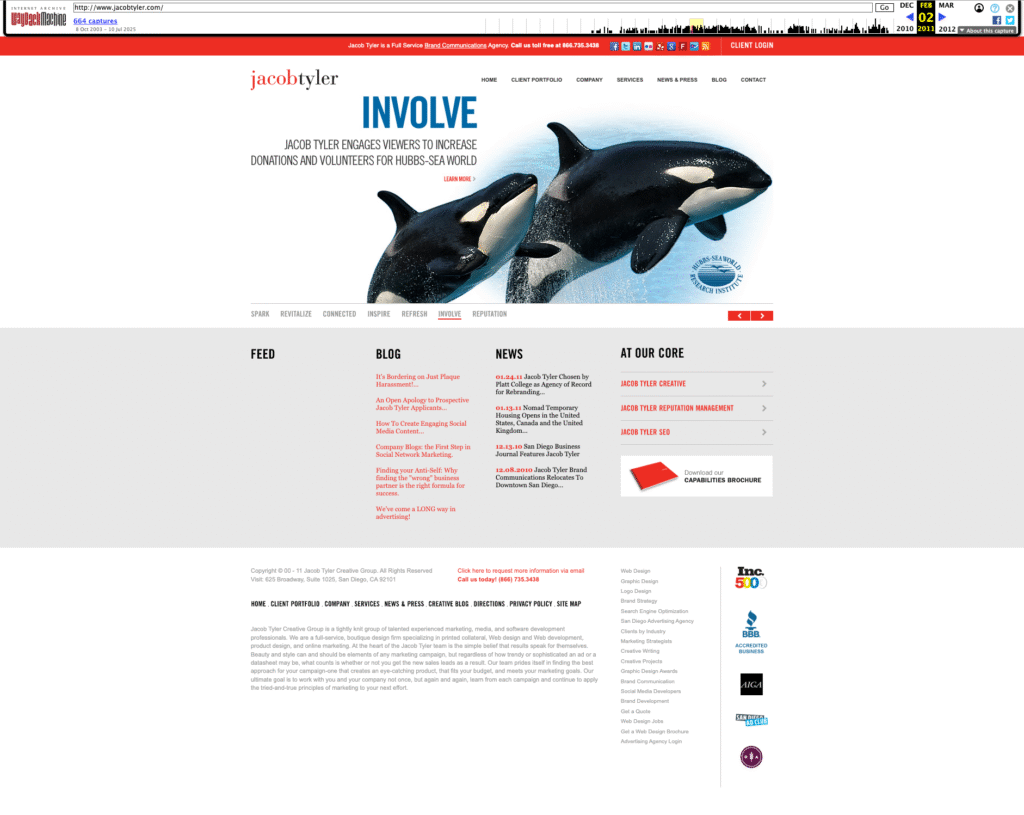
 

Key characteristics of Version 1:

  • Static, information-rich design
  • Desktop-only optimization
  • Traditional corporate aesthetic
  • Content-heavy approach
  • Clear service differentiation

Version 2: The Interactive Revolution

Our second go-around was a total game-changer (at least to us). We ditched the static, corporate look and went big—think larger images, video content (super high-tech at the time), and interactive stuff that actually made people feel something when they landed on our site. Instead of just showing our work like a boring gallery, our case studies started telling real stories with visuals that packed a punch.

This was right when everyone was really getting overly obsessed with Facebook and Instagram (just getting started), and suddenly every brand needed to be a storyteller. So we flipped the script on how we presented our portfolio. Instead of just saying “Hey, look what we made,” we started showing “Here’s how our creative work actually moved the needle for our clients.” We stopped being an information dump and started creating experiences that people actually wanted to stick around for.
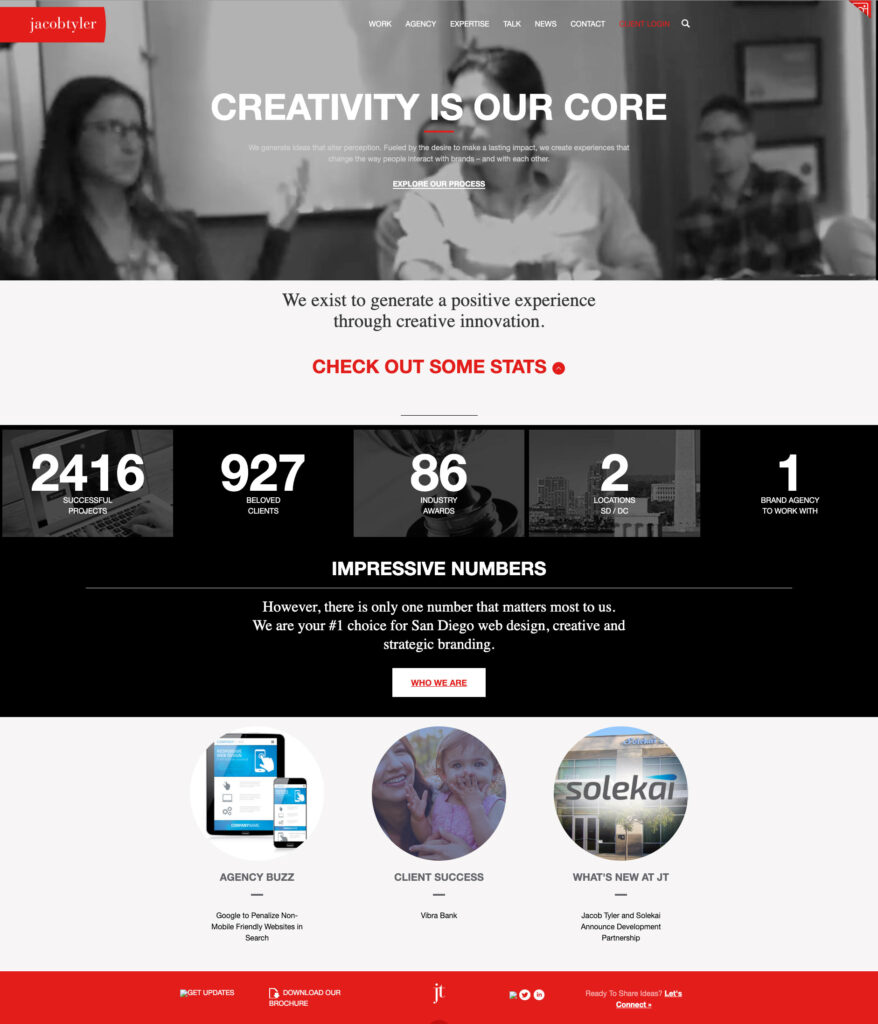
Notable improvements in Version 2:

  • Enhanced visual storytelling
  • Interactive portfolio elements and video
  • Stronger emotional connection
  • Social media integration
  • Results-focused case studies

Version 3: Mobile-First Thinking

The third generation of our website represented our adaptation to the mobile revolution. As smartphones and tablets became ubiquitous, we redesigned with responsive principles at the core. The layout became more flexible, typography scaled appropriately across devices, and navigation transformed to accommodate touch interfaces. At the time, everyone was asking us who designed from mobile phones. And of course, this is extremely important however, a lot of companies that we work with, including us actually have less views on mobile platforms even to this day. That’s because in the business to business environment, many people are doing their research on their laptops and desktop devices.

Also, suddenly, scrolling became natural—people were swiping and scrolling with their thumbs all day long. Mobile screens were small, so longer pages made more sense than trying to cram everything into tiny viewports. That became the norm for desktop as well.

This was also when we started playing around with all the shiny new web tech and jumped on trends like parallax scrolling and those tiny animations that make everything feel more alive. We even spent some time wondering if we should design for the Apple Watch—yeah, that was a thing for about five minutes. Looking back, it’s a good reminder that just because something’s new and buzzy doesn’t mean you need to go all-in, but it’s still worth checking out to see if it’s actually useful or just another flash in the pan.
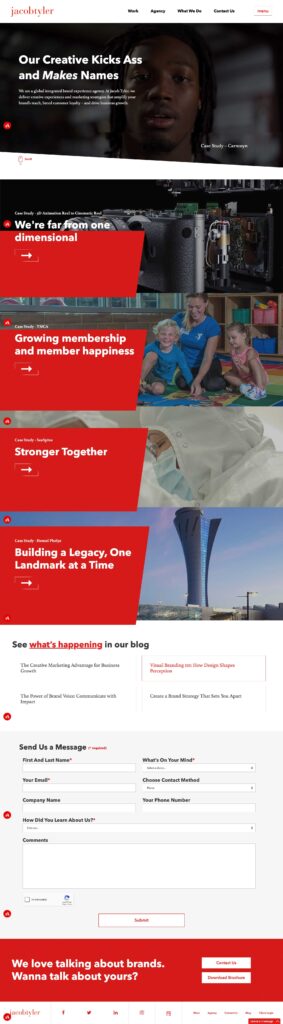
The mobile-first approach fundamentally changed how we structured content:

  • Responsive design principles
  • Touch-friendly navigation
  • Optimized loading speeds
  • Progressive enhancement
  • Cross-platform compatibility

Version 4: The Current Era – Bold, Creative, and Results-Driven

Our latest website embodies everything we’ve learned about effective digital experiences. The tagline “Our Creative Kicks Ass and Makes Names” was the only copy that stayed from the previous website because it immediately establishes our confident, results-oriented approach while maintaining the professional credibility our global clients expect.
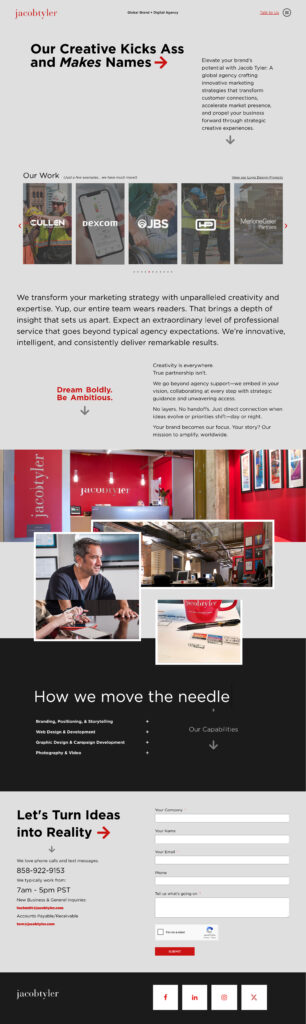
The current design features:

  • Bold Visual Hierarchy: Large typography and strategic use of white space guide users through our story
  • Integrated Case Studies: Portfolio pieces are woven throughout the experience.
  • Multi-Device Optimization: Seamless experiences across desktop, tablet, and mobile devices
  • Performance Focus: Fast loading times and smooth interactions enhance user engagement
  • Conversion-Oriented: Strategic placement of contact forms and calls-to-action drive business results

The Importance of Strategic Redesign

Each evolution of our website wasn’t driven by boredom or aesthetic trends—it responded to fundamental shifts in user behavior, technology capabilities, and business objectives. This strategic approach to redesign offers several key benefits:

Technological Relevance

Keeping pace with web standards, security protocols, and performance expectations ensures your site remains functional and trustworthy.

User Experience Evolution

As user expectations change, websites must adapt to meet new interaction patterns and consumption preferences.

Brand Maturation

Your digital presence should evolve alongside your business, reflecting growth, expanded capabilities, and refined positioning.

Competitive Advantage

Regular updates help maintain differentiation in increasingly crowded markets.

Search Engine Optimization

Fresh content, improved site structure, and modern technical implementation boost search visibility.

Lessons from Our Journey

Our two-decade website evolution offers several insights for businesses considering their own digital transformation:

1. Plan for Longevity: While we joke about dog years, our eight-year average lifespan proves that thoughtful design and solid technical foundation can extend website value significantly.

2. Embrace Change Gradually: Each iteration built upon previous successes rather than starting from scratch, ensuring continuity while enabling innovation.

3. User-Centric Design Wins: Our most successful redesigns prioritized user needs over internal preferences or fleeting design trends. This applies for our clients as well.

4. Technology Should Enable, Not Drive: We adopted new technologies when they enhanced user experience, not simply because they existed.

5. Content Strategy Matters: Effective websites balance engaging presentation with substantial, valuable content that serves user intent.

Looking Forward

As we continue evolving our online presence, we’re already anticipating the next wave of changes: voice interfaces, AI-powered personalization, generative search, and immersive technologies that will reshape how users interact with brands online.

But regardless of technological advancement, our core philosophy remains constant: create experiences that connect with users, drive business results, and stand the test of time. After all, in an industry where dog years apply, longevity is the ultimate measure of success.

The Jacob Tyler website journey demonstrates that strategic redesign isn’t about chasing trends—it’s about thoughtfully evolving to serve users better while achieving business objectives. Whether you’re considering your first major redesign or your fourth, remember that the best websites aren’t just built to impress today’s visitors, but to adapt and thrive for years to come.

Ready to discuss how your website design can evolve to meet changing user expectations and business goals? Let’s start that conversation.

Why a Good Logo is So Important

First off, let’s define terms: Your logo is not your brand. As we’ve written before, your brand is the reflection of your products and services, your workplace culture and the totality of your values. Your logo, meanwhile, is the imprimatur of your brand. Think of it as your professional coat of arms—the seal that guarantees the quality that you provide to your customers, the emblem perched at the apex of your brand architecture. Need a few more reasons why a logo is so important? Let’s get granular with it.

A Logo Gets You Noticed

Never forget how busy your consumers are. We’re all sending emails on our tablets, jumping on work calls on our laptops, hopping around between twenty apps on our phones. All that shuttling between tabs and devices tends to obliterate our attention spans into fruitflyish units of a few seconds that your digital marketing has to capture an audience’s interest.

Enter your logo, which amounts to a 1,000-words snapshot of your brand. If an ad pops up on your consumers’ screens and they get the vibe that even the logo isn’t for them—it’s too posh, not posh enough, perfectly posh but more (or less) than they wanted to spend—they’re going to keep on clicking on. Rest assured, this is judge-a-book-by-its-cover territory, and the cover of your book needs to scream, “Buy me. Because this experience, my target audience, is tailored to you.”

A Logo Imparts Legitimacy

Since your logo is the summation of your visual identity, a sloppy logo is akin to a restaurant buffet swarming with flies—that first-impressions moment when a customer thinks, ‘Definitely not spending my money here.’ And even a good product without a logo might seem scammy. Microsoft is an established brand, but if someone tries to sell you a Microsoft laptop that doesn’t have the Microsoft logo on it, would you trust it?

If your answer to that is ‘definitely not,’ then you’ve pinpointed the importance of a logo, which rubber-stamps legitimacy onto a brand—and onto all the collateral that your brand produces. Dedicate some time to perfecting your logo design, because it’s gonna live front and center on your website, tucked in the corner of your business cards and peppered throughout your social media feeds. As the North Star of your brand’s aesthetic, your logo ensures the consistency that consumers need in order to be confident that the same company is talking to them across a medley of platforms and campaigns.

A Logo Communicates Your Brand Personality

A good logo should be eye-catching, but it also needs to hint at what your brand does or convey who you are. For that reason, banks or life insurance companies opt for typography that looks sturdy and reliable. Whereas a business that delivers beauty and wellness products might draw from a palette of yellows and greens and pinks—and throw in a few monstera leaves while they’re at it—to send out vibes of optimism, health, joy. 

Position your logo so that it acts as a harbinger of the experience that consumers are about to receive, be it financial advice or a box of hand lotions and jade rollers. At the same time, bear in mind that some of the most famous logos toe the line between functionality and artistry—getting across what a business does in more subtle messaging. In the Gillete logo, the “G” and the “i” look sliced open, as if by a razor. The yellow arrow in the Amazon logo connects the letters “a” and “z,” implying that Amazon sells and ships everything from A–Z. The ultramodern Apple symbol nods to the Biblical story of the fruits of knowledge (with the bite—or byte—in it representing the tasting of that knowledge).

Because a strong logo should err on the side of coherency and precision, making even one of its design features too abstract can befuddle people. Take the Apple logo again. The bite-of-knowledge motif is clever, but Steve Jobs & Co. were allegedly worried that, without that bite, customers would think the fruit was a cherry tomato. Point taken. If you’re on a mission to build the most urbane tech company in the world, the last thing you want is to overhear someone saying, “Does this thing look like a tomato to you?”

A Logo Welcomes You into the Club

One of the truisms you often hear in marketing is that your customers need to see themselves in your branding. Which means that your logo should tell your audience, on some level, “You’re in the club.” 

Imagine that you own a gym and your logo is a bodybuilder lifting a ponderous barbell above his head. That logo is going to do wonders to attract lunkish fitness fanatics rather than the just-making-a-change crowd, because an effective logo has its own personality and it talks to the personality of its clientele. The Mercedes-Benz logo is refined, silver, sleek. The Nike logo is on a swift upward-and-onward trajectory. The Coca-Cola logo is energetic and bouncy. The iconography of each of these brands tells you what the brands stand for, but it also fulfills a blank-canvas effect of absorbing meaning that customers pour back into them.

One of the most original recent examples of this in-the-club blank canvas may be Disney. The Disney logo is Walt Disney’s signature written against the backdrop of a fairytale castle, but it’s sometimes abbreviated to the silhouette of Mickey Mouse’s head, which is three black circles resembling a Venn diagram that’s drifting apart. Think about that: Three black circles can stir up memories of watching movies and reading books about adventure and friendship. Those memories, in turn, are powerful enough to sway people to subscribe to Disney+, get married at the Happiest Place on Earth, and become annual passholders who fill closets upon closets with Disney merch—which are stamped all over with three black circles.

That’s the power of a logo.

A Logo Champions Your Individuality

Your logo design should be the crowning symbol of your values and beliefs, the shield or flag that your company rallies behind, the signpost that guides consumers along their journey into your fold. All true—but stay flexible enough to change it. Case in point: Check out Apple’s ye olde logo from 1976, a landscape portrait of Isaac Newton reading under an apple tree (with a William Wordsworth quote decorating the frame, to top it off). Pivoting to the minimalist apple with the bite taken out of it was the right move, because Apple is all about sophistication and simplicity. So be honest about who you are and what you want your logo to say about you. Otherwise, you may end up contriving an image rather than consolidating an identity.

Bistalk Radio Interview on ESPN 1700 with Les Kollegian and Richard Truss

Les Kollegian and Richard Truss interviewed by Bob Ryan on ESPN 1700 and had a fun and insightful conversation on small business and branding. Check out the podcast below to listen to the whole show.

Logos vs Brand Identity

When companies or business owners consider developing their “brand”, the first thing that usually comes to mind is the creation of their logo. While considering a new logo’s colors, graphic elements, and other design components are a good starting point, it’s important to remember this important fact:

Your logo is NOT your brand.

What does that mean exactly? Simply put, a logo is only a small component of the larger working parts that come together to define your company’s brand.

What is a Logo?

A logo is an image, symbol or identifier that represents your company. It essentially serves as a visual shorthand that ties into your company’s identity.  It will be at the forefront of your company’s signage, letterhead, and marketing materials so it’s important to have your overall marketing strategy outlined before you consider its design. As a general rule, your logo should seamlessly integrate with your company’s name, slogan and overall mission, giving your organization a good strong marketing presence to work hand-in-hand with your branding efforts. While a logo is a very important factor in a company’s overall identity, it does not necessarily define who or what the company actually is or represents. That’s where branding comes in.

What is Branding?

Branding is the foundation of your company or business. It works to create the overall perception of your company and helps build trust between you and your clients. It seeks to create a positive relationship between your business and its customers. A good branding strategy will seek to bring people to your brand in a meaningful way while earning their trust and support.  The more confidence you gain with your clients, the more successful your branding strategy is.

Creating a strong brand is a multi-step process. A successful branding agency like Jacob Tyler understands that establishing your brand the right way is very important. Since your brand is the core of your company and is one of the most important aspects of your business, it’s important that you get it right. Jacob Tyler builds brands that inspire, evolve, engage, and grow. Learn how our branding agency expertise sets us apart from other San Diego branding agencies.

Jacob Tyler | Branding Agency

Clutch Announces Leading San Diego Web Designers

WASHINGTON, DC, July 6, 2017 – Today, Clutch released its Leaders Matrix of top San Diego web designers. The featured firms are highlighted based on verified client reviews and a track record of delivering well-crafted web designs.

The leading web designers in San Diego are: Jacob Tyler, Bop Design, Tiny Frog Technologies, MaxAudience, Visceral, AshWebStudio, Oui Will, PINT, Inc., BASIC, BLVR, BusinessOnline, Incitrio, and Webbege, Inc.

“In addition to the stellar praise and acclaim they received from their clients,” said DJ Fajana, business analyst at Clutch, “these web designers have consistently crafted creatively designed websites, which truly speaks to their exceptional technical talent.”

To systematically rank and review each web design company, Clutch used a proprietary research methodology which considers a company’s ‘ability to deliver’, experience, reviews and market presence.

Clutch’s research on leading web design companies is ongoing. The firm encourages all web design companies to apply for inclusion. Upcoming publications will feature top Portland and Seattle web design companies.

The full research can be found below:

https://clutch.co/web-designers/san-diego

https://clutch.co/web-designers/san-diego/leaders-matrix

About Clutch

A B2B research firm in the heart of Washington, DC, Clutch connects you with the agencies and software solutions that can help you enhance your business and meet your goals. Our methodology maps agencies and software solutions based on consumer reviews, the type of services offered, and quality of work.

That year-end marketing budget is worth more than you think.

money2

‘Use it or lose it’ is the mantra of many organizations when it comes to year-end budgets. If you’re in charge of the budget, it should be more than just a mantra, it should be your battle cry.

For starters, not spending allocated funds this year could mean you won’t receive those dollars next year. It’s no secret that budget planning is rooted in what departments spent the previous year to achieve their goals. To avoid being shortchanged in 2017, come up with a plan to do something your marketing team may not have tried before – a new tactic that could generate leads, drive revenue or build greater brand awareness.

You may be thinking, “Okay, cool. So, what should we do?” When considering what to spend those clams on, think in terms of the objectives you didn’t get to do this year. Some examples to kick start the ideas include the following:

  • End-of-Year email campaign – Creating an end-of-year email campaign can drum up business fast for the New Year. Consider a 3 email “drip campaign” with a landing page featuring content that addresses common consumer problems. To gain access to the content, the recipient will need to provide a name and email – giving you the contact information of a potential lead. As far as content, provide some thought leadership in your market by offering a whitepaper, video or E-book that provides value about the solving the issues your customers face. As an additional option, use the email campaign to generate buzz around a New Year special offer if your business has a product or service that could benefit customers as they start the year with fresh new purchasing or technology budgets.
  • Blog Posts – Speaking of content, investing in some fresh content for your website is an affordable and smart thing to do with year-end dollars. Hire a writer or agency that specializes in targeted content that can position your company as an industry thought leader. This is a fast, low cost option that can happen BEFORE the ball drops on 2016.
  • SEO Audit – Are the keywords on your website hitting the mark? Work with a strategic agency partner that can help your business identify keywords that are relevant to your product or service. An SEO-focused writer can make sure those SEO keyword opportunities are woven through your website in a logical, cohesive way.
  • Social Media Advertising Campaign – There’s an art to doing a social media campaign the right way. Social media advertising has grown to the point that sponsoring ads is having a powerful effect on driving awareness and conversions. Post one of your best performing offer ads and then sponsor the ad on Facebook, Instagram or Twitter depending on where your customers engage the most. Follow this up by considering an ad re-targeting strategy. Have an experienced firm set up a targeted ad campaign for people who have visited your website. Your ad will show up in their social media feeds, ensuring your product or service is always top of mind. Statistics are showing that retargeting is the most successful form of social advertising right now and social media engagement continues to grow at a voracious rate.
  • Get your info out there – Everyone’s talking about infographics. Easy to share through social media channels, on your website or in a presentation, infographics are a powerful “at-a-glance” tool for describing how your business can solve customer challenges. Find a partner or designer who is not only skilled at creating a visually appealing campaign but also developing a concept or theme for the graphic. Your customers love infographics. Trust me!

When it comes to year-end budgets, the bottom line is don’t lose it! Find new, affordable and creative ways to raise awareness, generate leads and ultimately, close deals. If you’d like to learn more about the tactics listed above or discover other ways to get the most out of your marketing budget, reach out.

We love talking about this stuff.

Marketing in San Diego | Jacob Tyler

Brand Review: Rio 2016

Although the Olympic games have concluded, there are still valuable pieces of inspiration that will live on. When most people think of the term “brand”, images of sleek smart phones and white and green coffee cups come to mind. The Olympic brand presents a unique branding challenge that is by nature ever evolving, yet must represent the core concepts of the games. Branding a city in a way that can be both universally understood and uniquely distinctive can be a monumental task. Rio de Janeiro was a host city that many people had never been to but the design firm Tátil Design did an excellent job bringing the city to life in a thoughtful and intriguing way.

Here is how they did it:

A Huge Challenge

“To represent the Passion and Transformation of a city and an entire country, and project these values to the rest of the world. A brand that must express unity. Inspire achievement and optimism. Avoid clichés and present Rio de Janeiro as the site of the largest sporting event in the world — to its very own Cariocas, and to athletes and people around the world.”

rio-article-header-alt-e1458225119445

Brand Inspiration

“We designed a human brand, made of mixture of people, athletes and cultures. A brand that welcomes a hug and has an exciting way to celebrate. One way that reveals the Sugar Loaf and is living mirror of the lush nature of Rio de Janeiro and the city. A brand-carving, infinite, three-dimensional, winning textures, seen form object. Made to be experienced. An invitation and an inspiration to the river and to the world.”

rio-article-1

07

Color

“The natural beauty of our landscape is embodied by the brand and its color palette. Yellow symbolizes the sun and our warm, vivacious and happy nature. Blue expresses the fluidity of the water that surrounds us, and our easygoing way of life. Green represents our forests and hope, a positive vision that inspires us to go even further.”

bg-all

Shape

“Inspired by the rich landscapes of Rio and Brazil – full of the sinuous curves of mountains, rivers and lakes – the city’s best-loved icons, including Sugarloaf Mountain and Corcovado, the athletes and its people, the Brand of the 2016 Rio Olympic Games evokes unity, inspires the will and desire to work together, to share our knowledge and talents, to join forces and ambitions for a sustainable way of life that will transform the present and our future. It’s a brand that embodies unity, transformation, passion and energy. It’s a large collective network in motion, an invitation and inspiration to Rio and the world.”

The Rio Font

“Each letter expresses a characteristic of the Rio 2016 Games, its people and the city. The letters are written in single continuous strokes, with fast and fluid motions, suggesting the movements of the athletes in action. The strong contrast between thick and thin strokes was explored during the design process by putting brush to paper and writing by hand. The variety of the curves in the different letters has a unique informality, inspired by the joyfulness and warmth of the Brazilian people.”

rio-article-11

San Diego Digital Marketing Agency | Jacob Tyler

Turning Strategic Energy into Powerful Design Execution

We’ve recently partnered with a leading provider in the residential solar industry to create a compelling and highly engaging digital experience to inspire homeowners to go solar.

As with all projects, we focus heavily on our discovery process to learn as much as we can about our clients – who we view more-so as partners. In order to create a successful solution to the challenge we’ve been presented, it’s imperative that our team fully understands their business as well as the industry and market they serve. While we’re all familiar with the many benefits of going solar, the process of flipping the switch from traditional power to solar energy can seem complicated, when in reality it’s rather simple. We’ve been in education mode recently and have learned a great deal about the solar industry – and believe it or not, the process is not all that different than how we operate as an agency. In our case, instead of the sun delivering the energy, we build strong relationships with our clients allowing us to collect energy directly from them.

StrategicEnergy_image
Just as solar panels collect energy from the sun and convert direct current (DC) electricity into alternating current (AC) electricity, we at JT collect energy from our clients, harness it and convert their DC into creative strategy (CS). The energy of CS flows from our creative leadership through our talented team of designers where it is distributed through powerful design execution creating both an efficient process and a successful end result.

Design in San Diego | Jacob Tyler

On the Eleventh Day of Creative: Eva Mann


As told by Senior Brand Manager, Amanda Schremser


On the Eleventh Day of Creative, I want to share a project that’s extra merry and bright, and nothing says bright quite like Hollywood runway models, sequin tailored uniforms and the lights of a fashion photoshoot!


11908612_10204640207955167_8785239627164510971_o


When we think fashion, our minds immediately go to the likes of Channel, Marc Jacobs and Vera Wang. But what about the fashion that surrounds our every day lives–the fashion we don’t find on the racks at Nordstoms?


Eva Mann Designs is a fashion forward company who focuses on specialty tailored uniform wear.When you experience brands like Caesar’s Palace, Medieval Times or Margaritaville, Eva Mann Designs is in the details and their uniforms are playing a major part in delivering those experiences.


EM Designs has been around for over 20 years, and like any strong designer, knew it was time for a brand modernization. Jacob Tyler was tasked with updating the EM logo, directing a photo shoot for a new uniform line, creating a brochure to showcase their specialties and most important, redesigning their website.


Eva Mann Jacob Tyler 11 Day Xmas


Just like Eva’s one-of-a-kind uniforms, Jacob Tyler made sure everything we created for EM Designs was fabulously fashionable yet functional. And since responsification is the new black, we made sure to perfectly pair their site with innovation as well: evamanndesigns.com


So the next time you walk into the Hard Rock, Bally’s or one of Trump’s hotels or spas, make sure to pay extra close attention to your valet’s top hat, your waiters tuxedo or your nightly visual entertainer’s headdress. There is a good chance Eva’s team created it and Jacob Tyler is proud to have contributed to such a fine brand.


Marketing in San Diego

On the Eighth Day of Creative: e.Digital

As told by Visual Designer, Lisa Inoue

On the Eighth Day of Creative, I’m excited to share a sneak peek into some work we’re doing for our client e.Digital. Since our initial kickoff, I’ve been inspired by their twenty-four year history of creating game-changing foundational technologies that are at the core of wireless headset, digital audio/video recorder and portable music player markets. The more I’ve learned about their vast innovations that fuel many of the consumer products we rely on every day, the more excited I’ve become about the opportunity to work on this project.

Tasked with revamping their brand identity to portray them as the innovation leader they are, I worked closely with our ACD to explore, and design various logo concepts. With several great logos to choose from, we have since landed on a winner which you can see a teaser of in the included photo. We’ll leave it to e.Digital to share the full reveal, so hang tight.

With the new identity in place, we moved into phase two which includes developing a new digital strategy and creating a website that just as the logo, portrays e.Digital as the leader in foundational technologies. My favorite part of this project was hearing about their milestones throughout the years and translating those into a stunning timeline of innovations that will be a focal point of the new site. As much as I’d love to share that, we’re a matter of weeks away from launch so you’ll just have to wait it out.

edigital

Digital Marketing in San Diego | Jacob Tyler